


One Week Until the Midterms: How Will Trump's Fate Shape Crypto and the U.S. Stock Market?


- Key Takeaways: With the U.S. midterm elections approaching, prediction markets show Democrats are highly likely to win the House. The direction of crypto policy and market performance are closely tied to Republican electoral fortunes, and the industry should prepare for tighter regulation.
- Key Elements:
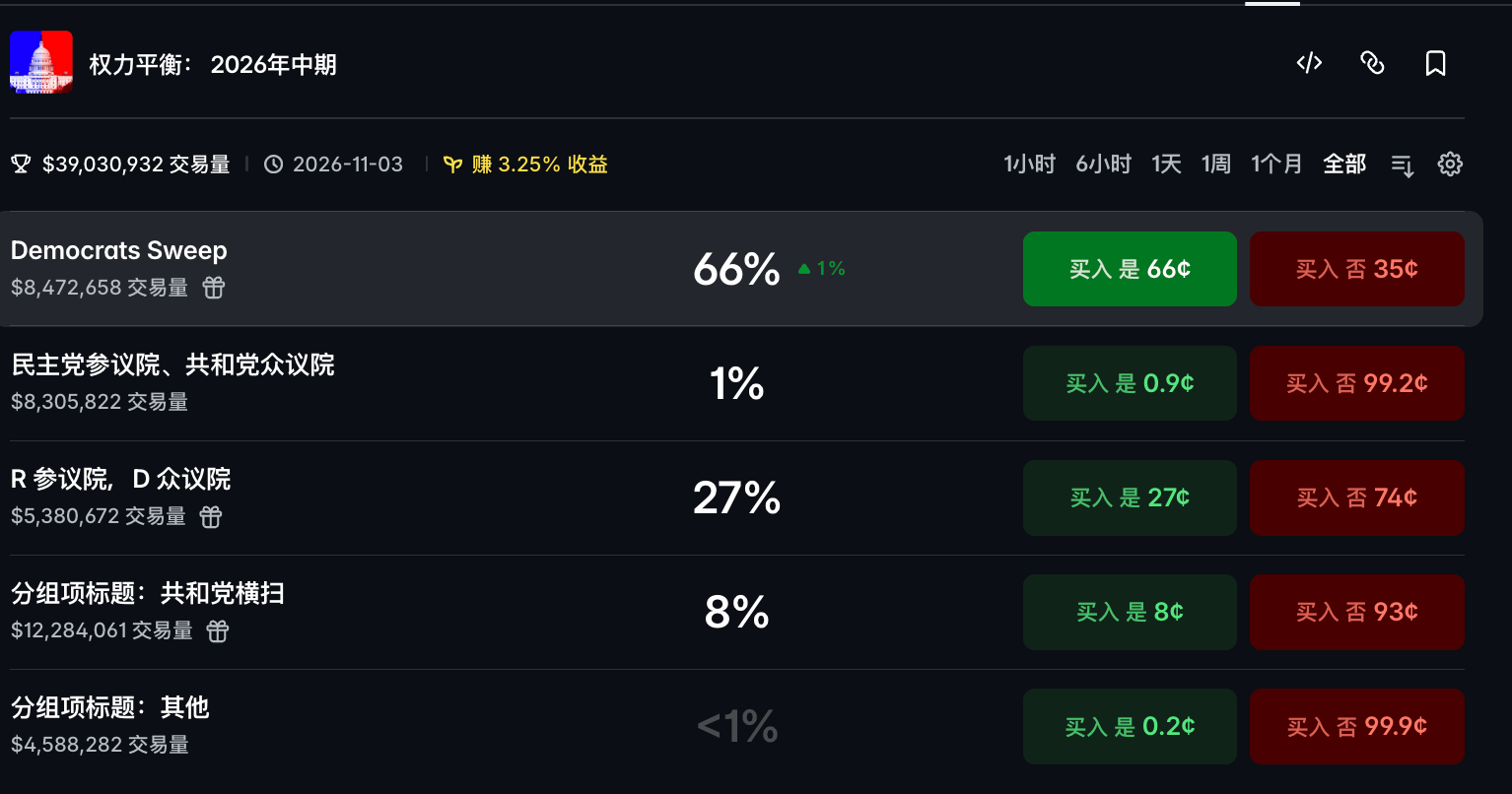
- Polymarket and Kalshi both put the probability of Democrats winning the House above 90%, with the Senate at roughly 64%–67%. Among the chamber combinations, a full Democratic sweep carries a 66% probability, while Republicans holding both chambers sits at just 8%.
- Trump's approval rating edged up to 32%, Democrats lead nationally by 11 percentage points, and Republicans' majorities in both the Senate and House face challenges.
- The crypto industry has bet heavily on Republicans: Coinbase donated roughly $57.8 million, Ripple about $49.6 million, and the Winklevoss brothers a combined ~$55.9 million, mostly to Republican camps.
- If Democrats take both chambers, progress on the CLARITY Act will be blocked, and altcoins, DeFi, and crypto-related stocks could come under short-term pressure, while Bitcoin's decline is expected to be limited.
- If Republicans hold both chambers, the CLARITY Act could be revived, and ETH, SOL, DeFi, and crypto-related stocks will likely surge; in a divided-government scenario, the market has already priced it in, so volatility should be smaller.
Original | Odaily@OdailyChina)
Author | Wenser (@wenser 2010 )
With just one week until the U.S. midterm elections on November 3, the crypto market has already begun pricing in the House and Senate outcomes for Democrats and Republicans. Based on aggregated data from prediction market platforms such as Kalshi and Polymarket, as well as several polling and electoral models, there is little suspense remaining over Democrats winning a majority of House seats, but for Republicans, the Senate still leaves some room for maneuvering.
Meanwhile, Trump's approval rating has edged up slightly from its historic low, rising marginally to 32% this morning. Previously, media reports indicated that Trump has spent a cumulative $280 million on this midterm election in an uphill push; in September, to ensure a smooth midterm outcome, Trump even declared that "if Republicans win, every American adult citizen will receive $5,000," calling it the "Trump Dividend."
This midterm election is not only about Trump's political career but will also determine the direction of crypto policy at the U.S. SEC and CFTC, as well as the market performance of cryptocurrencies and U.S. equities, for a considerable period to come. Odaily will briefly discuss the relevant issues.
Midterm Election Preview: Trump's Approval Rating Holds Between 30% and 40%
As the U.S. midterm elections enter their final week, the latest polling shows Trump's approval rating edged up 1% from last week's historic low to 32%, while Democrats lead Republicans by 11% nationwide in congressional races.
A Reuters/Ipsos poll completed on October 26 found that 47% of registered voters said they would support Democrats in the November 3 midterm elections, 36% backed Republicans, and another 11% were undecided. The Democratic lead narrowed by 1% from the previous week. When undecided voters' leanings are factored in, Democratic support stands at 50% versus 41% for Republicans, narrowing the gap to 9%. Among those most likely to vote, Democrats also lead 53% to 44%.
Currently, Republicans control both the House and Senate and are fighting to retain their majorities. The midterm elections matter because if Republicans lose control of either chamber, Trump's policy agenda for the final two years of his second term could be obstructed—especially regarding crypto-friendly regulatory policies and allegations related to presidential immunity and the boundaries of crypto profit-making.
Below is aggregated data from multiple U.S. media outlets and polling organizations: Trump's approval rating remains essentially above 32%, with a net approval of -19% to -27%, significantly worse than the same period in Trump's first term (October 2018 net approval: -11.7).

Poliwave, FiftyPlusOne, PollResults
Quick Overview of House and Senate Races: Democrats Need Just 3 House Seats; Senate Requires a Net Gain of 4
According to Inside Elections data as of October 15, in the House, Republicans currently hold the majority with 220 seats to 215, and Democrats need a net gain of just 3 seats to achieve a majority; in the Senate, Republicans hold the majority with 53 seats to 47, and Democrats need a net gain of 4 seats. In the event of a 50-50 tie, Vice President Vance would cast the deciding vote, effectively leaving Republicans in control.
Prediction Markets Price the Midterms: Democrats' Chance of Winning the House Exceeds 90%, Senate Odds Mostly Below 70%
Thanks to a stellar track record that includes successfully predicting Trump's U.S. election victory, prediction market platforms have become another hot focus of attention alongside media, polls, academic institutions, and various models.
As of writing, the probability of Democrats winning the House on Polymarket has surged to 92%, with Democrats projected to capture 236 of the 435 seats; meanwhile, the platform puts the probability of Democrats winning the Senate at 67%, with Democrats projected to capture 52 seats.


Data from fellow prediction market platform Kalshi is broadly similar: it predicts Democrats will win the House majority with 234 seats at a 91% probability; however, the platform puts the probability of Democrats winning the Senate majority at 64%, with the specific seat count likewise at 52.
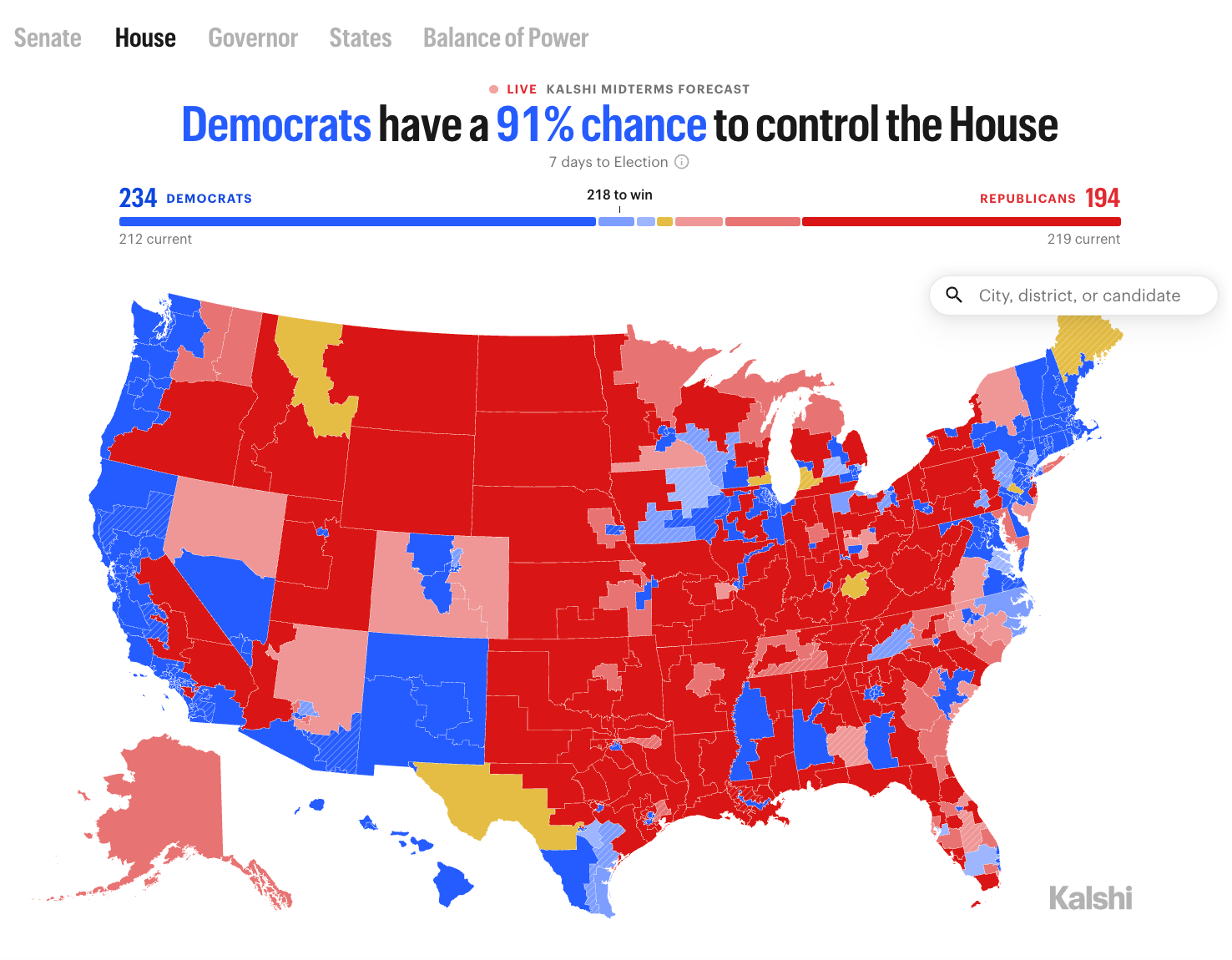
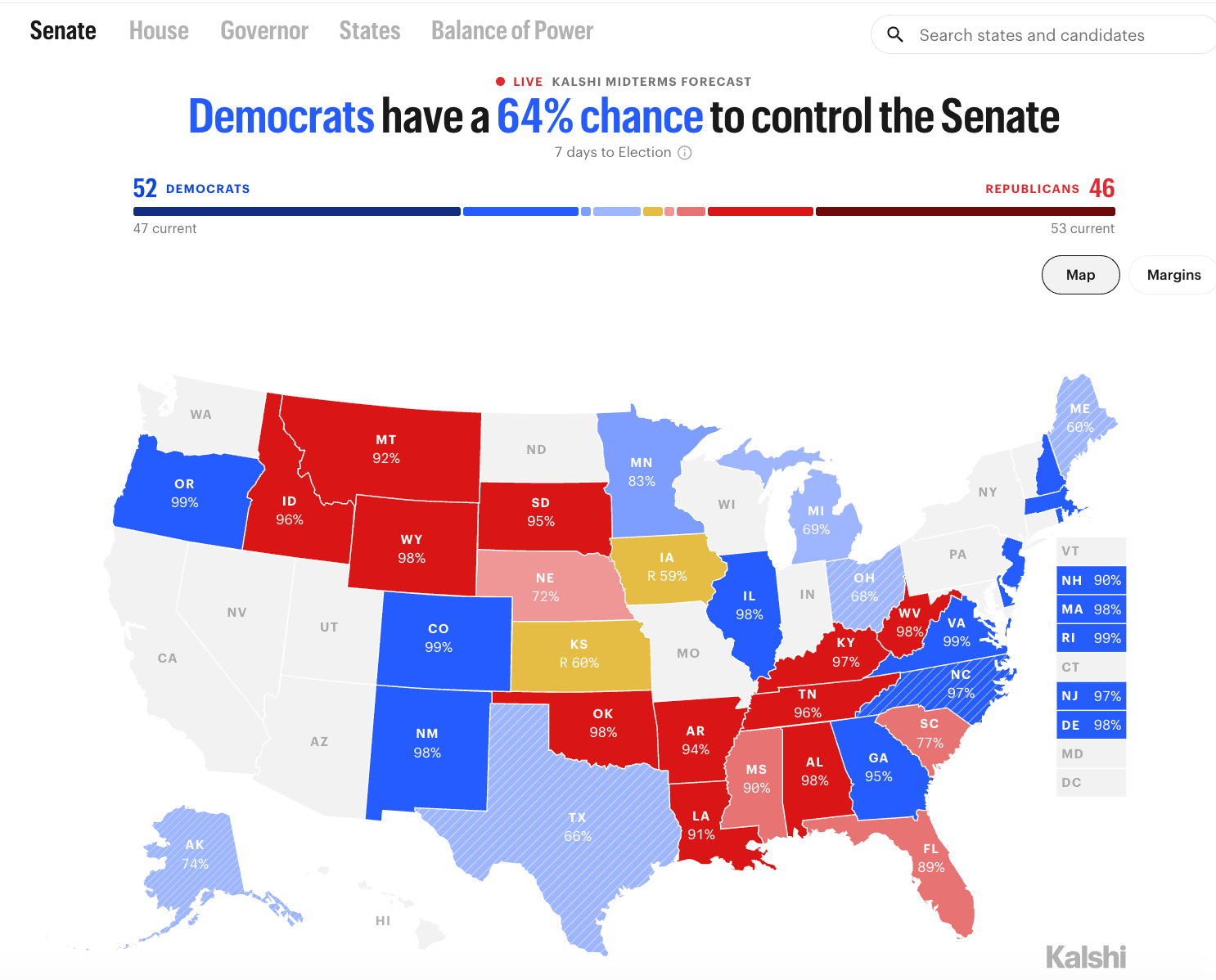
In addition, Silver Bulletin (Nate Silver's model) forecasts a 92% probability of Democrats winning the House and a 76% probability of winning the Senate; academic model data tracked by DeLuca at Yale University's political science department offers a wider range of predictions: the probability of Democrats winning the House ranges from a high of 95% to a low of 68%; the probability of capturing a Senate majority ranges from a low of 37% to a high of 69%.
Back to prediction markets, the combination data may be more intriguing: in Polymarket's two-chamber combination event, the probability of Democrats winning both chambers is 66%, Democrats taking the House with Republicans holding the Senate is 27%, and the probability of Republicans retaining both chambers is just 8% (Polymarket).
Crypto Markets and U.S. Equities Both Hinge on Trump: U.S. Stocks May See Continued Volatility, Crypto Could Face Short-Term Setback
Having covered the preview data and election outlook predictions, let's discuss the potential aftermath.
U.S. Equities: If Democrats Take Both Chambers, Crypto-Linked Stocks and AI Stocks May Face Pressure and Volatility
For U.S. equities, the midterm elections' main impact lies in "tariffs, taxes, and regulation" within the executive branch's purview. A Morgan Stanley research report published on October 14 noted that these areas are largely driven by the executive branch, with changes in the congressional majority having limited impact; once the House and Senate majorities are split between Democrats and Republicans, congressional investigations and budget standoffs may intensify.
However, historical data shows that in the second year of a midterm cycle with a Republican president and a divided Congress, the S&P 500 has posted its strongest average performance, gaining 23%; while with a Republican president and Democrats controlling Congress, the average gain in the year after the midterms was 15%.
In addition, a Citi report published in early October noted that the temporary funding measure expires on December 11; if Democrats win the House, they may demand concessions on the budget, and the risk of a government shutdown—as seen last year—remains.
As for specific U.S. equity sectors, if Democrats sweep both chambers, crypto-linked stocks could see short-term setbacks amid news of stalled momentum for the CLARITY Act and limited progress on crypto-friendly regulatory policies; the AI sector would also be negatively affected, with various "build fast, build big" data center projects likely taking a hit, and near-term sentiment around Anthropic's IPO potentially dampened as well. While this would not alter the industry's long-term trajectory, short-term volatility is unavoidable.
The reason: if Democrats achieve better-than-expected victories in congressional and state-level elections, policy uncertainty surrounding data center construction, AI regulation, and tech company taxation could further weigh on AI supply chain stocks; Wall Street financial institutions, crypto companies, and related regulators would also face greater scrutiny.
As for the crypto market, its interests are currently deeply tied to the Republican Party; if Republicans lose their majorities in both chambers, a short-term setback is likely.
Crypto Market: If Republicans Hold Both Chambers, CLARITY, Major Coins, and Crypto-Linked Stocks Would See a Sharp Short-Term Rally
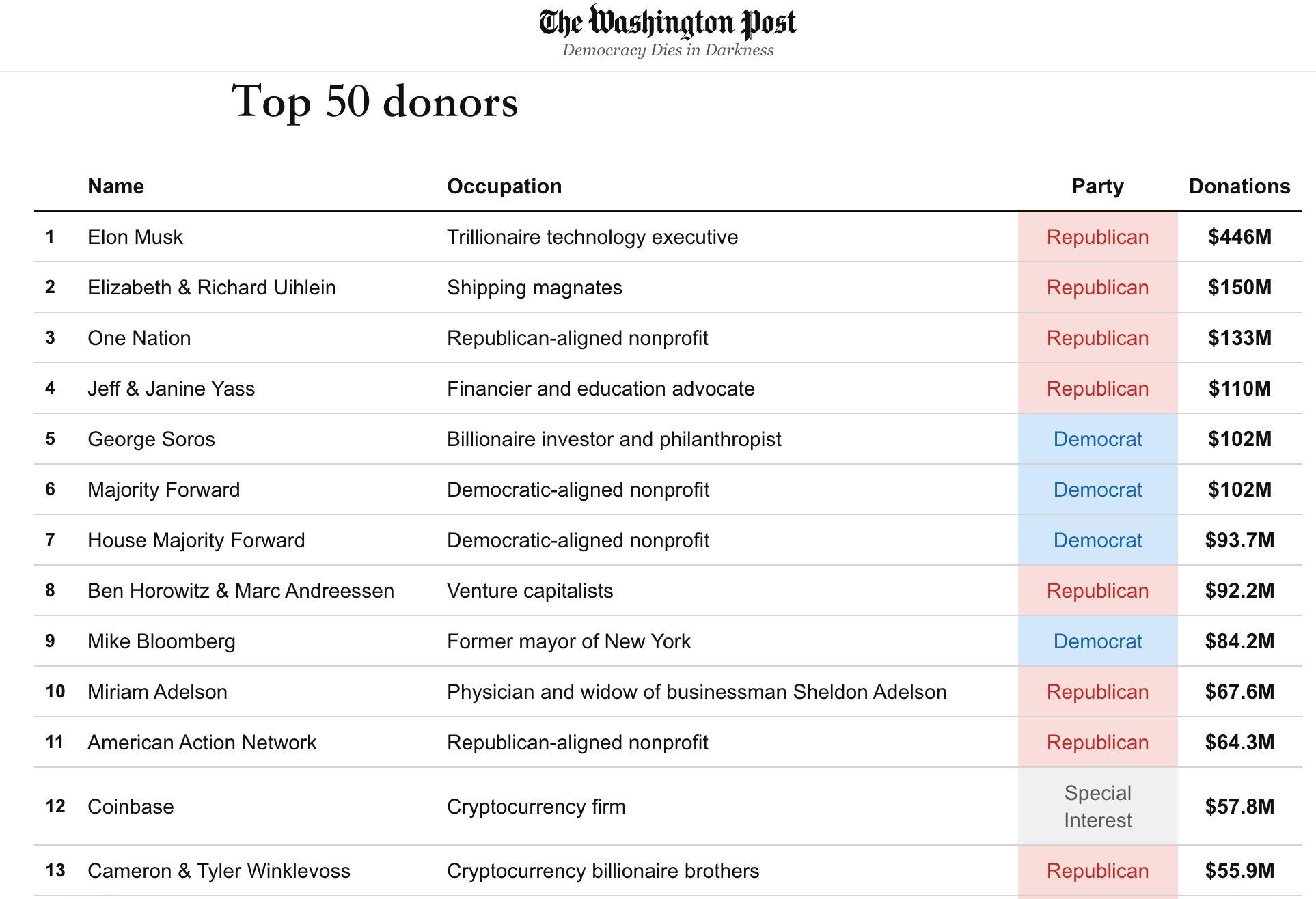
According to a Washington Post report, in the 2026 midterm election cycle, the top 50 donors have contributed a cumulative $2.77 billion, of which Republican-aligned donations account for approximately $1.67 billion, Democratic-aligned about $832 million, and special interest groups about $264 million.
Among individual donors, Musk leads with approximately $446 million, setting a record for the largest individual political donor in modern U.S. history, with funds primarily flowing to super PACs and related organizations supporting Republican candidates. (Odaily note: As of October 13, this figure was still around $276 million.)
Among crypto industry donors, Coinbase ranks 5th among donating organizations and 12th overall with approximately $57.8 million; Ripple ranks 7th among donating organizations and 17th overall with about $49.6 million; Gemini founders Cameron and Tyler Winklevoss donated a combined approximately $55.9 million, ranking 13th overall; Foris Dax ranks 24th overall with $39 million. Notably, apart from Coinbase and Ripple, which donated in the name of special interest groups, all other parties are Republican donors.
If Democrats take both chambers, CLARITY legislation would be further delayed, and regulatory-sensitive altcoins, DeFi, and crypto-linked stocks could see short-term declines, while Bitcoin may experience limited downside;
If Democrats win the House and Republicans hold the Senate, a slower legislative pace and stricter regulatory scrutiny would be all but certain, but the crypto market has already priced this in, resulting in smaller volatility;
The most ideal scenario, of course, is Republicans holding both chambers, which would likely restart the CLARITY Act and probably trigger a sharp rally in ETH, SOL, DeFi, and crypto-linked stocks.
Of course, based on current conditions, the first scenario is most likely, the second next, and crypto industry participants should prepare mentally and manage risk accordingly.





