


Tron TRON Industry Weekly: Tech Stocks Weaken as BTC Falls Below $80,000, a Detailed Look at AI-Driven Robot Execution Infrastructure Axis Robotics


1. Outlook
1. Macro-Level Summary and Future Forecast
Macro Weekly Summary (October 19–25, 2026): Global markets were affected by the dual pressures of energy inflation and concerns over tech stock valuations. On October 23, Brent crude closed at $116.72/barrel; during the week, the S&P 500 and Nasdaq fell 0.5% and 0.7%, respectively; safe-haven buying pushed the U.S. 10-year Treasury yield down about 11 basis points during the week to 4.987%, reflecting the coexistence of inflation risks and growth concerns.
Macro Forecast for Next Week (October 26–November 1): Market volatility is expected to increase, with the focus on the Federal Reserve decision, U.S. GDP and PCE, as well as earnings from major tech companies. The Federal Reserve interest rate decision will be announced at early morning Beijing time on October 29, with the market consensus expecting rates to remain unchanged; at 20:30 that day, third-quarter GDP and September PCE will be released. If the Federal Reserve signals continued rate hikes and core inflation remains strong, stock market valuations may continue to come under pressure; if the policy wording is moderate and inflation cools, this would help sentiment recover. Elevated oil prices mean that even if rate hikes are paused this time, it cannot be directly interpreted as the end of tightening.
2. Crypto Industry Market Changes and Alerts
Crypto Market Changes This Week (October 19–25): BTC and ETH rose first and then fell, with the midweek rebound failing to continue. BTC rose from about $81,953 on October 19 to about $84,117 on the 21st, then fell back to $81,164 on the 23rd; ETH during the same period rose from about $2,407 to $2,473, then fell back to $2,387. As of 09:00 Beijing time on October 25, BTC was at $80,688.28 and ETH at $2,354.14, which are not yet full-week closing prices. Weakness in tech stocks, rising oil prices, and interest rate uncertainty weighed on risk appetite; from the 19th to the 23rd, BTC spot ETFs saw net inflows of about $309 million, while ETH spot ETFs saw net outflows of about $221 million, indicating clear divergence in institutional capital.
Crypto Market Forecast for Next Week (October 26–November 1): A bias toward high-volatility range trading, with direction depending on the Federal Reserve's stance, PCE, and changes in ETF flows. If tightening concerns ease and institutional buying continues, BTC is expected to retest this week's level near $84,000, while ETH would first need to reclaim $2,400; if policy is hawkish or tech stocks continue to decline, BTC's $80,000 psychological threshold may be tested again, and ETH also faces the risk of continued weakness. These price levels are scenario observation points and are not yet sufficient to confirm a trend reversal; particular caution is needed regarding leveraged liquidations around the meeting amplifying volatility.
3. Industry and Sector Hotspots
This week's focus was on stablecoin payments, bank deposit tokens, and compliance infrastructure. On October 19, JPMorgan announced that its JPM Coin deposit token would expand to Ethereum, targeting approved institutional clients; HSBC's HKD stablecoin RedCoin launched on PayMe this week, advancing personal transfers and merchant payments; on October 21, the U.S. OCC issued final rules implementing the GENIUS Act, covering reserves, redemption, custody, and risk management, set to take effect on January 18, 2027. The common direction is that on-chain funds are beginning to connect more deeply with banks and real payment scenarios, but deposit tokens and stablecoins have different legal attributes, and business adoption growth does not necessarily translate into gains for public chains or related tokens.
2. Market Hot Sectors and Projects with Potential This Week
1. Overview of Projects with Potential
1.1. In-depth: Total funding of $12 million, led by Hack VC, with participation from Nomad Capital, Pi Network, 10K Ventures, and other institutions — building AI-driven intelligent robot execution infrastructure Axis Robotics
- Introduction
AXIS Robotics is a distributed training infrastructure for Physical AI, where anyone can participate and contribute compute and training data. Users do not need to purchase robot hardware; they only need a browser to control robots to complete simulation tasks and generate large-scale training data, jointly building the "brain" of next-generation intelligent robots.
AXIS Robotics adopts a Simulation First technical approach: first, training data is collected through a browser-based robot simulation environment; then, high-fidelity (Photorealistic) data augmentation technology is used to expand the dataset on a large scale; finally, intelligent control policies (Policy) that can be directly deployed to real robots are trained, achieving seamless transfer from virtual simulation to real robots.
- Protocol Element Analysis
AXIS Technical Architecture (The AXIS Stack)
1. End-to-End Robot Training Pipeline
AXIS has built an end-to-end robot training infrastructure that gradually transforms natural language tasks into control policies (Robot Policy) deployable to real robots. The entire process covers five stages: task generation, behavior data collection, data augmentation, model training, and real robot deployment, realizing a complete closed loop for intelligent robot training.
2. System Overview
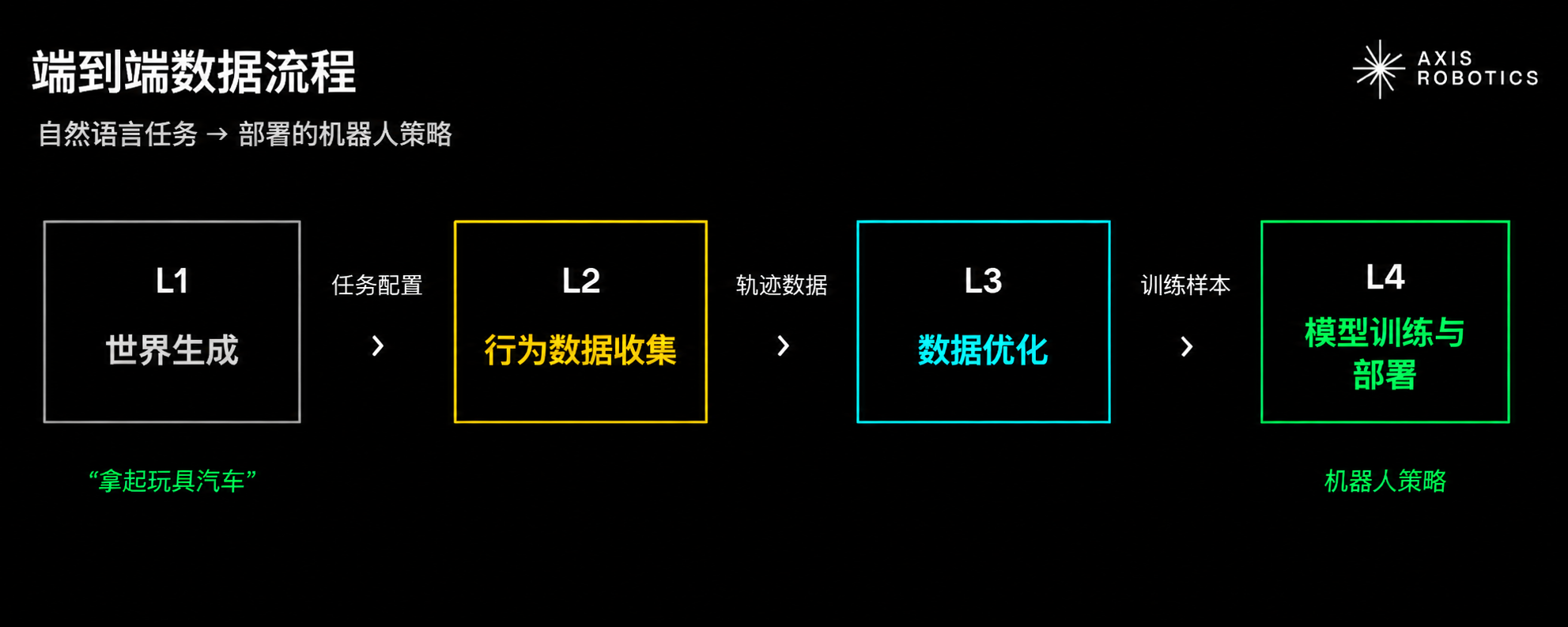
The entire AXIS architecture adopts a four-layer pipeline design, with each layer responsible for data processing and model construction at different stages, ultimately generating intelligent control policies that can be deployed to real robots.
3. Detailed Explanation of the Four Layers (The Four Layers in Action)
L1 — World Generation
The system first receives a natural language task description (for example: "pick up the toy car on the table"), which is automatically parsed by the Task Generation Engine and broken down into structured information such as task configuration, scene configuration, and target object configuration.
Subsequently, the Assets Manager automatically matches the corresponding object from an asset library of more than 2,000 3D models, and can also automatically create new 3D models through Image-to-3D technology.
After object preparation is completed, the 2.5D Layout Generator automatically generates the robot operating environment, while the Layout Supervisor is responsible for continuously validating and correcting the scene until it meets task requirements. At the same time, each task automatically generates a corresponding Success Checker for subsequent automatic evaluation of whether the robot has completed the task.
L2 — Behavior Collection
The data collection stage adopts a browser-accessible participation method.
Contributors do not need robot hardware; they only need a browser and can use a keyboard, phone, or game controller to remotely control the simulated robot to complete tasks.
Robot physics simulation is run locally by MuJoCo compiled to WebAssembly, so no GPU, software installation, or professional equipment is required.
Each operation of about 1–2 minutes generates a complete robot trajectory (Trajectory), including:
- Timestamps
- Robot joint states
- Object poses
- Control commands
- Task metadata
All trajectories use a unified data format and are compatible with different robot simulation platforms. Approved data also records on-chain data provenance (Data Provenance) and generates a unique Data ID on the Base network, ensuring data traceability.
L3 — Data Refinement
The collected raw trajectories first undergo data cleaning, including:
- Static Frame Removal
- Savitzky-Golay smoothing filtering
- Cubic Spline interpolation, increasing the sampling frequency from 6–8Hz to 20Hz
- Removal of low-quality data
After cleaning, the system replays the trajectories in Isaac Sim on GPU servers and uses the Augmentation Engine to randomly adjust:
- Lighting
- Textures
- Materials
- Physical parameters
- Camera viewpoints
Ultimately, a single robot trajectory is expanded into thousands of training samples with high realism (Photorealistic) and domain randomization (Domain Randomization), significantly improving the model's generalization ability.
L4 — Model Training & Deployment
The augmented dataset is used to train two types of robot control models:
- Task-specific models: using imitation learning methods such as Behavior Cloning and Diffusion Policy to learn execution strategies for specific tasks.
- General-purpose Vision-Language-Action (VLA) models: combining natural language goals to train robot models with stronger generalization capabilities.
Models are first fully tested in randomized simulation environments to verify their stability and success rates under different initial conditions. After validation, they are deployed to real robots (currently supporting Franka Research 3) for Sim-to-Real validation, achieving reliable transfer of robot policies from virtual environments to the real world.
- Brief Description of Protocol Technical Architecture
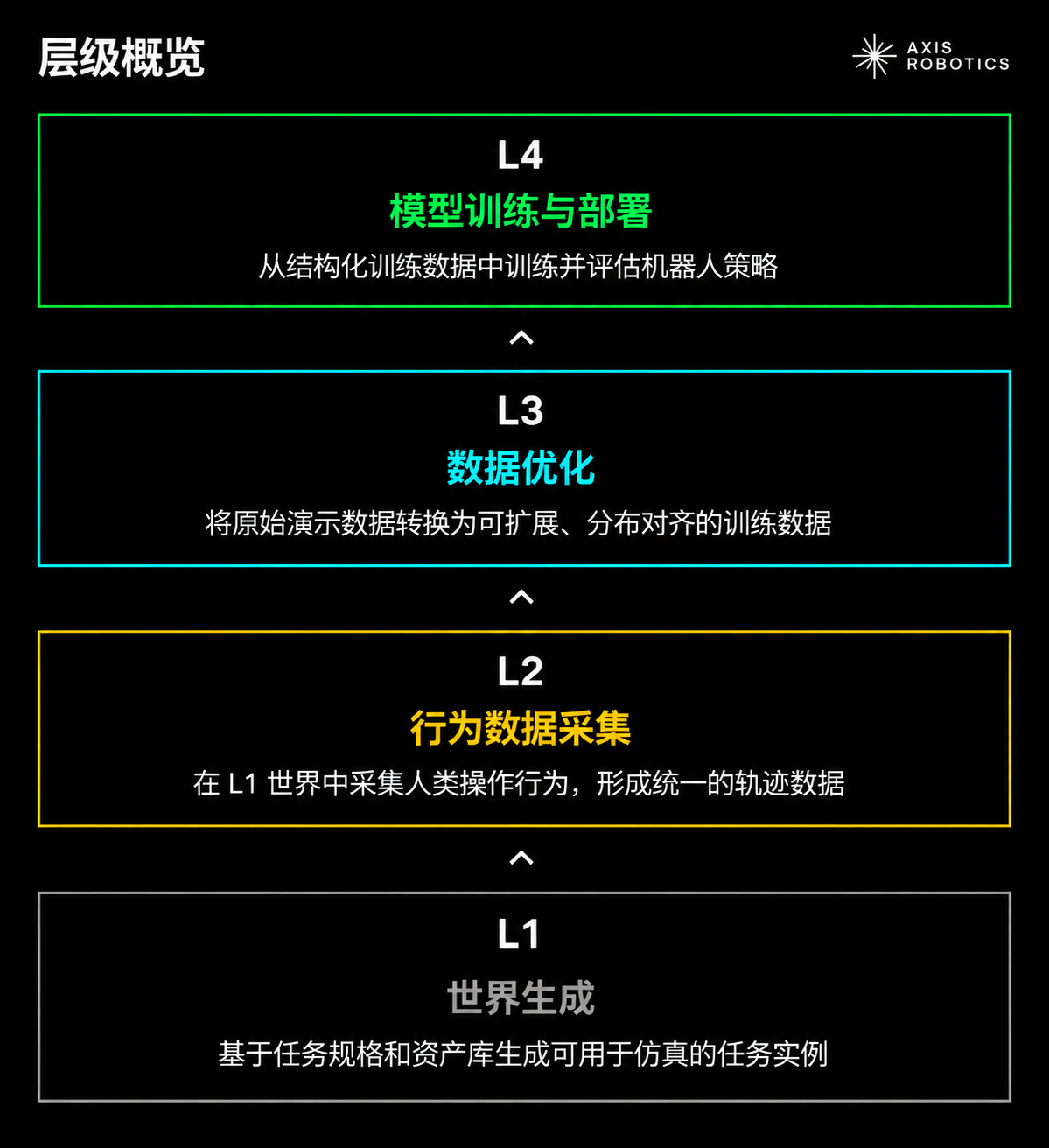
1. L1 — World Generation
L1 is responsible for generating the simulation environments and task instances required for robot training. The system receives natural language task descriptions and, combined with more than 2,000 objects in the asset library, automatically generates runnable simulation tasks including scene structure, object layout, physical parameters, and task success detectors.
This layer is based on MetaSim (a simulator-agnostic scene description language), decoupling task semantics from the underlying simulator. Generated tasks can be directly converted into formats such as MJCF, USD, and URDF, and are compatible with different simulation environments such as MuJoCo and IsaacSim.
Consumes
- Asset library (EmbodiedGen, Kujiale, image reconstruction data)
- Natural language task descriptions
- Scene layout constraints
Produces
- Parameterized task instances
- Cross-simulator compatible scene configurations
Abstraction
Separates task logic from specific simulator implementations, so that subsequent layers do not need to handle different simulator interfaces.
Key components
- MetaSim scene description language
- LLM-driven task generation engine
- Automated 2.5D scene layout generation
- Unified USD / URDF / MJCF asset pipeline
2. L2 — Behavior Collection
L2 introduces human operation behavior into the simulation environments created by L1 and converts it into structured trajectory data executable by robots.
Users do not need to install software or use professional equipment; they only need a browser to control simulated robots using keyboards, phones, game controllers, or VR. The system runs physics simulation locally through MuJoCo WebAssembly and maps different input methods into unified robot control commands, enabling data collection across devices and robot embodiments.
Each valid trajectory records on-chain provenance information (Base network Data ID), ensuring traceability of training data.
Consumes
- Interactive task instances generated by L1
- Multi-device, multi-modal human control signals
Produces
Robot trajectory data with provenance proofs:
{robot states, object states, control actions, task information, language goals, Data ID}
Abstraction
Decouples human operation intent from specific robot structures, enabling unified use of data from different devices and robot embodiments.
Key components
- MuJoCo WASM browser runtime environment
- Cross-embodiment robot control
- Grasp template interpolation system
- Decentralized data collection network
- Base on-chain data provenance records
3. L3 — Data Refinement
L3 is responsible for transforming low-quality, sparse human demonstration data into large-scale, high-quality datasets suitable for model training.
This layer does not merely perform simple data cleaning; rather, through distribution engineering (Distribution Engineering), it builds training data capable of supporting real-world generalization.
The process is divided into two parts:
Data cleaning:
- Removal of static frames
- Savitzky-Golay smoothing
- Cubic spline interpolation
- Increasing sampling frequency from 6–8Hz to 20Hz
Data augmentation:
Using the IsaacSim GPU simulation environment, trajectories undergo multi-dimensional randomization, including:
- Scene structure
- Materials
- Lighting
- Camera parameters
- Physical properties
Ultimately, a single trajectory is expanded into thousands of high-realism training samples.
Consumes
- Raw trajectory data with provenance proofs from L2
- World configuration data from L1
Produces
Distribution-aligned training data:
Cleaned trajectories × domain randomization augmentation × multi-view RGB / depth / segmentation data
Abstraction
Decouples data scale from manual collection costs, so that models receive structured data distributions rather than individual demonstration samples.
Key components
- Trajectory cleaning pipeline
- IsaacSim GPU replay
- Domain Randomization data augmentation system
- Multi-view camera generation
4. L4 — Model Training & Deployment
L4 uses the structured training data generated by L1–L3 to train and output deployable robot control policies (Robot Policy).
This layer supports multiple training methods, including:
- Behavior Cloning (BC)
- Diffusion Policy
- Vision-Language-Action (VLA) models
Different models are all trained on a unified data interface, enabling the system to compare the performance of different algorithms in complex task environments.
AXIS focuses more on the model's real-world generalization ability rather than单纯 benchmark scores. Models need to undergo:
- Cross-simulator validation
- Multi-scene layout testing
- Strong visual perturbation testing
- Sim-to-Real real robot deployment validation
Final models are deployed to real robots (currently supporting Franka Research 3). At the same time, each model retains a complete data provenance chain traceable to L3 data augmentation, L2 data collection, and L1 world generation, and linked to original contributors through on-chain Data IDs.
Consumes
- Distribution-aligned training data from L3
- Evaluation environment configurations from L1
Produces
- Task-specific robot policies
- General-purpose robot models
- Sim-to-Real validation results
- Deployable model files
Abstraction
Decouples learning algorithms from data infrastructure, enabling different training methods to接入 a unified data system without concern for data collection and augmentation processes.
Key components
- Task-specific imitation learning (BC / DP)
- General-purpose VLA models
- Cross-simulator validation
- Sim-to-Real testing
- Multi-world × multi-robot embodiment generalization evaluation
RoboVerse: Unified Framework
RoboVerse provides a unified interface framework connecting multiple robot simulation backends, enabling different simulators to work together through standardized APIs.
Its core philosophy is: different simulators have their own advantages at different stages of the robot training pipeline. For example, some simulators are better suited for high-precision physics computation, while others are better for large-scale data generation or visual simulation. Therefore, RoboVerse abstracts the underlying differences between different simulators and unifies them under a common interface, enabling each stage of the robot training pipeline to automatically invoke the most suitable simulation environment.
This design avoids the need for developers to repeatedly develop adaptation code for different simulators, improves the efficiency of robot simulation, data generation, and model training pipelines, and provides unified infrastructure for generalization training across multiple environments and robot embodiments.
Built on MetaSim
RoboVerse's cross-simulator capability is built on MetaSim. MetaSim is a unified Scene Representation & Description Language, whose core function is to decouple task definitions from specific simulator implementations, enabling the same set of tasks, assets, and trajectory data to migrate freely between different simulation environments.
Through MetaSim, AXIS can treat different simulators as replaceable execution backends without developing separate adaptation logic for each simulator.
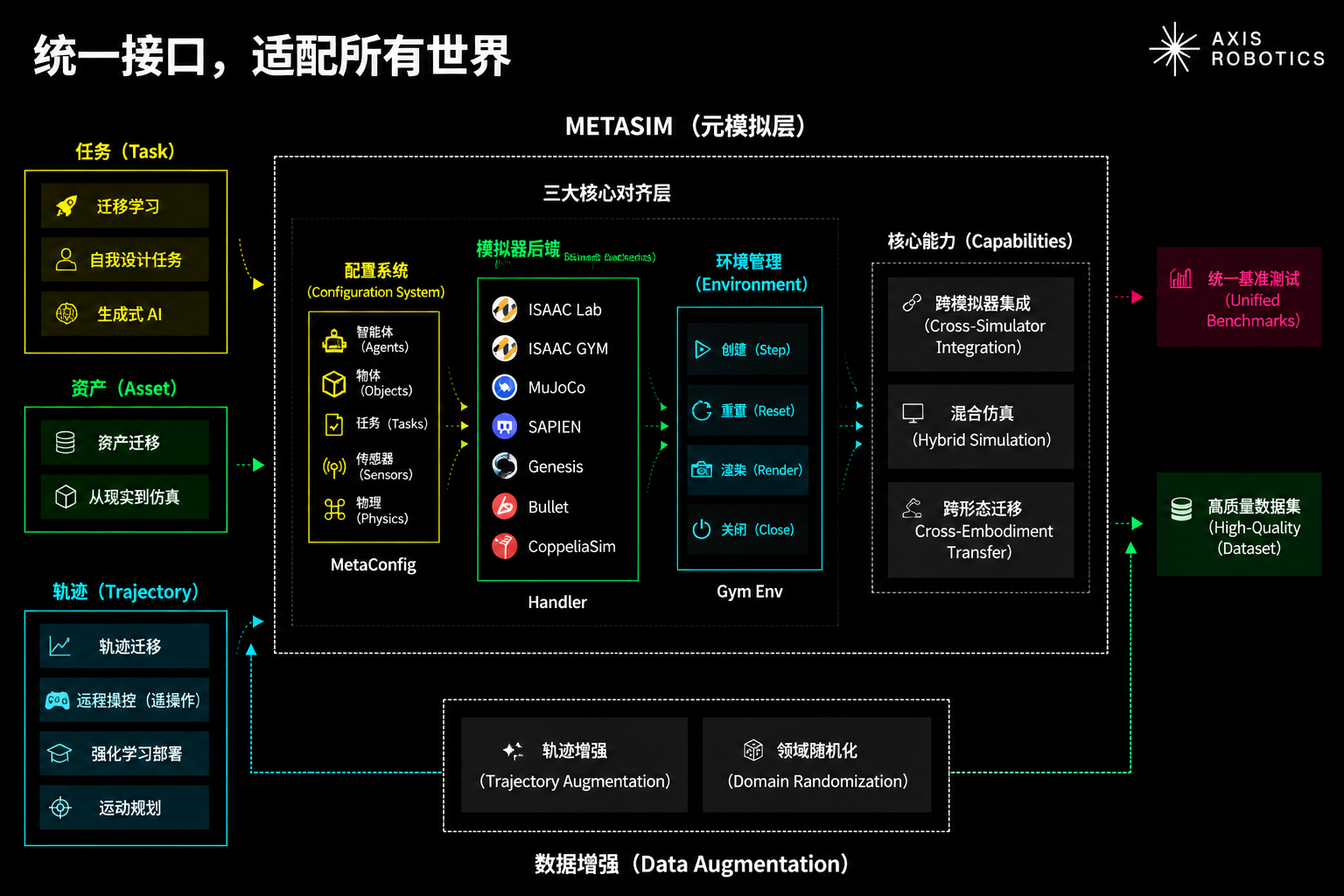
MetaSim Architecture: One Interface for All Worlds
MetaSim mainly provides the following capabilities:
Standardized Scene Graphs
MetaSim uses a unified, simulator-agnostic format to describe scene information, including:
- Objects
- Articulations
- Materials
- Physics Properties
Enabling different simulators to share the same set of scene definitions.
Automatic Translation
MetaSim can





