Where AI profits lie is where the valuation gap between the two markets lies


- Core view: The valuation gap between U.S. AI stocks and Hong Kong AI stocks essentially stems from differences in business models—Nvidia, with its pricing power over compute, achieves a net margin of about 71.5%, while Hong Kong platform companies generally have profit margins between 9% and 29%. The former earns money from the compute shortage, while the latter earns money from traffic and scenarios, so their valuation systems naturally diverge.
- Key elements:
- Nvidia's FY27Q1 net margin is about 71.5%, Tencent's is about 28.9%, Alibaba's is about 10.2%, and Kuaishou's is about 8.9%. The profit margin gap directly corresponds to the difference between a 33x P/E ratio and a low-teens P/E ratio.
- Microsoft's quarterly capital expenditure rose from $14.9 billion to $35.8 billion, more than doubling in eight quarters. Compute procurement has entered cloud providers' annual budgets rather than being a one-time pulse.
- There are three layers to the Hong Kong market discount: the earnings growth gap (U.S. compute revenue growth of more than 80% vs. Hong Kong companies' core businesses growing in the single digits), an index structure lacking pure AI names, and marginal pricing power still being affected by foreign capital and U.S. Treasury yields.
- Since July, southbound funds have made cumulative net purchases of about HK$134 billion. Last week's net sale of HK$6.637 billion was digestion after pre-holiday inflows, with buying in platforms and insurance and selling in some hardware manufacturing.
- The rhythm of Hong Kong's three main AI themes: compute reacts first, cloud follows, and applications cash out last. Kling's second-quarter revenue was RMB 850 million, with ARR approaching $500 million, accounting for 2.4% of Kuaishou's total revenue.
- Four verification indicators for third-quarter reports: cloud revenue growth, the relative speed of capital expenditure and revenue, AI penetration in advertising and e-commerce, and Kling's ARR and revenue share.
Over the past year, "Hong Kong AI is cheap, US AI is expensive" has been repeated time and again, but cheap and expensive are both outcomes. What truly determines the valuation gap between the two markets is where in the value chain profits remain, whether capex is still expanding, and who is setting the marginal price. Break these three things apart, and the opportunities in each market become clear: for US stocks, the question is whether earnings can continue to beat expectations; for Hong Kong stocks, whether the discount can be absorbed by commercialization progress. This article offers no position recommendations—it simply lays out the clues on pricing, earnings, and capital flows.
1. Who Makes the Most Money in the AI Value Chain? The Margin Gap Between Nvidia and Hong Kong Platform Companies
Both are called AI assets, but the profit pools sit in completely different places.
Nvidia reported FY27Q1 revenue of $81.615 billion and net income of $58.321 billion, a net margin of roughly 71.5%. This is not a software company's gross margin—it is a direct reflection of pricing power amid compute shortages: the price of a chip is set by supply and demand, and customers have few alternatives.
Tencent reported Q2 2026 revenue of RMB 206.561 billion and net income of RMB 59.801 billion, a net margin of roughly 28.9%. Platform profits come from advertising, gaming, fintech, and cloud, where AI is more of an efficiency tool than a separately charged product.
Alibaba reported FY2026 revenue of approximately RMB 1.02 trillion and net income of RMB 103.592 billion, a net margin of roughly 10.2%. E-commerce fulfillment costs and upfront cloud investment keep margins in the low double digits.
Kuaishou reported Q2 2026 revenue of RMB 35.384 billion and net income of RMB 3.133 billion, a net margin of roughly 8.9%. Content costs, bandwidth, and AI investment make it difficult to lift margins to platform-company levels in the near term.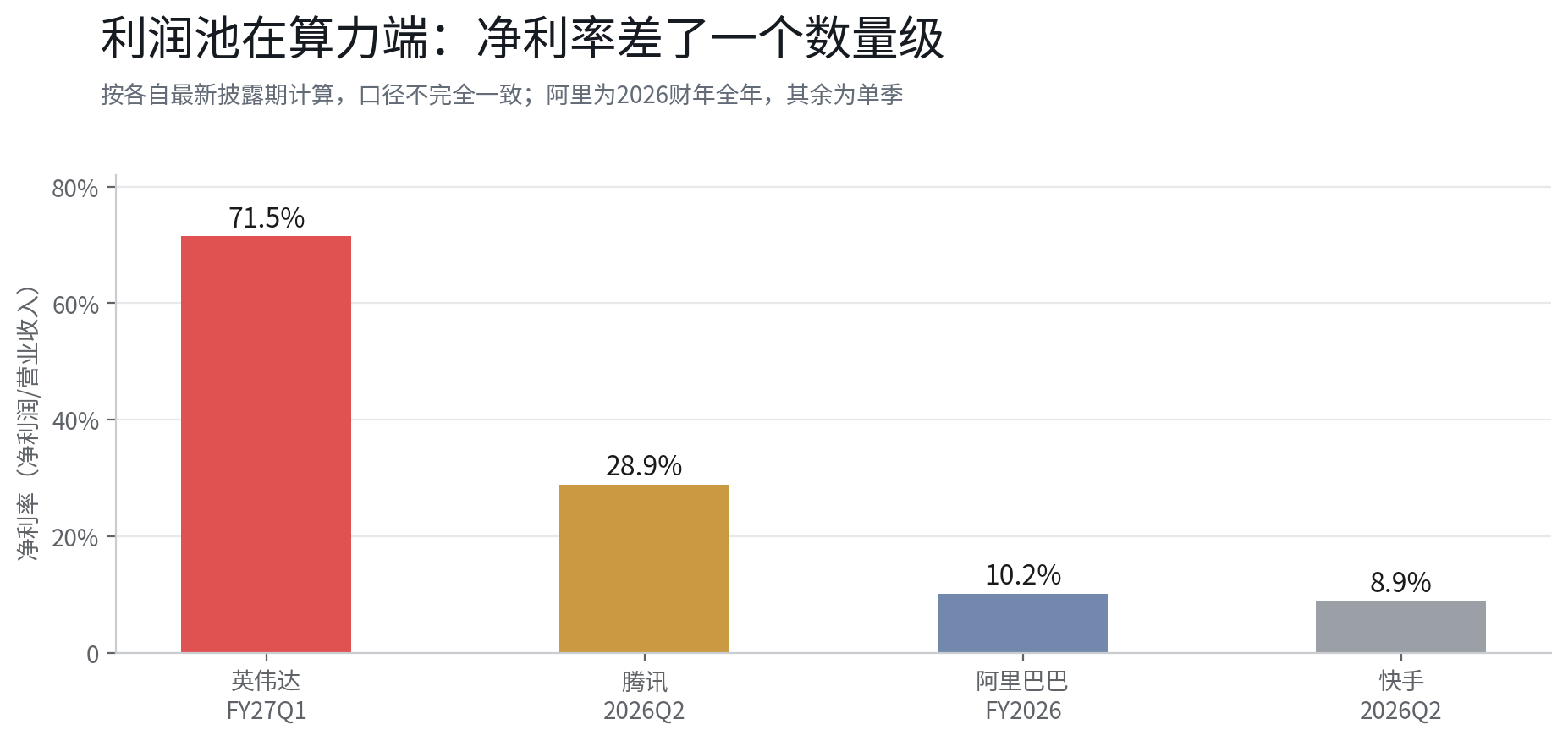
This chart explains half of the valuation gap. Nvidia trades at 33x TTM P/E because its margins are high, growth is fast, and visibility is strong; Hong Kong platforms trade at a dozen-plus times because margins cannot rise and growth is flatter. The valuation gap is not sentiment—it is first and foremost a difference in business models.
But the chart also points to opportunity. Low margins mean large room for improvement. If AI can bring down content production costs, ad delivery efficiency, and per-unit compute costs in the cloud, margin elasticity will translate directly into valuation. This logic is cheaper to buy in Hong Kong than in the US because the starting point is lower.
2. Microsoft's Capex Doubles—How Long Can AI Demand Hold Up?
Nvidia's revenue is the result; cloud providers' capex is the cause. Microsoft's quarterly capex rose from $14.9 billion in FY25Q1 to $35.8 billion in FY26Q4, more than doubling in eight quarters, and it has accelerated in the past two quarters.
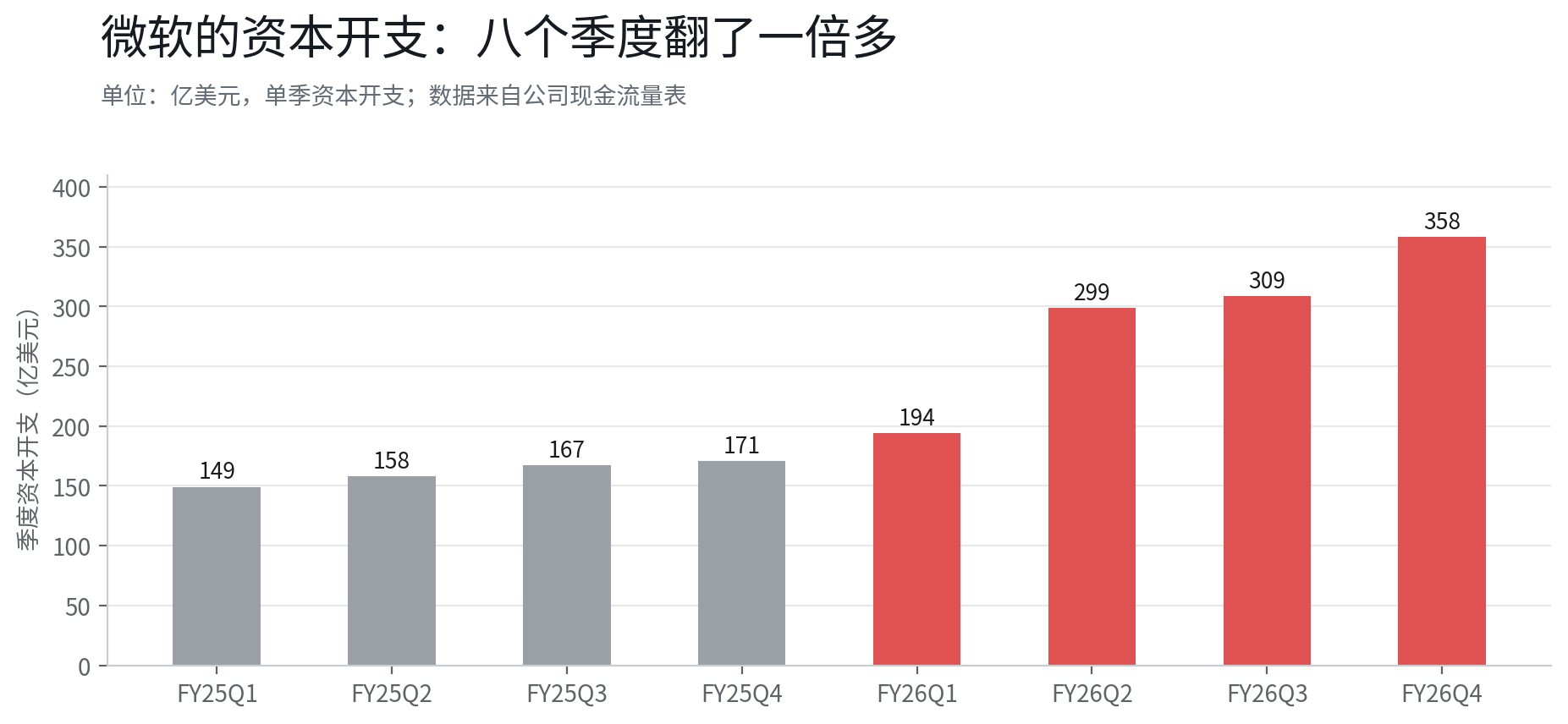
This curve matters to both markets. For Nvidia, it means orders; for SMIC and Hua Hong in Hong Kong, it means supporting demand for mature-node processes; for Alibaba Cloud and Tencent Cloud, it means upfront investment in compute costs and capacity. It shows that compute procurement has entered cloud providers' annual budgets rather than being a one-off pulse.
The risk lies here too. If capex growth continues to outpace cloud revenue growth, depreciation will first pressure margins and then valuations. For US stocks, the key is not just Nvidia's guidance but the relative speed of Microsoft's and Meta's capex versus cloud revenue. Once this ratio deteriorates for two consecutive quarters, AI-chain valuations will react before earnings do.
3. Why the Hong Kong Discount Persists—and Why It's Still Worth Watching
Tencent trades at roughly 14x 2027E P/E, Meta at about 20x, and Nvidia at about 33x TTM. The three figures come from different sources and cannot be directly subtracted, but the direction is clear: Hong Kong's platform leaders remain at a valuation low among global AI assets.