Gold's Rare Divergence from the Dollar and Treasuries: Plunge Erases Months of Gains — What Exactly Happened?


- Key Takeaways: Gold has exhibited a rare anomalous divergence, falling in tandem with the dollar and Treasury yields. Analysts speculate the primary cause may be cross-market liquidations triggered by the AI tech stock selloff, or yen intervention suppressing the dollar — rather than a disappearance of safe-haven demand.
- Key Elements:
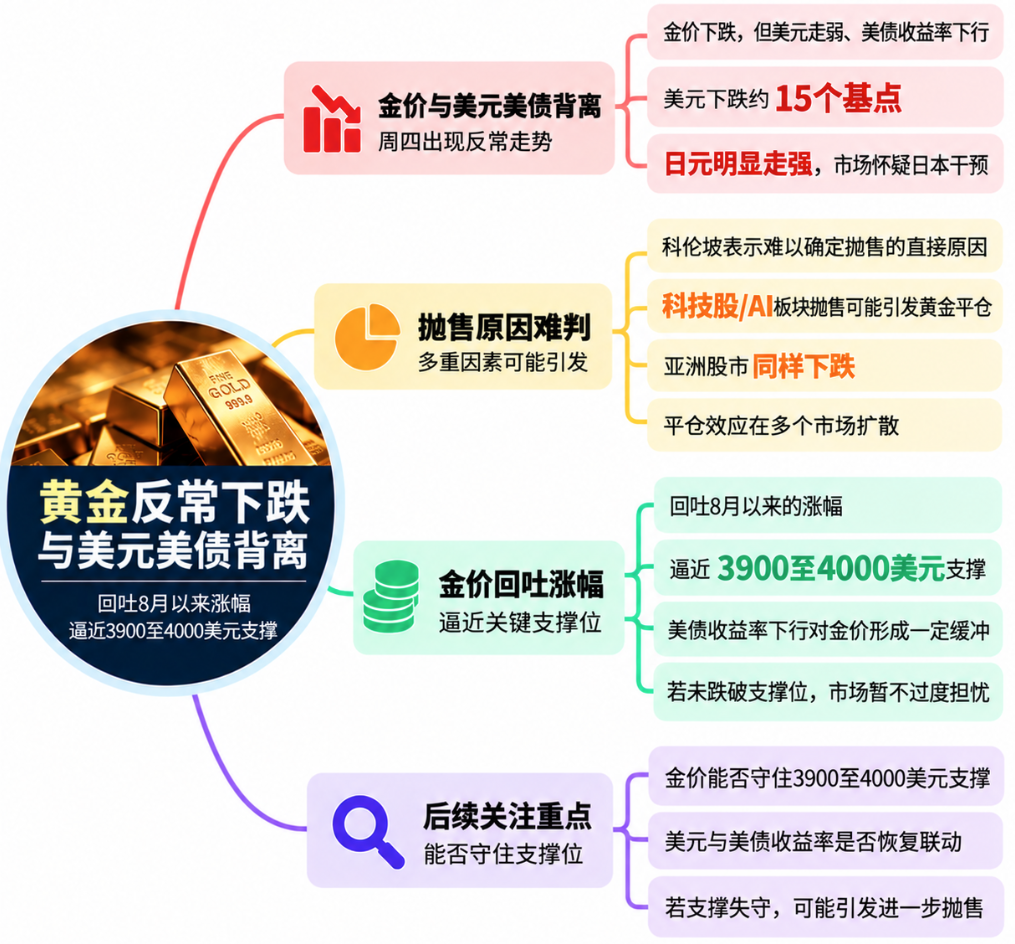
- The dollar index has fallen and Treasury yields have declined, conditions that would typically benefit gold, yet gold prices have weakened in tandem — a clearly anomalous move.
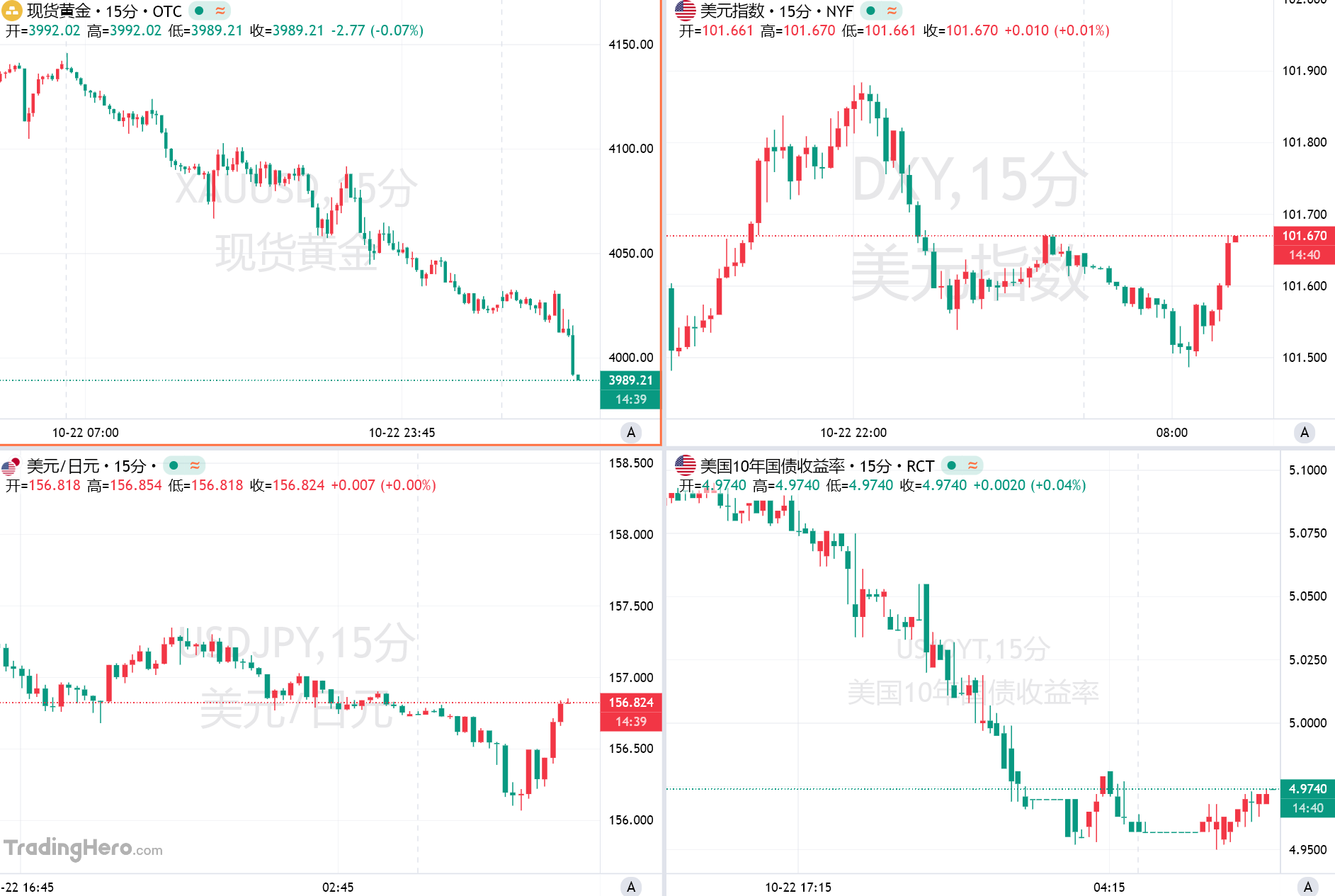
- Spot gold fell below $4,000/oz for the first time since July, erasing all gains accumulated since August.
- AI-related tech stocks have been sold off, with North American markets, South Korea's KOSPI, and Japan's Nikkei coming under simultaneous pressure, potentially forcing investors to liquidate gold to raise liquidity.
- Analysts suspect yen intervention may be underway, with its effects potentially offsetting the safe-haven support the dollar would otherwise receive.
- Technically, the key is whether the $3,900–$4,000 support zone holds; only a breakdown would warrant a reassessment of the trend.
- Declining Treasury yields may provide some cushion for gold prices; otherwise, the decline could have been deeper.
Original source: Jin10 Data
The gold market saw an unusual move on Thursday. Jesse Colombo, independent precious metals analyst and founder of BubbleBubble Report, said the divergence between gold prices and the movements of the U.S. dollar index and U.S. Treasury yields made it difficult for him to determine the real cause of this round of selling.
In an interview with Kitco News on Thursday, Colombo said he was trying to figure out exactly what was happening in the gold market.
"The price action is very unusual," he said. "The dollar index is falling. Normally, on a day like this, you would expect the dollar index to be up 1%, but instead it is down 15 basis points."
Colombo also noted that the Japanese yen had strengthened sharply. He believes this may mean the market is seeing intervention aimed at pushing the yen higher, which is usually bearish for the dollar.
"Normally, that would push precious metals higher. But today, precious metals are falling alongside the dollar—though, of course, the dollar's decline is not particularly large. At the same time, bond yields are moving lower, yet that also failed to give precious metals a boost. This performance is very unusual."
Crude oil prices rose slightly, but Colombo said the gain was not enough to explain the size of gold's decline.
As of the update time of this article, spot gold in Friday trading fell below the $4,000/oz mark for the first time since July, down 0.6% on the day. Brent crude rose above $110/barrel for the first time since May 5, up 0.84% on the day; WTI crude broke above $100/barrel, up 1.35% on the day.
Two Possibilities: Tech Stock Selloff Triggers Liquidation, or Yen Intervention Weighs on the Dollar?
Colombo believes gold's decline may be related to a chain reaction triggered by a tech stock selloff. As artificial intelligence (AI)-related stocks came under selling pressure, North American and global equity markets came under strain, and investors may have been forced to liquidate positions, which in turn spilled over into the precious metals market.
"I suspect this is partly due to technical factors, and there may also be some liquidation related to AI stocks and tech stocks that could be one of the causes. Part of the decline may also stem from risk aversion ahead of next week's Federal Reserve meeting, especially concerns that Warsh may once again deliver a hawkish signal."
However, the performance of the dollar and U.S. Treasury yields left Colombo doubtful of a simple liquidation explanation. Normally, if the market turns to safe havens because of a selloff in risk assets, the dollar tends to find support, but on Thursday the dollar did not strengthen as expected.
Colombo said the biggest beneficiary on Thursday appeared to be U.S. Treasuries. But he noted: "Usually in this kind of situation, the dollar would also strengthen, and this time that did not happen."
He suspects that yen intervention may explain this divergence.
"Maybe yen intervention offset the support the dollar should have received. I have not seen relevant news... Sometimes the market only reports these actions after the fact, but I suspect that yen intervention did indeed occur."
Colombo shared a chart showing confirmed yen interventions since February. He believes Thursday's market move resembles some of the patterns seen when those interventions took place and may be the beginning of a new round of intervention.
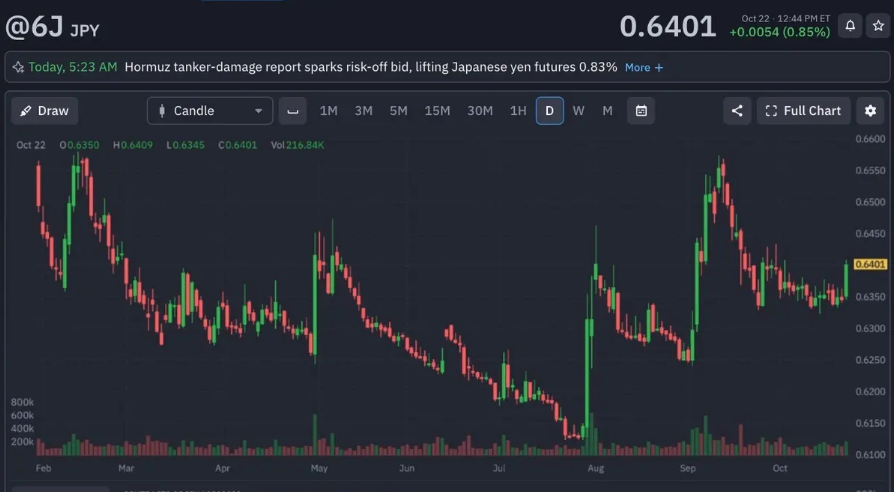
"This matches those huge green vertical bars on the chart over the past few months. Those were all confirmed yen interventions. And today, we are again seeing the beginning of a similar move. Sometimes interventions occur consecutively, so the possibility of another yen intervention tonight or in the coming days cannot be ruled out."
However, there is currently no confirmation that the intervention he mentioned has actually taken place. Colombo's judgment remains speculation based on market price action.
Gold Nears $3,900-$4,000 Support Zone; Key Is Whether It Holds
On the technical side, Colombo noted that gold is once again approaching the key support zone of $3,900 to $4,000 per ounce. In the summer, gold prices found support in this area before rebounding.
"As long as gold does not break below this zone, I will not be worried. Before that, this could still just be the formation of a double bottom or a rebound. We cannot be sure yet. The only thing we know for now is that gold is testing this support level."
He stressed that it is too early to conclude that gold's trend has turned weak. If gold ultimately breaks below the support zone, further assessment will be needed in light of subsequent price action.
"If gold breaks below support, we will make a judgment based on the subsequent price action. I do not want to jump to conclusions. But yes, this move is indeed very unusual, and it feels like it has fallen a bit too far."
The size of this pullback is already quite significant. Colombo said: "Unfortunately, gold has given back all of its gains since August, and the entire rally has been almost completely erased."
Even so, he believes the bond market's performance may have limited gold's decline to some extent. On Thursday, U.S. Treasury prices strengthened and yields moved lower, which, according to normal market logic, should have provided some support for gold.
Colombo explained that if this gold decline was mainly caused by risk aversion triggered by the tech stock selloff, then without the support from a Treasury rally, gold prices might have fallen even further. He said:
"The decline in yields may actually have provided some buffer for precious metals. That is, if bond yields had risen today instead, gold would probably have already broken below $4,000. From that perspective, falling yields may be softening the blow to gold."
Global Risk Assets Under Pressure Together; Liquidation Effects May Still Be Spreading
In addition to North American markets, the performance of Asian stock markets also offers another possible explanation for the cross-market shock triggered by the tech stock selloff.
Colombo said: "Asian markets may also be affected and may likewise involve liquidation. The KOSPI fell sharply, and the Nikkei also fell sharply... So this explanation is also quite plausible."
This means that the selloff in gold does not necessarily mean safe-haven demand has completely disappeared. If investors are forced to sell gold to meet liquidity needs because other assets are falling, gold can also decline in tandem during periods of market turmoil.
At present, Colombo cannot confirm which factor dominated Thursday's price action: liquidation triggered by the selloff in AI-related stocks, or possible yen intervention. For now, the more direct focus is whether gold can hold the $3,900 to $4,000 per ounce support zone, and whether the dollar and U.S. Treasury yields can once again show their usual relationship.