Humanity's tech tree has finally unlocked alchemy


- Core thesis: Silicon Valley fusion startup Marathon Fusion uses high-energy fusion neutron streams to transmute mercury into gold at a rate 10x faster than the CERN record, and is using this technology pathway to enter medical isotope production, potentially reshaping the gold scarcity narrative and the logic of fusion commercialization.
- Key elements:
- By bombarding mercury-198 with 14.1 MeV fusion neutrons to trigger an (n,2n) nuclear reaction, which through decay produces stable gold-197, at a rate 10x higher than the 2025 CERN record.
- The company employs a beam-driven fusion architecture validated by LLNL in the 1980s, targets delivery of its first-generation commercial reactor in 2027, and has secured approximately $4 million in government funding plus a $5.9 million seed round.
- The real commercial core is medical isotopes: actinium-225 is valued at tens of billions of dollars per gram, with each neutron creating value roughly 3 billion times that of power generation.
- The economics rewrite the commercialization threshold: breakeven for power generation requires an energy gain of 10-22x, gold production drops that to 3x, and molybdenum-99 production requires only 0.001x.
- Nic Carter calls this gold's "quantum crisis"—Bitcoin can resist quantum threats through software upgrades, but gold's physical rules cannot be patched.
- Michael Green estimates the total cost of fusion-produced gold at roughly $850 per ounce, far below current gold prices, drawing parallels to the industrialization-driven price declines of scarce goods like aluminum and diamonds.
Original | Odaily (@OdailyChina)
Author | Azuma (@azuma_eth)

Throughout humanity's long history, "turning stone into gold" has always been one of the most fascinating ultimate fantasies.
From the smoke-filled underground chambers of medieval Europe to the alchemical furnaces that Eastern emperors searched the world for, countless alchemists and scientific giants—including Isaac Newton, the father of modern physics—were drawn to alchemy, attempting to extract gleaming gold from cheap lead or mercury. Yet for thousands of years, these attempts all ended in failure without exception.
With the establishment of the modern chemical system, humanity finally understood that chemical reactions can only manipulate the electron clouds in the outer layers of atoms, and cannot change the number of protons inside the atomic nucleus. The "one-proton gap" between element 79, gold (Au), and element 80, mercury (Hg), is an insurmountable chasm at the chemical level.
For this reason, in modern finance and physics common sense, gold has always been regarded as nature's constant, artificially irreproducible ultimate scarce resource—every gram of gold on Earth comes from cosmic-scale catastrophes billions of years ago, such as supernova explosions or neutron star collisions. The reason gold can serve as a hard currency and cornerstone of value storage spanning thousands of years is precisely built upon this iron law of "physically impossible to inflate supply."
However, this underlying logic that has persisted for thousands of years is now facing unprecedented challenge in a laboratory in downtown San Francisco.
On October 22, a Silicon Valley nuclear fusion startup called Marathon Fusion announced with great fanfare that it had demonstrated high-rate modern "alchemy"—using high-energy neutron streams generated by nuclear fusion to successfully transmute mercury into real, stable gold, and the conversion rate broke the record set by CERN in 2025, improving it by a full 10 times.
What exactly is Marathon Fusion? Does the so-called "turning mercury into gold" really have a scientific basis? When "alchemy" enters reality, will gold's scarcity narrative be rewritten? All the answers must start with this Silicon Valley hard-tech startup's highly rebellious technological approach.
Marathon Fusion's Ambition: From "Turning Mercury into Gold" to a Nuclear Transmutation Commercial Empire
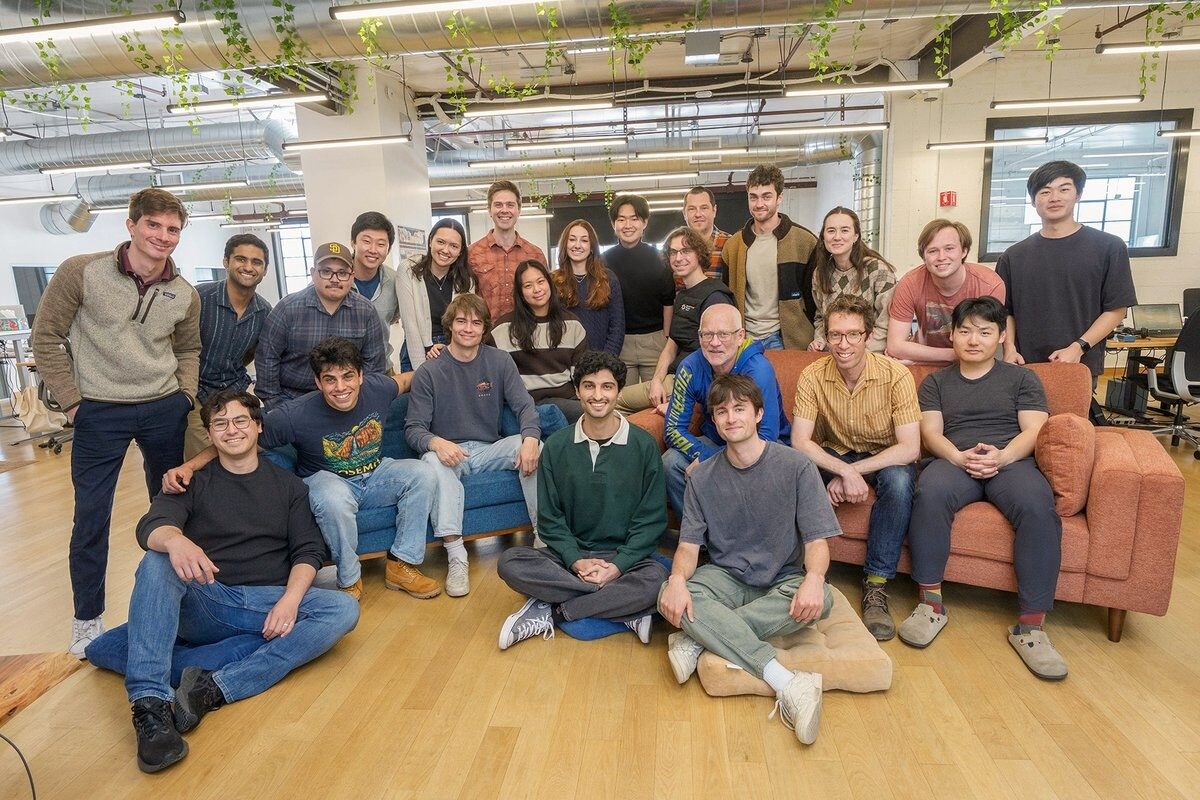
Marathon Fusion was founded in San Francisco in 2023. Its two co-founders are Kyle Schiller (CEO), who previously served as a science policy researcher at Schmidt Futures—the foundation of former Google CEO Eric Schmidt—and Adam Rutkowski (CTO), a former SpaceX propulsion engineer with a background in plasma physics from Princeton.
At its founding, Marathon Fusion secured approximately $4 million in funding from the U.S. government, and also completed a $5.9 million seed round. The company originally focused on solving the most daunting underlying challenge of fusion reactors—the "tritium fuel cycle and separation." However, during R&D in 2025, the team unexpectedly worked out a disruptive economic calculation—rather than waiting decades to sell electricity from fusion, it would be better to first use the high-energy neutron streams produced by fusion to launch "nuclear transmutation" (directly changing atomic nucleus structures through nuclear reactions, converting one element into another), and achieve a commercial closed loop ahead of schedule by co-producing gold and ultra-high-priced medical isotopes. Today, this hardware engineering team of only 28 people, with fewer than one-fifth holding PhDs, is attempting to build a "full-stack fusion" device from scratch.
Carefully dissecting the technical roadmap and experimental videos disclosed by Marathon Fusion reveals that the "turning mercury into gold" they promote is by no means a mere scientific magic trick for attention, but a key component of their grand "Scalable Transmutation" commercial blueprint.
Core Architecture: Reviving a Classic 1980s Approach
Unlike the vast majority of fusion companies pursuing large-scale power generation, Marathon Fusion has taken an extremely pragmatic engineering shortcut for its first-generation commercial reactor—Beam-Driven Fusion.
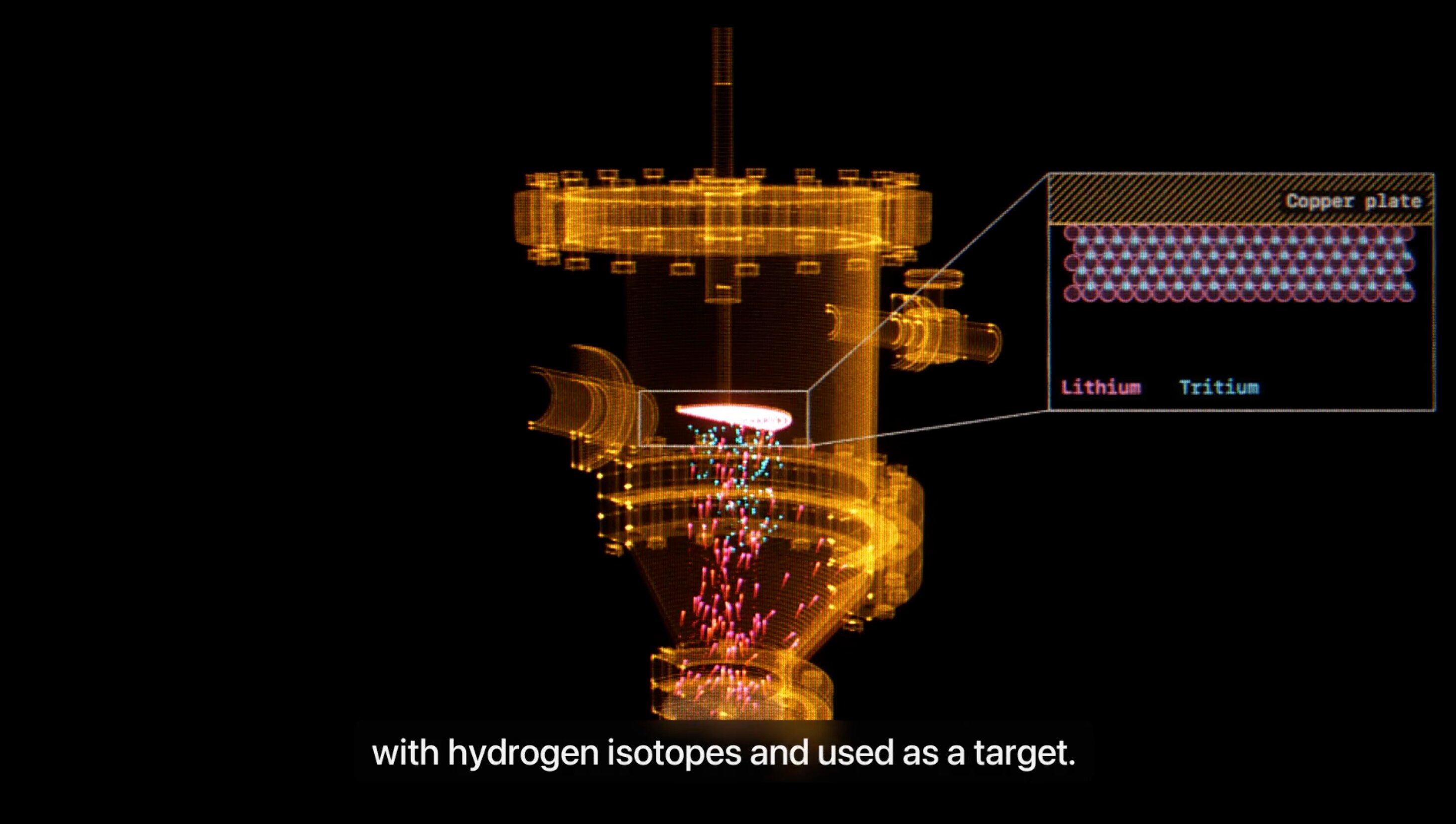
In the officially released technical video, the working principle of its first-generation reactor is very clear. First, metallic lithium is melted and evaporated onto a solid copper plate, then this lithium layer absorbs saturated hydrogen isotope (tritium) to form a solid target; next, deuterium gas is ionized and accelerated through a high-voltage electric field, and a high-energy deuterium ion beam directly bombards the target, thereby triggering deuterium-tritium (D-T) nuclear fusion.
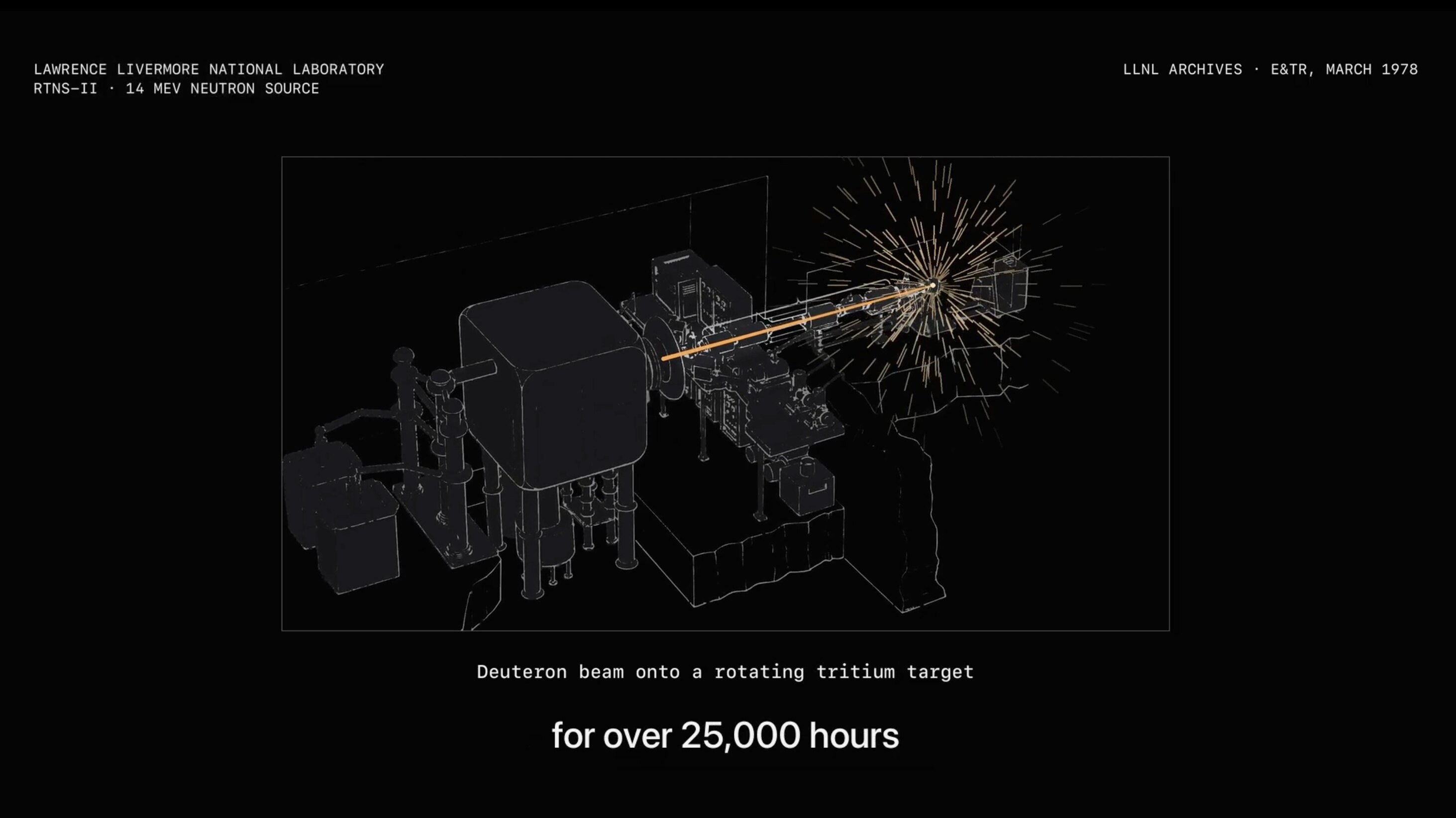
This architecture was not fabricated out of thin air. As early as the 1980s, Lawrence Livermore National Laboratory (LLNL) in the United States used a similar Rotating Target Neutron Source (RTNS-II) to operate stably at high fusion power density for over 25,000 hours.
Marathon Fusion combines modern molten lithium handling, radio-frequency ion generation, and plasma centrifuge technology—just last week, they broke the Soviet Union's 40-year-old record for isotope enrichment using plasma centrifuges—to re-commercialize this classic architecture. Marathon Fusion's goal is to continuously bombard a target only 1 centimeter in diameter with one trillion high-energy neutrons per second, and to achieve "doubling fusion power density every month" within the next year, with plans to deliver its first-generation commercial reactor to initial partners in 2027.
How Is "Turning Mercury into Gold" Achieved?
Since chemical methods cannot create gold, how does nuclear physics do it? The answer lies in 14.1 MeV (megaelectronvolt) fusion high-energy neutrons.
Each deuterium-tritium fusion reaction ejects a neutron with energy as high as 14.1 MeV at extremely high speed. When this "super bullet" bombards the stable isotope mercury-198 found in nature, an (n, 2n) nuclear reaction occurs—that is, one neutron crashes in and knocks out another neutron from the original nucleus, with two neutrons flying out in total.
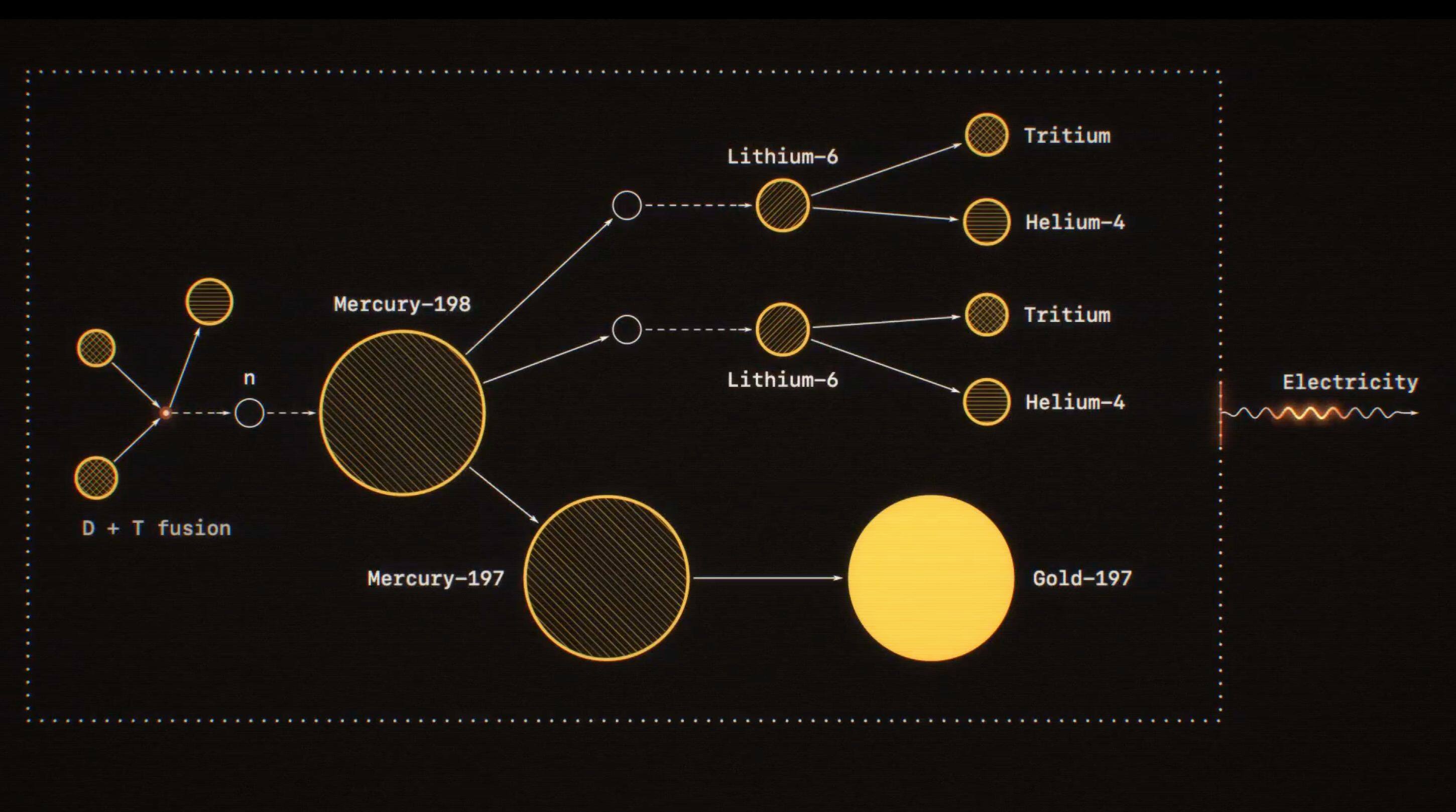
At this point, mercury-198, having lost a neutron, becomes the unstable radioactive isotope mercury-197. After several days of half-life decay (electron capture), a proton inside the mercury-197 nucleus converts into a neutron, and element 80, mercury, naturally transforms into element 79—gold-197, which is also the only stable gold isotope in nature.
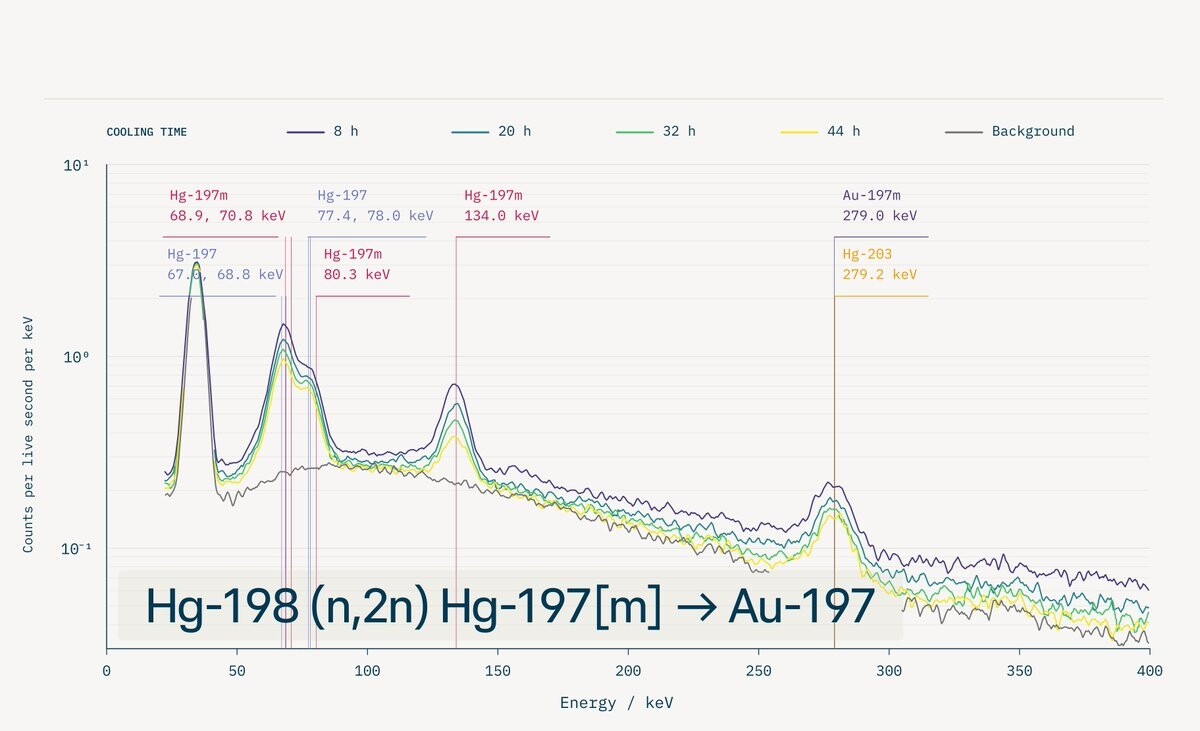
The reason this process must rely on nuclear fusion is that the energy threshold to trigger this reaction is approximately 6 MeV or above. The neutrons produced by traditional nuclear fission power plants have energy that is far too low to knock mercury nuclei; fusion reactors can precisely produce such high-energy neutrons with each ignition. More importantly, in Marathon Fusion's reactor design, the two neutrons knocked out of mercury-198 are not wasted—they continue to bombard lithium-6 in the blanket, splitting to produce the tritium fuel and helium-4 needed by the reactor, thereby achieving the triple benefit of "power generation + fuel breeding + alchemy" in the future.
The Real Money Printer: Something a Billion Times More Valuable Than Gold
Although "making gold" sounds sexy enough, at the current stage, Marathon Fusion's true commercial core is actually rare medical isotopes.
So-called medical isotopes can be described as "biological nuclear missiles" in the field of modern precision medicine—after being combined with specific targeting molecules and injected into a patient's body, they can precisely lock onto tumors and use radiation released from their own decay to eliminate cancer cells from within, without harming surrounding healthy tissue. However, most of these isotopes have extremely short half-lives (they cannot be stockpiled long-term and must be produced and used on demand), and the production capacity of the few remaining old fission research reactors worldwide is already near its limit. The extreme supply-demand imbalance means they are often priced by the "microgram" or even "millicurie" in the pharmaceutical market, with per-gram prices reaching tens of millions or even tens of billions of dollars, making them among the most expensive substances by unit value on Earth.
In recent years, targeted radiotherapy has experienced exponential explosive growth in the field of cancer treatment. Novartis's prostate cancer radiopharmaceutical Pluvicto is priced at up to $42,500 per dose, with sales reaching $1.9 billion last year, and it was even forced to temporarily stop accepting new patients due to upstream isotope supply disruptions; pharmaceutical giants such as Eli Lilly and Bristol-Myers Squibb have spent billions of dollars frantically acquiring radiopharmaceutical assets.
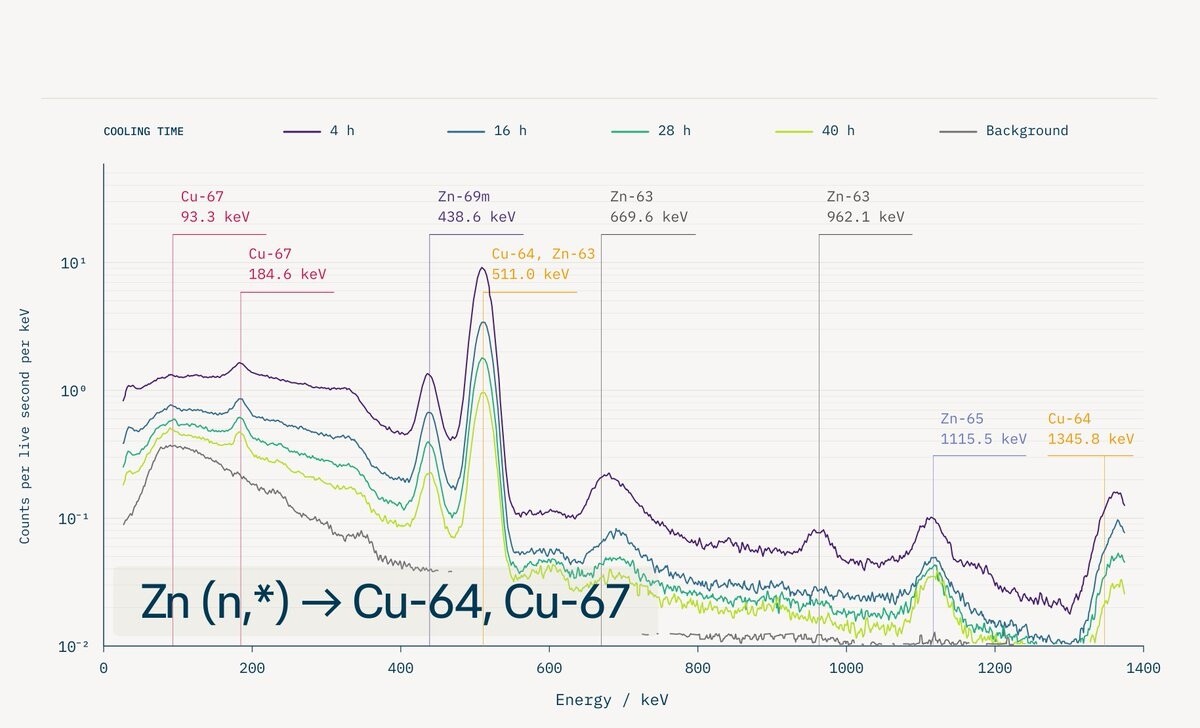
If the mercury target in Marathon Fusion's reactor is replaced with other metals, it would become a true money printer by creating different medical isotopes:
- In the latest experiment, Marathon Fusion has successfully bombarded zinc (Zn) with fusion neutrons to transmute radioactive copper isotopes used for cancer diagnosis and cutting-edge therapies;
- The official demonstration video also shows the pathway of bombarding europium-151 to ultimately produce terbium-149, which is urgently needed for cancer treatment;
- If the target is replaced with radium-226, the same (n, 2n) reaction can produce the extremely scarce actinium-225—the core raw material for Novartis's next-generation anti-cancer blockbuster, whose current global annual production is only enough for a few thousand patients.
As Marathon Fusion stated in its promotional video—in the 20th century, humanity invented synthetic ammonia fertilizer, silicon semiconductors, and aspirin that feed half the world's population through "designing molecules" (synthetic chemistry); now, they are launching an industrial revolution of "scalable transmutation" by directly manipulating atomic nuclei.
Market Buzz: Neutrons Can Also Be Priced, Gold's "Quantum Crisis"
Marathon Fusion's blockbuster announcement quickly sparked cross-disciplinary discussions in Silicon Valley tech circles, the nuclear energy industry, and Wall Street and crypto finance circles. The focus of discussion mainly centers on the following dimensions: Is nuclear transmutation gold production really profitable? How exactly is this calculated? And what impact will it have on gold and macro asset pricing?
Doing the Economics: Why Fusion Companies Shouldn't Just Focus on "Selling Electricity"
Silicon Valley AI research guru Aakash Gupta conducted a brilliant financial breakdown of Marathon Fusion's paper data, directly revealing the secret behind this company's disruption of the fusion industry logic—putting a "price tag" on every fusion neutron.
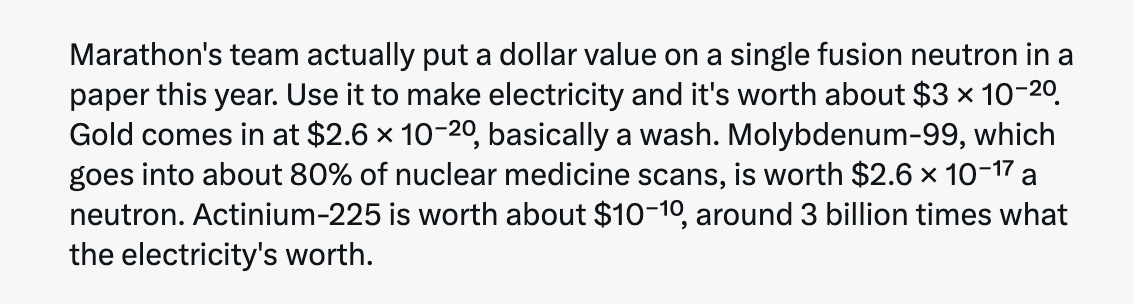
If we assign a dollar price to each neutron emitted by the reactor (Single Fusion Neutron) based on the value it generates:
- For power generation, one neutron is worth only about 3 × 10⁻²⁰ dollars;
- For making gold, one neutron is worth about 2.6 × 10⁻²⁰ dollars (roughly break-even with power generation);
- For making molybdenum-99, which accounts for 80% of nuclear medicine scans, the value of one neutron jumps to 2.6 × 10⁻¹⁷ dollars (nearly a thousand times that of power generation);
- For making the anti-cancer drug raw material actinium-225, converted to grams at millicurie pricing ($1,200 to $2,500 per unit), its per-gram price reaches hundreds of billions of dollars. This means each neutron hitting the target is worth about 10⁻¹⁰ dollars—a full 3 billion times the value of power generation!
This calculation completely reconstructs the commercialization threshold for fusion. Aakash points out that traditional fusion companies are all struggling with grid-connected power generation, but to break even selling electricity, the ratio of plasma output energy to input heating energy must reach 10 to 22 times, while humanity's best tokamak device (UK's JET) currently achieves only about 0.33 times. But with Marathon Fusion's approach, by adding "gold production" as a byproduct subsidy in the power generation blanket, the break-even point drops directly to 3 times; if dedicated to producing the medical isotope molybdenum-99, the break-even point plunges to 0.001 times!
In other words, even if a fusion machine's output energy is only one-thousandth of its input energy (a complete loss in terms of power generation), as long as its neutrons hit the right metal target, it can make money right now. A small machine with just 3 megawatts (MW) of power would be enough to cover the entire global supply of molybdenum-99.
And gold, as a massive market worth about $700 billion annually, is enough to absorb up to 2 terawatts (TW, grid-scale) of fusion capacity. Therefore, Marathon Fusion's calculation is very clear—currently making huge profits by selling anti-cancer isotopes from small machines; in the medium term, using gold byproducts to pay for building giant reactors; and ultimately, completing the fusion grid deployment ahead of schedule before electricity can be profitable on its own.
Clash Between Finance and Crypto: Is Gold Facing a "Quantum Crisis"?
When "turning mercury into gold" becomes a byproduct of fusion power generation, the financial and crypto communities also erupted.
Some exclaimed that this may be the most bearish thing for gold we've seen in our lifetime. This description is not exaggerated—if Marathon Fusion truly achieves commercial scale, it would undoubtedly deal a massive blow to gold's long-term scarcity.
Nic Carter, a partner at Castle Island Ventures and well-known crypto scholar, compared this to the "quantum computing threat" often discussed in Bitcoin circles, and offered a piercing comment: "This is gold's quantum FUD, but much worse—because you can't give gold a software update."
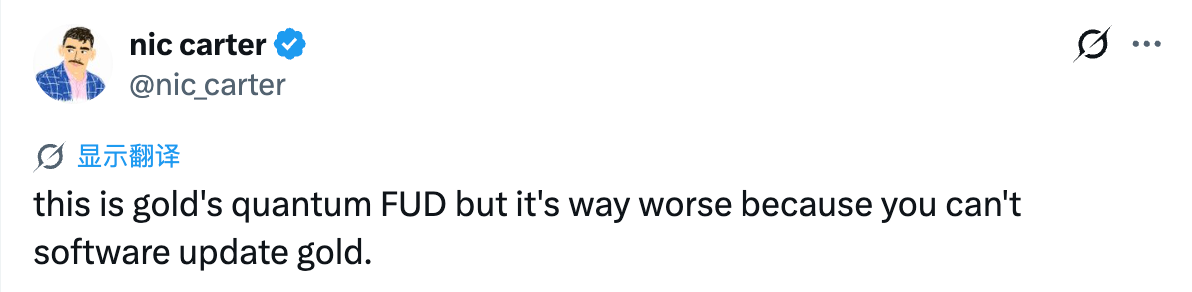
In Nic Carter's view, if quantum computers threaten Bitcoin's cryptographic algorithms, Bitcoin can still upgrade to quantum-resistant signature algorithms through community consensus to defend its 21 million cap; but gold's physical rules cannot be modified—you can't "patch" gold atoms to prevent nuclear reactors from inflating gold supply.
Well-known macro investor Michael Green also expressed partial agreement with Nic Carter's view, arguing that gold should never be considered "money"—it is merely one of many metals, whose applicability depends on chemical properties.
But Michael Green also offered a different, sobering perspective. He calculated that as a byproduct of radioactive isotope production, the initial cost of fusion-made gold is estimated at only about $250 per ounce. Even accounting for the approximately 13-year storage period needed for residual radiation to decay (at a 10% cost of capital), the total cost would be only around $850 per ounce—far below the current gold price. This is not unprecedented in history—aluminum, fertilizer, and diamonds were all once extremely scarce luxury goods, ultimately transformed into abundant ordinary commodities by modern industrial technological innovation.
However, even if Marathon Fusion successfully mass-produces gold, they would only become a low-cost gold miner (similar to small copper-gold byproduct miners). This would indeed constitute a net bearish factor for gold prices, but gold is still a chemical element—the gold in your hands still belongs to you; whereas once quantum computing breaks Bitcoin's algorithms, the blockchain will no longer be secure, and your Bitcoin will no longer belong to you—the former is merely a mild price negative, while the latter is complete annihilation.
When Myth Is Reduced to Engineering
Looking back at the history of science and technology, every leap that humanity has made across eras has often been accompanied by reducing yesterday's "magic" into dry, precise "engineering."
In its post, Marathon Fusion wrote a declaration full of Silicon Valley spirit: "We have reduced alchemy to a series of difficult but tractable engineering problems." In the hands of these engineers who worship extreme hardware execution, controlled nuclear fusion—long joked about as "always 50 years away"—is now, through the side door of medical isotopes and modern alchemy, crashing open the door to commercialization earlier than anyone expected.
And for financial markets, when the arrangement and combination of atomic nuclei begin to be custom-ordered by humans like building blocks,