


With daily throughput reaching trillions of tokens and nearly 3 million users, how does B.AI capture Web2 AI traffic through underlying "frictionless" architecture?


- Core Viewpoint: As the AI industry enters deep waters of retention and cost in 2026, B.AI uses its "frictionless" underlying architecture to fold away the complexity of model scheduling, payment settlement, and agent collaboration, successfully bridging Web2 and Web3 circles to become a leading player in next-generation AI infrastructure.
- Key Elements:
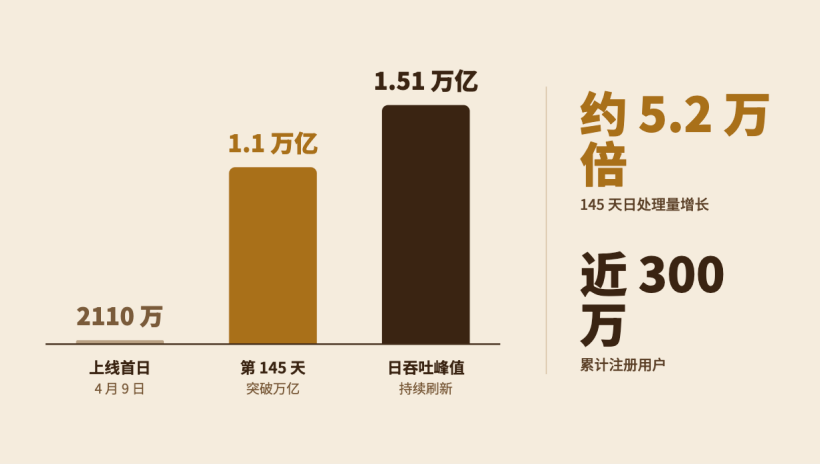
- Platform registered users approach 3 million, with daily token throughput reaching 1.51 trillion—climbing from 21.1 million to the trillion scale in just 145 days, approximately 7 times faster than OpenRouter.
- Fiat payment channels such as Stripe account for over 50%, marking a reversal in user composition from Web3 geeks to the Web2 mass market.
- The platform covers 70+ multimodal large models, with Responses API compatible with upstream standard protocols, allowing new models to be seamlessly invoked without code modifications.
- The top eight models on the 7-day invocation leaderboard are all Chinese large models, with the top four being Flash series focused on low latency and high cost-effectiveness; Xiaomi and Zhipu token usage grew nearly 50% and over 44% week-over-week, respectively.
- During the free access period for top-tier models, 8.19 trillion tokens were processed in 15 days, adding over 220,000 API users, supporting accessible computing power through scale effects.
- Launched five major components—x402 payment, 8004 identity, Agent Wallet, MCP Server, and Skills—to build a standardized "machine interaction skeleton" for the agent economy.
In 2026, the global AI application sector has accelerated from the early "model launch frenzy" into a new phase of "stock cultivation and cost refinement." As customer acquisition costs for large models remain high and retention rates come under pressure, the industry as a whole has entered a deep-retention phase. Yet in this crowded red ocean of traffic, B.AI, as a new-generation AI infrastructure, has bucked the trend with a strong growth curve.
Recent data shows that B.AI's user base has surged to nearly 3 million, successfully supporting an ultra-high computing throughput of trillions of tokens per day. Even more significant for the industry is that, thanks to B.AI's "frictionless" underlying design, payments made through traditional fiat channels such as Stripe now account for more than 50% of the total, successfully capturing a massive wave of users migrating from the Web3 geek community to the Web2 mass market.
In the past, external perception of B.AI often remained fixed on "a hardcore platform with Web3 and cryptocurrency DNA." Today, B.AI is systematically reshaping that perception, proving to the market that it is currently the most Web2-friendly AI gateway. By building a cross-boundary "frictionless universal compute base," B.AI is enabling the world's top AI resources to flow as freely as water and electricity.
Breaking Through Community Boundaries: B.AI Becomes a Web2 Traffic Super Gateway with Its "Frictionless" Underlying Architecture
Behind this cross-boundary leap is a profound shift in how the large-model industry bills and schedules compute. Entering the second half of 2026, the era of winning solely on low prices is ending, replaced by a dizzying game of compute arbitrage. DeepSeek, as a leading Chinese player, has begun introducing "peak-valley pricing" similar to an electricity grid. Meanwhile, overseas leaders such as OpenAI and Anthropic are cutting API prices in stages to cope with fierce market competition. Rises and cuts run in parallel, with layered, time-based, and scenario-based billing rules stacking up. For developers, price is no longer a stable reference point but a variable that requires constant recalculation.
Behind this lies a deeper change: as model capabilities converge and prices fluctuate, which model to choose, how to invoke it, and how to control costs—complexities that once belonged to vendors—are being shifted onto every user. In the second half of large-model competition, for AI infrastructure players, whoever can absorb these complexities on behalf of users and let them use top models "without thinking about it" holds the ticket to building the next-generation AI super ecosystem.
This is also a new lens through which to understand B.AI's strategic leap. When the industry throws the compute multiple-choice question at users, B.AI chooses to be the underlying base that "folds complexity." In the past, the first impression of B.AI was mostly shaped by its Web3 background as a joint incubation project of TRON and YZi Labs, carrying the label of "hardcore, high-threshold." But today, with its comprehensive "frictionless" underlying architecture, B.AI is helping itself cross the geek community and attract a massive, broader influx of traditional internet users.
Explosive business data confirms this. Since launching on April 9, the platform took only 145 days to push daily token processing from 21.1 million to 1.1 trillion—reaching the trillion scale roughly 7 times faster than OpenRouter. Since then, its daily throughput has refreshed to a new high of 1.51 trillion tokens, with cumulative registered users approaching 3 million. With its undisputed growth slope and ecosystem scale, B.AI has firmly established itself as the leader of the new-generation AI infrastructure.
Beyond the staggering scale growth, the reversal in the platform's payment structure better explains where these massive users actually come from. Compared with the early days when Web3 payments dominated, payments completed through traditional fiat channels such as Stripe now account for more than 50%. This means more than half of compute consumption genuinely occurs along the everyday paths most familiar to Web2 users. On B.AI's underlying infrastructure, the community boundary between Web2 and Web3 is being completely broken down by an ultimate "frictionless" product experience.
Folding Technical Complexity: B.AI Reshapes Model Scheduling and Compute Consumption Experience
What makes this cross-boundary "product experience" truly land is the "functional folding" B.AI has completed at the infrastructure layer: the heterogeneity of the model ecosystem, the volatility of the pricing system, and the friction of payment habits are all absorbed on the platform side. What is delivered to the public is no longer a tangle of configuration options, but absolutely pure, ready-to-use "certainty."
The first layer of frictionlessness brought by this "functional folding" shows up in model scheduling. According to a Zapier survey, as many as 58% of enterprises in 2026 paid far more than expected when switching AI vendors. To break this ecosystem fragmentation, B.AI covers more than 70 top multimodal large models across the site while carrying out a major upgrade of its underlying Responses API. By fully compatible with upstream standard protocols, B.AI thoroughly simplifies the once extremely complicated underlying invocation logic.
When the platform later adds new models from onboarded vendors, developers can automatically and seamlessly invoke them on the client side without modifying any code configuration. Connecting top AI capabilities to a business becomes as simple and stable as calling a standardized cloud service. It is precisely this stability and smoothness that has driven a large volume of platform traffic toward API calls and Agent workflows, truly achieving seamless integration of AI with automated business operations.
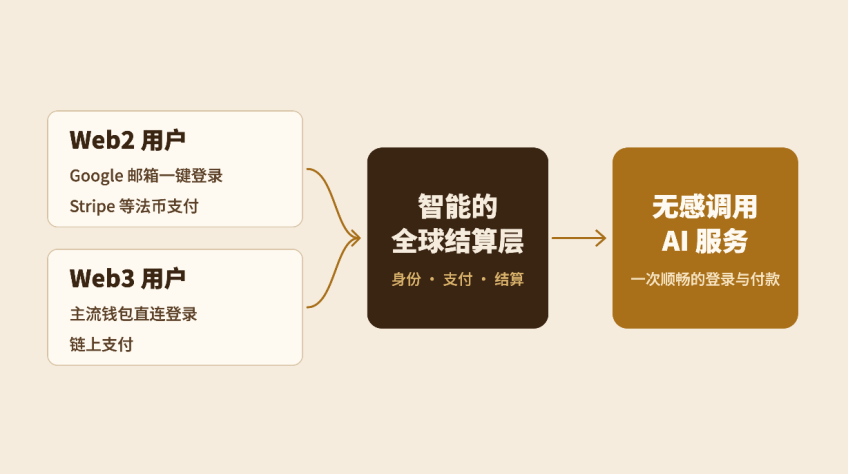
The second layer of frictionlessness occurs at onboarding and fund settlement, backed by the "intelligent global settlement layer" B.AI is focused on building. It does not require any party to change existing habits; instead, it makes identity verification and payment paths a dual-track system running in parallel. At the entrance, Web2 users can log in with one click via Google email and directly invoke AI services even if they have never touched a crypto wallet. Web3 users can connect directly to mainstream wallets such as TronLink, MetaMask, OKX Wallet, Trust Wallet, and Phantom. On the payment side, dual channels also run in parallel: beyond on-chain payments, traditional fiat channels such as Stripe have become the mainstream choice for users. Differences in identity verification and settlement paths are absorbed into this global settlement layer, and what users perceive is simply a smooth login and payment.
If "frictionless" onboarding is the super gateway that attracts mass users, what truly retains this massive C-end traffic over the long term is the thorough downgrading of compute consumption costs. B.AI's core capability lies precisely in its ability to precisely connect this large-scale inclusive demand to B-end large models on the supply side, building a low-resistance "super channel to global markets" for them. At this intersection where supply and demand meet, B.AI perfectly achieves an ecosystem closed loop and value fusion at both ends.
B.AI platform data also confirms this trend. As of October 20, among the platform's top call rankings for the past 7 days, the top eight were all Chinese large models, and the top four were all Flash series主打 low latency and high cost-effectiveness, directly targeting cost efficiency. On the brand popularity ranking from October 9 to 15, Xiaomi and Zhipu Token usage posted extremely impressive week-over-week growth, up nearly 50% and over 44%, respectively.
This cost-effectiveness wave set off by Chinese large models coincides with B.AI's strategy of releasing platform dividends. Relying on the scale effect of trillions of tokens in daily throughput, B.AI has the absolute confidence to continuously break the price barriers of top compute. During the period when multiple top models were opened for free, the platform processed a cumulative 8.19 trillion tokens in 15 days and added more than 220,000 API users. Currently, the platform has also launched a long-term "discount season," rolling out benefit campaigns from time to time so that dividends continue to be released. This continuously escalating compute inclusion not only completely removes mass users' cost concerns, but also uses a unified gateway to undertake distribution and a global settlement layer to handle payments, making it the "super hub" for Chinese large models going global.
It is precisely this dual advantage of "low cost + zero threshold" that has enabled B.AI to pierce through community barriers. Top AI is no longer an expensive toy for the few but an everyday tool within reach of millions of ordinary people. This is also the ultimate password for B.AI to stand out in the red ocean of traffic and successfully carve out a Web2 territory.
Rebuilding the Underlying Collaboration Protocol to Accelerate the Full Outbreak of the Agent Economy
Removing barriers for human users is only the first step. As AI capabilities evolve explosively, B.AI keenly observes that the next area where technical friction urgently needs to be eliminated is no longer the human-machine interaction interface, but the autonomous collaboration system among Agents.
Today, Agents are no longer chatbot software confined to a dialog box; they have evolved into super employees capable of autonomously finding tools and executing tasks. This awakening of autonomy has directly spawned massive demand for high-frequency machine microtransactions. According to an October report by Chainalysis, as of September, AI Agent payments completed via x402 on the Base chain alone exceeded 138 million, with 87% of individual transactions under 10 cents, mainly for model inference, data APIs, and code auditing; Web2 giants such as AWS, Stripe, and Google have also successively laid out Agent payments. The infrastructure race for the agent economy is likewise a race across community boundaries.
B.AI's choice is to lay the infrastructure in advance during this window. B.AI innovatively built five core underlying components, constructing a standardized "machine interaction skeleton" for the future agent economy:
l x402 Payment Protocol (solving payment friction): Empowers Agents with autonomous "pay-before-response" flow capabilities. Agents no longer need to cumbersome register traditional accounts and can complete high-frequency micro-deductions and settlements in the background at extreme speed.
l 8004 Identity Protocol (solving machine mutual trust): Issues a verifiable on-chain "ID card" to every Agent in the network and continuously accumulates traceable credit ratings, thoroughly opening up the trust chain between machines.
l Agent Wallet (solving fund management): Gives every Agent an independent "digital vault" with the ability to autonomously receive, custody, and settle assets, making it a truly self-driving economic entity.
l MCP Server (solving communication barriers): As the system's "simultaneous interpreter," it can losslessly translate obscure and complex on-chain code into natural language that large models can directly understand and execute.
l Skills (completing execution capabilities): In the form of minimalist, modular "skill packs," it enables Agents to rapidly expand and land execution in complex scenarios such as DeFi interactions and on-chain tracking.
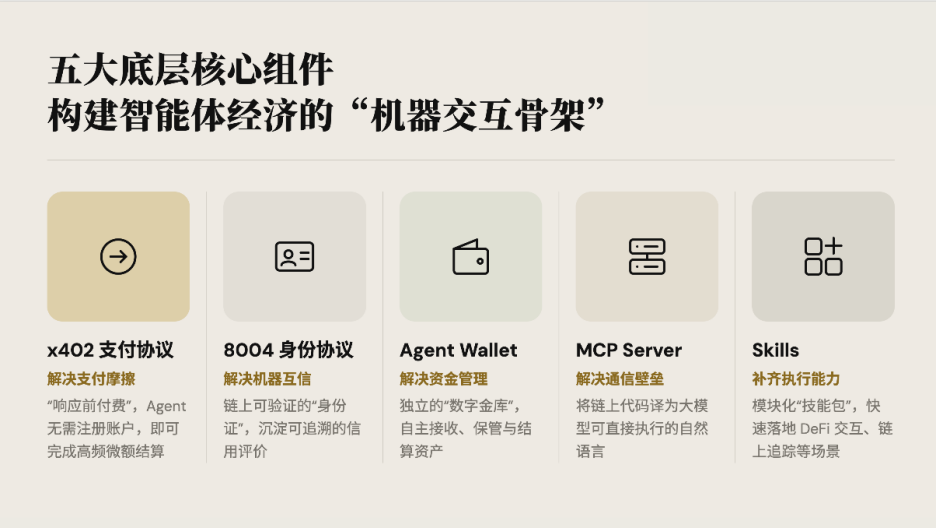
The five components correspond respectively to payment, identity, funds, communication, and execution, and connect upward with multi-model scheduling, covering the entire process of an Agent from "thinking" to "acting" to "settling." This is also the extension of B.AI's "intelligent global settlement layer" on the machine side. For users, these complexities are likewise folded onto the platform side; users do not need to care whether Web2 or Web3 is behind it—they simply issue instructions and enjoy the most extreme, pure AI productivity.
In the deep contest between the traffic red ocean and compute involution in 2026, B.AI, with the precise positioning of a "frictionless universal compute base," has delivered an impeccable answer to the industry. From model scheduling, onboarding and settlement, and compute consumption to agent collaboration, B.AI folds the complexity of these four links layer by layer into the infrastructure, delivering to users the same experience: frictionless and predictable. This is exactly the meaning of a "frictionless universal compute base": enabling users across different communities, and even humans and machines, to use AI on the same set of infrastructure. As the agent economy accelerates its arrival, B.AI has already paved this pipeline network that allows top AI resources to flow freely around the world like water and electricity.





