


Crypto AI's "Trillion Tokens," but Only $8.7 Million in Monthly Revenue


- Core Viewpoint: The actual paid scale of the Web3 model inference market is far smaller than advertised. Verifiable 30-day revenue is approximately $8.7 million, with 83% concentrated in Venice alone. Most projects rely on token subsidies and wash trading to sustain their token numbers.
- Key Elements:
- Among 130 projects, Venice accounts for approximately $7.2 million in 30-day credit sales, with the rest totaling about $1.5 million. Most projects generate less than $10,000 in monthly revenue.
- The gap between self-reported tokens and on-chain actual receipts ranges from 3x to over 400x, with actual revenue per million tokens ranging from less than $0.003 to $2.3.
- Although x402 has become the Agent payment standard, large model resources account for only 3% of Bazaar registrations, and inference gateways generate approximately $3,800 in combined 30-day revenue.
- Credit tokens are widely issued but sparsely used. Only Venice's DIEM has a usage rate of approximately 44%, while Orbio's CREDIT is mostly cashed out by arbitrageurs rather than activated.
- Decentralized inference customers are highly dependent on OpenRouter. Chutes' daily emissions are approximately 12x its listed revenue, and usage drops significantly after subsidy reductions.
Author: @BlazingKevin_, Researcher at BlockBooster
On August 19, 2026, Stripe announced its acquisition of model routing platform OpenRouter, with media reports putting the price above $7 billion. The company processed 656 trillion tokens in 30 days. Large models are priced by token, and "selling tokens" has already become a standalone big business.
The crypto industry is also moving into this business: topping up with USDC to purchase model credits, letting Agents pay per use via x402, turning credits into tradable tokens, or selling inference through decentralized networks. The metric these projects most often publish is "how many trillion tokens have been processed."
To figure out how much revenue these tokens actually generated, we individually verified 130 Web3 projects that directly touch model tokens, without using the token counts self-reported by the projects. We looked only at on-chain receipts, token burns, x402 settlements, and supply-side data publicly disclosed by OpenRouter, with a statistical window from September 13 to October 12, 2026.
Excluding OpenRouter, verifiable or estimable model payments within 30 days totaled about $8.7 million, of which Venice alone accounted for about $7.2 million, or 83%; the remaining one hundred-plus projects combined accounted for about $1.5 million.
In other words, the actual scale of this business is far smaller than the hype, and revenue is highly concentrated.
1. Eighty Percent of Revenue Flows to Venice
Across the five categories of projects, the most numerous are decentralized inference networks (43) and pay-per-use gateways (31), but revenue is almost entirely concentrated among a handful of the former. Pay-per-use gateways received only about $3,800 in total over 30 days, and Agent platforms and AI applications brought in less than $1,000.
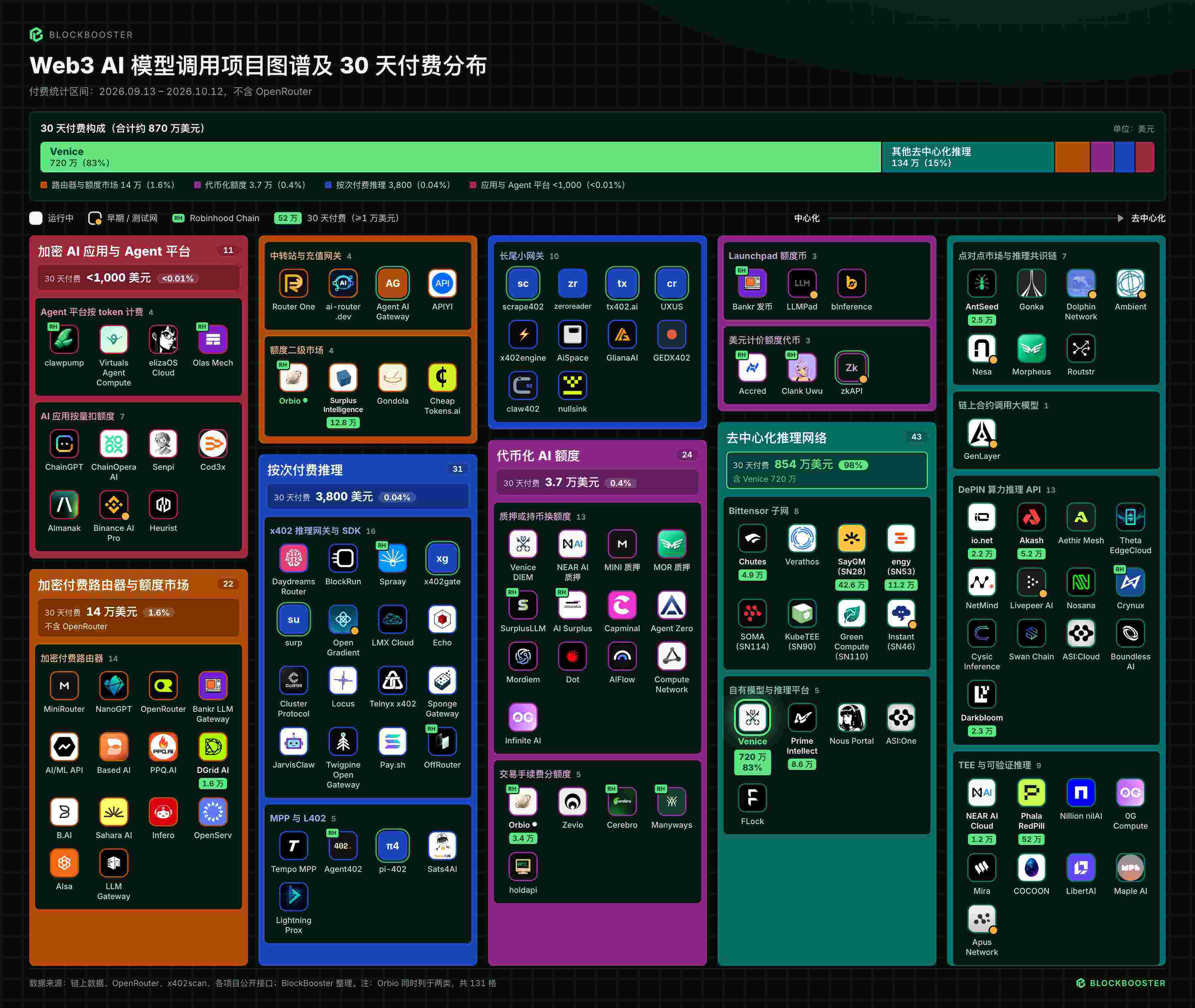
Since July 17, Venice has stipulated that for every $100 of API credits sold, it uses $5 to buy back and burn VVV from the open market. The third-party dashboard venicestats recorded 71,958 credit burn transactions totaling $359,800 over 30 days, implying credit sales of about $7.2 million. Annualized on this basis, that is about $87 million, in the same order of magnitude as Sacra's estimate of $110 million in annualized revenue.
The projects ranked after Venice range from $80,000 to $520,000: Phala, which sells TEE inference through OpenRouter, at about $520,000; Bittensor subnet SayGM at $426,000; discounted credit marketplace Surplus Intelligence at $128,000; engy, which uses all revenue for buybacks, at $112,000; and Prime Intellect at about $86,000. Most of the remaining projects generate less than $10,000 in monthly revenue.
Compared with centralized platforms, this market is still very small. Backing out from Sacra's estimated revenue and a 5%–5.5% fee, OpenRouter alone handles about $240 million to $270 million in monthly transaction volume, and all the other Web3 projects on the map combined amount to only 3%–4% of that.
2. Token Consumption Figures Are Heavily Inflated
Dividing 30-day payments by 30-day tokens yields each project's actual revenue per million tokens. The differences between projects span thousands of times: SayGM at about $2.3, Gonka and Twigpine at less than $0.003, and OpenRouter across its entire platform at about $0.39.
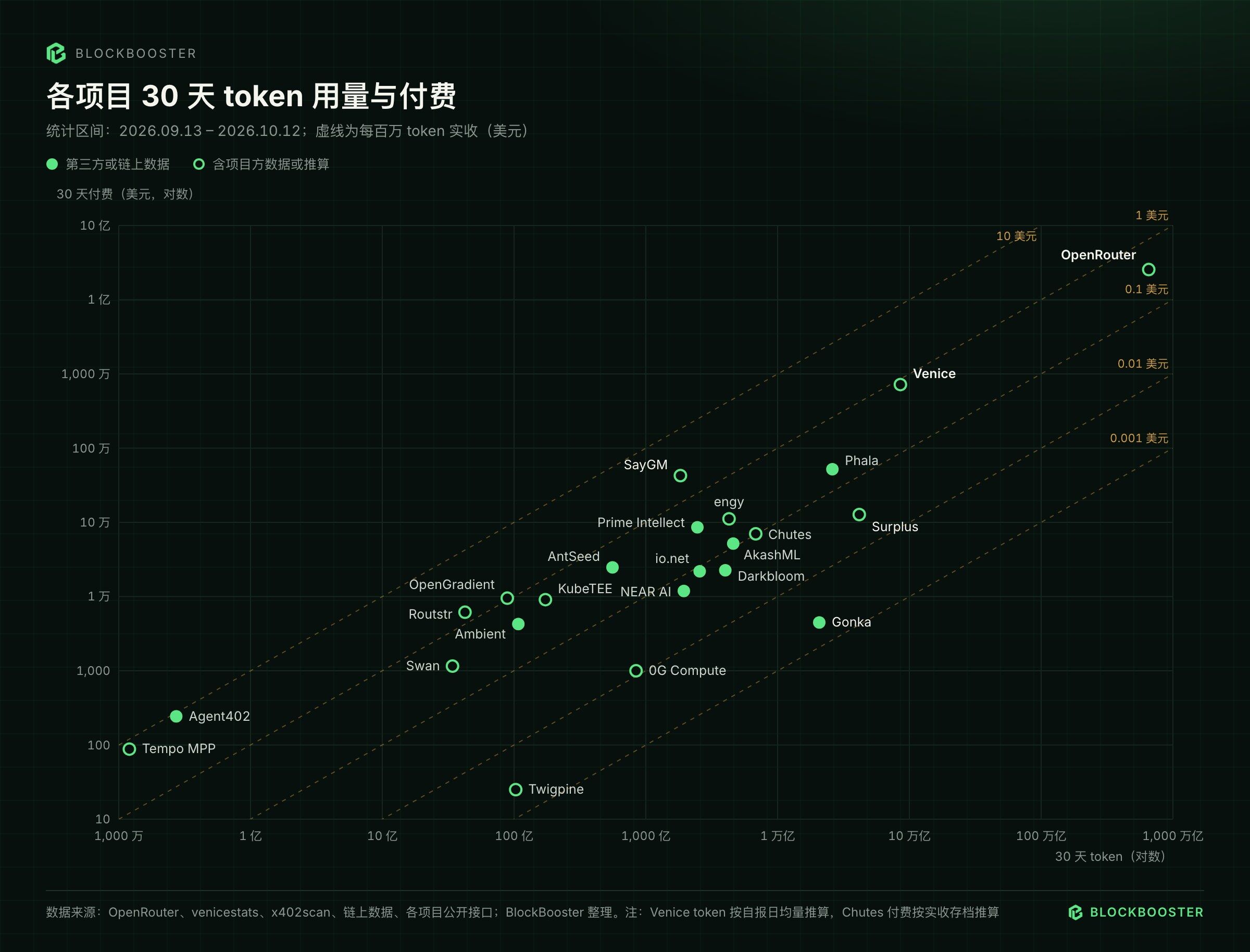
Projects with higher unit prices are mostly reselling closed-source models. SayGM's miners use their own keys to resell Claude, GPT, and Gemini; Venice charges about $0.84 per million tokens, with closed-source models priced 20%–25% higher than official rates there, yet users are still willing to pay.
The reasons for lower unit prices vary. Surplus has 79% of its input as cached, nearly half of its tokens come from DeepSeek V4.1 Flash, and it sells at roughly one-tenth of the original price. Twigpine gets 82% of its usage from models with free quotas. 0G Compute's actual on-chain charges are only 1.6% of what it should collect at list price, Gonka's on-chain price is stuck at the floor price, and node revenue depends almost entirely on emissions. Some usage also comes from projects' own internal tasks—for example, Prime Intellect self-reports nearly 1 trillion tokens per day and Dolphin reports 332.2 billion over 30 days—which does not represent external demand.
Comparing the figures published by the projects with the amounts visible on-chain, the gaps range from 3x to more than 400x.
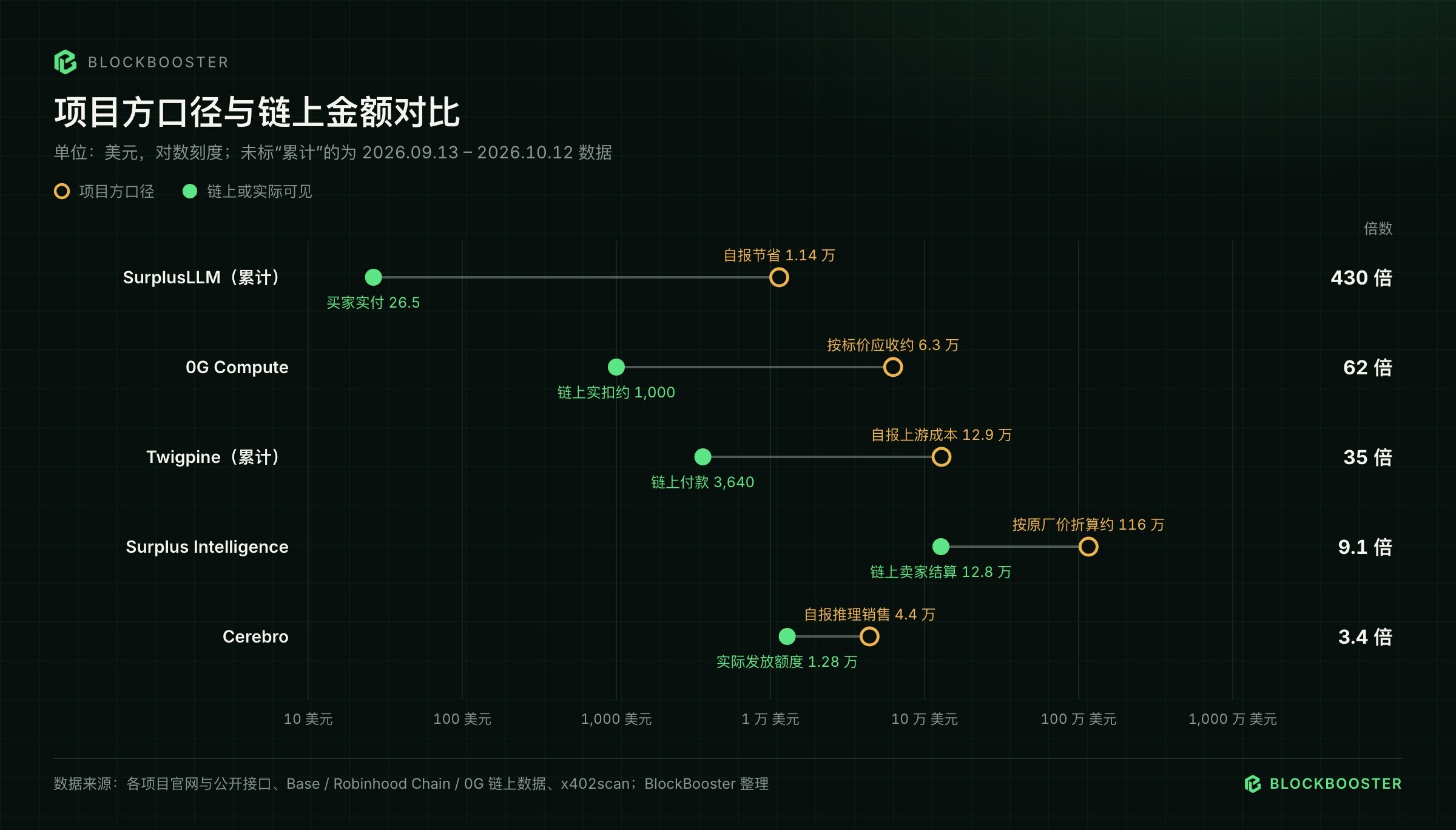
A few cases are particularly typical:
- Surplus Intelligence: processed 4.17 trillion tokens in 30 days, but paid sellers only $128,000 on-chain; 96% of buyer-side deposits came from the on/off-ramp wallet of Stripe-owned Bridge, i.e., USDC converted from fiat.
- AntSeed: cumulative on-chain settlement of $312,000, of which about 68% came from wash-trading sellers it itself excluded in its reward rules; weekly settlement fell from about $22,000 in July to $4,000–$5,000 in October.
- Cluster Protocol: of $54,800 in x402 revenue over 30 days, model conversations accounted for only $152; 722 wallets called a fixed combination every day and all stopped simultaneously on October 2, while its token disclosure listed wallets that had used x402 as eligible for the airdrop.
- DGrid AI: the frequently cited "first-half revenue of $23 million" is membership pass sales; the gateway's on-chain top-ups over 30 days were about $16,000.
A project claiming it "processes hundreds of billions of tokens per day" could correspond to a few thousand dollars in monthly revenue, or to several million. When comparing such projects, actual revenue per million tokens is a more useful reference than total token count.
3. x402 Has Become the Standard, but Model Revenue Is Small
x402 is already the de facto standard for Agent payments, with the x402 Foundation counting around 40 members including Stripe, Visa, and Google, but large model calls account for a very small share of it.
Of the 32,498 x402 resources registered on Coinbase Bazaar, only 3% are related to large models; of roughly 940,000 calls in the past 30 days, large models accounted for 9%, of which 88% came from BlockRun alone. On x402scan, token-billed inference gateways received only about $3,800 in total over 30 days; the largest, BlockRun, handled 349,000 transactions for about $3,186, or less than 1 cent each.
On the demand side, of Venice's roughly $7.2 million in credit sales over 30 days, only about $3,100 was paid via x402, less than 0.05%.
Crypto payments on centralized platforms are also declining. Based on on-chain addresses, OpenRouter's crypto payment share fell from about 5%–6% in mid-2025 to about 1.3%–2.2% in Q1 2026; on April 2, it discontinued programmatic crypto top-ups after upstream Coinbase Commerce shut down its Charge API. Based AI has shut down x402 and wallet top-ups, accepting only bank cards, and its x402 receiving address has received only about $1,122 cumulatively since March.
The primary way to pay for models today is still card payments and prepaid credits. x402 model call revenue is still very small, and its value depends more on whether scenarios for Agents to pay autonomously can take shape. Only if AI inference sellers on x402 can exceed $500,000 in monthly revenue and the largest seller's share falls below half would it show that Agents have begun paying for inference on their own at scale.
4. Credit Tokens Are Issued in Abundance but Rarely Used
Turning model credits into tokens was a relatively hot model this autumn, including staking for credits (Venice DIEM, NEAR AI, MOR), trading fees for credits (Orbio, Zevio, Cerebro), and directly issuing USD-denominated credit coins (Accred, Clank Uwu). But most of the credits issued have gone unused.
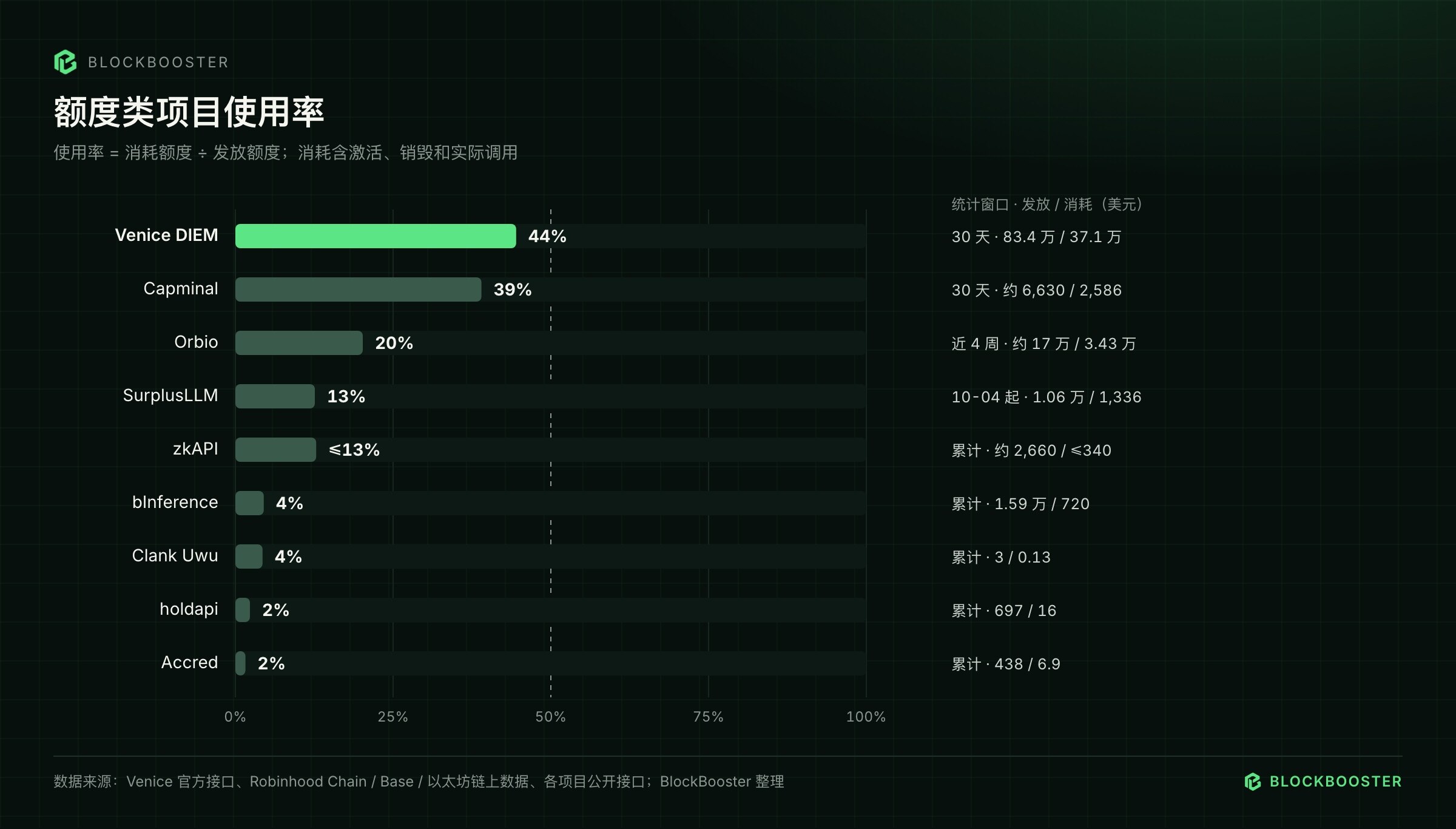
Venice DIEM is the only one with meaningful usage. Each staked DIEM provides $1 of credits per day, for a 30-day credit cap of about $834,000, of which $371,000 was actually used, a utilization rate of about 44%. Behind this is Venice's more than $7 million per month in paid business and users willing to pay for privacy.
Orbio is the largest "trading fees for credits" project on Robinhood Chain, and also the one whose hype faded fastest. It launched on August 31 via the token launch platform Pons, charging a 1.5% fee per transaction, half of which is converted into the credit token CREDIT and distributed to stakers, with 1 CREDIT redeemable for $1 of model usage.
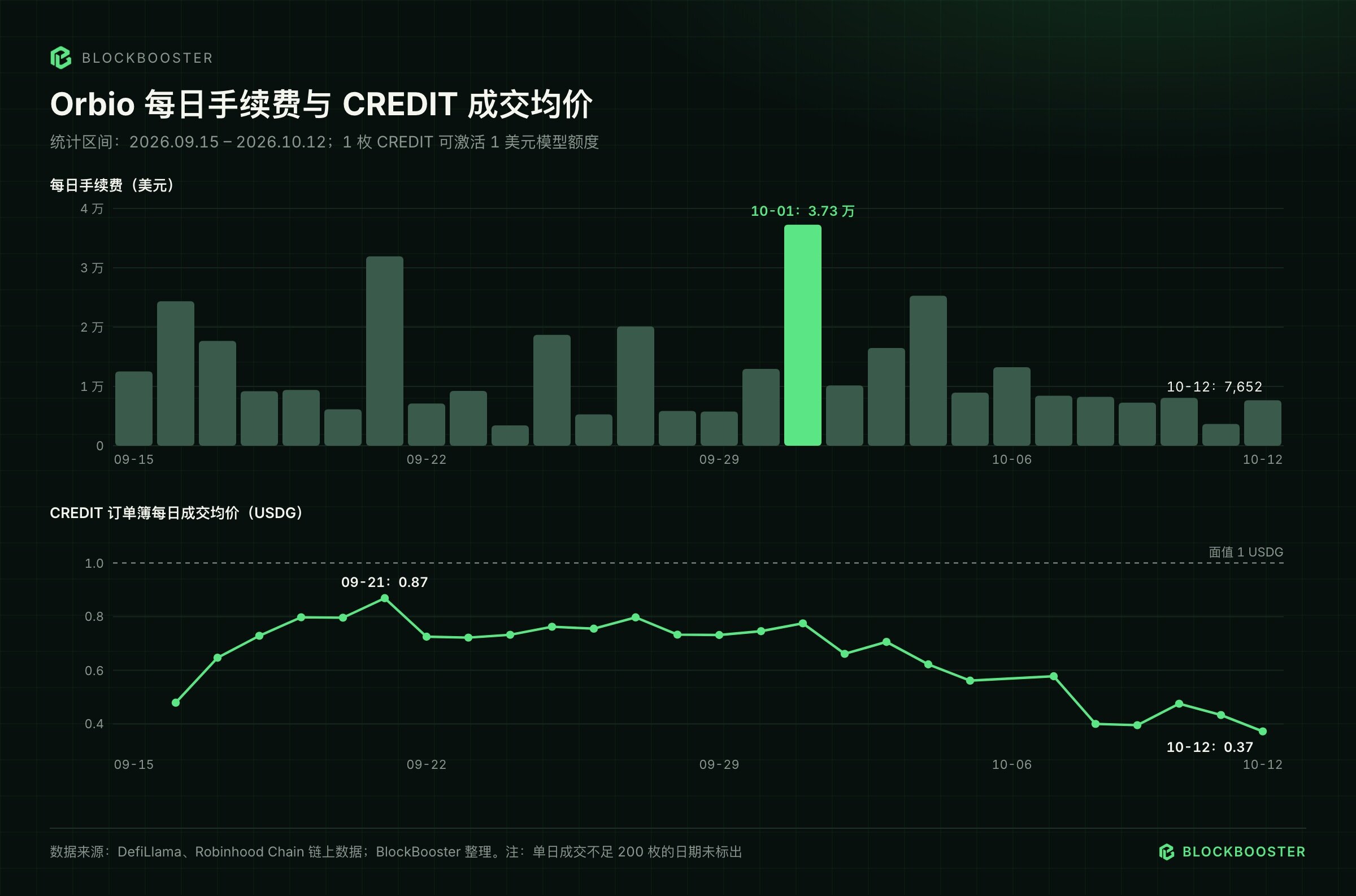
According to DefiLlama data, Orbio collected about $342,000 in fees from September 16 to October 12, of which about $170,000 was converted into credits; daily fees fell from about $37,000 on October 1 to $7,652 on October 12. Over the past 4 weeks, only about 34,300 CREDIT were activated on-chain, of which about 15,000 came from card users on the official website, activated on their behalf by Orbio's operating wallet, and about 19,000 came from roughly 480 wallets.
The CREDIT secondary market is dominated by arbitrage trading. The order book saw 236,500 CREDIT traded over 30 days, with the weekly average price falling from 0.82 USDG to 0.42; the top 5 buyers by volume were all arbitrage contracts, accounting for 80% of buyer volume, and not a single CREDIT they received was activated—all were moved to Uniswap v4 and cashed out.
Other credit coins have seen even worse usage. SurplusLLM issued $10,600 in credits and activated 1,336; holdapi issued 697 and used 16; Accred minted 438 and used 6.9. Among the 6 credit coins on Robinhood Chain with trading pools other than Orbio, their combined market cap is only 3% of Orbio's, and they include counterfeit contracts such as fake Zevio and fake c0mpute ZERO, some of whose pools are deeper than the genuine ones.
Based on these projects, whether a credit token can sustain depends on three things: whether the credits come from external revenue rather than trading fees or emissions of the project's own token; whether the credits are actually consumed; and whether fees can hold up after trading activity declines. Currently only Venice DIEM comes close to meeting these conditions.
5. Decentralized Inference Relies on Subsidies, and Orders Come from OpenRouter
Decentralized inference is the most numerous category on the map, but most customers come from OpenRouter. Based on OpenRouter's publicly disclosed daily supply-side data, seven providers—Phala, AkashML, Darkbloom, io.net, Prime Intellect, NEAR AI, and Chutes—sold about 4.34 trillion tokens through it over 30 days, generating about $760,000 in user payments. In August, 98% of AkashML's usage and about 95% of Darkbloom's usage came from OpenRouter.
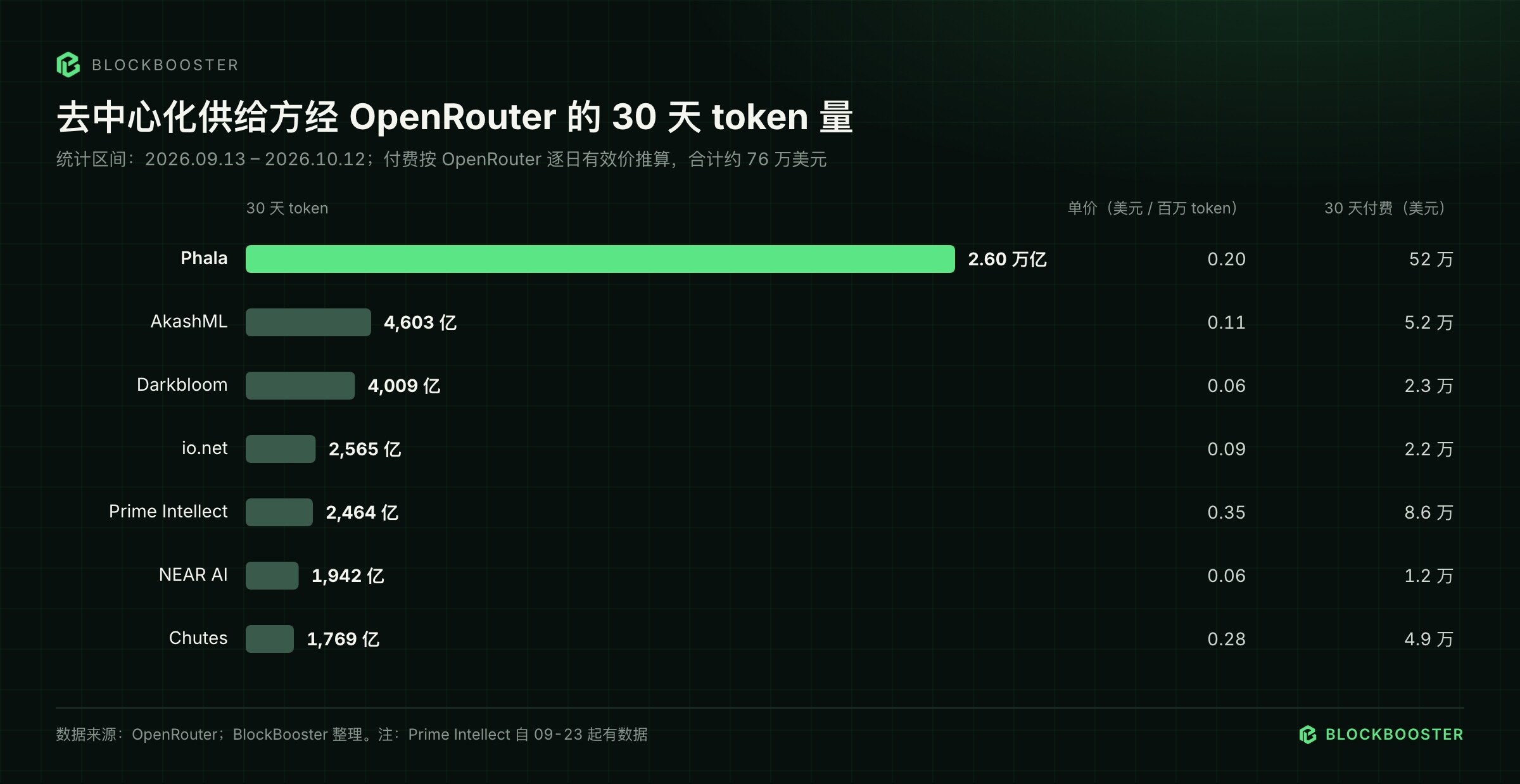
These networks' low prices are mainly sustained by token subsidies. Chutes (Bittensor SN64) saw its daily average tokens fall from about 107.8 billion in January to about 19.6 billion in early October; the subnet receives about 318 TAO (about $88,000) in emissions per day, roughly 12 times its list-price revenue. Gonka billed 2.07 trillion tokens on-chain but settled only about $4,475, just 0.3% of emissions over the same period. Some inference projects from the previous cycle have abandoned inference APIs and pivoted to GPU rental, such as Hyperbolic.
TEE is one of the few differentiated directions in this category. Phala, the decentralized provider with the largest usage through OpenRouter, offers inference running inside TEEs, which can prove that operators cannot see users' prompts—something centralized platforms find hard to replicate. Still, this direction is early: of NEAR AI Cloud's 58 models, only 9 have their own TEE; Telegram's COCOON usage peaked in March and had stopped by September.
Until the ratio of emissions to customer revenue falls below 10x, usage data from these networks should be discounted.
Conclusion
Judging from the books of 130 projects, revenue is mainly concentrated in platforms that control model supply or user entry points. Many gateways on the map merely wrap OpenRouter's and Venice's APIs into crypto payments, marking up 4% to 30%, and once usage grows they are easily displaced by upstream providers. Users are willing to pay more mainly for privacy and freedom from censorship: Venice's closed-source models are more expensive than official rates and users still pay; meanwhile OpenRouter's crypto payment share is declining, and 80% of Surplus's deposits come from fiat. Networks relying on token subsidies show huge token numbers, but usage falls back as subsidies shrink—Chutes' daily average usage has dropped from about 107.8 billion to about 19.6 billion this year.
Project turnover in this space is also fast. The crypto AI model call market does exist, but currently verifiable payments are less than $9 million per month, far from the token scale published by the projects.
Data notes: The statistical window is September 13 to October 12, 2026, with data read on October 13–15. The "about $8.7 million" is the sum of three parts: on-chain verifiable receipts, burns, buybacks, credit activations, and x402 settlements; estimates derived from OpenRouter supply-side daily tokens multiplied by effective prices; and settlement documents publicly disclosed by projects. It excludes OpenRouter itself, credit consumption such as DIEM, and self-reported-only figures, and overlapping portions between resale gateways and upstream providers are counted only once. Off-chain card payment revenue is not visible, and figures through OpenRouter are only a lower bound for the corresponding projects' usage.
This article is compiled from public data and does not constitute investment advice. Judgments about wash trading, subsidies, and reporting standards may have explanations we are not aware of, and we welcome projects to provide more complete data.





