


SpaceX Q3 2026 Earnings: Superintelligence Business Now Accounts for Over Half of Revenue, Capex Remains in Focus


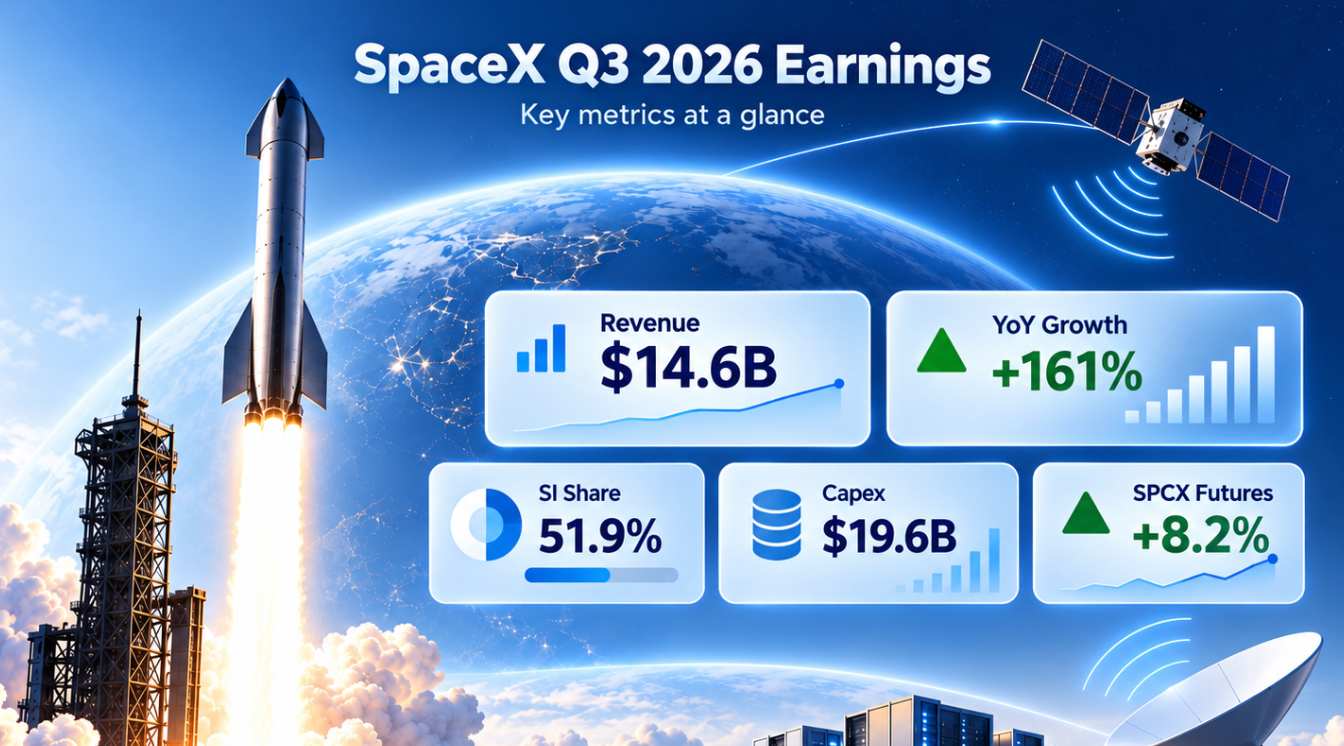
- Key Takeaways: SpaceX's Q3 2026 revenue reached $14.575 billion, up 161% year-over-year. The AI Superintelligence (SI) business contributed more than half of revenue for the first time and turned profitable, marking a fundamental shift in the company's business structure as market attention turns to the sustainability of profitability under heavy capital investment.
- Key Details:
- SI business revenue was $7.56 billion, accounting for 51.9% of total revenue, up 195% quarter-over-quarter; operating profit was $431 million, a reversal from a $1.26 billion loss in Q2.
- Group capital expenditure was $19.593 billion, exceeding revenue for the same period; SI capex was $16.444 billion, approximately 2.18 times its revenue, with compute capacity expanding to 1.7 gigawatts.
- Connectivity business revenue was $5.248 billion, up 69% year-over-year, with operating profit of $2.367 billion, remaining the most stable source of profit; the space business was near break-even.
- Starlink subscriptions reached 13.6 million, up 1.6 million in the quarter; ARPU rose 5% quarter-over-quarter to $69, but remained below $83 in the same period last year.
- Net profit of $4.404 billion exceeded operating profit of $2.791 billion, with the difference mainly from interest income of $873 million, other gains of $1.025 billion, and income tax benefit of $390 million.
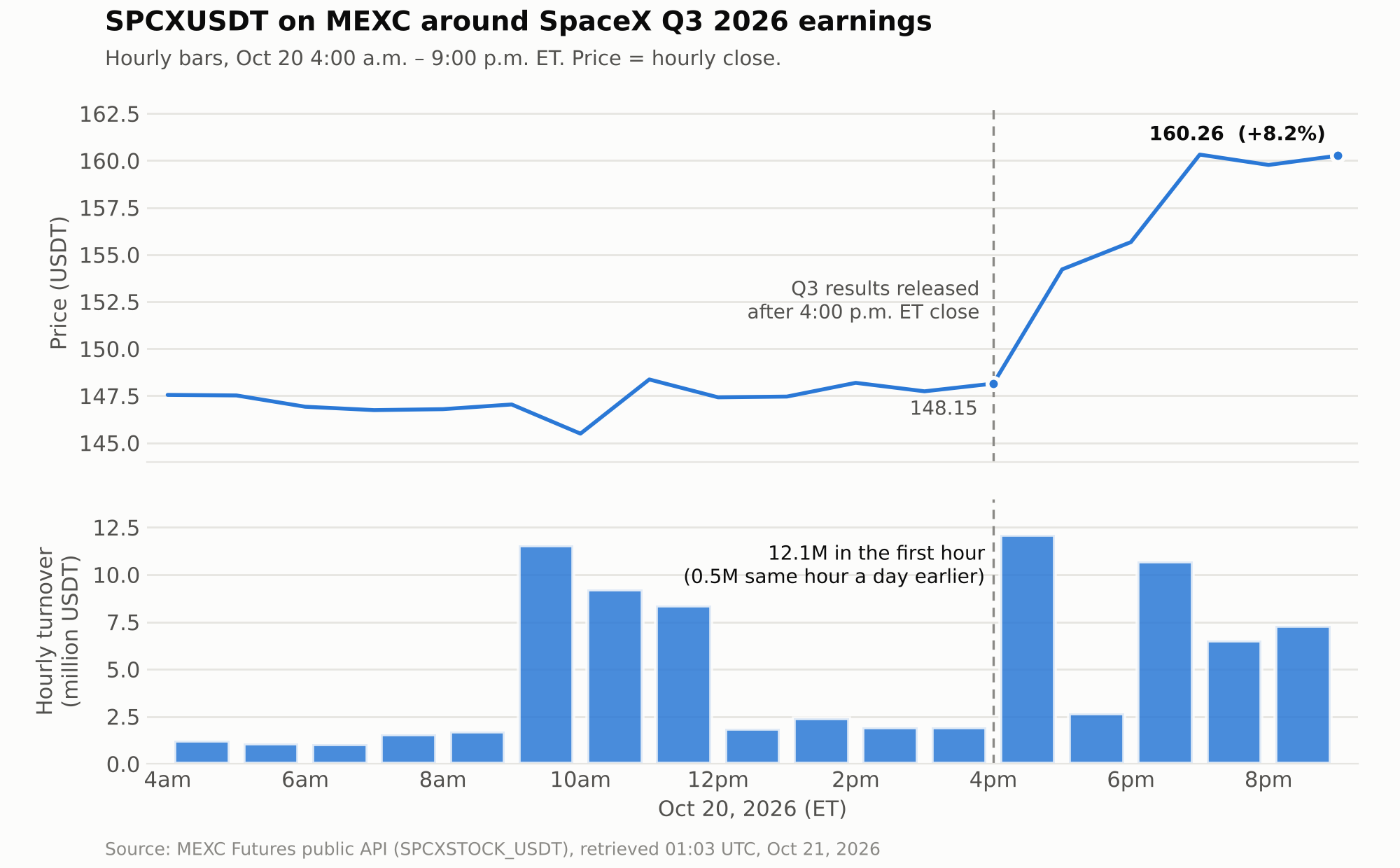
- MEXC's SPCXUSDT rose about 8.2% in the five hours after earnings, with first-hour trading volume 23 times that of the same period the previous day; the first funding rate settlement was 0%, with no leverage premium observed.
According to SpaceX's Q3 2026 financial report filed with the SEC, the company (Nasdaq: SPCX) reported quarterly revenue of $14.575 billion, up 161% year-over-year, and net income of $4.404 billion. More noteworthy is the shift in business structure: what was previously disclosed under the name of its artificial intelligence business, the Super Intelligence (SI) business, now contributes more than half of the group's revenue.
Key Takeaways
- SI revenue: $7.56 billion, accounting for approximately 51.9% of total revenue, up 195% quarter-over-quarter. Cursor, whose acquisition closed on August 14, contributed $608 million in group revenue during the consolidation period.
- SI profitability: operating income was $431 million, a turnaround from an operating loss of $1.26 billion in the second quarter, including approximately $1.2 billion in share-based compensation expenses related to Cursor.
- Capex: SI capex reached $16.444 billion, approximately 2.18 times the segment's revenue; group capex was $19.593 billion, exceeding group revenue for the same period.
- Starlink: consumer subscribers reached 13.6 million, up 1.6 million in the quarter; monthly average revenue per user (ARPU) rose 5% quarter-over-quarter to $69, but remained below the $83 reported in the same period last year.
- MEXC market reaction: SPCXUSDT rose from 148.15 USDT to 160.26 USDT within five hours, first-hour turnover was approximately 23 times that of the same period the previous day, and the first funding rate settlement after the earnings release was 0%.
Where Does SpaceX's Profit Come From?
SpaceX's operating income for the quarter was $2.791 billion, while net income reached $4.404 billion, meaning that line items below operating income further boosted the final profit. These included $873 million in interest income, $1.025 billion in net other income, and $390 million in income tax benefit, partially offset by $675 million in interest expense.
Connectivity remains the most stable source of profit, with quarterly revenue of $5.248 billion, up 69% year-over-year, and operating income of $2.367 billion, up 99% year-over-year.
The Space business is near break-even, with quarterly revenue of $1.767 billion and an operating loss of $7 million, amid increased Starship R&D spending during the period. In the quarter, SpaceX also completed its first revenue-generating Starship mission.
AI Business Growth Has Shifted What Investors Need to Watch
The SI business has achieved $431 million in operating income. The key question going forward is whether profitability can continue to grow as infrastructure investment expands. As of September 30, nominal compute infrastructure capacity increased from 1.4 gigawatts at the end of June to 1.7 gigawatts, and SI capex has exceeded $15 billion for two consecutive quarters.
The capex-to-revenue ratio reflects investment intensity; it is not equivalent to cash burn, nor does it directly measure the returns these assets can ultimately generate. The cash flow statement provides a more complete picture: in the first nine months of the year, the company's operating cash flow was $13.097 billion, while purchases of property and equipment totaled $48.069 billion.
Currently, this funding gap is supported by cash reserves on the balance sheet. After raising $85.675 billion in net IPO proceeds, as of September 30, the company held $51.294 billion in cash and $38.561 billion in marketable securities.
Starlink offers another dimension to watch: subscriber growth accompanied by sequential ARPU improvement reflects operating performance better than subscriber growth alone. However, ARPU remains significantly below the same period last year, and it will be important to watch in coming quarters whether this sequential improvement can be sustained as the user base expands.
How Did the SPCX Contract on MEXC React?
Data snapshot: Data from MEXC, covering SPCXSTOCK_USDT hourly candlesticks, index price candlesticks, and funding rate history, extracted at 01:03 UTC on October 21, 2026. Data at later points in time may differ.
The observation window begins with the hourly candlestick starting at 4:00 PM Eastern Time on October 20 (20:00 UTC), the market close. The earnings report was released within that hour, ahead of the earnings call that began at 4:30 PM Eastern Time.
Price Performance
SPCXUSDT rose from 148.15 USDT at the close to 160.26 USDT at 9:00 PM Eastern Time, a gain of approximately 8.2%. Over the same period, the contract's index price rose approximately 8.4%.
Trading Activity
First-hour turnover after the close was approximately 12.09 million USDT, compared with approximately 530,000 USDT in the same hour the previous day, and an average hourly turnover of approximately 2.1 million USDT over the prior 24 hours.
Within the five-hour observation window after the earnings release, cumulative turnover was approximately 39.27 million USDT, roughly comparable to the 37.27 million USDT recorded between 9:00 AM and 4:00 PM Eastern Time that day. The latter period covers the regular U.S. stock trading session and includes the half hour before the open.
This method compares the event window with the same period the previous day, avoiding attributing the entire rolling 24-hour turnover to the earnings release.
Premium/Discount Relative to the Index
During the U.S. stock trading session before the earnings release, the contract traded at a premium of approximately 5 to 12 basis points to the index price; after the release, it traded at a slight discount of up to approximately 10 basis points.
In other words, in terms of pricing relative to the index, this rally mainly tracked changes in the reference price rather than manifesting as a premium行情 in which leveraged buying pushed the contract above the index price.
Funding Rate
SPCXUSDT settles funding every eight hours. The last settlement before the earnings release occurred at 16:00 UTC, with a funding rate of 0.0182%; the first settlement after the release occurred at 00:00 UTC on October 21, with a funding rate of 0%.
For these two settlements, the post-earnings price increase was not accompanied by an increased funding cost burden on longs. A positive funding rate typically means longs pay shorts; it reflects the cost of holding positions, not the ratio of bullish to bearish traders.
Tracking SPCX Market Performance via MEXC
The SPCXUSDT perpetual contract on MEXC provides an independent derivatives market that can be used to observe trading reactions before and after earnings. Analysis should combine price changes, funding rates, trading activity, and premium/discount relative to the index, rather than concluding that demand is sustainable based solely on a rise in the contract price.
For eligible users who wish to hold the stock, MEXC Real Stocks offers another product path. Specific service availability and supported securities should be based on the platform's actual information.
FAQ
How much of SpaceX's revenue comes from the AI business?
Based on calculations from the company's disclosed data, SpaceX's AI business—the Super Intelligence business—contributed $7.56 billion in revenue in Q3 2026, approximately 51.9% of total revenue.
Is SpaceX's SI business profitable?
On a quarterly operating income basis, it is now profitable. The SI business recorded $431 million in operating income in Q3 2026, compared with an operating loss of $1.26 billion in the second quarter.
How did the SPCX contract on MEXC react to the Q3 earnings report?
Within five hours after the U.S. market close on October 20, SPCXUSDT rose approximately 8.2%, broadly in line with its index price movement. First-hour turnover was approximately 23 times that of the same period the previous day, and the first funding rate settlement after the earnings release was 0%.
Does buying SPCXUSDT mean holding SpaceX stock?
No. SPCXUSDT is a perpetual derivative and, unlike holding common stock, carries no shareholder rights.
Does a positive funding rate mean there are more bullish traders?
No. A positive funding rate typically means longs pay shorts. It reflects the cost of holding positions, not a headcount of bullish versus bearish investors.





