






JST's Fifth Buyback and Burn Successfully Concludes: Over 170 Million Tokens Burned This Round, Worth Approximately $23.53 Million; Buyback Mechanism Poised for Comprehensive Upgrade


- Core Viewpoint: The JUST ecosystem has completed JST's fifth buyback and burn, marking the conclusion of the first phase. Five consecutive rounds of burning within a year—cumulatively exceeding 1.881 billion tokens, with a deflation rate of over 19% and over $100 million in real revenue deployed—have validated a long-term deflationary mechanism driven by genuine ecosystem revenue.
- Key Elements:
- The fifth burn destroyed 170 million JST (1.72% of total supply), worth approximately $23.53 million, with all funds sourced from JustLend DAO's net operating revenue.
- Five consecutive quarterly burns from October 2025 to October 2026, with no delays or interruptions, deploying over $100 million in real capital cumulatively, with most individual rounds in the $20 million range.
- JST's total supply has decreased from 9.9 billion to approximately 8.02 billion tokens, with cumulative burns of 1.881 billion tokens and a deflation rate exceeding 19%.
- Since the mechanism's launch, JST's price has risen from approximately $0.03 to a high of $0.142, representing an annual increase of over 300%, with circulating market capitalization surpassing $1 billion.
- The $59 million in existing revenue extracted at the initial launch has been fully deployed as planned, formally concluding the first phase.
- The mechanism is about to be upgraded, with funding sources set to expand to ecosystem business revenues such as GasFree, making the capital structure more diversified.
On October 17, JUST, a leading DeFi infrastructure project in the TRON ecosystem, announced that it has completed its fifth large-scale buyback and burn of its ecosystem-native token JST as scheduled. A total of over 170 million JST was burned this time, accounting for approximately 1.72% of the total token supply, with an estimated value of nearly $23.53 million. Consistent with the previous four rounds, all funds this time again came from the real operating net revenue of JustLend DAO, the core protocol of the JUST ecosystem.
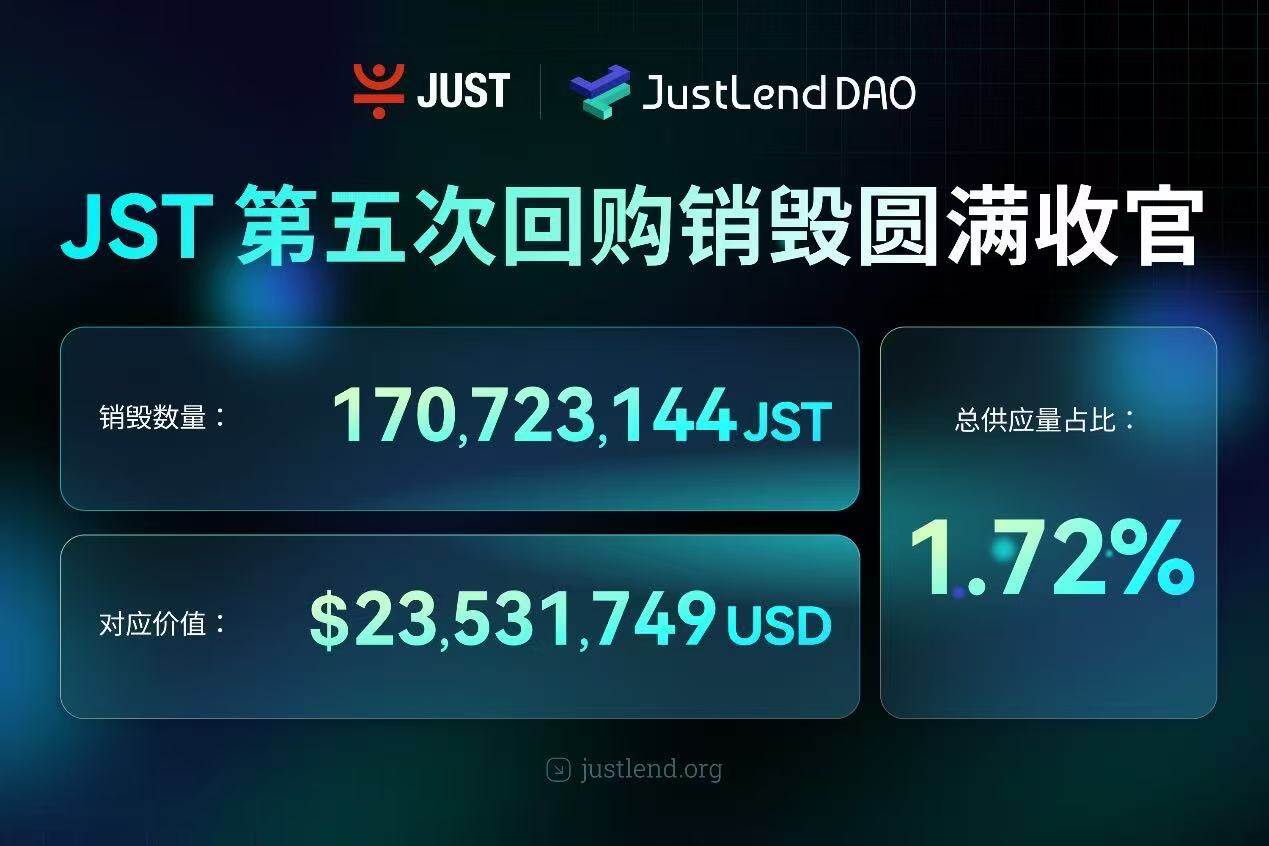
Looking at a longer time horizon, with the fifth burn completed, JST has executed buyback and burn for five consecutive quarters since October 2025, with each round involving tens of millions of dollars and each completed on schedule without any delay.
In terms of cumulative results, to date, the five JST buyback and burn rounds have burned over 1.881 billion JST in total, with a cumulative deflation rate exceeding 19% and over $100 million in real buyback funds deployed. Based on the October 10 high of $0.142 per JST, the total market value of the permanently burned tokens exceeds $267 million.
Within a year, five consecutive buyback and burn rounds of tens of millions of dollars each were carried out without interruption or reduction in amount, which directly confirms the strong and sustainable profitability of the JUST ecosystem and means that this long-term value-reward mechanism for the community is being continuously delivered in a verifiable and traceable manner.
With the fifth buyback and burn completed, JST has also reached a milestone: the remaining 70% of the stock revenue extracted from the JustLend DAO ecosystem, as planned at the launch of the buyback and burn mechanism, has now been fully deployed into buyback and burn. This marks the full completion of the first phase of JST buyback and burn, and the mechanism will now enter a new upgrade phase.
JST's Fifth Buyback and Burn Successfully Completed: Over 170 Million Tokens Burned, Funds Valued at Over $23.53 Million
According to the official "Announcement on the Completion of the Fifth JST Token Buyback and Burn," the fifth JST buyback and burn has been successfully completed. As the regular buyback for Q3 2026, a total of 170,723,144 JST (approximately 170 million) was burned this time, accounting for approximately 1.72% of the total token supply, with an estimated value of over $23.53 million.
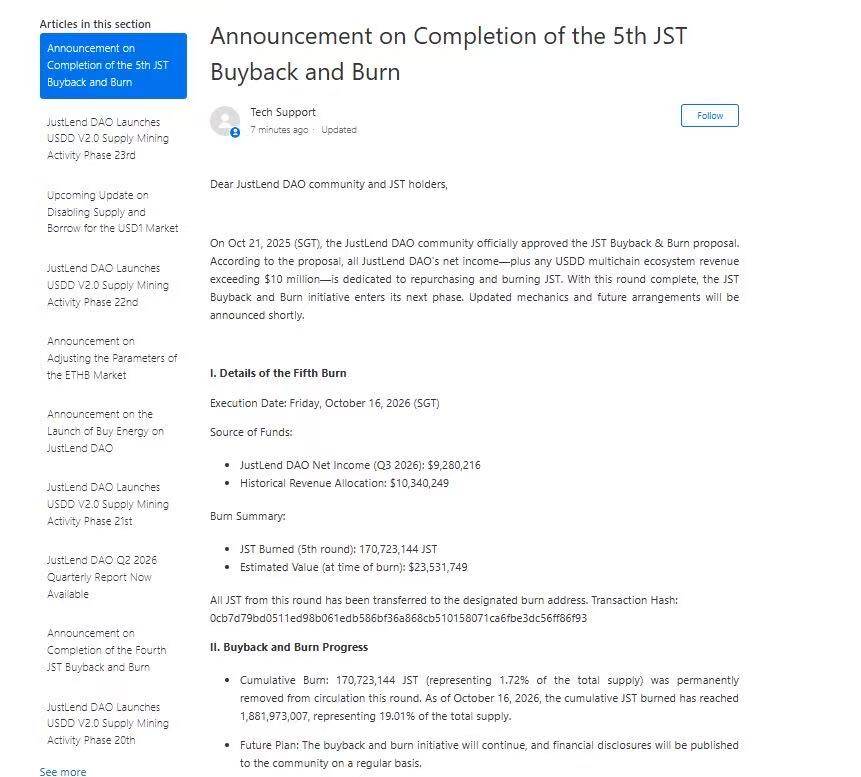
In terms of burn scale and capital deployment, this round is essentially comparable to the previous four regular quarterly levels, continuing the stable and predictable execution rhythm of JST buyback and burn.
Looking further at the funding sources, all funds for this buyback and burn came from the operating net revenue of the JustLend DAO platform, specifically consisting of two parts: the final batch of stock revenue from JustLend DAO of $10.34 million, and $9.28 million in newly added net revenue from Q3.
In terms of quarterly revenue performance, JustLend DAO's newly added net revenue in Q3 reached $9.28 million, essentially flat with previous quarters, with quarterly net revenue steadily maintained at the tens of millions of dollars level, and the ecosystem's revenue fundamentals remaining solid.
At the same time, the remaining 70% of the stock revenue extracted from JustLend DAO at the launch of JST buyback and burn has also been fully deployed with this buyback and burn. This detail not only clearly presents the funding composition of this round but also means that the use of the early-planned stock revenue has officially concluded, and the JST buyback and burn mechanism is about to undergo a comprehensive upgrade.
At the operational level, this buyback and burn continues to follow the principle of openness and transparency, with all operations completed on-chain. The burn address has been made public, and information such as burn quantity and transaction hashes can be verified and traced at any time through the TRONSCAN blockchain explorer. All burned JST has been transferred to a publicly verifiable black hole address, completely removed from circulation, with no possibility of flowing back into the market.
From a market and ecosystem perspective, with this completion, JST has once again deployed over $20 million, with approximately 170 million JST permanently removed from circulation. This not only directly compresses JST's token supply but, with continuous deployment of real ecosystem revenue into burning, once again confirms that the JUST ecosystem possesses solid and sustainable profitability, and with sustained real-money investment, once again confirms the JUST ecosystem's solid and sustainable profitability.
More significantly, the completion of the fifth burn represents the full completion of the first annual execution cycle of the JST buyback and burn mechanism. A year ago, it was a newly launched ecosystem reward program; a year later, after five rounds of market validation, it has evolved into a normalized institution, executed on schedule every quarter and continuously delivering on its promises with real ecosystem revenue. This stable and predictable commitment is gradually becoming a shared expectation among community users every quarter.
Five Consecutive Buyback and Burn Rounds Completed Within a Year: Over $100 Million in Cumulative JustLend DAO Revenue Deployed, JST Up Over 300% Year-to-Date
From the mechanism's launch in October 2025 to the completion of the fifth buyback and burn on October 16, 2026, the JST buyback and burn mechanism has been running for a full year. Within a year, JST completed five consecutive rounds of large-scale buyback and burn in the tens of millions of dollars, all executed on schedule each quarter without delay or interruption. Across the five rounds combined, JST has burned approximately 1.881 billion tokens in total, with a cumulative deflation rate exceeding 19% and over $100 million in real buyback funds deployed, primarily from JustLend DAO's real operating revenue.
With each successive buyback being carried out in an orderly manner, JST's circulating supply has been continuously compressed, the deflationary effect has been accumulating, and the JUST ecosystem's long-term value-reward mechanism for the community has been fully validated in market practice. At the same time, JST's price has formed a positive resonance with the buyback and burn mechanism: its year-to-date gain has exceeded 300%, and its circulating market cap has surpassed $1 billion, successfully ranking among the top 70 cryptocurrencies globally by market cap.
The execution details of JST's five buyback and burn rounds are as follows:
• First round (October 19, 2025): approximately 559 million JST burned, accounting for 5.66% of total supply, corresponding to approximately $17.72 million;
• Second round (January 14, 2026): approximately 525 million JST burned, accounting for 5.30% of total supply, corresponding to approximately $21 million;
• Third round (April 15, 2026): approximately 271 million JST burned, accounting for 2.74% of total supply, corresponding to approximately $21.3 million;
• Fourth round (July 17, 2026): approximately 355 million JST burned in total, accounting for 3.59% of total supply, corresponding to $34.59 million; on top of the regular quarterly buyback, this was the first time that USDJ historical stability fees were included as a dedicated burn fund (approximately $10.39 million);
• Fifth round (October 16, 2026): approximately 170 million JST burned, accounting for approximately 1.72% of total supply, corresponding to a value of approximately $23.53 million.
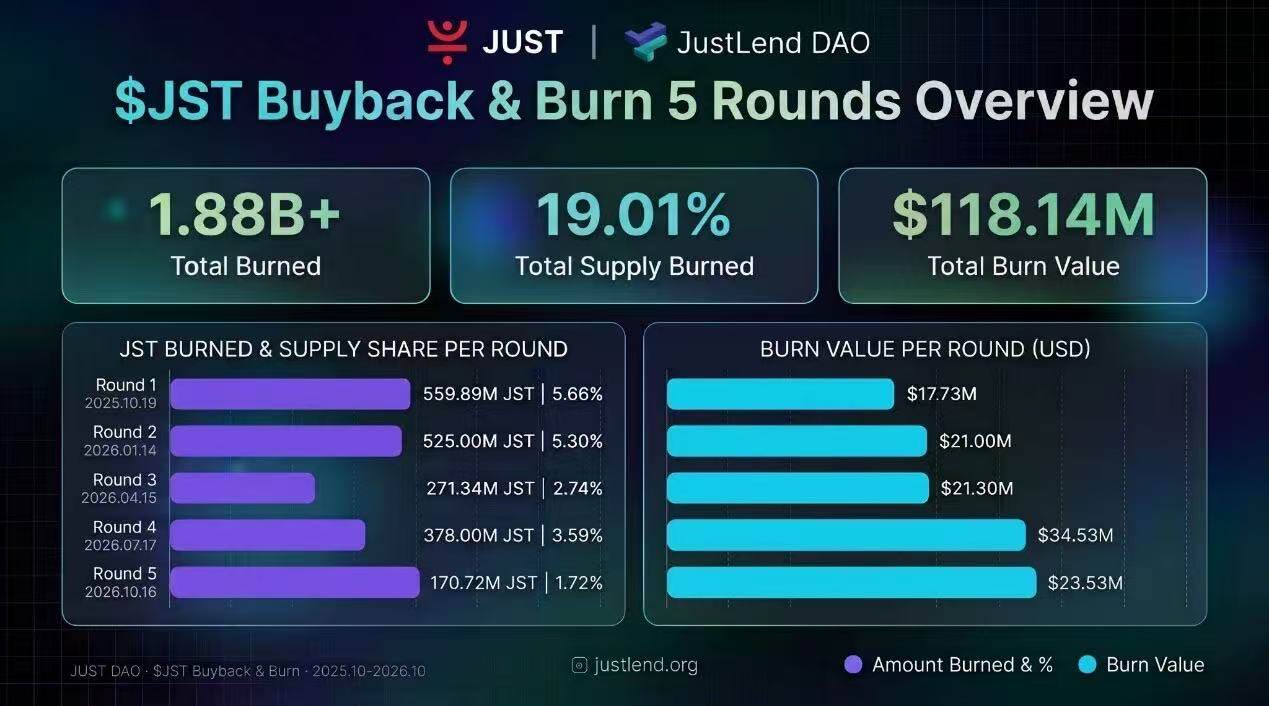
In terms of execution intensity, within a one-year cycle, JST completed five consecutive buyback and burn rounds, with each round mostly around $20 million, over $118 million in cumulative actual funds deployed, and a cumulative burn amount approaching one-fifth of total supply. Such execution frequency, intensity, and scale are rare among token buyback cases in the current DeFi industry.
Placed in an industry context, its scarcity becomes even clearer. According to data released by Allium Labs in August, since the start of 2026, sampled crypto projects have spent approximately $638 million in total on token buybacks, with the sample covering leading protocols such as Hyperliquid, pump.fun, ChainLink, Sky, and Jupiter.
Beyond the sampled projects, the JUST ecosystem's buyback and burn intensity remains prominent: as of October 16, within 2026 alone, JUST had deployed nearly $100 million in actual funds for JST buyback and burn; based on the recent high of $0.142 per token, the value of JST burned during the year has exceeded $190 million. It should be noted that the former is actual funds deployed, while the latter is token value converted at market price. Whichever measure is used, this volume is already on the same order of magnitude as these industry-leading protocols with the strongest buyback intensity.
A full year of stable execution has long since elevated the value of the JST buyback and burn mechanism beyond the short-term boost of a single burn. This mechanism is not an isolated market action but transmits layer by layer along the chain of "funding foundation—execution assurance—transparent trust—deflationary results—market feedback," building a solid long-term value support system.
On the funding foundation, JST buyback and burn relies on the endogenous cash generation of the JUST ecosystem's real business, laying a solid value foundation. In the five buyback and burn rounds completed to date, apart from the fourth round's additional dedicated burn of USDJ historical stability fees, all buyback funds came from JustLend DAO's real operating revenue, with cumulative funds deployed exceeding $100 million, including both the platform's previously accumulated stock revenue and the newly added operating profit each subsequent quarter. This means that buyback and burn has been built from the very beginning on the cash flow of sustainable real business rather than relying on short-term capital maneuvers or marketing hype, safeguarding the mechanism's endogeneity and sustainability from the source and constituting the cornerstone of the entire value system.
On execution assurance, sustained funding resilience and stable delivery of the execution rhythm together confirm the sustainability of the buyback and burn mechanism. In terms of funding resilience, the single-round buyback scale started at $17.72 million, then stabilized at around $20 million, and after the fourth round's additional USDJ dedicated burn, reached $34.59 million, a record high. In terms of execution rhythm, all five quarters landed on time, with no delay, interruption, or significant reduction in scale, and the mechanism has evolved from a "newly launched reward program" into a "normalized institution validated through multiple real-world operations." Real revenue and stable investment reinforce each other, jointly constituting the underlying foundation of the mechanism's sustainability—for crypto projects, this kind of credit accumulated through continuous delivery is far harder to build and far harder to replicate than any one-off boost.
On transparent trust, a publicly transparent trust foundation is established through a fully verifiable execution chain. Each JST buyback follows the three-step standard of "rules disclosed in advance, execution completed on schedule, results verifiable on-chain," with all tokens ultimately transferred to a publicly verifiable black hole address, and transaction records permanently on-chain and immutable. Compared with the phenomenon in some industry projects of "verbal buybacks not delivered" and "loud announcements when the market is good, quiet suspension when the market is bad," JST's fully transparent execution chain provides a reference sample for token value management in the DeFi industry.
On deflationary results, the continuous deflation of the token supply structure enhances JST's scarcity. After five cumulative buyback and burn rounds over a year, JST's total supply has dropped from 9.9 billion to approximately 8.02 billion, with nearly 1.881 billion tokens permanently removed from circulation, accounting for nearly 19% of total supply. For holders, this means that even without acquiring any additional tokens, their ownership share is passively increasing—the logic is exactly the same as a listed company buying back and canceling shares with net profit.
Ultimately, the simultaneous strengthening of JST's price and market cap validates the effectiveness of the buyback and burn mechanism through real market feedback. According to CoinGecko data, since the official buyback and burn mechanism launched in October 2025, JST has bucked the broader market downtrend and moved independently, with its price steadily climbing from a low of approximately $0.03 at launch to a high of $0.142 before this buyback and burn (October 10), achieving a year-to-date gain of over 300% and hitting a new high since 2022; its circulating market cap has also grown in tandem from $300 million at launch and surpassed the $1 billion mark this month.
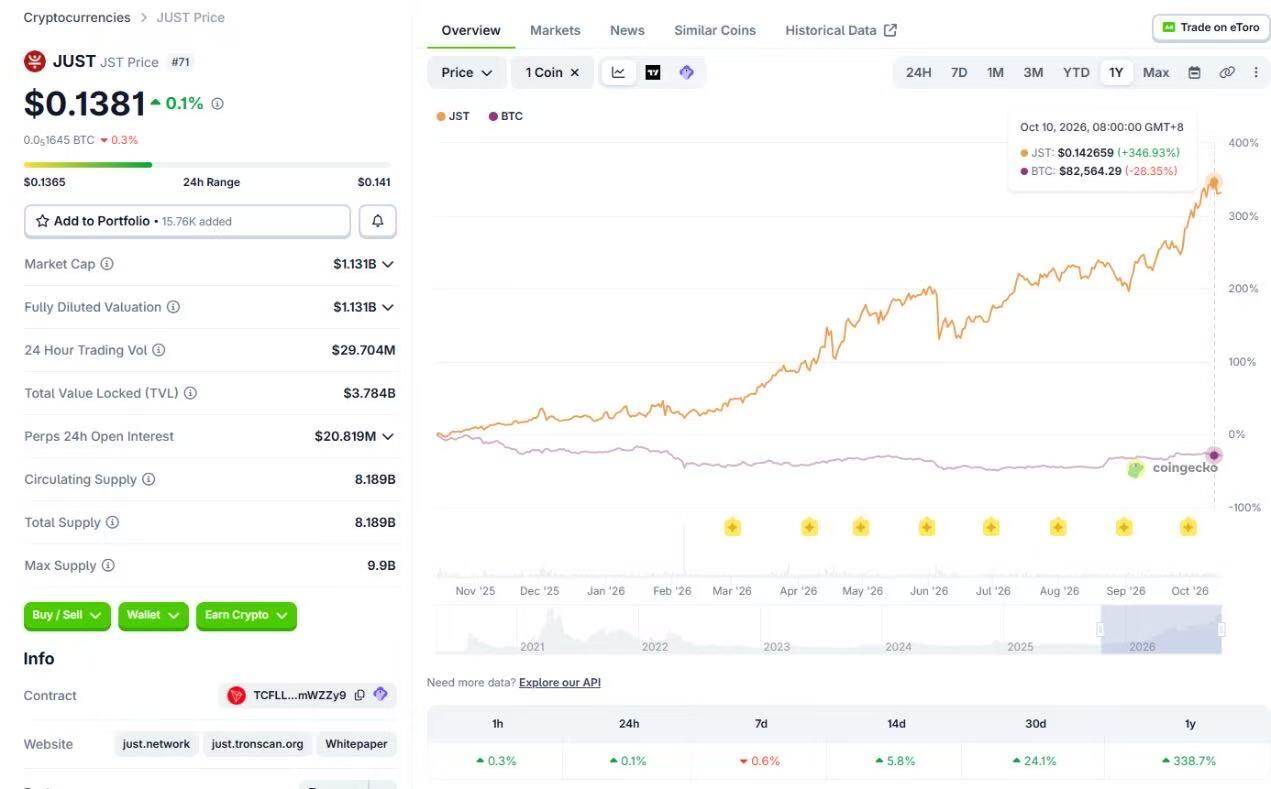
In summary, it is precisely this complete closed loop—driven by real ecosystem revenue, built on stable quarterly execution, trusted through an on-chain transparent burn mechanism, enhanced by the deflationary effect of supply contraction, and ultimately validated by market performance—that has allowed the JST buyback and burn mechanism to break out of the old paradigm of one-off boosts and truly grow into the core pillar supporting JST's long-term value.
JST Buyback and Burn Set for Comprehensive Upgrade, with More Diversified Funding Sources
With the completion of five consecutive buyback and burn rounds, the JST buyback mechanism has also reached an important juncture: the first phase has been successfully completed, and it is about to enter a brand-new upgrade phase.
Looking back at the initial launch, the funding sources for JST buyback and burn were originally planned to be jointly supported by two business lines, JustLend DAO and USDD. According to the established rules, USDD's incremental revenue would only join the buyback funding pool after its multi-chain ecosystem revenue reached $10 million; as of now, that condition has not yet been met. Therefore, in the first phase, the funding was in practice mainly based on JustLend DAO's previously accumulated stock revenue and newly added net revenue each quarter. Among this, the over $59 million in stock revenue extracted at launch was deployed in stages according to the plan of "30% for the first burn, 70% burned in batches." After five consecutive executions, this portion of stock revenue has been fully burned, the initial target has been smoothly achieved, and the mechanism has thus completed a smooth transition from launch to normalized operation.
As early as the "JST 2026 Q1 Financial Quarterly Report" released in April this year, the JUST ecosystem had already outlined the direction for the next upgrade: after the phased stock revenue burn plan is fully executed, the JST deflation mechanism will officially upgrade to a brand-new phase. At that time, JUST will carry out a systematic upgrade on the basis of the existing mechanism, broaden the buyback funding sources, and add revenue from businesses such as GasFree, providing more ample and more diversified funding support for JST buybacks.
More importantly, this upgrade path is not merely at the planning stage; actual moves have already been implemented first. In the fourth buyback and burn, USDJ historical stability fees were included as a buyback funding source for the first time. Meanwhile, the "JST Q2 Financial Quarterly Report" released in July also mentioned that in the future JUST will continue to deploy ecosystem revenue for JST buyback and burn in light of the operating performance of GasFree and other ecosystem businesses.
These pieces of information collectively point to a clear trend: the new JST buyback and burn mechanism will further expand funding sources, with more business lines such as GasFree expected to be gradually connected, and the overall funding structure becoming more diversified.
Now, with the successful completion of JST's fifth buyback and burn, the official announcement has clearly stated that the JST buyback and burn mechanism is about to undergo a comprehensive upgrade and adjustment. For specific details of the upgraded mechanism, such as funding sources, execution rhythm, and ecosystem synergy, please follow the official JUST X account @JUST DAO for the latest information.
The completion of the first phase of JST buyback and burn is not an endpoint but a new starting point for the next phase. Over the past year, the JST buyback and burn mechanism has gone from a paper plan to five real-world executions, forging a path of continuous delivery and continuous validation: from the orderly release of JustLend DAO stock revenue to the eventual cumulative burn of approximately 1.881 billion JST and a cumulative deflation rate exceeding 19%—every step has been paving the way for the mechanism's long-term stable operation. As the mechanism is about to enter a brand-new upgrade phase, JST's long-term deflationary effect and value-reward capability are also expected to open a more sustainable and more predictable new cycle.





