Justin Sun Establishes the "Justin Sun Prize": My Wealth Comes from Mathematics, and Will Return to Mathematics


- Core Viewpoint: Justin Sun has established the "Justin Sun Prize," the world's first zero-trust, decentralized academic bounty mechanism based on a problem list, with machine formal verification as the sole criterion for awarding prizes. The maximum prize for a single problem is $1 million, aiming to reshape the scientific incentive paradigm in the AI era.
- Key Elements:
- The first batch of winners covers 66 mathematical problems. The top prize was awarded to the OpenAI team for solving the "existence and smoothness of the three-dimensional Navier–Stokes equations," with proof that GPT-6 Astra completed the formalization and passed Lean verification.
- Reward rules: The first completer receives 70% of the total prize, and the formal verifier receives 30%. AI systems are also eligible for awards, but must have a natural person, legal entity, or authorized representative as the applicant and legal payee.
- The prize covers mathematical advances starting from January 1, 2026. The problem list is permanently locked and can only be expanded, never reduced; prizes are paid out and never returned. Currently included are the formal verification of the Poincaré conjecture, the Riemann hypothesis, the Goldbach conjecture, and Erdős's unsolved problems.
- Adhering to the principles of openness, public benefit, and open source: no restrictions based on nationality, institution, or identity, and no distinction between humans and AI. The problem list, proofs, and verification materials are made public via GitHub, and prize disbursement records are stored on-chain.
- Justin Sun stated that his philanthropic focus will shift entirely to this prize. He has previously donated nearly $45 million cumulatively in areas such as technology, environmental protection, and disaster relief.
On September 16, Justin Sun, founder of TRON, officially announced the establishment of the "Justin Sun Prize." This is the world's first zero-trust, decentralized academic bounty mechanism based on a "problem list," with major breakthroughs in fundamental disciplines and machine formal verification as the sole criteria for awarding prizes, with a maximum single-problem prize of up to $1 million. The establishment of this prize not only fills the historical gap left by the Nobel Prize's lack of a mathematics award for over a century, but also seeks to redefine the logic and boundaries of scientific rewards in the AI era, driving humans and artificial intelligence to jointly accelerate fundamental scientific research.
Justin Sun also announced the first batch of "Justin Sun Prize" winners, recognizing achievements in solving and formally proving 66 mathematical problems. Among them, the highest prize was awarded to the OpenAI research team, with a prize of $1 million, in recognition of its solution and formal proof for "the existence and smoothness problem of the three-dimensional Navier–Stokes equations." According to information published by OpenAI, the relevant proof was generated by its internal system, the formalization work was completed by GPT-6 Astra, and it has passed Lean verification.
This problem involves the Navier–Stokes equations, which describe fluid motion, abbreviated as the N–S equations. These equations were developed and established in the 19th century by French physicist Claude-Louis Navier, Irish-born British mathematician George Gabriel Stokes, and others, and have a history of about two hundred years. In 2000, the Clay Mathematics Institute listed "the existence and smoothness problem of the three-dimensional Navier–Stokes equations" as one of the seven Millennium Prize Problems, and established a $1 million bounty for it.
The award-winning achievements this time also involve the Sendov conjecture, the Erdős distinct subset sums problem, the Dinitz–Garg–Goemans cost-preserving conjecture, and others. According to the rules of the "Justin Sun Prize," winners on the published list must actively apply to claim their prize money.
Justin Sun stated that mathematics is the underlying language and framework of all fundamental sciences. What truly expands the boundaries of human cognition has never been only solitary exploration, but rather the transformation of insights into formalized results that can be rigorously verified by machines and reproduced by all humanity. The "Justin Sun Prize" was born precisely for this purpose. It does not use traditional nominations and seniority thresholds as barriers, nor does it follow a four-year cycle or lifetime achievement rhythm, but instead directly binds prize money to unsolved mathematical problems and machine-verifiable formal proofs. Any contributor, whether a professional researcher, an independent enthusiast, or an individual or team collaborating between humans and AI, can receive the reward as long as they are the first to complete the breakthrough.
In the AI era, the resolution cycle of a conjecture is being compressed from years to months or even days. Traditional reward systems centered on "lifetime achievement" or fixed cycles can no longer match this accelerated pace of science. The vision of the "Justin Sun Prize" is to become the "Nobel Prize of the AI era," responding to the profound transformation of scientific research and incentives in the new era in a more decentralized, more formalized, and more machine-driven way. It will continuously maintain and publicly update a repository of mathematical problems and formalized code. Once a problem is posted, it is permanently locked, only increasing and never decreasing, and prize money is only paid out and never refunded, becoming a "construction map with price tags."
According to the introduction, the "Justin Sun Prize" reward will be granted only to the first completer; if multiple people complete it jointly, it will be distributed according to contribution proportion. Solvers can receive 70% of the total prize, and those who complete formal verification receive 30%; if one person completes both the solution and the formalization, they can receive the full prize. Even if the bounty is completed by an artificial intelligence system, it will still be awarded, but the relevant natural person, legal entity, or their written authorized representative must serve as the applicant and legal payee. The prize covers mathematical progress achieved from January 1, 2026 onward; if a problem was already solved before that date but formal verification is completed afterward, the formalizer can receive the reward. The current problem list already includes the formal verification of the Poincaré conjecture, the Riemann hypothesis, the Goldbach conjecture, and a large number of unsolved problems proposed during his lifetime by the late mathematician and Wolf Prize winner Paul Erdős.
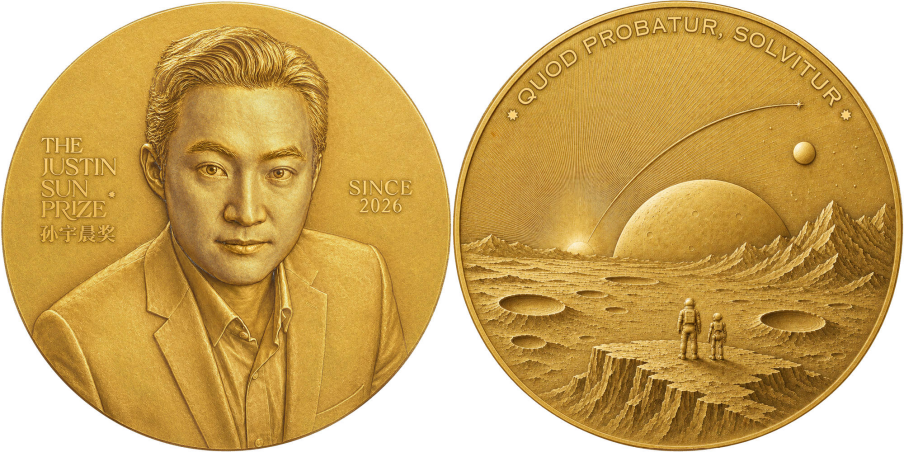
Justin Sun revealed that in addition to prize money, winners will also receive certificates and medals. The front of the medal features Justin Sun's portrait and the "Justin Sun Prize" in both Chinese and English, while the back features an engraving reflecting humanity's exploration of the universe, with the Latin phrase "Quod probatur, solvitur" engraved on the edge, meaning "what is proved is solved." The main body of the medal is made of copper, with its surface plated with 6 grams of pure gold.
The "Justin Sun Prize" adheres to three major principles: openness, public welfare, and open source: it is open to all eligible contributors, with no restrictions based on nationality, institution, or identity, and no distinction between humans and AI; funds are dedicated solely to prize awards and open work, not for profit; the problem list, confirmation standards, proofs, and verification materials are all open to the public through GitHub, and prize distribution records are stored on-chain, permanently traceable and tamper-proof.
Justin Sun pointed out that the current work of converting human mathematical proofs into machine-verifiable formal proofs still mainly relies on the spontaneous enthusiasm of formalization communities such as Lean, and systematic economic incentives have long been lacking. "People who do formalization never lack enthusiasm; what they lack is a construction map with price tags." The "Justin Sun Prize" provides a public, reward-bearing list for this key link for the first time, aiming to completely change this situation.
He further stated, "A prize named after a person is the least political thing in the world. More importantly, it gives me an explanation to myself—my wealth has its roots in mathematics. It comes from mathematics, and it returns to mathematics." According to public information, over the past several years, Justin Sun has donated nearly $45 million (about RMB 300 million) cumulatively in fields such as technology, environmental protection, and disaster relief. From now on, his philanthropic focus will fully shift to the "Justin Sun Prize," continuously promoting accelerated breakthroughs in fundamental science in an open and verifiable way.
"I am not a mathematician. I am a bystander, and I pay. The rest is left to proof," said Justin Sun. The official establishment of the "Justin Sun Prize" has already opened a new paradigm of scientific incentives centered on machine verification, driven by human-machine collaboration, and based on decentralized bounties.