






Behind the 30% annualized fixed yield, a brief analysis of the opportunities and risks of Pendle's new arbitrage product


- Core Viewpoint: Pendle's Boros has launched Spread Markets, packaging the funding rate spreads of perpetual contracts across different platforms into a single trading instrument, claiming to replicate "kimchi premium"-level arbitrage opportunities. However, simplification of the tool does not equal simplification of the strategy—returns still depend on funding rate levels, spread persistence, and cost management.
- Key Elements:
- On October 15, Boros launched Spread Markets, initially covering BTC and ETH, allowing users to trade cross-platform funding rate spreads with a single position.
- The product is essentially an exchange of fixed rates for floating rates. Going long/short on the spread does not directly capture the funding rate differential; instead, profit and loss are settled based on the implied annualized rate versus the actual spread.
- Retail strategies include directional funding rate bets and fixed-income-like arbitrage, the latter requiring combining perpetual contracts on two platforms with a Boros spread position.
- Official marketing claims 25%–35% fixed yield, but this figure does not account for entry fees, holding period, leverage, and trading costs.
- Main risks include: high volatility of funding rate spreads, liquidity and liquidation risks of the underlying exchanges and Boros itself, and limited arbitrage capacity leading to spread convergence.
Original | Odaily (@OdailyChina)
Author|Azuma (@azuma_eth)

Veterans of the cryptocurrency world have likely heard of the "Kimchi Premium" at some point.
In the early years, Bitcoin prices on South Korean exchanges were once significantly higher than on overseas markets, and countless early participants made substantial profits as a result. The famous Sam Bankman-Fried (SBF) even earned his first fortune from this arbitrage.
However, as the market gradually matured and arbitrageurs kept pouring in, such opportunities have gradually narrowed. Now, Boros, the funding rate trading protocol under Pendle, is attempting to bring similar opportunities back to the crypto market.
On October 15, Boros officially announced the launch of Spread Markets, initially covering BTC and ETH, allowing users to trade the perpetual contract funding rate spread between different platforms through a single position. In its promotional copy, Boros boldly touted the product as the next "Kimchi Premium"-level opportunity. So how exactly does Spread Markets work? What returns can ordinary users gain from it, and what risks must they bear?

Turning the Rate Spread Between Two Markets into a Single Trade
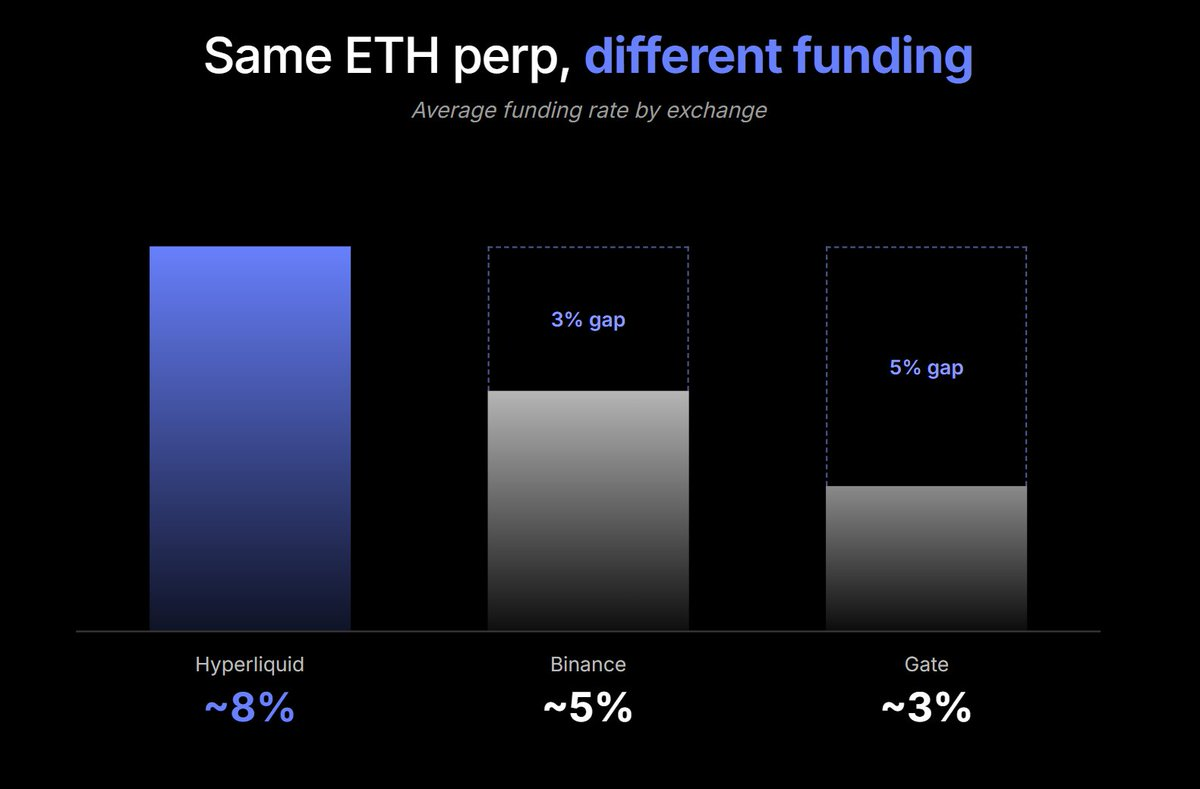
Since perpetual contracts have no delivery date, exchanges typically use funding rates to balance the holding demand between longs and shorts. Even for the same asset, funding rates often differ across platforms.
Take BTC as an example. Suppose the funding rate on Exchange A annualizes to 20%, while on Exchange B it is 8%. That creates a 12-percentage-point annualized rate spread — such differences may stem from trader composition, market sentiment, liquidity, and each platform's distinct rate calculation mechanisms. As long as the long and short demand in the two markets is not fully synchronized, the spread may persist.
Where there is a spread, there is demand for arbitrage. But traditional funding rate arbitrage typically requires establishing perpetual contract positions on two separate exchanges, while simultaneously handling different funding rates, margin requirements, and liquidation mechanisms. If one further wishes to lock in future returns, additional management of the risk from rate changes is needed.
Earlier, Boros had already launched a product allowing users to directly trade the funding rate of a single market, and the newly launched Spread Markets aims to further merge the rate spreads of different platforms into a single trading instrument.
For example, the floating rate corresponding to BTC Spread A-B is Exchange A's BTC funding rate minus Exchange B's BTC funding rate. Users no longer need to operate separately across platforms — they can directly go long or short on this difference.
Specifically, Boros allows users to trade the spread in both long and short directions.
- Going long the spread: This means believing that the future average funding rate spread between the two markets will be higher than the implied annualized rate at the current entry point;
- Going short the spread: This means believing that the future average funding rate spread will be lower than the current implied annualized rate. It can also be combined with perpetual contract positions on both sides to lock in arbitrage returns;
It should be noted here that Boros positions are essentially an exchange between a fixed rate and a floating rate. Going long does not mean directly receiving the funding rate spread between the two exchanges, but rather settling profit and loss based on the actual floating spread versus the rate locked in at entry — therefore, what the new product truly reduces is the operational complexity of trading rate spreads, not turning all arbitrage steps into automated one-click trading.
What Trading Opportunities Are There for Retail Traders?
Directional Funding Rate Bets
The simplest approach is to treat the funding rate spread as an independent trading instrument.
Suppose a market currently has an implied annualized rate of 10%, and you judge that over the coming period, the average funding rate spread between the two platforms could reach 20% — then going long the spread has the potential to yield positive settlement returns. Conversely, if the current implied annualized rate is 20%, but you believe that as market sentiment cools, the rate spread between the two platforms will fall back to 5%, then going short the spread may be more advantageous.
This strategy does not require simultaneously holding perpetual contracts on both sides, so there is no need to bear the full price exposure of the crypto asset just to capture the spread — relatively speaking, capital efficiency is higher. However, since rate spreads tend to be highly volatile, please be sure to pay attention to leverage risk in actual trading.
Fixed-Income-Like Arbitrage
For users more focused on yield rather than betting on rate direction, another approach is worth studying.
Suppose Exchange A's BTC funding rate is significantly higher than Exchange B's. Users can go short BTC perpetual contracts on the high-rate market and go long an equal amount of BTC perpetual contracts on the low-rate market, offsetting the price exposure on both sides as much as possible; at the same time, users need to go short the corresponding Spread Market on Boros, converting the floating rate spread into a fixed-rate position. The reverse works the same way.
Combining these three trades has the potential to lock in the rate spread between the two markets. Boros's official arbitrage tool is also built around this idea — for trading pairs with a Spread Market, the two rate positions that originally required separate management can be merged into a single spread position.
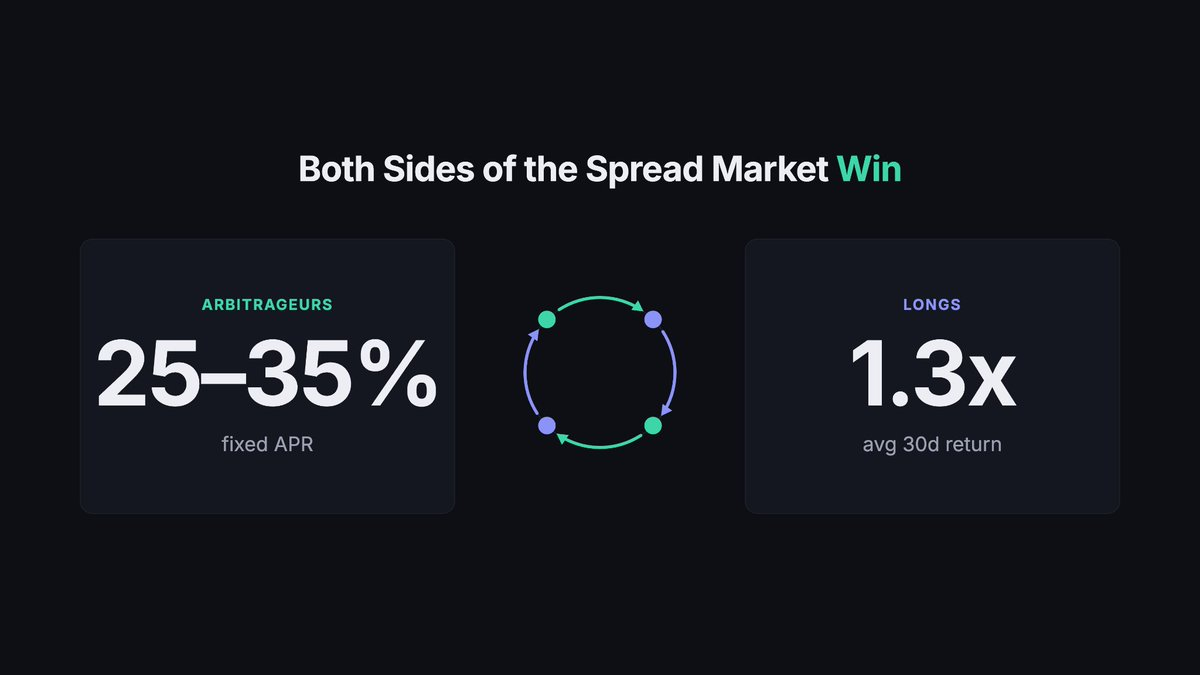
In its official promotional copy, Boros gives examples claiming fixed returns of 25%–35%, but this figure cannot be directly regarded as the net return ordinary users can actually obtain, let alone compared in isolation without considering entry rates, holding period, leverage, and costs.
For retail traders, what truly deserves attention is not the highest annualized yield at a single point in time, but whether the spread can persist, whether the entry price is reasonable, and how much return remains after deducting transaction costs.
What Hidden Pitfalls Lie Behind High Yields?
High Volatility: Historical Data ≠ Future Results
Funding rates across different platforms do frequently differ, and cross-platform spread behavior does show certain patterns over larger samples and longer cycles, but historical data can only help with judgment — it cannot guarantee future settlement outcomes.
A reversal in market sentiment, changes in trader positioning, or a sudden surge of longs or shorts on a particular platform can all cause funding rates to change dramatically. A previously favorable spread may rapidly widen or narrow, or even turn into a negative spread, directly affecting the outcome of long or short strategies.
Underlying Platform Risk Still Exists
Packaging a cross-platform arbitrage strategy into a single spread trade reduces the complexity of managing multiple rate positions, but it does not eliminate underlying risk. The entire strategy still depends on the funding rate settlement of the relevant exchanges, as well as Boros's own liquidity, settlement, and liquidation mechanisms.
If an underlying exchange experiences abnormal volatility, liquidity exhaustion, or trading interruption, the arbitrage portfolio may be unable to adjust in time. Even if the price exposure of the underlying asset has theoretically been hedged, it does not mean the actual risk is fully offset; under extreme market conditions, liquidation of single-leg positions, cross-platform price deviations, and other issues may all cause the portfolio to suffer additional losses.
Capacity Has an Upper Limit
Boros has turned cross-platform funding rate spreads into an easier-to-trade instrument, but such opportunities are not in unlimited supply.
As more and more traders flood into the same market, arbitrage capital will gradually compress the rate spread that originally existed, which is what Boros calls Premium Narrowing. As the spread narrows, the yield that new entrants can lock in will also decline accordingly.
Simplified Tools Do Not Mean a Simplified Strategy
In summary, Boros's Spread Markets provides a more direct way to trade funding rate arbitrage. It isolates the rate spread between two markets, reduces the complexity for traders managing multiple rate positions, improves capital efficiency, and offers new tools for directly trading spreads and building fixed-income strategies.
But simplified tools do not mean the strategy itself becomes simple. What truly determines returns is still the rate level at entry, the persistence of the spread, transaction costs, and the risk management of the entire position.
For ordinary traders, before rushing to chase the high annualized yields advertised, they should at least first get hands-on experience with traditional cross-market arbitrage solutions, and then upgrade from that foundation.





