






MSX US Stock Daily Observation: ASML Q3 Revenue Hits Record High, AI Equipment Demand Extends to 2030, Capacity Becomes New Growth Constraint


- Key Takeaways: ASML's Q3 2026 revenue and profit both hit record highs. AI semiconductor capital expenditure is transmitting from GPU to wafer fabrication equipment. The company's core constraint has shifted from order acquisition to capacity delivery.
- Key Elements:
- Q3 net sales of €11.662 billion (+55% YoY), net profit of €4.960 billion (+133% YoY), EPS of €12.95 beating expectations, though approximately €500 million of that came from an increase in the valuation of its Mistral AI investment.
- Customers have begun booking equipment for 2029 to 2030. Planned capacity for 2027 to 2028 cannot meet demand, and supply of advanced lithography equipment remains tight.
- Memory customers accounted for 46% of system revenue. The company expects memory system revenue to grow approximately 75% in 2026, far outpacing the approximately 10% growth in its logic business, driven jointly by HBM and advanced DRAM capacity expansion and increasing EUV layer counts.
- Gross margin rose to 57.5%. Installed base management and service revenue reached €3.289 billion (+19.1% QoQ), reflecting robust demand for equipment upgrades; however, gross margin is expected to dip slightly to approximately 57% in Q4 due to capacity expansion costs.
- High-NA EUV has entered early commercialization: Intel has completed over 1 million wafer exposures, while Samsung plans to introduce it for mass production in 2028 and TSMC in 2030.
- The ADR fell approximately 3.9% after earnings, pressured by both a reassessment of profit quality and rising US Treasury yields weighing on risk appetite for tech stocks.
[MSX Research Institute · Daily U.S. Stock RWA Observer] is a flagship daily report produced by MSX Maitong, a leading RWA trading platform. Leveraging our strong macro research capabilities, we capture the core pulse of global traditional U.S. stocks, liquidity changes, and the RWA tokenization market, helping you position ahead for quality assets.
Today's Observation
ASML delivered a record-breaking third-quarter earnings report.
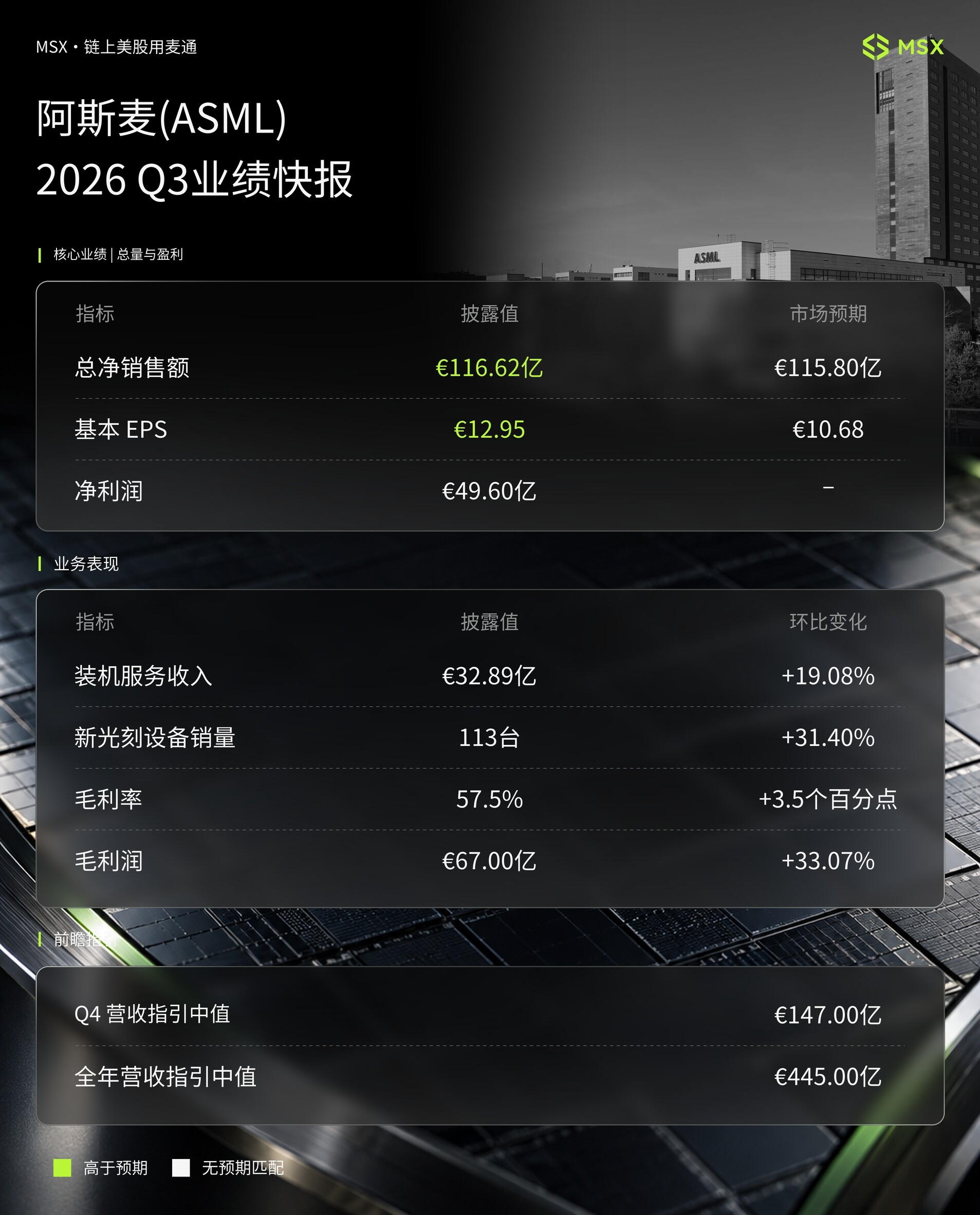
In Q3 2026, the company's net sales reached €11.662 billion, up approximately 55% year-over-year, landing at the high end of its previous guidance range of €11 billion to €12 billion; net profit reached €4.960 billion, up approximately 133% year-over-year; basic earnings per share came in at €12.95, significantly above the market expectation of approximately €10.7.
But what is most noteworthy about this earnings report is not just the record revenue and profit, but the further shift in management's assessment of future demand.
ASML stated that customer demand for advanced logic and memory chip capacity continues to strengthen, and the company's currently planned equipment supply for 2027 and 2028 can no longer fully meet customer demand. Some customers have not only begun increasing equipment orders for 2028, but have also expressed a desire to reserve equipment for 2029 and even 2030.
This indicates that the impact of AI semiconductor capital expenditure is continuing to propagate from Nvidia GPUs and data center servers further upstream to wafer fabrication equipment. TSMC, Samsung, Intel, SK Hynix, and Micron need to expand advanced logic, DRAM, and HBM capacity, all of which ultimately translates into purchases of EUV, DUV, and inspection equipment.
The problem ASML currently faces is no longer whether there are orders, but whether it can produce, install, and maintain these tools quickly enough. In Q3, the company sold 113 new lithography systems, up 31.4% from Q2; net system sales reached €8.4 billion, of which EUV equipment revenue was €4.1 billion, including one High-NA EUV system; non-EUV equipment revenue was €4.3 billion.
Installed base management and service revenue reached €3.289 billion, up 19.1% from Q2 and nearly €400 million above the company's original expectations. The large number of customers opting to upgrade the productivity of their existing EUV and DUV systems is the primary reason gross margin rose to 57.5% this quarter.
However, the profit beat also includes a factor that warrants separate scrutiny. ASML disclosed that approximately €500 million of this quarter's net profit came from an increase in the valuation of its initial investment in Mistral AI. This is an investment value revaluation, not operating profit directly generated from lithography equipment sales.
Therefore, the operational performance in this earnings report remains very strong, but the €12.95 EPS cannot be fully understood as sustainable operating profit.
After the earnings release, ASML's American Depositary Receipts fell approximately 3.9%. The Nasdaq also dropped 1.9% that day, as higher-than-expected U.S. inflation drove Treasury yields higher and the AI and semiconductor sectors came under broad pressure. Thus, ASML's decline reflects both the market's reassessment of valuation and profit quality, as well as the overall decline in risk appetite for tech stocks.
Data in a Minute
Q3 2026 net sales of €11.662 billion, up approximately 55% year-over-year, a record high;
Net profit of €4.960 billion, up approximately 133% year-over-year;
Basic EPS of €12.95, above the market expectation of approximately €10.7;
Approximately €500 million of this quarter's profit came from the valuation increase of the Mistral AI investment;
Gross profit of €6.7 billion, gross margin of 57.5%, up 3.5 percentage points from Q2;
Net system sales of €8.4 billion, of which EUV equipment revenue was €4.1 billion and non-EUV equipment revenue was €4.3 billion;
113 new lithography systems were recognized as sold this quarter, compared with 86 in Q2;
Installed base management and service revenue of €3.289 billion, up 19.1% from Q2 and nearly €400 million above the company's original expectations;
In the system sales mix, logic chip customers accounted for 54% and memory chip customers accounted for 46%;
The company expects memory business system revenue to grow approximately 75% in 2026, with logic business growing approximately 10%;
The company expects full-year EUV revenue to grow more than 45%, non-EUV system revenue to grow approximately 20%, and installed base management business to grow approximately 50%;
Q4 revenue guidance is €14.2 billion to €15.2 billion, with a midpoint of €14.7 billion;
Q4 gross margin is expected to be approximately 57%, and installed base management and service revenue is expected to be approximately €3.7 billion;
Full-year 2026 revenue guidance was narrowed and raised from the previous €43 billion to €45 billion to €44 billion to €45 billion;
Full-year gross margin is expected to be approximately 56%, with full-year revenue growing approximately 36% year-over-year;
The company expects China to account for approximately 20% of total revenue in 2026;
Q3 free cash flow reached €11.4 billion, including prepayments from customers for future orders;
The company repurchased approximately €4.1 billion of shares in Q3 and will pay an interim dividend of €1.88 per share.
MSX View
ASML currently occupies a rather unique position in the entire AI infrastructure supply chain. Nvidia, AMD, and custom AI chip companies design processors; TSMC, Samsung, and Intel manufacture advanced chips; and Micron, SK Hynix, and Samsung produce HBM and advanced DRAM. Regardless of which chip company ultimately gains market share, as long as advanced logic and memory capacity continues to expand, lithography equipment demand will ultimately flow through to ASML.
This makes ASML a relatively upstream equipment supplier in AI capital expenditure that covers multiple chip companies simultaneously. In this quarter's system revenue, logic business accounted for 54% and memory business accounted for 46%. Management expects memory system revenue to grow approximately 75% in 2026, significantly faster than the approximately 10% growth in the logic business. The reason behind this is not only rising HBM demand, but also the fact that advanced DRAM is beginning to use more EUV processes.
As DRAM processes continue to shrink, chipmakers need to increase the number of critical lithography layers. What ASML gains is not only equipment demand from memory makers expanding wafer capacity, but also the increase in lithography steps required per advanced DRAM wafer.
The more important signal is that customer demand has already begun to extend to 2029 and 2030. Planned capacity for 2027 and 2028 can no longer fully meet demand, indicating that at least for the next two years, advanced lithography equipment will remain in a tight supply situation. ASML previously planned to increase capacity by approximately 30% in 2027 based on its 2026 capacity of roughly 65 Low-NA EUV systems; DUV immersion systems are also planned for approximately 30% capacity expansion. The company is currently studying making the 2028 capacity increase exceed the previously discussed 30%.
This will have implications in two directions:
On one hand, tight supply strengthens ASML's pricing power. Management has already completed price increase negotiations with customers on some key products, with the related impact beginning to show in 2027 and becoming more pronounced from 2028 onward. As long as demand continues to exceed supply, higher equipment prices and higher output have the opportunity to jointly drive revenue and gross profit growth.
On the other hand, rapid capacity expansion also incurs additional costs. ASML needs to add production sites, train technical personnel, and require core suppliers such as Zeiss to expand in tandem. The company expects Q4 revenue to be significantly higher than Q3, but gross margin to slip slightly from 57.5% to approximately 57%, primarily due to increased capacity expansion costs.
Therefore, what ASML needs to solve in the next phase is delivery capability. High-NA EUV represents a longer-term growth source. The one High-NA system whose revenue was recognized this quarter means this technology is gradually moving from R&D and customer validation into the commercialization stage.
Management stated that Intel has already used the High-NA EUV system to expose more than 1 million wafers; Samsung plans to introduce High-NA into mass production in 2028, while TSMC plans to adopt it in 2030. Currently, the availability rate of the High-NA equipment fleet is already close to 90%. These timelines indicate that High-NA revenue will not immediately ramp up across the board in the short term, but once major customers enter volume production, it could simultaneously raise ASML's average selling price, service revenue, and long-term customer stickiness.
Aside from that, China business remains another important variable. The company expects China to account for approximately 20% of revenue in 2026, with demand mainly coming from mature-node logic and memory capacity. Management believes China's domestic demand remains strong, but actual revenue still depends on Dutch and U.S. export control policies, as well as whether ASML can continue to provide spare parts, software updates, and maintenance services for existing equipment.
Therefore, this quarter's earnings report can be summarized into three key points:
First, AI demand continues to spread to advanced logic, DRAM, and wafer fabrication equipment, and there is currently no sign of major customers significantly cutting capital expenditure.
Second, ASML's core constraint for 2027 and 2028 has shifted from orders to capacity, and the pace of capacity expansion will determine how much revenue the company can deliver.
Third, the 57.5% gross margin and €12.95 EPS are very strong.
What needs to be closely watched next is whether Low-NA EUV and DUV capacity can be ramped up as planned, whether installed base upgrade revenue can remain at a high level, whether High-NA can enter mass production according to customer timelines, and whether China business will be affected by new export restrictions.
About MSX Maitong:
MSX is a leading RWA trading platform dedicated to providing secure, efficient, and transparent access to global financial markets. As one of the world's earliest on-chain U.S. stock trading platforms, MSX has always been at the forefront of the industry, leading market transformation through continuous innovation.
The platform deeply integrates blockchain technology with a compliance framework, offering comprehensive spot and derivatives trading for nearly 400 tokenized stocks and Pre-IPO assets, perfectly bridging the gap between traditional finance and the digital asset industry.
Centered on the core mission of "enabling quality assets to circulate freely," MSX has now built a diversified digital financial services system covering U.S. stock spot and perpetual contracts, crypto-to-crypto trading, Pre-IPO, and Maitong Research Institute, aiming to provide global investors with round-the-clock, high-performance access to quality assets.
Official Website: https://msx.com/
Chinese TG: https://t.me/MSXOfficial
Global TG: https://t.me/MSXGlobal
Now available simultaneously on the global App Store / Google Play.
Risk Disclaimer: Macroeconomic conditions and U.S. stock markets are highly volatile. This content is provided solely for academic and research observation reference by Maitong Research Institute and does not constitute any investment advice.





