Why Can't Hyperliquid's Prediction Market Catch Up to Polymarket?


- Core Viewpoint: Hyperliquid's HIP-4 prediction market surpasses Kalshi and Polymarket in product design, achieving same-account margin, pre-written settlement conditions, and a shared order book. However, the market size gap is approximately 1,400x and still widening — the design leads, but the market has yet to arrive.
- Key Elements:
- HIP-4 has accumulated $317 million in trading volume. In September, for every $1,000 traded on Kalshi and Polymarket, HIP-4 saw only about $0.7 — a gap of roughly 1,400x.
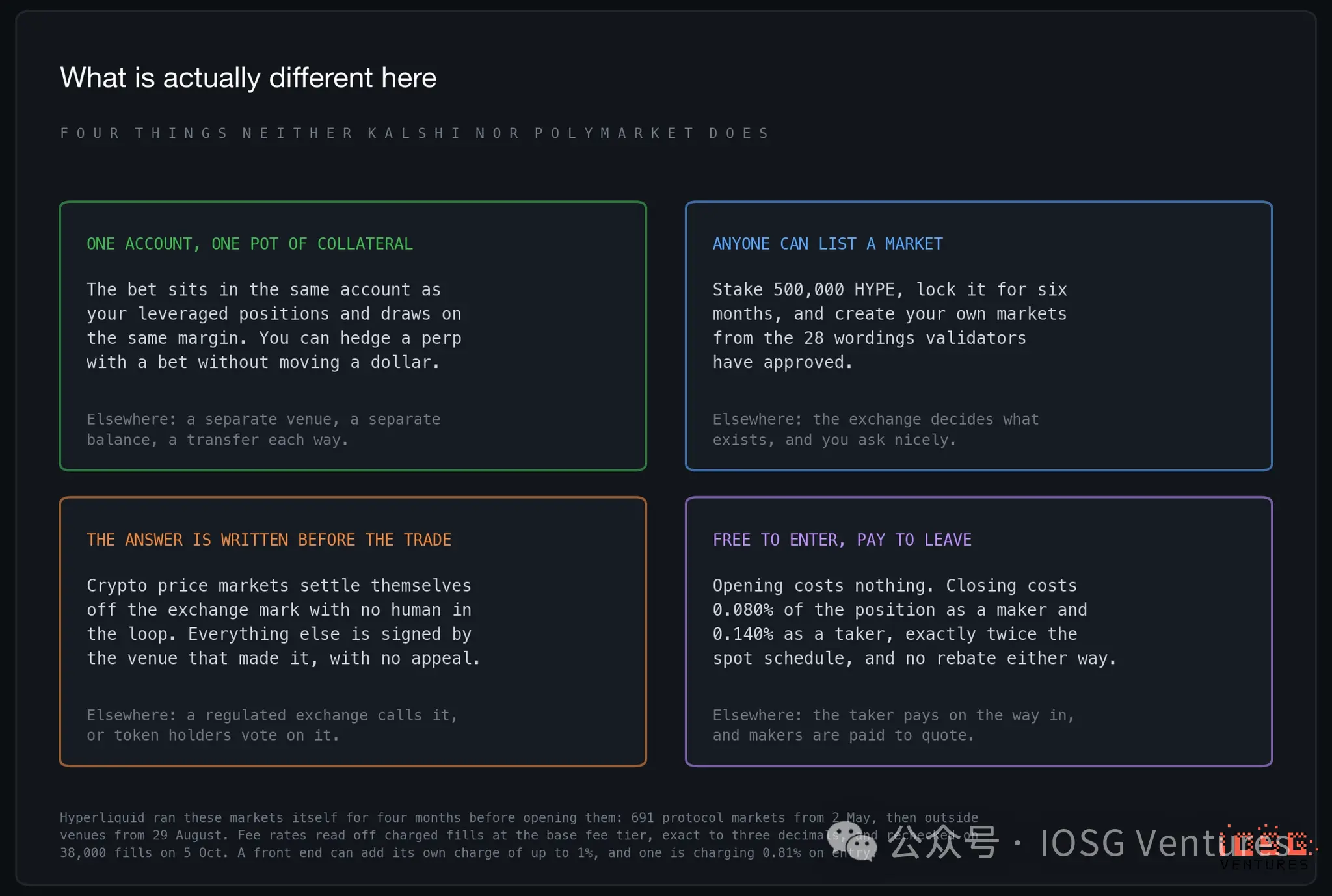
- Four key design differences: same-account same-margin trading, market creation via 500,000 HYPE staking, settlement conditions pre-written into templates, and free entry with exit fees of approximately 0.1%.
- Trading volume is highly event-driven: World Cup soccer markets account for 28% of cumulative volume, dropping over 80% within two months after the event ended; the daily Bitcoin market is down 93% from its May peak.
- Among external venues, Outcome accounts for 92% of volume, but its $1 million reward program distributes approximately $7,400 per day — roughly 0.6% of its trading volume — meaning subsidies are propping up the volume.
- Total annual fees across the entire market amount to approximately $480,000 — less than half the annual interest on a single venue's $47 million staked (approximately $1 million); the largest venue distributes $2.7 million in annual rewards.
- Order book depth is insufficient: the median bid-ask spread across the 25 most active order books is 0.29 cents, a $10,000 buy order requires paying 2%-3% more, and some order books cannot absorb such orders at all.
- Polymarket launched perpetual contracts in September, placing betting and leverage on the same platform — HIP-4's unique advantage is narrowing.
Original author: Mario Chow
Original source: IOSG Ventures
Data as of October 5, 2026. Prices, staking, order books, and trades come from the Hyperliquid API; per-market volume comes from node trade archives published by Liquidiction; Kalshi and Polymarket volumes come from The Block. Charts are identical to the English version, see above.
Summary
The thing most similar to HIP-4 isn't Polymarket — it's an options ticket sitting next to your perpetual position. Yes shares and your leveraged position live in the same account, use the same margin, and match on the same engine, so a bet and the position it's meant to hedge are always on the same screen. Three other things set it apart: anyone who stakes 500,000 HYPE can open a market; settlement terms are hard-coded into a template before the first trade; and entry is free while exit costs roughly one basis point — the exact opposite of how Kalshi and Polymarket charge.
For the first four months, only Hyperliquid itself was running. When it launched on May 2, 2026, all markets were operated directly by the protocol — 691 of them — and it wasn't until August 29 that it opened to external venues. Since then three have staked, and as of now there is no fourth.
Whether you can see it depends on where you are. Prediction markets have their own page at app.hyperliquid.xyz/outcomes, and the front end decides by region whether to put it in the trading list alongside perps and spot. Access it from a Korean network and you'll see the tab in the market list; from the network we tested on, it's absent from both the list and the menu, yet the page itself still opens and trades. Hyperliquid restricts front-end access in several countries — an entry point you can't see may be visible to someone two time zones away.
From May to now, HIP-4 has done $317 million in cumulative volume. Kalshi does that in under four hours. In September, for every $1,000 Kalshi and Polymarket traded, HIP-4 traded about 70 cents.
The design is its best feature; the problem is scale. More than a quarter of HIP-4's all-time volume came from a soccer World Cup that has already ended. The daily Bitcoin market that carried the first four months is down 93% from its May peak. New venues pulled September back to $51 million, flat with July, and the biggest contributor is paying traders roughly 0.6 cents for every dollar of volume. October started slower, averaging about $1.25 million a day. Fees across the whole market run about $1,300 a day — less than half the interest a single venue earns by leaving its stake idle.
1. Product design: four ways it differs from Kalshi and Polymarket
Under the base fee tier, rates reverse-engineered from trades with actual charges are as follows:
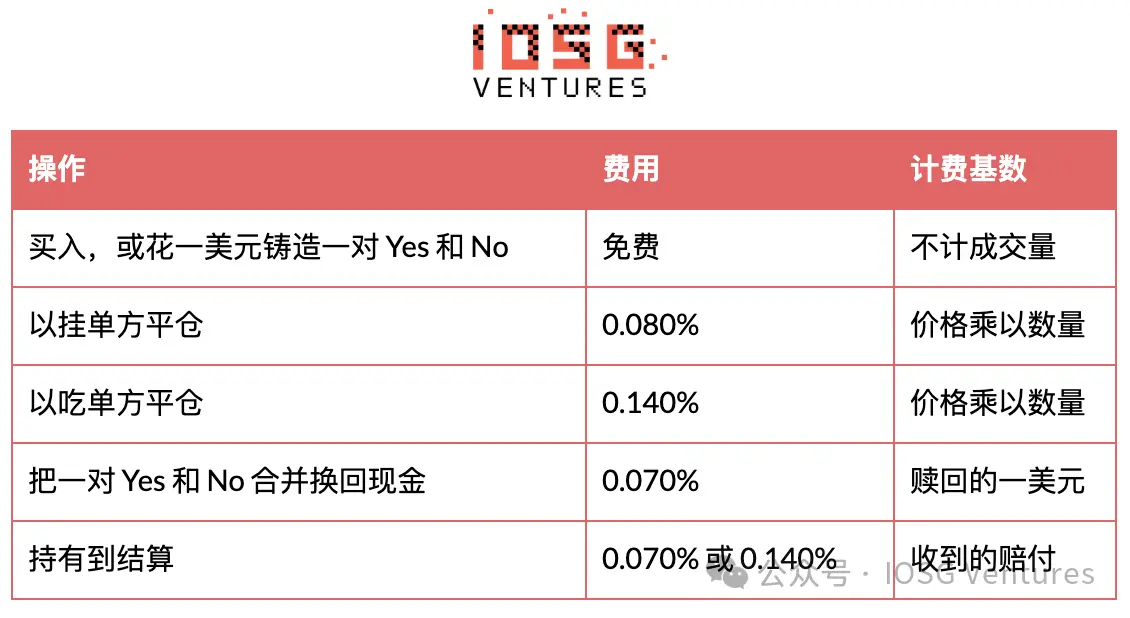
That's exactly double the spot rate: spot base tier is 0.070% taker, 0.040% maker. Double on one side, zero on the other, and a round trip costs the same as spot — it's just all collected on exit. Common discounts multiply simply: a 4% referral discount turns 0.140% into 0.1344%, and stacking a 10% staking discount gives 0.12096%. Every trade we checked matched to the decimal. There's no maker rebate, which is the one place market makers are worse off here than in other parts of the exchange.
No venue has raised its fee coefficient above the default yet, so venue revenue is carved out of the protocol fee rather than added on top. The only charge you might hit on entry comes from the front-end app: under spot rules the builder fee cap is 1%, and one app charges 0.81% on entry — roughly six times the protocol's exit fee.
Settlement deserves a closer look, because that's where venue risk lives. Polymarket relies on UMA token holders voting to adjudicate — earlier this year a $375 million Microstrategy market descended into a bitter dispute over it. Kalshi, as a regulated exchange, adjudicates itself, with regulators above it. HIP-4 splits the problem: crypto price markets read the exchange mark price at the agreed minute and settle automatically; everything else is resolved by the market opener signing off on the outcome, with no dispute window and no one else able to sign on their behalf.
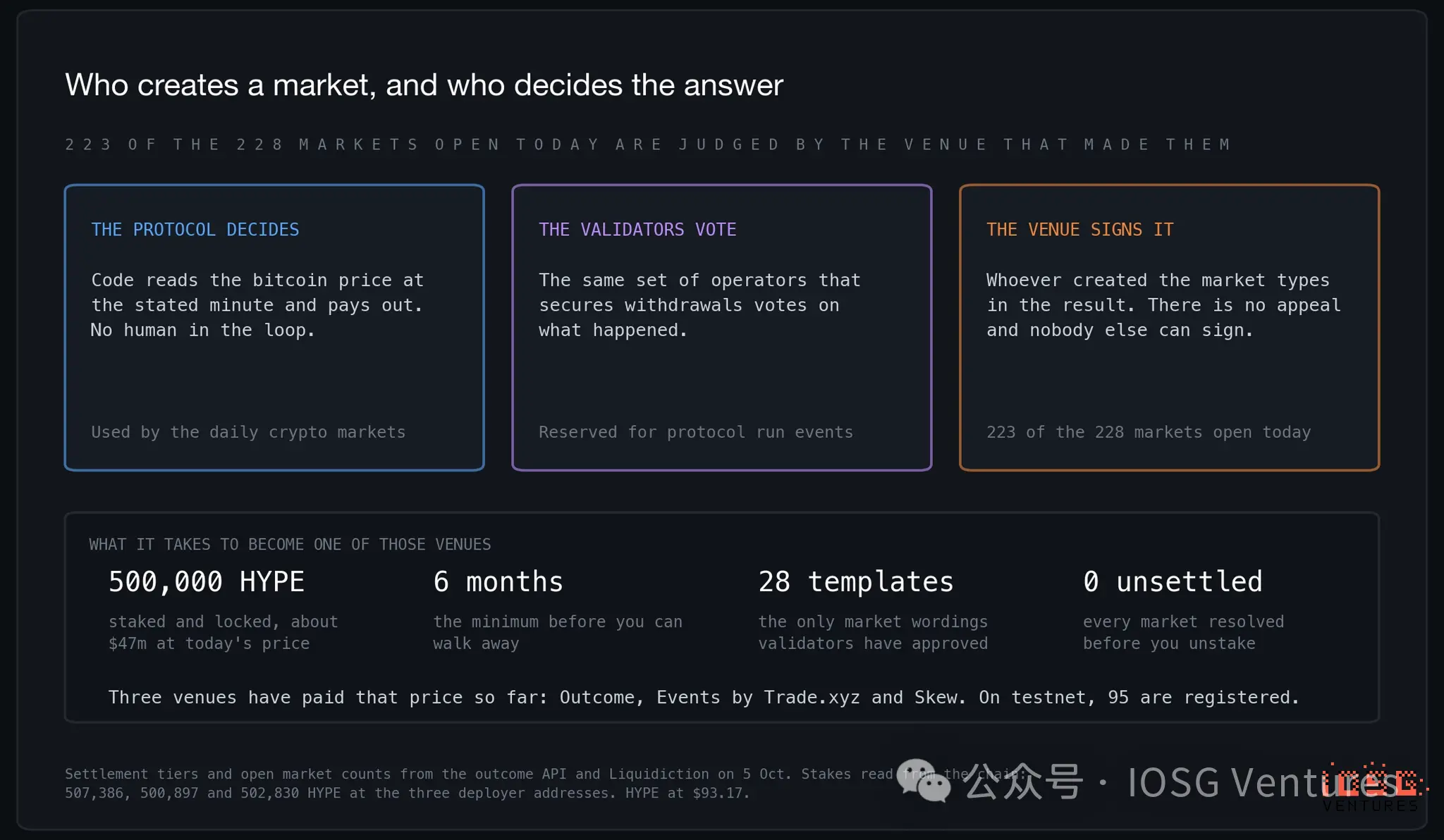
Of the 228 markets open today, 223 fall into the latter category. The constraint is money and time, not code. As long as a venue has unsettled markets, its stake stays locked; it can't be withdrawn for six months; and only pre-approved validator wording can be used. That wording is deliberately long and pedantic — the "company IPO" template, for instance, spends a full page just on what counts as a listing. Rules written before trading beats arguing afterward. Handing the pen to a named party with no appeals channel is genuinely worse than having a procedure — provided that procedure itself doesn't break.
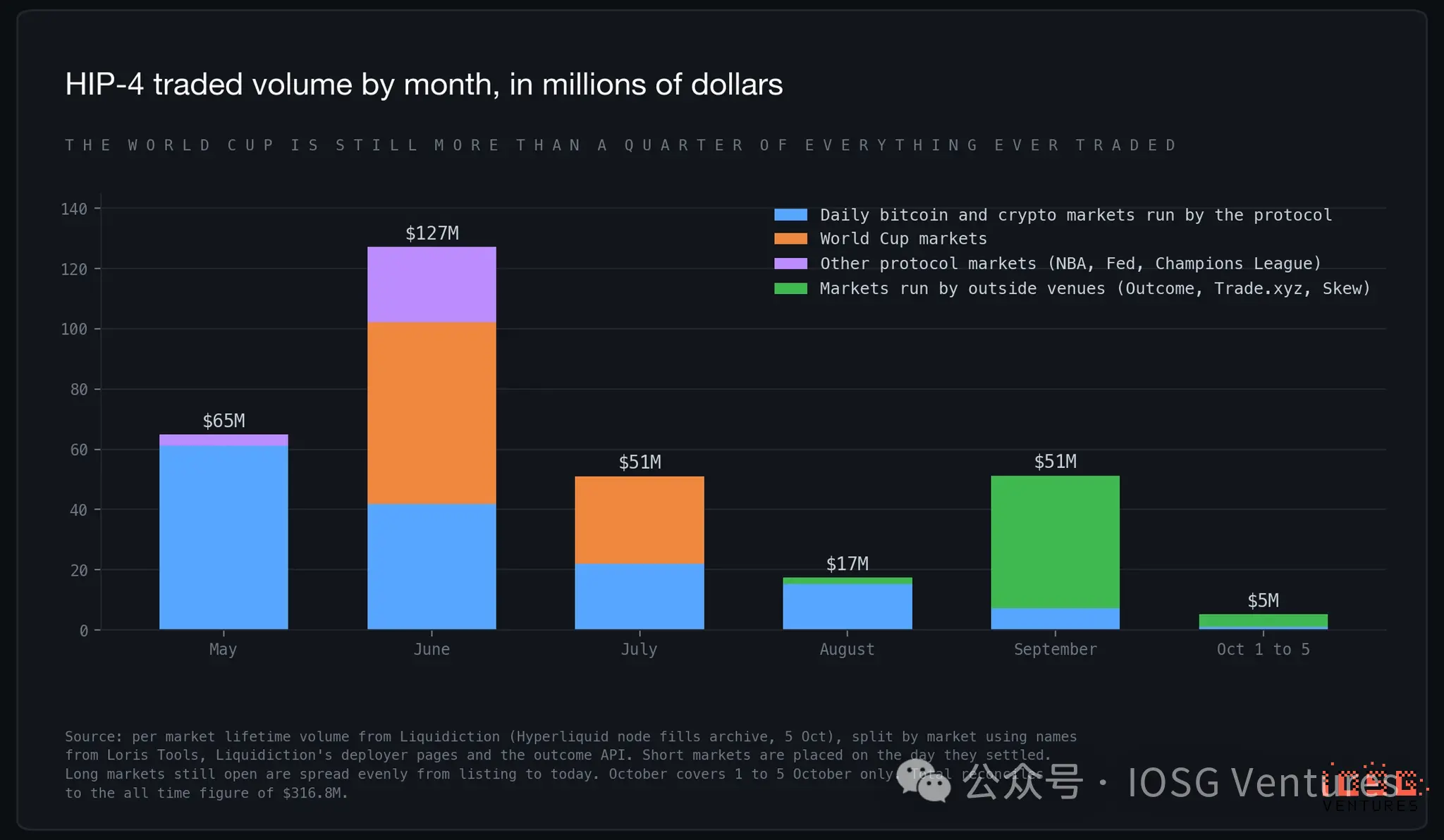
June was the peak, thanks to the World Cup. Soccer markets alone did $89.5 million, 28% of HIP-4's cumulative volume. Once the World Cup ended, it fell more than 80% in two months. September came back to $51 million, with all of the recovery coming from external venues; the first five days of October did $5 million.
Beneath these events, the protocol has run the same market every day since May: will Bitcoin be above a certain price at 6 a.m. tomorrow. This is probably the most Hyperliquid-flavored product there is, and it fell for four straight months before bottoming out.
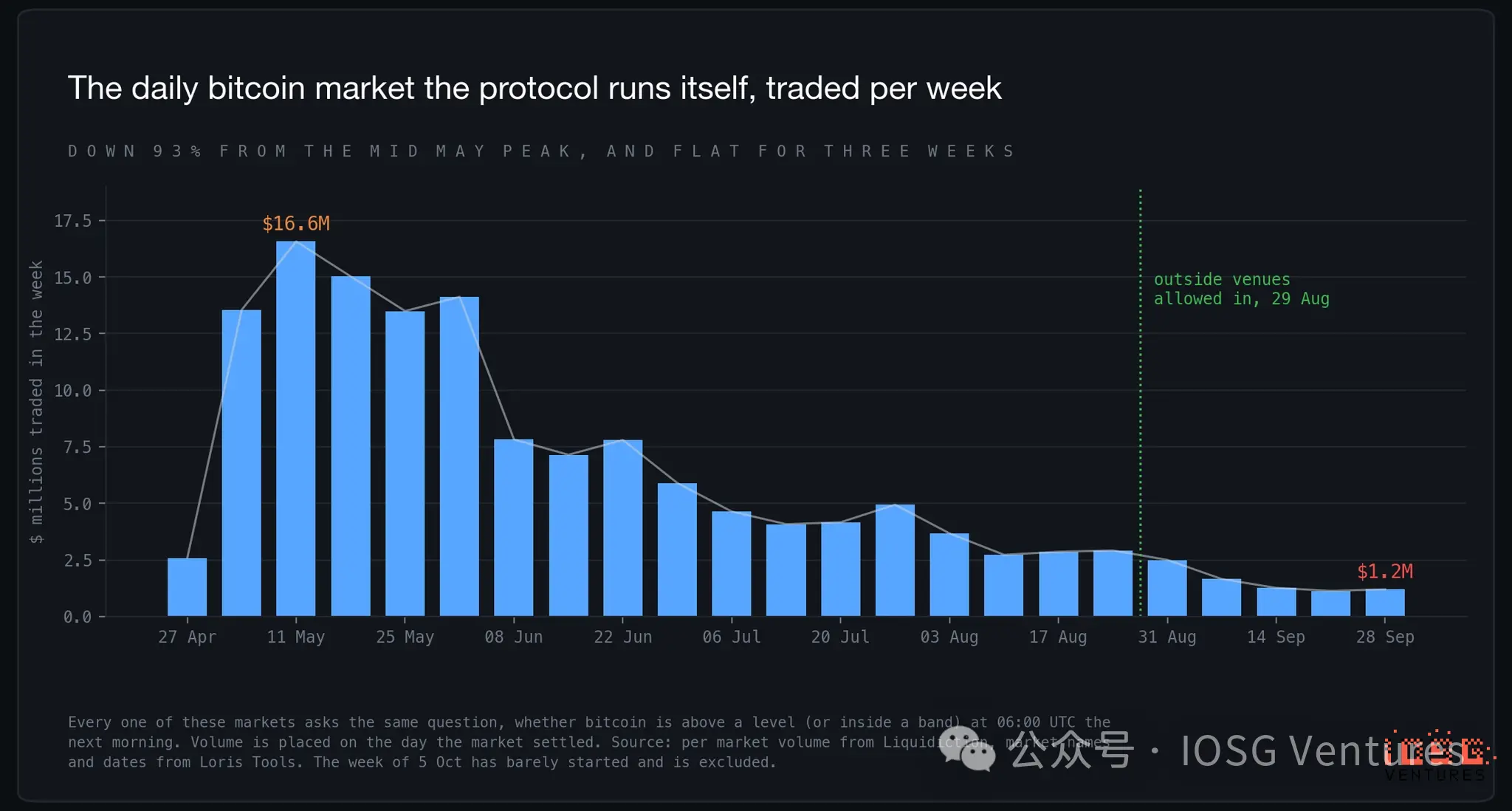
The week of May 11 did $16.6 million; the week of September 28 did only $1.2 million, with the two prior weeks roughly the same. Asking the same question once a day, to a shrinking audience, until it stopped only when almost no one was left. Whatever HIP-4 becomes, it won't be this.
2. Five weeks of open deployment: subsidy-fueled volume and duplicated markets
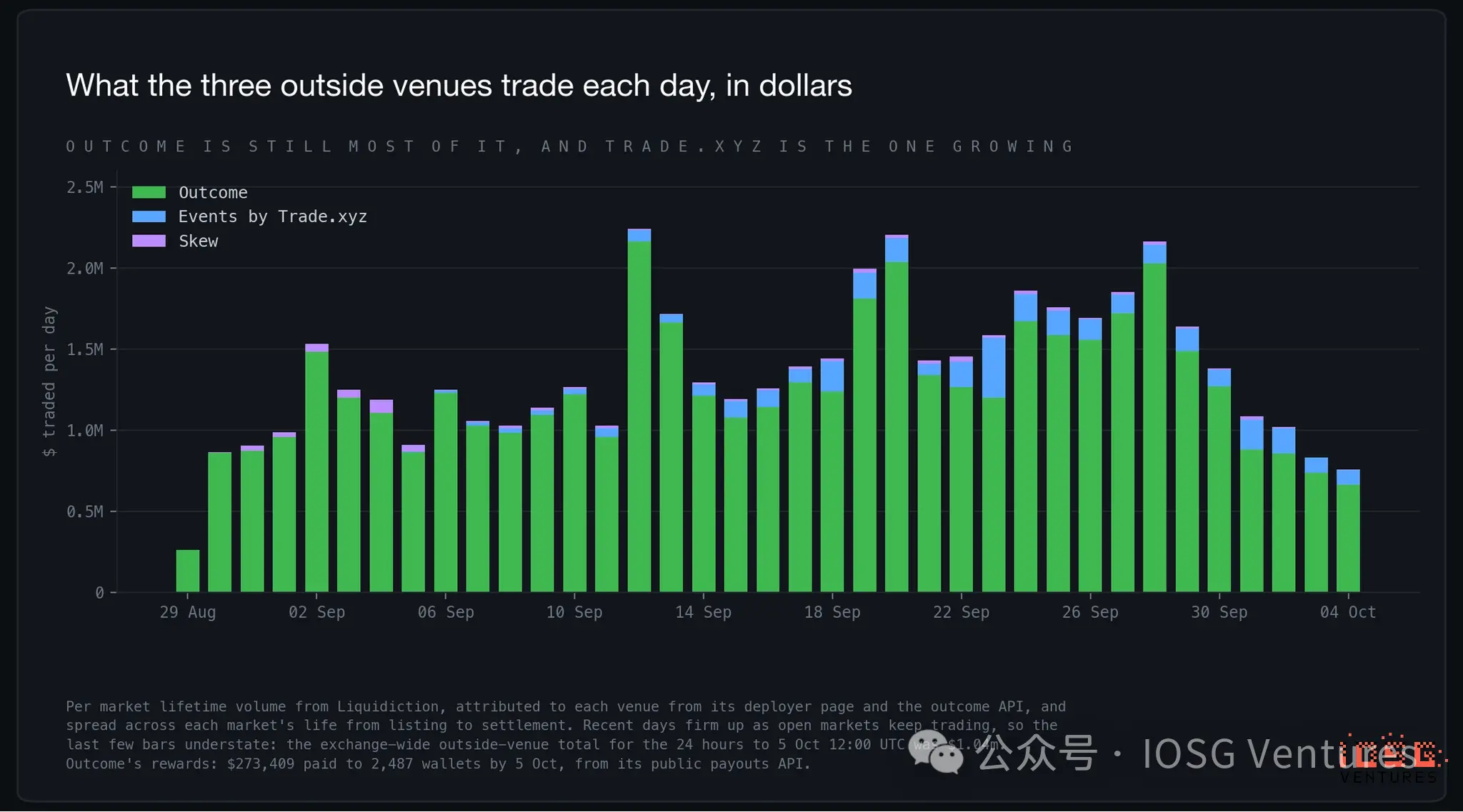
Outcome went live first on August 29. Skew registered markets the next day and has seen almost no volume since. Trade.xyz's Events registered on September 5 and opened to the public on the 10th. Across all of HIP-4, over the most recent day Outcome accounts for 68%, Trade.xyz 21%, protocol-operated markets 10%, and Skew the rest. Among external venues only, Outcome has taken 92% since August 29, while Trade.xyz has gone from zero to nearly a quarter in the most recent day. It picks the most opinionated markets: binary contracts betting on its own stock and commodity perp prices, NFL, and the exchange's only questions on whether Anthropic and OpenAI will list before a deadline.
These volumes need a discount applied. Outcome has a $1 million rewards program paying makers and traders per market, per day, but only rewards orders carrying its own app code. As of October 5 it had paid $273,409 to 2,487 wallets, averaging about $7,400 a day — roughly 0.6% of Outcome's total volume, four times the cost of a round trip. A quarter of the budget is spent, and daily payouts haven't slowed. External venues did $1–2 million a day in September, busiest on weekends; by October it fell to about $1 million a day, while rewards kept flowing.
Open listing has also produced the first duplicated markets. Both Outcome and Trade.xyz list a market on the Fed's October meeting; over the past seven days Outcome did $354,000 and Trade.xyz just $90. Both also list a set of questions on Anthropic's first-day market cap, and neither has meaningful volume. Anyone being able to list a question means two venues can list the same question, and their order books don't merge. Volume flows to whoever pays the subsidy.
Trading content is tilting toward sports. Over the past 30 days, soccer, American football, and esports accounted for 45% of volume, crypto price questions 42%, stocks and commodities 7%, and the Fed 6%. Open interest is even more skewed: two-thirds of capital at risk sits on sports, mostly season-long plays like Premier League, Champions League, and NFL champions, with crypto prices at just 17%.
Available templates are growing faster than venues. Validators have approved 28 templates, up from 18 in mid-September, adding handicaps and totals, the Ballon d'Or, head-to-head matchups between two AI models on a leaderboard, and first-day market cap for company listings. The next network upgrade will double each venue's cap, allow 200 concurrent markets, and open up to 1,000 new ones a day. Ninety-five deployers have registered on testnet; mainnet still has three.
3. Order flow sources: 70% of traffic routes through Outcome
For a front-end app to place orders for you, it needs you to authorize a separate signing key, and that key gets named after the app. So a wallet that has registered on outcome.xyz permanently carries a tag like Outcome-9d3c74de, publicly visible to anyone. The exchange's own mobile login works the same way, showing as Mobile QR; on desktop, every step is signed with your own key and leaves no tag. We only looked at Outcome, because it accounts for about 90% of external venue volume and only its answers carry weight.
About 70% of volume comes from wallets registered on outcome.xyz, about a fifth from wallets with no tag at all, and a tenth from scripts and third-party tools that named their own keys. The larger the size, the higher Outcome's share: three-quarters of dollar volume among the top 20 wallets, roughly half among the rest. This is exactly what a rewards program produces: it only rewards orders routed through Outcome's code, and the market makers claiming rewards are precisely the largest wallets.
The method has limits. A tag only shows a wallet once registered through some app; it doesn't show that a given trade was routed by it. The untagged fifth can't be treated as users of the exchange's official page either: most are quoting both sides across many order books, scripts signing with their own keys. The sample is 121 wallets drawn from recent trades in the 60 most active order books, weighted by dollar volume over 48 hours, and is inherently biased toward market makers. Fees don't answer the question either. Under 1% of dollar volume in the sample paid a builder fee — nine dollars over two days — and Outcome's own code charges nothing, so a free-routing app and no app at all look identical.
4. Benchmarking against Kalshi and Polymarket: roughly a 1,400x gap, and still widening
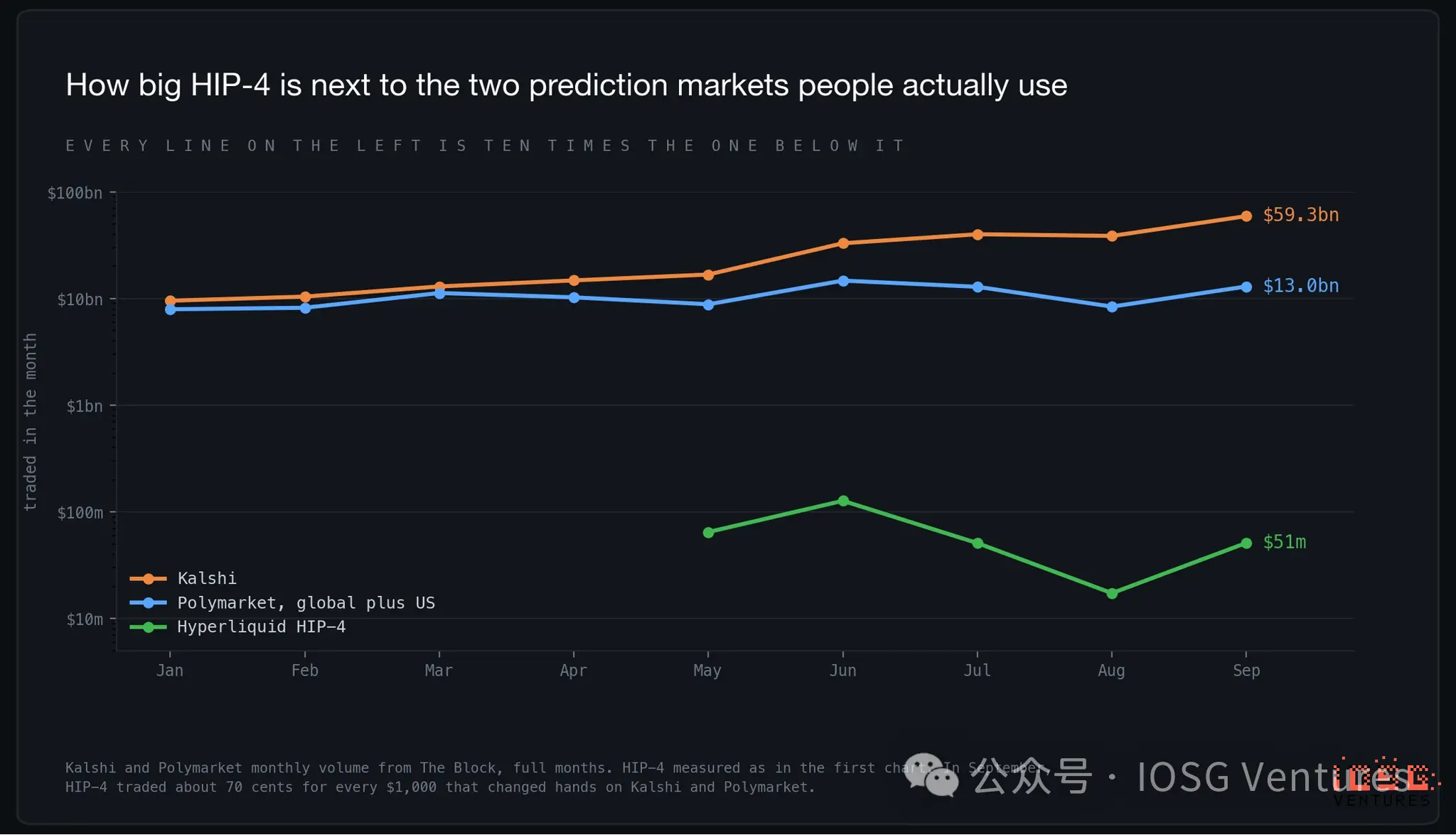
The gap is roughly 1,400x, and in dollar terms it's still widening, even as HIP-4 itself grows. Kalshi did $59.3 billion in September, up $20.6 billion from August. Polymarket plus its US business did $13 billion, with the bulk now in the US app. HIP-4 did $51 million.
The incumbents' edge isn't market design — they win on the two things that actually drive volume. First, events people care about, thousands of them, listed within hours of the news. Second, distribution: apps, brand, sports audiences, and for Kalshi a regulatory wrapper US brokerages can plug into directly. HIP-4 has 28 templates, three venues, and a user base that was already trading perps.
The incumbents are also starting to move toward Hyperliquid. In early September Polymarket launched perpetuals for non-US users, 67 markets covering crypto, stocks, indices, and commodities, with up to 20x leverage. Putting bets and leveraged positions under one roof was supposed to be HIP-4's exclusive thing. Now it's a feature race, and Polymarket entered it holding the events.
5. The economics: market-wide fees are less than half a single venue's staking yield
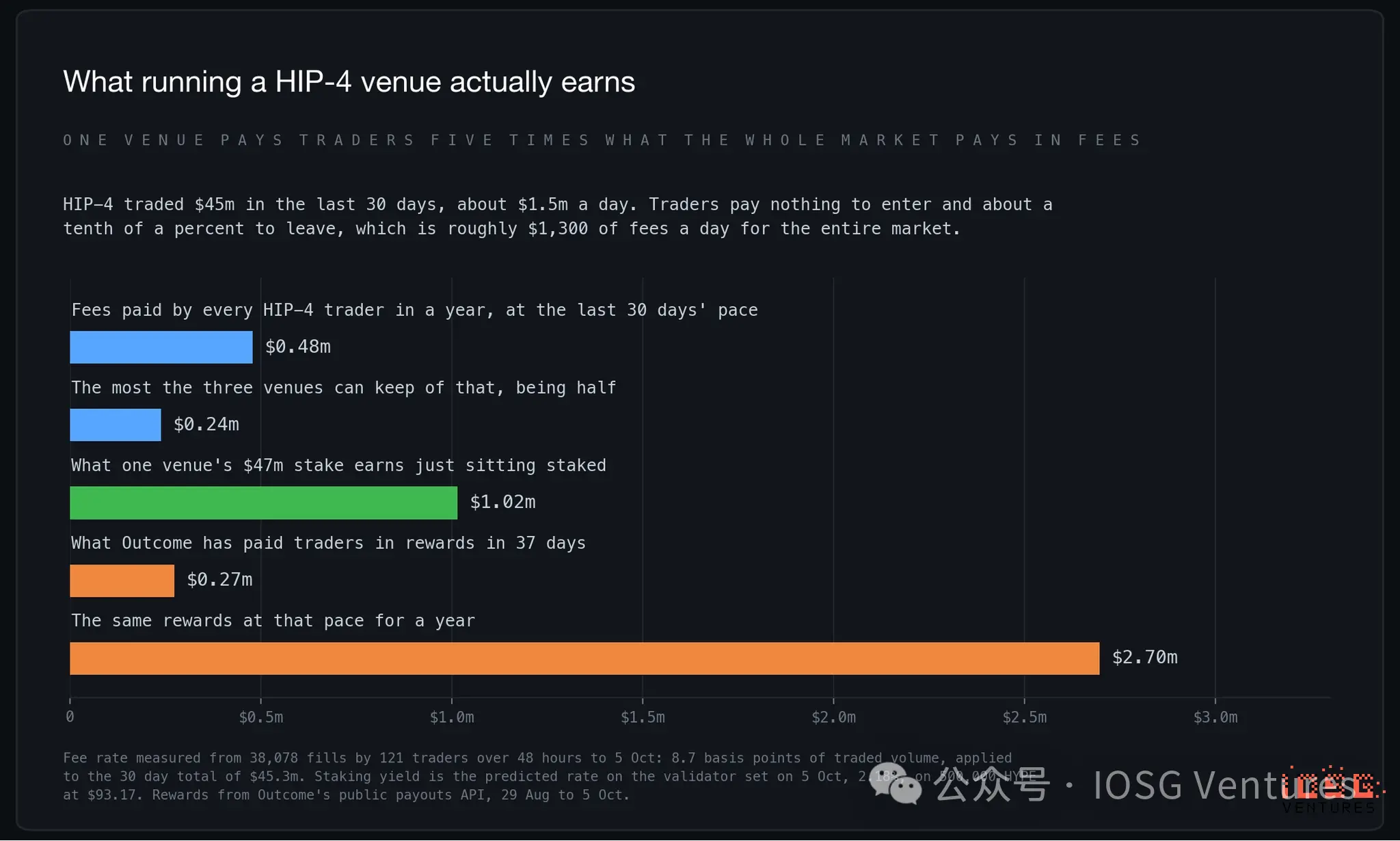
At the past 30 days' pace, all HIP-4 traders pay about $480,000 a year in fees. Venues take at most half, split three ways. The stake a venue must lock up to enter would earn $1 million a year sitting idle; the one with the most volume is paying out rewards at an annualized rate of $2.7 million to buy that volume.
By these numbers, no venue is running a business. They're buying an option, and the option has value: Hyperliquid says deployers can raise fees themselves later, volume can grow enough to support them, and private comps in the sector are $22 billion and $21 billion, with Kalshi reportedly in talks at $40 billion. But it's still an option, the carrying cost is a $47 million stake, and if volume never comes, it expires worthless.
6. Conclusion: design ahead, market not yet
The blocks are well built; the market hasn't arrived.
On the dimensions an engineer would pick, Hyperliquid built the better product: one account, one margin pool, bets and the positions they hedge on the same screen; settlement written into the template before the first trade; Yes and No on the same question sharing one order book so liquidity isn't split in two. Nothing over the past five months suggests design is the bottleneck.
The strongest argument for it is that you never have to leave. Margin, hedges, and bets all in one account — for a desk already trading perps on Hyperliquid, adding a prediction position is one click, no switching platforms, no new balances, no transferring back and forth. Whatever the competition with Kalshi turns out to be, that has value, and it's why it will persist at some scale even if it never becomes a business. But it's less unique than it was in August: Polymarket now sells leverage next to bets too, and it started from the side that has users.
It isn't deep enough. Across the 25 most active order books, the median bid-ask spread is 0.29 cents, with about $4,700 posted within