J.P. Morgan Report: The 2026 "Election Market" — Corporate Fundamentals Matter More Than Party Combinations


- Core View: According to a J.P. Morgan report, midterm elections may create market volatility and change certain policy constraints, but politics is not an independent asset pricing framework — monetary policy and the macroeconomic cycle have far greater explanatory power for market returns than party combinations.
- Key Elements:
- Since 1937, the S&P 500 has delivered an average total return of 9.2% in midterm election years, below the 13.3% in non-election years, but the drawdowns in 2018 and 2022 were primarily driven by Fed tightening rather than the elections themselves.
- Data from 1982–2022 shows that average returns in the first three quarters of midterm election years were slightly negative, while the fourth quarter averaged a 6.6% gain — market improvement often begins a month before voting day.
- Divided government limits fiscal expansion, but the president still retains considerable executive authority in the tariff domain, and changes in Congress do not necessarily lead to a synchronized shift in trade policy.
- On AI regulation, the two parties differ significantly in direction, but this will only enter market pricing after it genuinely changes corporate costs and earnings expectations.
- Macro pressures in 2026 are more direct: August CPI came in at 3.4% year-over-year, the Fed raised rates to 3.75%–4.00% in September, and the market has already priced in the possibility of another rate hike within the year.
- The report emphasizes that inflation, interest rates, fiscal deficits, and tariffs should be incorporated into a unified analytical framework — election outcomes must transmit to fundamentals before they constitute an effective market variable.
Editor's note: As the 2026 U.S. midterm elections approach, market discussion is shifting from "can Republicans hold Congress" to "what will the election results actually change." As of mid-September, Republicans' majority advantages in both the Senate and the House are relatively narrow, and the possibility of Congress returning to divided government has made fiscal policy, tariffs, regulation, and presidential appointments political variables in asset pricing once again. But when "elections bring uncertainty" has already become consensus, a more fundamental question begins to emerge: to what extent can political changes independently determine market direction, and how much of the so-called "election rally" is actually just the result of economic cycles, interest rates, and changes in corporate earnings?
In its September report "2026 Midterm Elections," J.P. Morgan Asset Management re-examines this question from three dimensions: the electoral landscape, policy impact, and historical market performance, with core data as of September 18, 2026. Rather than a midterm election forecast, it is an attempt to answer a question more relevant to investors: how do elections transmit through policy and ultimately enter asset prices?

In this report, what J.P. Morgan really does is break down "will the midterm elections affect U.S. stocks" into a set of more fundamental structural questions: Is control of Congress sufficient to change the fiscal and regulatory path? Does the historical weakness of midterm election years stem from political uncertainty, or from concurrent macroeconomic shocks? And when political risk eventually fades, what variables truly determine whether the market can continue to rise?
First, the way politics influences markets is shifting from "partisan labels" back to "policy transmission." In the past, investors could easily directly compare stock market returns under different parties and different congressional combinations; but J.P. Morgan cautions that such statistics can hardly explain causality. What is more noteworthy in 2026 is that if divided government emerges, fiscal expansion may face more constraints, and the risk of government shutdowns and debt ceiling negotiations may rise; but in areas such as tariffs where the president has considerable executive authority, changes in Congress do not necessarily mean a synchronized policy shift. The same applies to AI regulation—the two parties differ in policy priorities, but these differences only enter market pricing after they actually change corporate costs, investment, and earnings expectations.
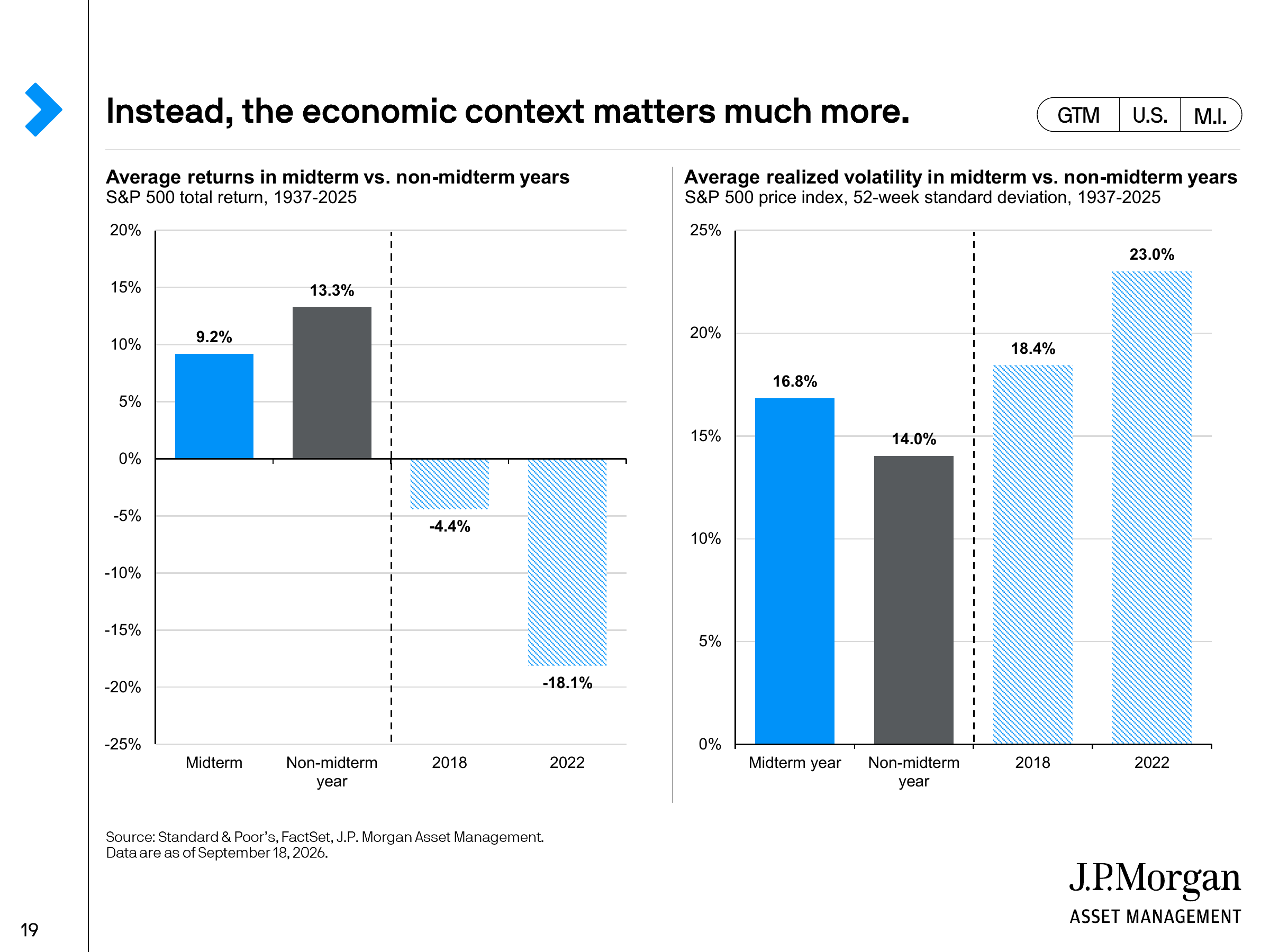
Second, the report's finding that "midterm election years perform worse" does not equal "elections cause market declines." Since 1937, the S&P 500's average total return in midterm election years has been about 9.2%, lower than the 13.3% in non-midterm election years, with higher volatility as well; but the notable drawdowns in 2018 and 2022 coincided with Fed tightening cycles, while 2002 was in the adjustment phase after the bursting of the tech bubble. J.P. Morgan therefore emphasizes that when understanding these years, the economic backdrop is more important than the political backdrop. This means historical data can show that markets are more prone to volatility during election periods, but it is insufficient to establish a stable "election—rise or fall" causal chain.
Third, what the market trades is not just the election result, but the dissipation of uncertainty itself. Historical data from 1982–2022 show that the S&P 500's average return in the first three quarters of midterm election years was slightly negative, while the fourth quarter averaged a gain of 6.6%; more importantly, the average market improvement often began less than a month before voting day. This means the post-election rally cannot simply be understood as "directional trading after the result lands," but is closer to a repricing of risk premium after multiple policy scenarios gradually converge.
Fourth, what truly weighs on the 2026 election is still the macroeconomic cycle. J.P. Morgan places inflation, interest rates, fiscal deficits, and tariffs into the same analytical framework, essentially reminding investors that even if the congressional map changes, as long as variables such as growth, monetary policy, corporate earnings, and valuations do not change in tandem, the market's pricing logic may not necessarily be rewritten. Another of its market analyses on the midterm elections likewise points out that monetary policy, the labor market, corporate profits, and valuations explain future returns better than which partisan combination controls the government.
If this report were compressed into a single judgment, it would be: midterm elections can create volatility and can change some policy constraints, but they are not an investment logic independent of the economic cycle. What truly needs to be observed is whether fiscal, trade, and regulatory changes after the election are large enough and further transmit to inflation, interest rates, growth, and corporate earnings.
In this sense, the subject discussed in this article is no longer just the 2026 U.S. midterm elections, but a more universal market question: when political events become headlines, what investors truly need to identify is the event itself, or the transmission mechanisms behind the event that can change fundamentals.
The following is the original content (the original content has been partly edited for ease of reading):
U.S. midterm elections are often one of the moments when financial markets are most easily drawn to political narratives.
Which party will take the House? Will the Senate flip? If divided government emerges, will fiscal stimulus weaken? Will regulation suddenly shift?
These questions will certainly affect policy, but in its latest "2026 Midterm Elections," J.P. Morgan tries to emphasize something else: historically, investors have often overestimated the explanatory power of "who controls Congress" for long-term market returns.
The report discusses in turn the 2026 electoral landscape, policy changes under different congressional combinations, and U.S. stock performance before and after past midterm elections. Its ultimate focus, however, is not politics, but a more traditional asset pricing framework—monetary policy, fiscal policy, economic growth, employment, corporate earnings, and valuations are usually more important than partisan combinations.
Both chambers are close, but what the market really cares about is whether policy can change
From the perspective of the elections themselves, there is indeed considerable room for congressional realignment in 2026.
J.P. Morgan's data show that as of September 18, the Senate consists of 53 Republican senators, 45 Democratic senators, and two independents who caucus with the Democrats; Democrats would need a net gain of 4 seats to take control. The House majority advantage is similarly narrow.
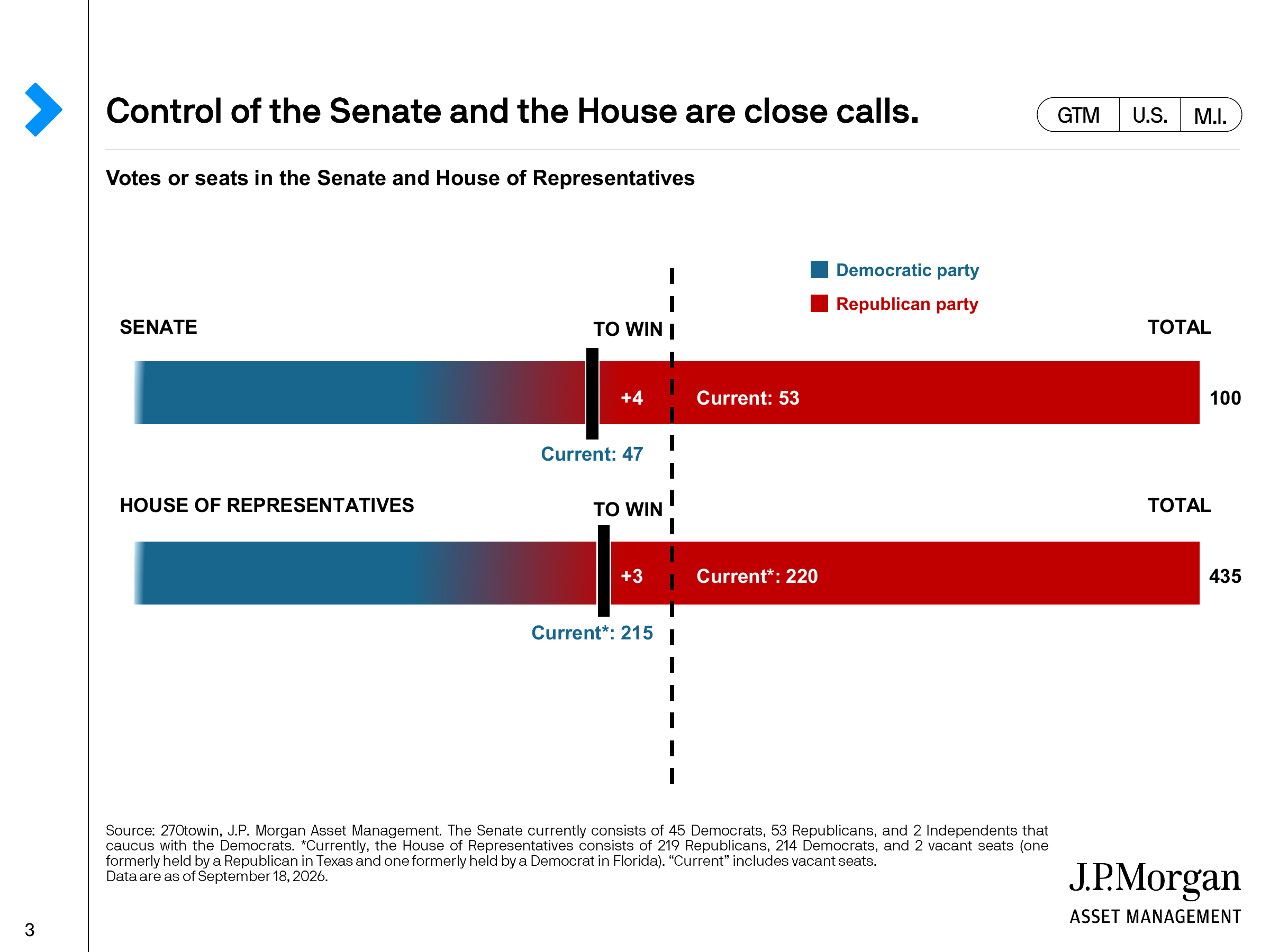
But the report does not directly equate "Congress flipping" with "a reversal in market logic." Instead, it focuses on which policies would be constrained after the congressional map changes, and which policies can still continue to advance.
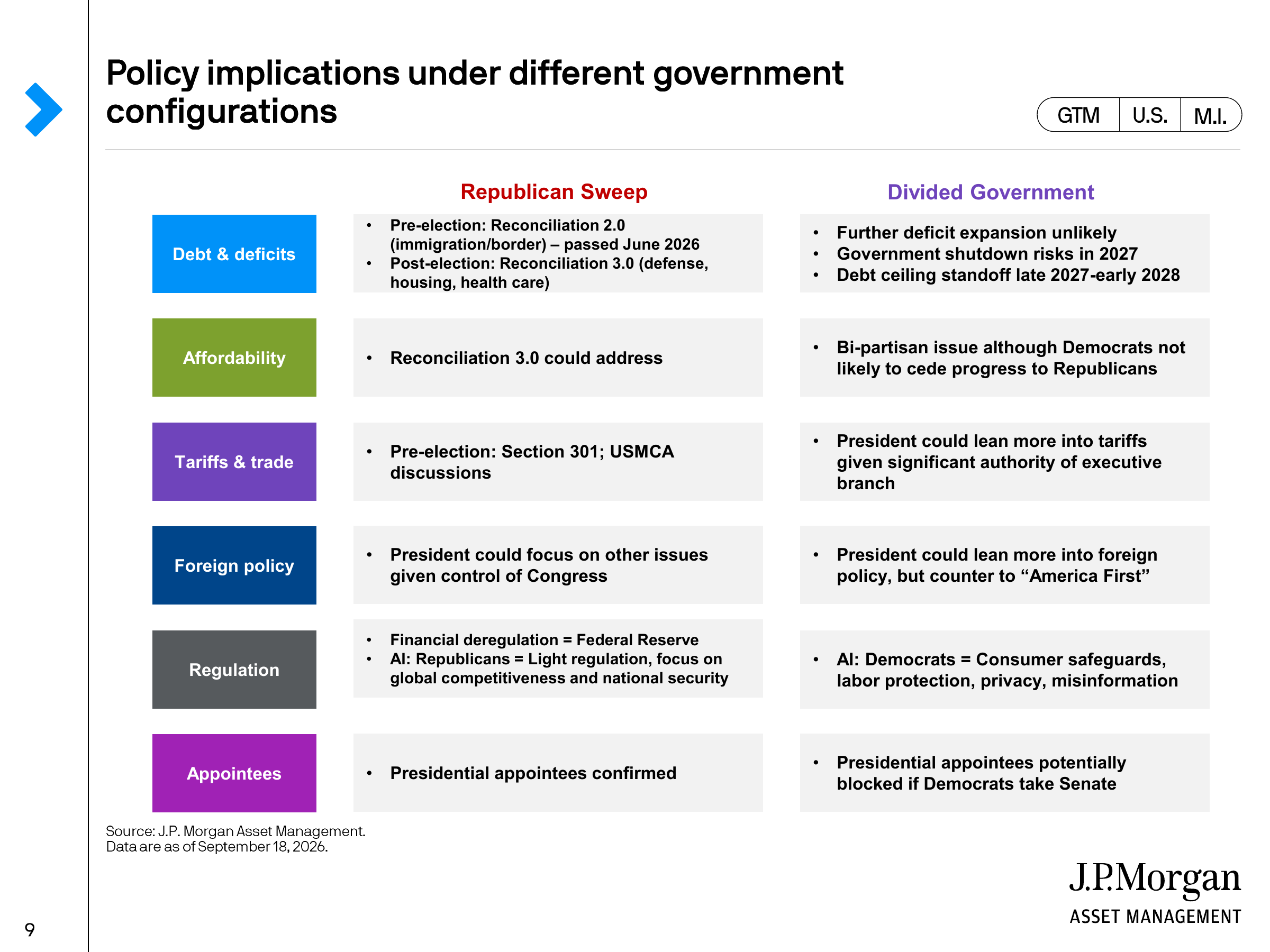
Taking fiscal policy as an example, J.P. Morgan believes that if divided government emerges, the room for further expanding the fiscal deficit may face more constraints; at the same time, a government shutdown in 2027 and debt ceiling negotiations from late 2027 to early 2028 may once again become market risk points. Conversely, if Republicans continue to control Congress, a new budget reconciliation bill could still involve areas such as defense, housing, and healthcare.
This shows that the election's impact on the market is not a simple chain of "which party wins → stocks rise or fall," but must pass through policy and then transmit to deficits, growth, inflation, and interest rates.
Fiscal policy may be constrained by Congress, but tariffs and regulation do not depend entirely on Congress
This distinction is especially obvious in trade policy.
J.P. Morgan points out that under a divided government scenario, the president still has considerable executive authority, so trade policy will not necessarily contract markedly as congressional control changes. The report mentions that a new round of Section 301 tariffs and USMCA-related discussions have already re-entered the policy spotlight; as of September 18, the effective average tariff rate on U.S. consumer goods imports was about 10.6%.
In other words, changes in Congress may significantly affect fiscal legislation, but may not constrain tariff policy to the same degree.
Regulation may show more direct policy differences. In its AI section, J.P. Morgan summarizes the Republican policy direction as lighter regulation, with emphasis on global competitiveness and national security; Democratic-related policies place more emphasis on consumer protection, labor rights, privacy, and combating disinformation. It should be emphasized that what is described here is J.P. Morgan's summary of policy directions under two government configurations, and does not mean that specific regulations will necessarily be implemented according to this framework.
Therefore, from the perspective of asset pricing, what truly matters is not the political label itself, but whether these policy differences ultimately change corporate costs, investment plans, profit margins, and macroeconomic inflation.
Midterm election years are indeed weaker, but "elections cause declines" does not hold
Historical data easily create the impression that midterm elections are bad for U.S. stocks.
J.P. Morgan's data show that since 1937, the S&P 500's average total return in midterm election years has been 9.2%, lower than 13.3% in non-midterm election years; average realized volatility in midterm election years is also higher.
But averages conceal a key issue: midterm election years often coincide with other, more important macroeconomic events.
In 2018, the S&P 500's full-year total return was about -4.4%, and in 2022 it was about -18.1%. Both years happened to be midterm election years, but J.P. Morgan primarily links the market pressure to Fed monetary tightening at the time. 2002 was also a poor-performing midterm election year, when the market was still digesting the bursting of the internet bubble.
So simply summarizing these years as "because of the midterm elections, stocks performed poorly" actually confuses correlation with causality.
This is also a point J.P. Morgan repeatedly emphasizes throughout the report: when understanding historical market returns, the economic environment usually has more explanatory power than the political environment.
The truly obvious seasonality is weakness in the first three quarters and recovery in the fourth
If one must look for common characteristics of midterm election years in history, the clearer pattern actually appears in the intra-year rhythm.
J.P. Morgan's statistics on midterm election cycles from 1982–2022 show that the S&P 500's average price returns in the first, second, and third quarters of midterm election years were about -0.5%, -0.6%, and -0.1%, respectively, while the fourth quarter rose to +6.6%. Its statistics on the 100 trading days before and after election day also show that historically, market improvement often did not begin on the day voting ended, but appeared less than a month before election day.
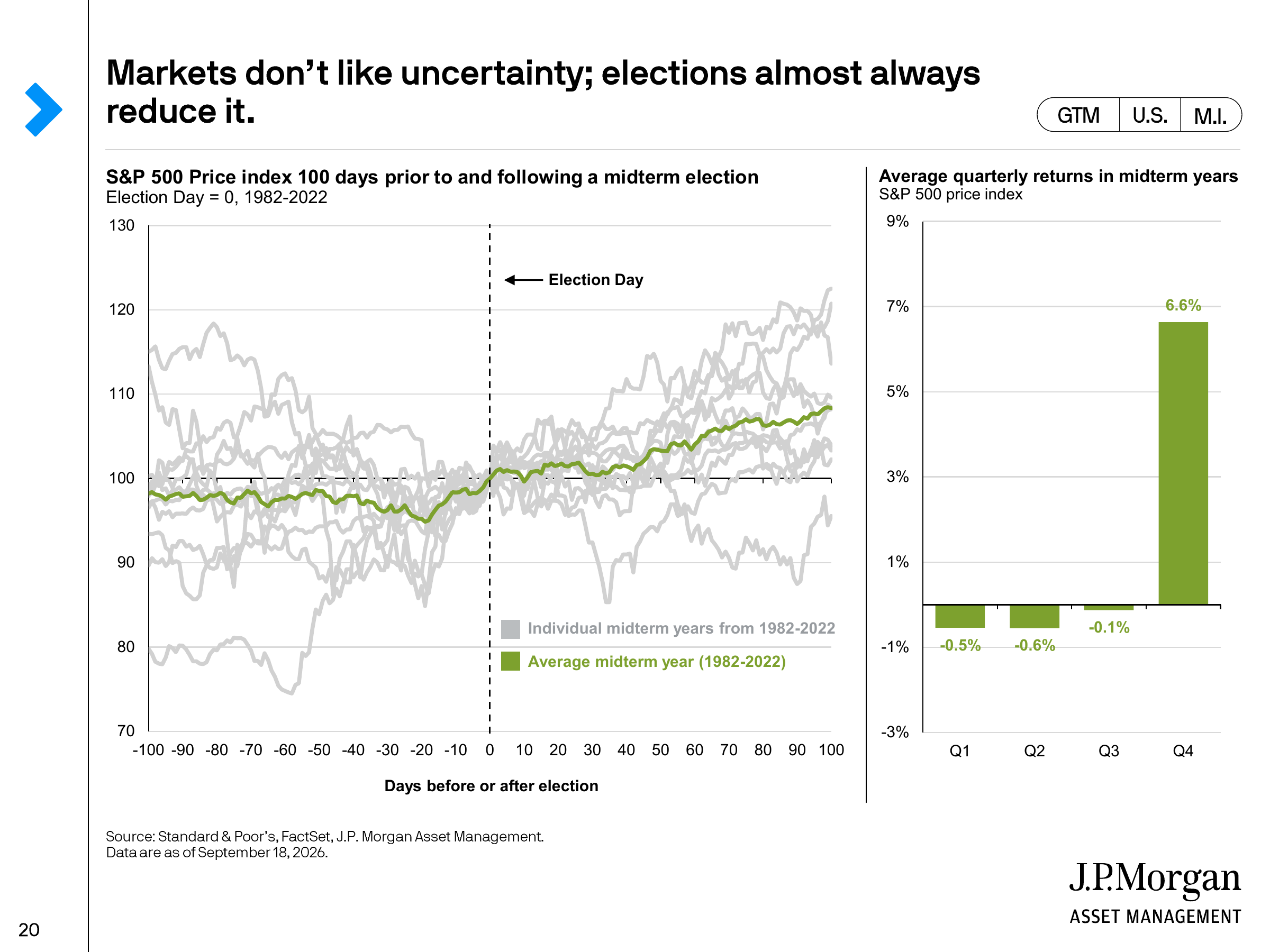
J.P. Morgan explains this phenomenon as "the dissipation of uncertainty": before the election, the market must simultaneously price multiple policy scenarios; as voting day approaches, the possible policy paths gradually narrow, and this source of election uncertainty declines accordingly.
But this can still only be understood as historical statistics, and cannot be directly extrapolated as a market forecast for 2026.
2002 is a clear counterexample. Even after the midterm elections ended, the fundamental pressure from the bursting of the tech bubble still outweighed the factor of "political uncertainty disappearing." In other words, elections can end political unknowns, but they cannot end the economic cycle itself.
What really needs to be watched in 2026 is still inflation and interest rates
This framework is especially evident this year.
In August, U.S. CPI rose 3.4% year over year, while core CPI rose 2.4% year over year; gasoline prices rose 3.9% month over month, contributing more than one-third of the month's overall CPI increase. J.P. Morgan's report therefore re-lists energy prices, household affordability, and inflation as important variables in the current macroeconomic environment.
Subsequently, the Federal Reserve raised rates by 25 basis points at its September meeting to 3.75%–4.00%. In the latest economic projections, the FOMC's median forecast for the federal funds rate at the end of 2026 is 4.1%, while it also expects full-year PCE inflation of 3.7% and core PCE of 3.4%.
J.P. Morgan also noted in its September 18 data that the market had already begun to price in the possibility of another rate hike within the year.
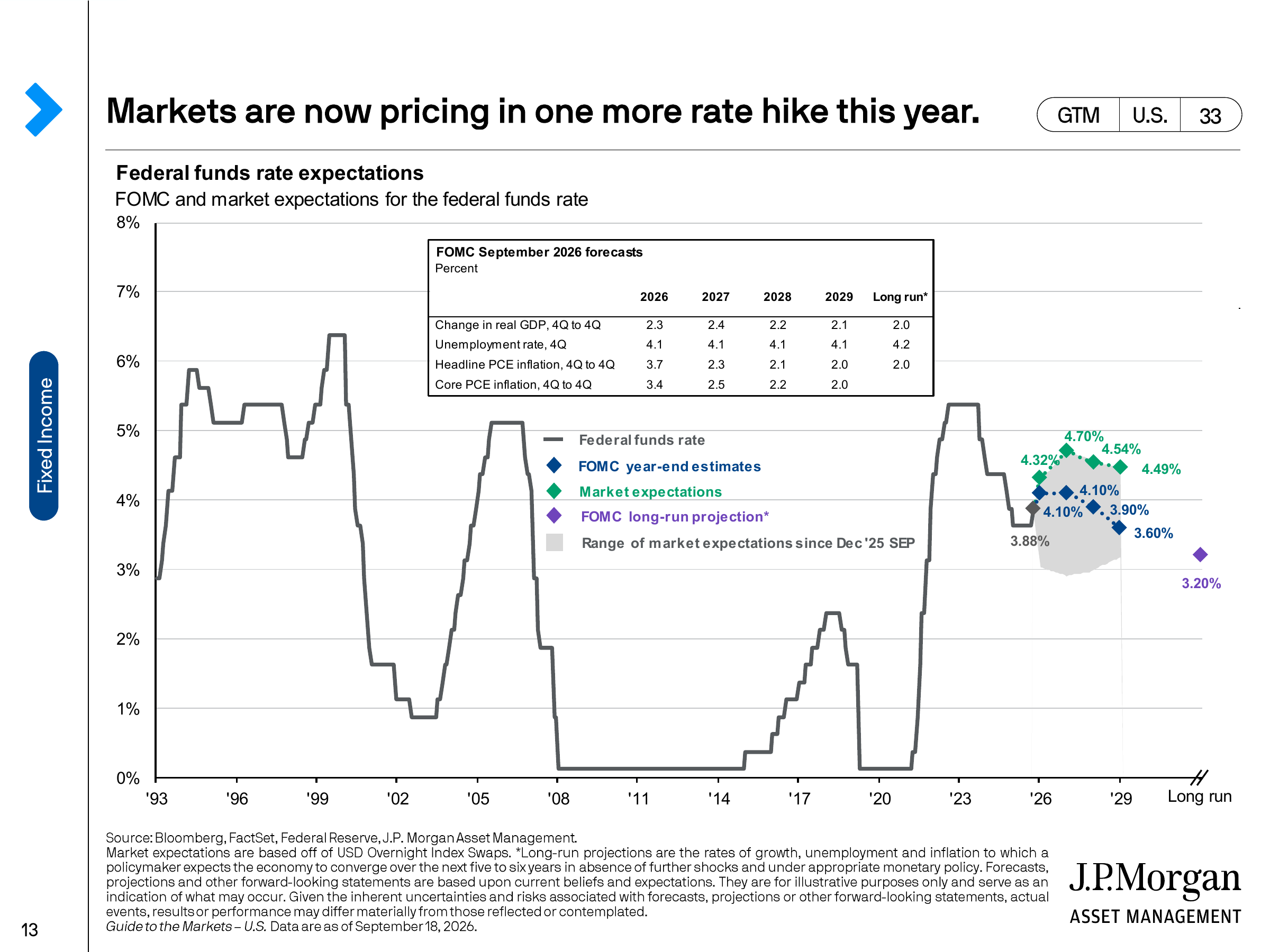
This makes the market environment surrounding the 2026 midterm elections clearly different from a pure "election trade": on one side are changes in the fiscal, trade, and regulatory paths brought by congressional control; on the other side are inflation and monetary policy repricing that have already occurred.
The latter can directly change the risk-free rate, valuation discount rate, and corporate financing costs, so its impact path on the broad market is more direct.
This is perhaps the most worthwhile conclusion to retain from J.P. Morgan's 22-page report: midterm elections may create additional volatility, but politics itself is not an independent asset pricing framework. Only when election results further change fiscal, trade, and regulatory policy and ultimately affect inflation, interest rates, growth, or corporate earnings do they truly become a market variable.
Therefore, to verify this logic going forward, what is more worth observing is not a single poll or seat change, but whether energy prices and inflation can fall back, whether the Fed's rate hike path continues to be revised upward, how fiscal space changes after the election, and whether tariff and regulatory policies truly enter corporate earnings expectations.