A 300% Surge in a Week — What Exactly Is QNT?


- Core View: Quant (QNT) surged nearly 300% in a week, driven by news including its partnership with U.S. payment clearing institution TCH, but whether its business growth can translate into actual value capture for the QNT token still lacks data support.
- Key Elements:
- QNT rose 46.64% in 24 hours and 297.3% over 7 days, peaking at 373 USDT.
- Quant's core product Overledger provides a blockchain interoperability middleware layer for financial institutions, and QNT can be used to pay for platform subscription fees.
- On September 24, Quant announced a partnership with TCH to provide technical support for a U.S. interbank tokenized deposit clearing network, which processes over $2 trillion daily.
- Quant is also involved in the UK's GBTD, the European Central Bank's digital euro Pioneer project, and collaborations with Japan's Dentsu Soken, among others.
- KOL tweets ignited FOMO sentiment with the narrative of "missed BTC, don't miss QNT," with views exceeding ten million.
- Whether banking projects require holding or using QNT has not been disclosed, and business growth cannot be directly equated with token value capture.
Original | Odaily (@OdailyChina)
Author|Azuma (@azuma_eth)
Over the weekend that just passed, Quant (QNT) became one of the most closely watched tokens in the crypto market thanks to its astonishing price surge. As of press time, QNT is trading at 265 USDT, up 46.64% in 24 hours and a staggering 297.3% over the past 7 days, having briefly touched 373 USDT at its peak.
Nearly tripling in a week — what exactly happened behind the scenes?
What Exactly Is QNT?
Quant is a UK fintech company founded in 2018. Its core business is not building a public chain similar to Ethereum or Solana, but rather providing blockchain interoperability, digital asset, and programmable money infrastructure for financial institutions.
Quant's core product, Overledger, can be understood as a middleware layer connecting traditional financial systems with various blockchains. Quant aims to enable banks to access tokenized deposits, digital assets, and different distributed ledgers without having to tear down and rebuild their existing systems. The official positioning of Overledger is to connect digital currencies, assets, traditional payment rails, banking infrastructure, and blockchain networks.
This is also why Quant has frequently appeared in central bank, banking, and payment projects over the past few years. For example, Quant participated as a technology provider in Project Rosalind by the BIS and the Bank of England; in 2025, it joined the European Central Bank's digital euro innovation platform Pioneer project to test conditional payment functionalities. Its founder, Gilbert Verdian, has also been involved in advancing ISO/TC 307 blockchain and distributed ledger standards, serving as convener of the interoperability working group.
As for QNT, it is Quant's native token. According to Quant's official materials, Overledger platform subscription fees can all be paid using QNT. In other words, Quant is essentially selling financial infrastructure, and QNT is a token connected to this commercial ecosystem.
But what truly brought market attention back to it was a recent partnership development.
News Catalysts Ignite, FOMO Sentiment Fuels the Rally
The starting point of this round of QNT's surge can be traced back to September 24, when Quant announced it had reached a partnership with US financial infrastructure institution The Clearing House (TCH).
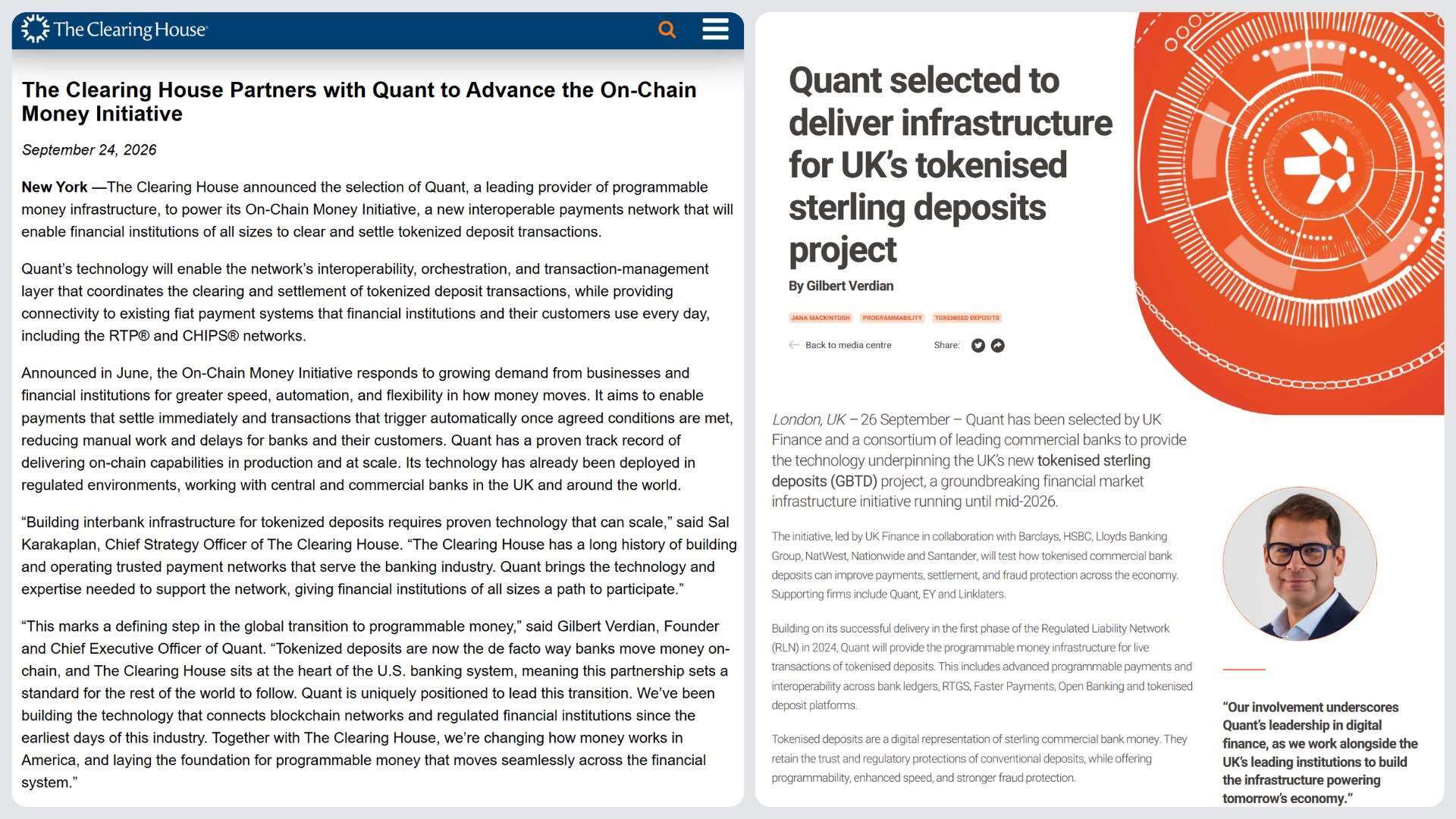
The core of the collaboration is that TCH will select Quant to provide technical support for its On-Chain Money Initiative, to build an interoperable payment network for financial institutions for the clearing and settlement of tokenized deposits. Quant will be responsible for interoperability, transaction orchestration, and transaction management layers, while also connecting existing payment systems such as RTP and CHIPS. The network is expected to open to participating institutions in the first half of 2027.
The reason this partnership has drawn market attention is that Quant is not plugging into an experimental project of a single bank, but rather into the payment infrastructure of the US banking system. TCH's payment network processes over $2 trillion in payment clearing and settlement daily, and its On-Chain Money Initiative was previously announced in June, with the goal of exploring how tokenized deposits can enter interbank payments, corporate treasury management, and digital asset settlement scenarios.
Of course, there is also a detail that is easily amplified by market narratives — TCH processing $2 trillion daily does not mean that $2 trillion will be settled through QNT in the future. What public information can currently confirm is that Quant has become a technology provider for the initiative, responsible for the infrastructure layer, but it has not been disclosed whether participating banks need to hold or use QNT.
And TCH is not the only case of Quant recently breaking into traditional financial infrastructure. In January of this year, Quant had already formed a strategic partnership with Japanese systems integrator Dentsu Soken, planning to jointly promote the adoption of tokenized deposits, institutional stablecoins, and programmable settlement infrastructure by Japanese financial institutions; in March, Quant partnered with financial software giant Murex to integrate its programmable money infrastructure into Murex's MX.3 platform, enabling banks to handle tokenized deposits and digital bonds within their existing trading, risk management, and post-trade systems; even earlier, Quant had already participated in the UK's GBTD (Great British Tokenised Deposits) project. The UK Finance association also announced this month that Barclays, HSBC UK, Lloyds, Monzo, Nationwide, NatWest, and Santander had completed the first batch of tokenized GBP deposit transactions with real customers, and Quant is precisely the technical infrastructure provider for that project...
These scattered developments have been woven together in the recent market into a single narrative — the US has TCH, the UK has GBTD, Japan has Dentsu Soken, and capital markets have Murex. Quant appears to be becoming the "infrastructure provider" for traditional financial institutions exploring tokenization and programmable money.
But what truly pushed this narrative to a sentiment peak was a tweet from overseas KOL Jan Nieuwenhuijs.
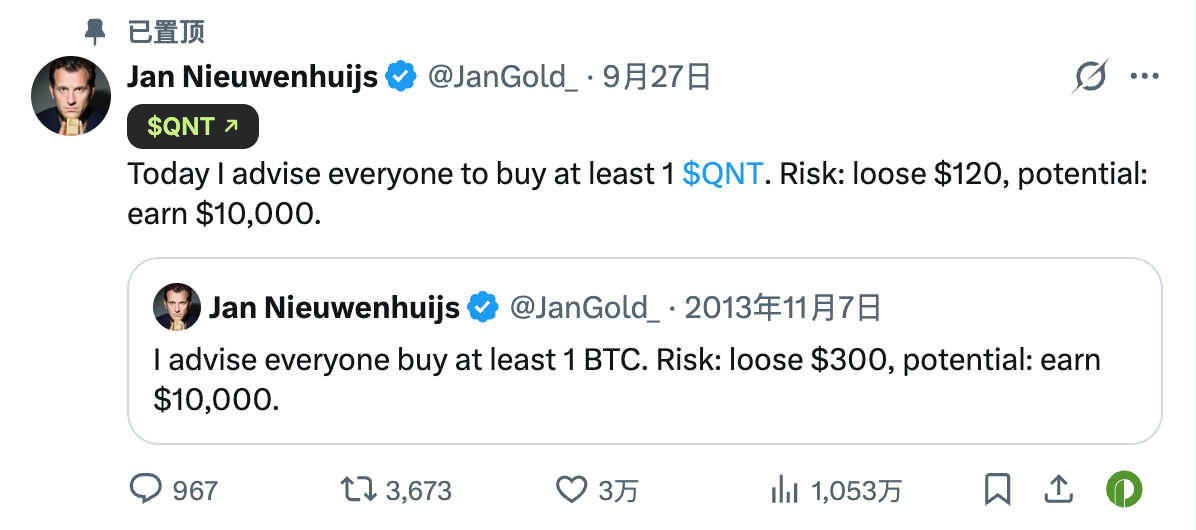
On September 27, Jan quoted his own 2013 post shilling BTC — "I suggest everyone buy at least 1 BTC. Risk is losing $300, potential profit is $10,000" — and shilled QNT in the same format: "I suggest everyone buy at least 1 QNT. Risk is losing $120, potential profit is $10,000."
As QNT initially rose, this tweet quickly spread within the community, surpassing 10 million views as of press time, and in turn further drove QNT's continued rally.
Thus, what was originally professional news in the financial infrastructure space was further compressed into a highly viral story — "You missed BTC back then, at least don't miss QNT now." Combined with the recent recovery in overall crypto market risk appetite, capital was already more inclined to chase high-beta assets. With institutional partnerships, scarce supply, and a BTC-style early narrative all appearing simultaneously, QNT's rise ultimately evolved from being "catalyst-driven" into a clear round of FOMO trading.
Does "Business Growth" Equal "Value Capture"?
From the project's own perspective, QNT's rally is not entirely without fundamental support. Whether it is TCH's on-chain money initiative or related projects in markets like the UK and Japan, they all demonstrate that Quant is gaining real validation of its technical capabilities from traditional financial institutions. As tokenized deposits, digital asset settlement, and similar directions gradually move from concept to implementation, the sector Quant operates in does indeed have room for further growth.
However, for the QNT token, "Quant's business growth" and "QNT's value capture" still cannot be entirely equated. What public information can currently confirm is that QNT can be used to pay for Overledger subscription fees, but how much revenue the aforementioned banking and financial infrastructure projects will actually bring to Quant, and how much of that will translate into real demand for QNT, still lacks sufficient data. Especially after a nearly 300% surge in a week, what the market is trading is no longer just these already-landed partnerships, but also advance pricing of future value capture.
Therefore, QNT currently looks more like a re-pricing driven by the resonance of fundamental catalysts and market sentiment. But the faster the price rises, the more the gap between expectations and reality may be rapidly widened. For a token that has already experienced such a violent surge, what is truly worth watching going forward may not be how many more partners it can find, but whether these partnerships can ultimately be converted into quantifiable commercial revenue, and further transmitted into real demand for QNT.