






Why do you have to wait in a queue for a month to participate in native Ethereum staking now?


- Core Viewpoint: The Ethereum validator queue is a rate-limiting mechanism actively set by the protocol, causing newly staked ETH to wait approximately 32 days before activation and reward generation, while the exit queue is usually clear. This reflects that staking demand far exceeds the rate of entry the protocol allows.
- Key Elements:
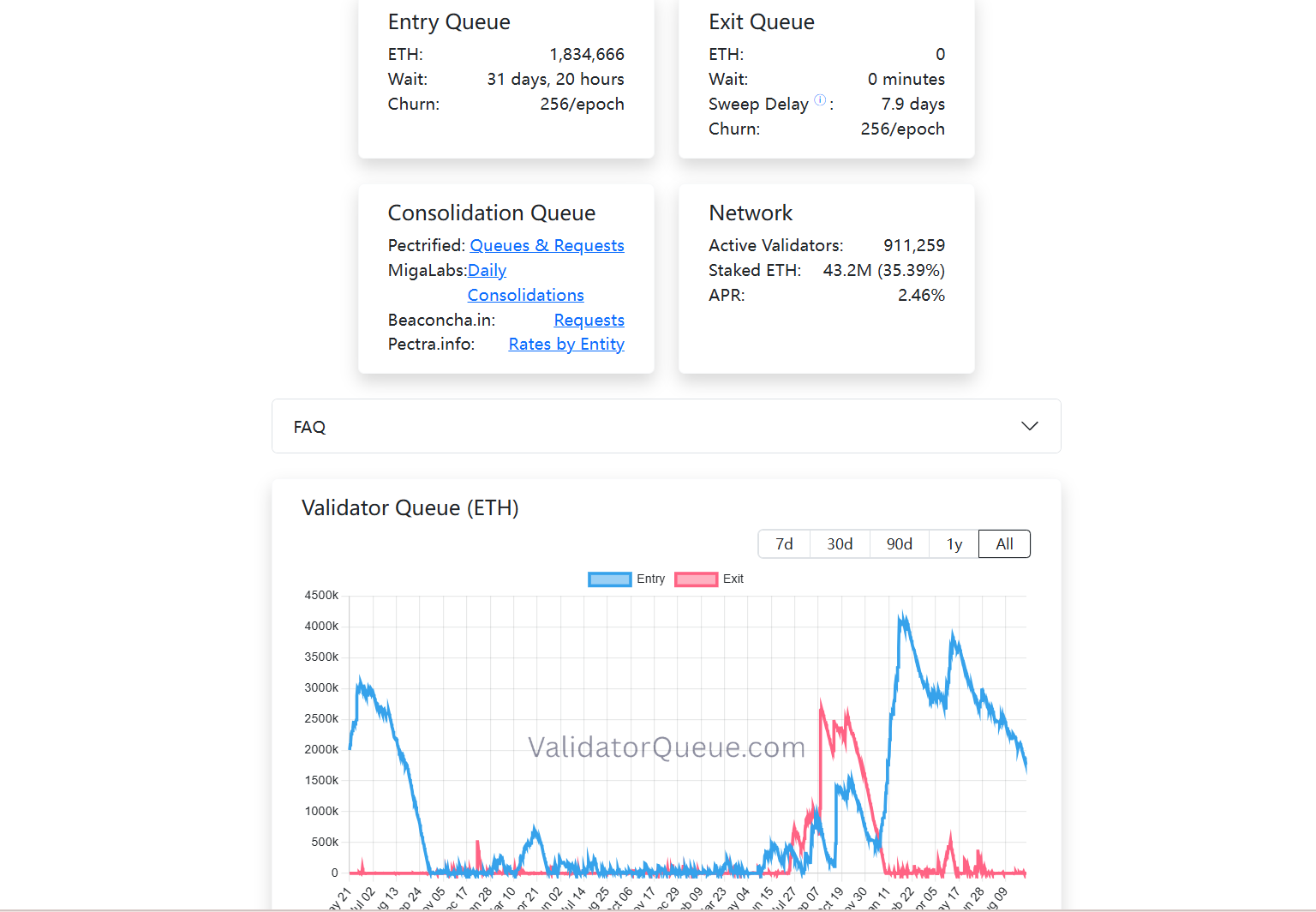
- As of September 16, approximately 1.83 million ETH were waiting to enter the validator set, with an estimated wait of about 32 days; at the March peak, this reached 3.4 million ETH with a wait of nearly 60 days.
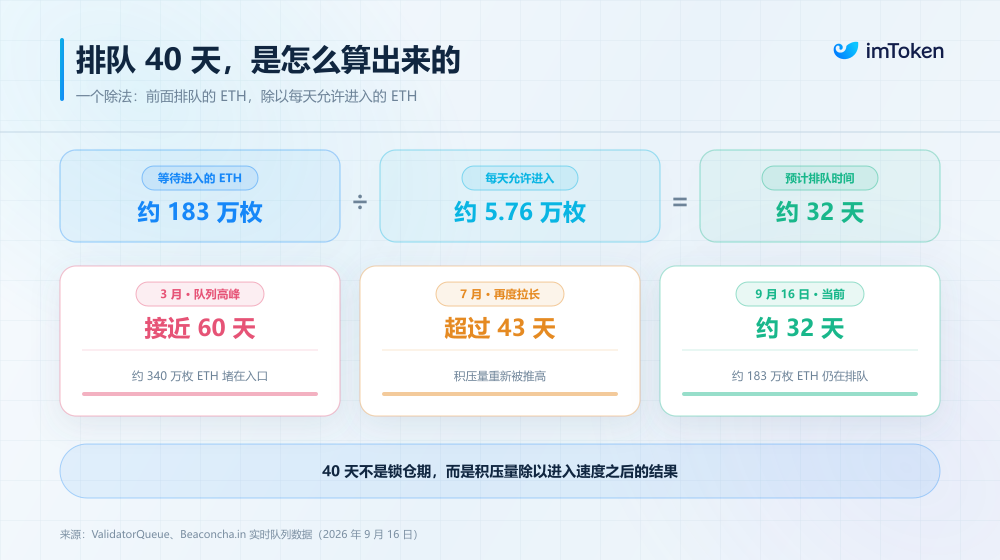
- The Churn Limit restricts entries to a maximum of 256 ETH per Epoch, equivalent to about 57,600 ETH per day; wait time = total queue volume ÷ daily processing capacity.
- Validators only receive protocol rewards after entering Active status; waiting 40 days results in an estimated loss of about 0.09 ETH (based on an estimated 2.6% APR).
- Ethereum has over 900,000 active validators and over 42 million ETH staked; EIP-7514 sets a cap to prevent drastic fluctuations in the validator set.
- The short exit queue is due to low demand, and after exiting there is still a withdrawal process of about 27 hours plus several days; Glamsterdam's EIP-8061 proposes to increase exit capacity while retaining the entry cap.
If you have recently participated directly in Ethereum native staking, you may have noticed that your ETH was deposited and the on-chain transaction succeeded, but the validator still hasn't started working, instead remaining in a "queued" state.
And this queue will most likely last over a month.
As of September 16, Ethereum still had over 1.8 million ETH waiting to enter the validator set, with an estimated wait time of about 32 days. In July of this year, the wait time once exceeded 43 days, and at the peak of the queue in March, roughly 3.4 million ETH was backed up at the entrance, with a wait time approaching 60 days.
In other words, "queuing for a month" is not an exaggeration.
But problems arise along with it.
Ethereum produces a Slot roughly every 12 seconds, and an ordinary transaction can be confirmed quickly. So why, when it comes to staking, does billions of dollars' worth of ETH have to sit and wait for dozens of days? More importantly, is there any yield during these dozens of days? Why does entering staking now require waiting over a month, while exiting may only take a few minutes?
The answer lies in a very important yet rarely noticed mechanism of Ethereum: the Validator Queue.
1. How exactly is "queuing for a month" calculated?
First, let's address the most easily misunderstood point: Ethereum does not stipulate that newly staked ETH must be locked for 40 days before it can start working.
One month is just a dynamic result.
Simply put, it can be understood as: ETH waiting ahead to enter ÷ ETH allowed to enter per day on Ethereum = approximate queue time.
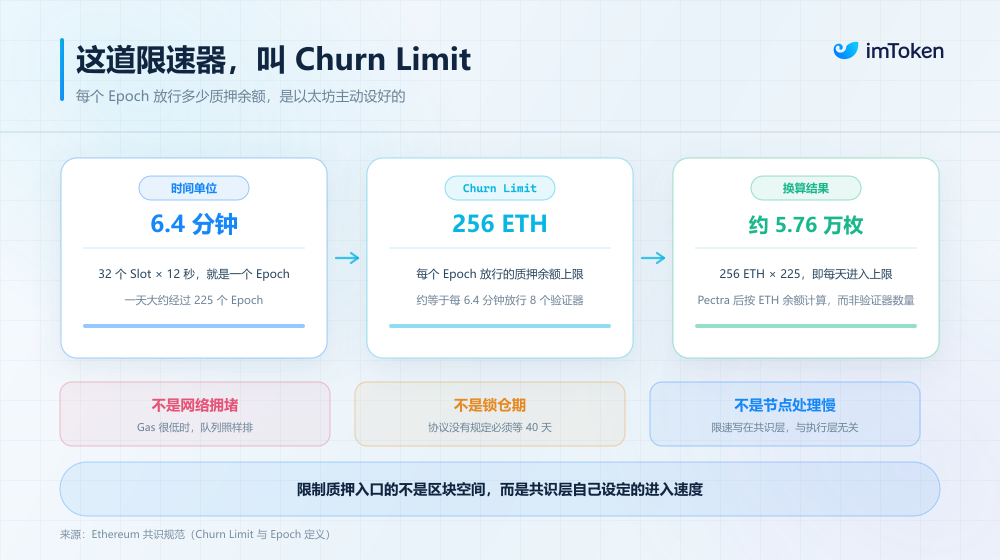
Ethereum PoS does not allow all new validators to enter the network at once. Instead, it has a rate-limiting mechanism called the Churn Limit, which controls the maximum amount of staking balance that can join the validator set per Epoch.
One Epoch contains 32 Slots, and each Slot is about 12 seconds, so one Epoch is approximately 6.4 minutes, and a day goes through about 225 Epochs.
After Pectra / Electra, Ethereum began calculating this limit more in terms of "ETH balance" rather than simply the number of validators. Currently, the processing cap for new stakes is 256 ETH per Epoch. Converted entirely into traditional 32 ETH validators, that equates to admitting at most 8 standard validators every 6.4 minutes.
From this, it's easy to calculate how much ETH can enter per day: 256 ETH × 225 ≈ 57,600 ETH/day.
So if there are about 1.83 million ETH waiting to enter ahead, that's 1.83 million ÷ 57,600 ≈ 32 days. This is the core source of "queuing for a month."
Therefore, this number changes every day.
If fewer than 57,600 ETH enter the queue each day, the backlog will gradually be cleared, and 40 days could become 30 or 20 days. Conversely, if more than this amount of ETH floods in each day, the queue will not only fail to shorten but will grow even longer.
The roughly 3.4 million ETH queuing in March of this year, with a wait approaching 60 days, was an extreme example.
So this is actually a different matter from what we usually understand as "whether Ethereum is congested."
Low gas and abundant block space do not mean validators can join immediately, because what limits it is not execution-layer transaction capacity, but a validator entrance rate limiter that Ethereum has deliberately set up.
2. Why not just open the entrance and let all ETH in at once?
Since queuing for dozens of days means funds cannot generate staking yield, the most direct solution seems simple: just raise the 256 ETH / Epoch cap, right?
The problem is that validators are not ordinary accounts.
Once an ETH transfer is completed, it basically does not add a continuous burden to the entire network. But once a validator is activated, it enters Ethereum's consensus system for the long term, participating in block attestations, committee assignments, and network consensus.
Ethereum currently has over 900,000 active validators, with over 42 million ETH staked. Every new validator becomes part of this massive consensus system.
This is why Ethereum has always actively controlled the rate of change in the validator set.
EIP-7514, proposed in 2023, specifically set a cap on validator activation speed. The concern behind it was not that "too many people staking is bad"—quite the opposite. It was that if the number of validators grew uncontrollably in a short period, the consensus-layer state size, validator management, and network communication and processing pressure would all rise accordingly.
After Pectra, Ethereum allows a single compounding validator's effective balance to be raised to as high as 2048 ETH, partly to ensure that large amounts of staked funds no longer have to be split into tens of thousands of 32 ETH validators, thereby reducing the extra burden caused by the continuous expansion of validator count.
But beyond that, the Churn Limit has an even more fundamental purpose: to prevent the group of people maintaining Ethereum's security from undergoing drastic changes in a short period.
After all, the security of a PoS network depends on the current active validator set.
If large amounts of staked funds could join or leave instantly, then the very basis on which the entire network determines who is eligible to participate in consensus and how much economic security remains in the system would also change rapidly. Therefore, Ethereum needs to impose an artificial speed limit on such changes.
This is also why "queuing" is not a Bug waiting to be fixed.

From the user's perspective, it does sacrifice some capital efficiency. But from the protocol's perspective, it is more like a deliberately placed speed bump, showing that Ethereum would rather let millions of ETH wait at the door for dozens of days than let the validator set suddenly expand or contract within a few days.
Even looking at the future roadmap, this approach has not changed.
EIP-8061, currently planned for inclusion in Glamsterdam, aims to significantly improve the processing capacity for exits and validator consolidation to alleviate exit congestion, but it still plans to retain the 256 ETH / Epoch cap on the activation side.
In other words, Ethereum is considering making "exiting" more flexible, but for now it is not prepared to fully open the "entrance" gate.
3. Is there yield during the queue? Why is exiting so fast now?
So once ETH is deposited, does the month of waiting count as staking?
From the perspective of protocol rewards, no.
Only when a validator truly enters the Active state will it begin performing attestations, participating in block proposals, and other validation work, and receive corresponding Ethereum protocol rewards.
Before that, even if the staking transaction has been completed and the ETH has entered the staking process, as long as the validator is still in Pending status, it will not generate normal validator staking rewards. Ethereum.org treats "Active" as the point at which a validator begins working and generating yield.
This is where the long queue truly affects ordinary users.
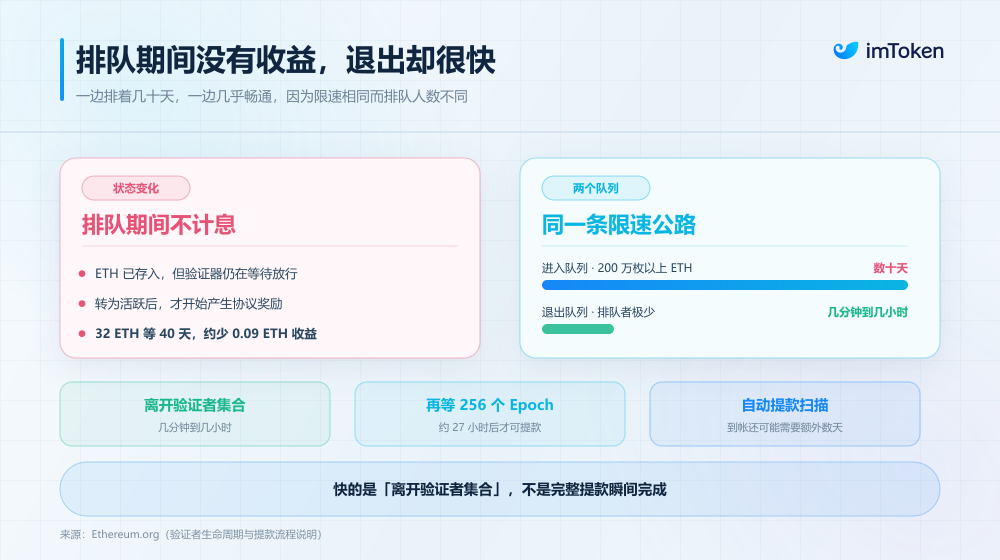
Based on the current network-wide staking APR of about 2.6%, a 32 ETH validator waiting 40 days forgoes approximately 0.09 ETH in potential protocol yield.
On its own, that doesn't seem particularly dramatic. But for an institution that needs to deploy tens of thousands or hundreds of thousands of ETH, the cost of idle capital over 40 days quickly magnifies.
This also explains why the Ethereum staking queue has recently attracted more attention from institutions and ETH treasury companies. In the past, when comparing different staking options, what people noticed most easily was how many percentage points the APR differed and what the fees were. But when the queue itself can last over a month, "when can yield actually start being generated" has also become part of capital efficiency.
However, there is an interesting contrast here.
If you check the exit queue, you'll find that wait times are often only a few minutes to a few hours. Does Ethereum allow people to run away quickly but not to enter quickly?
Actually, no. Both entry and exit have Churn Limits and are subject to protocol rate limiting; the queue length ultimately depends on how many people are queuing.
Right now, more than 2 million ETH want to enter, while very little ETH is actually waiting to exit. So on the same rate-limited highway, one side has a queue dozens of kilometers long, while the other side is almost completely clear.
Moreover, "a very short exit queue" does not mean ETH can return to your wallet minutes later. After a validator completes its exit, it still needs to wait a fixed 256 Epochs, about 27 hours, before entering a withdrawable state. After that, it must also wait for Ethereum's automatic Withdrawal Sweep to send the funds to the withdrawal address, and the entire process may still take several additional days.
For ordinary users, this also means there is an easily overlooked difference between different staking methods.
If you choose to run your own validator, or create an independent validator through a non-custodial ETH staking service like imToken, then the underlying layer still needs to genuinely enter the Ethereum validator set, and therefore must go through this protocol queue. For example, in imToken's non-custodial staking, users hold the withdrawal keys while the node service provider handles validator operation. When the page shows "queued," it essentially means the validator is waiting for Ethereum to let it through, and protocol yield only begins once the status changes to "Active."
Some liquid staking pools, however, because they already have a large number of active validators and liquidity tokens, can abstract this waiting period to some extent at the product level. Users may not directly experience the dozens of days of "zero-yield queuing period."
The trade-off, however, is introducing another set of trust boundaries, including additional risks such as smart contracts, LST liquidity, protocol governance, and asset exchange. This is also a problem often obscured by APR: the true cost of staking is never only fees and yield.
When funds enter, when they truly start working, when they can exit, and who holds control over the assets during this process are all part of the staking product itself.

Final Thoughts
On the surface, Ethereum making millions of ETH queue at the door for over a month seems like a rather inefficient design.
But if you shift your perspective to the entire network, it becomes understandable. After all, ordinary transactions pursue execution as quickly as possible, while validators determine who maintains Ethereum's consensus at the next moment.
The former can pursue ever-greater speed; the latter instead requires restraint.
So this is actually what happens when staking demand far exceeds the entry speed set by the protocol: a previously invisible safety guardrail is turned into a visibly long queue.
In a sense, the longer this queue is, the more it shows that at this stage, staking demand to enter the Ethereum validator set continues to exceed the entry speed allowed by the protocol.
But no matter how many people are standing outside, Ethereum still insists on opening the door only at its own pace, one Epoch at a time.





