Once worth $7 billion, the veteran DeFi protocol has decided to shut down


- Key Takeaways: Veteran DeFi protocol Balancer is initiating an "orderly shutdown" proposal led by its co-founder, as v3 revenue failed to succeed v2 and last year's $128 million hack continued to drag on partnerships. The plan would return approximately $9 million in treasury assets to BAL holders, with liquidation expected to complete by July 2028.
- Key Elements:
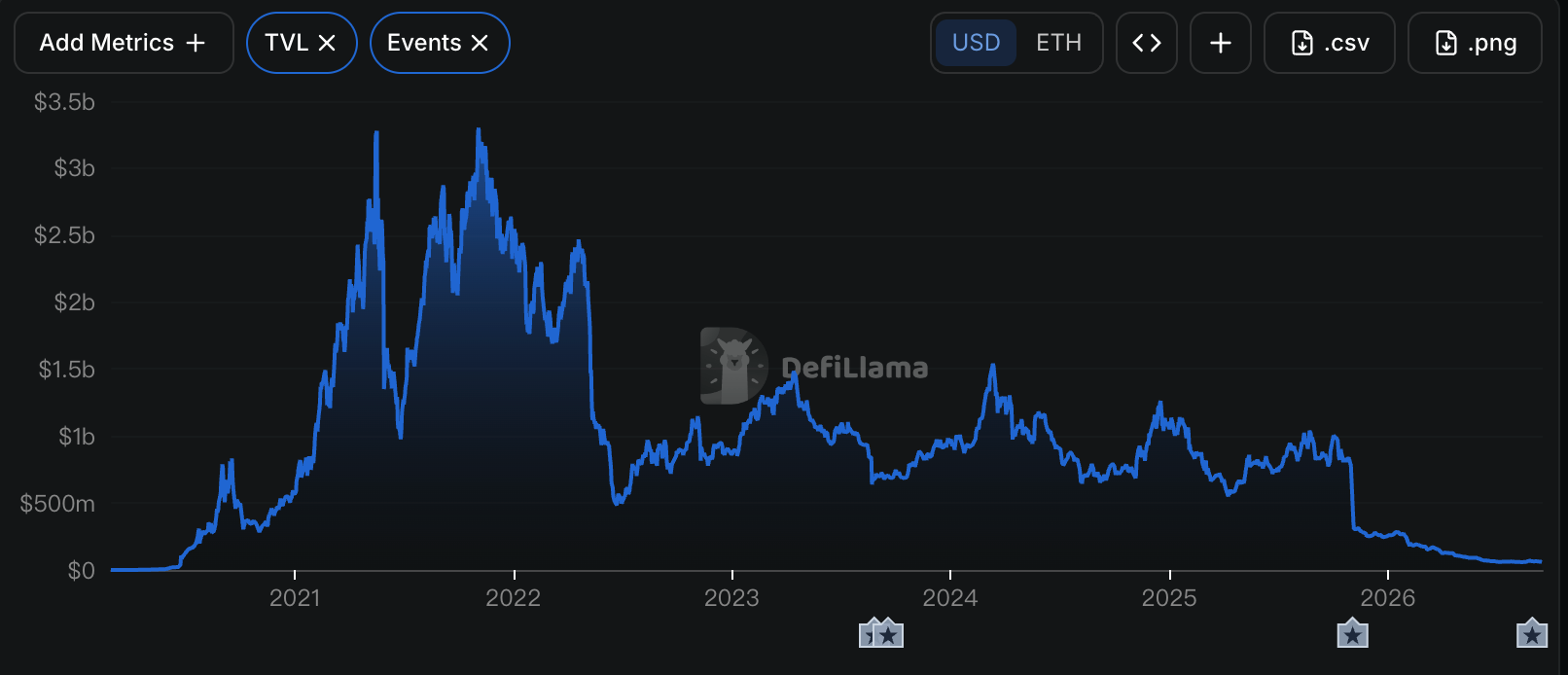
- Balancer's peak TVL exceeded $2.4 billion, with a token all-time high of $74.45 (FDV over $7 billion).
- In November of last year, v2's composable stable pool suffered a flash loan attack, resulting in $128 million in losses that severely impacted subsequent partnership adoption.
- An April restructuring halted BAL emissions, removed veBAL functionality, redirected all fees to the DAO, and reduced the team to 12.5 full-time positions, yet v3 revenue still fell short of targets.
- Shutdown timeline: October 30 — liquidity pools transition to withdrawal-only, fees reduced to zero; October 31 — contributor notice period ends; May 2027 — first round of treasury redemption begins; end of July 2028 — liquidation completed.
- Approximately $9 million in treasury assets will be distributed to holders via a "burn BAL, claim pro-rata" mechanism, with the original buyback plan cancelled.
- The proposal is still in the governance phase, with a Snapshot vote scheduled from September 25 to 29. If it fails to pass, the existing framework will continue to operate.
Original | Odaily (@OdailyChina)
Author|Azuma (@azuma_eth)
Balancer, once a DeFi leader, is now preparing to shut down operations.
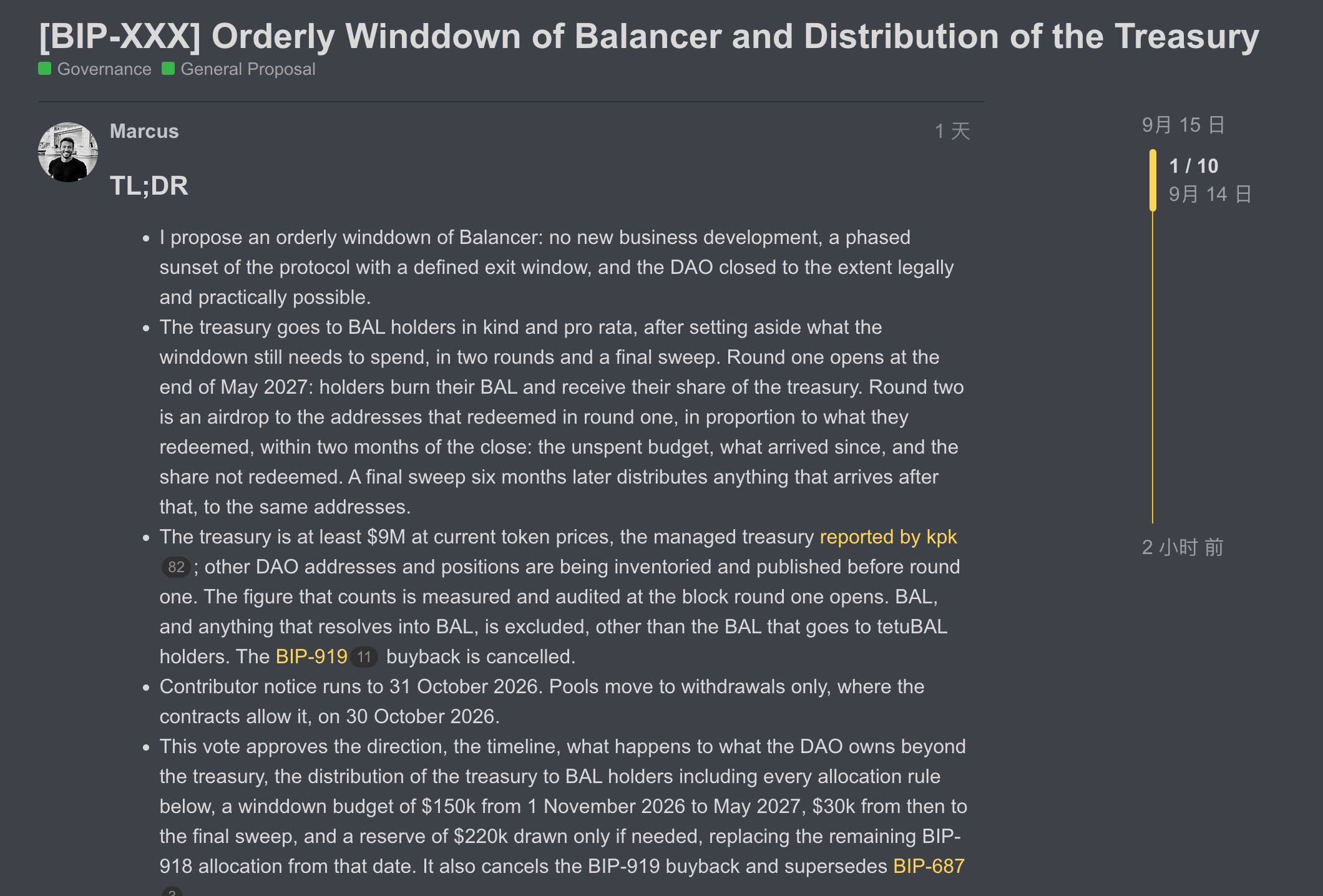
On September 15, Marcus Hardt, co-founder of Balancer Labs, submitted a proposal on the protocol's governance forum recommending an "Orderly Winddown" of the protocol — halting new business development, gradually transitioning liquidity pools to withdrawal-only mode, and ultimately closing the protocol.
This was not a sudden decision. As early as April this year, Balancer — still unable to move past the shadow of last year's hack — had already approved a restructuring plan: halting BAL emissions, directing all protocol revenue to the DAO treasury, cutting operational costs, and reducing team size. The core goal of the restructuring was clear — shrink Balancer to a scale that could survive on its own revenue, then bet on v3 for a comeback.
Several months later, Marcus, on behalf of Balancer, announced that this self-rescue effort had failed. This veteran DeFi protocol, which once peaked at over $2.4 billion in TVL and saw its token price reach as high as $74.45 (corresponding to an FDV of over $7 billion), could only make a quiet exit.
v3 Failed to Save Balancer's Fate
In the open letter explaining the shutdown decision, Marcus stated that the team had essentially completed the previously committed restructuring work.
Token emissions had been halted, veBAL's economic functions were removed, all protocol fees were directed to the DAO, the operational budget was cut by approximately one-third, and the team had been reduced to 12.5 full-time equivalent positions. On the product side, things had not stalled either — Balancer's Boosted Pools continued to operate, reCLAMM was launched after completing a security audit and renamed AutoRange Pools, and the team continued to pursue external integrations and partnerships. Marcus revealed that some partnership negotiations had even reached advanced stages, with counterparties genuinely interested in certain capabilities of v3.
But the problem was that this interest never translated into sufficient revenue.
Currently, most of Balancer's revenue still comes from v2, and v3's revenue growth has not reached the level needed to replace v2. Marcus put it bluntly: "The product works, but it doesn't sell well enough."
If one were to dig into the main cause of Balancer's current predicament, the exploit that occurred last November is undoubtedly an unavoidable topic.
Last November, Balancer suffered the most severe attack in the protocol's history. Hackers targeted Balancer v2's Composable Stable Pools, combining flash loans to exploit complex rounding precision errors and Vault accounting flaws, draining large amounts of staked tokens and stablecoins across mainnet and multiple L2 chains, ultimately causing $128 million in losses.
In this open letter, Marcus stated that although the incident was in the past, he still underestimated its lasting impact on subsequent adoption. Every partnership conversation since then often had to start with explaining what happened in the exploit, what changes were made, and why v3 was different from the past. While many counterparties accepted these explanations, it inevitably led to longer decision cycles and smaller partnership scales.
By August of this year, Marcus could no longer see a funding and revenue path that would allow v3 to continue developing according to the original plan. So Balancer chose to stop betting.
This Time, Even the Treasury Is Being Distributed
According to the proposal details Marcus published on the governance forum, if the proposal passes, Balancer will not "shut down" immediately, but will gradually exit according to an extended timeline.
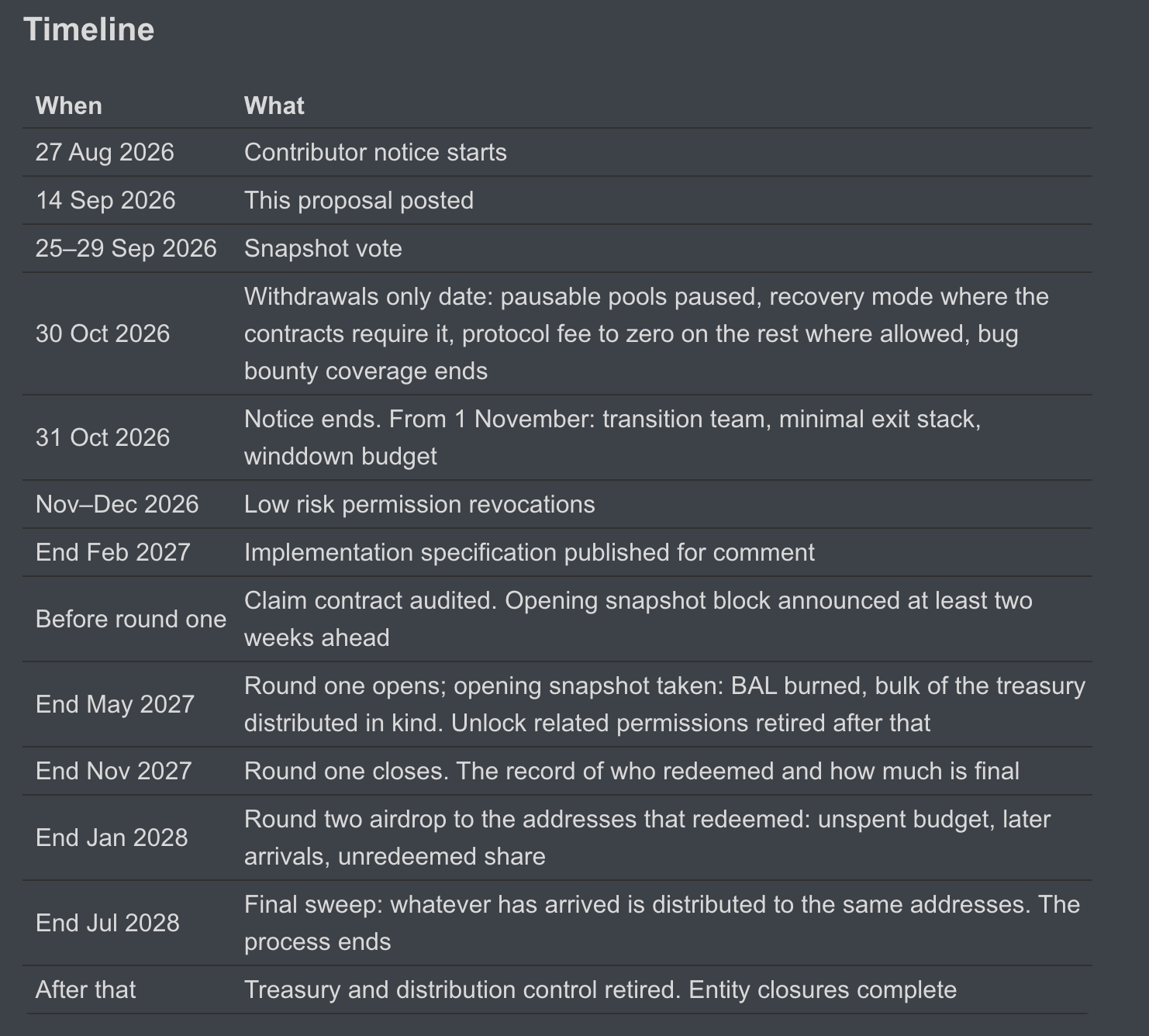
The first date is October 30. At that point, pausable liquidity pools will be paused and switched to withdrawal-only mode; pools whose contract mechanisms require entering Recovery Mode will be handled accordingly; and the remaining adjustable pools will have protocol fees reduced to zero. Balancer's bug bounty program will also end that day.
On October 31, the notice period for existing contributors ends. After that, Balancer will no longer conduct new business development, and the team will be further reduced, retaining only a small transition team responsible for protocol exit, asset consolidation, and subsequent treasury distribution. The remaining operational budget previously approved under BIP-918, covering through the end of October, will no longer be used as new operating funds but will be used as a winddown budget, with any unused portion eventually returning to the treasury.
Starting in November, Balancer will enter the true "wind-down phase." The team will retain the minimum infrastructure needed to maintain the exit process, and from November to December 2026, will gradually revoke low-risk permissions no longer needed. Meanwhile, the DAO will begin consolidating assets and receivables scattered across different wallets, fee addresses, and other locations, completing the aggregation before the first distribution round. If DAO assets such as code, licenses, and deployments are to be transferred, they will require a separate Snapshot vote and will not automatically go to any party as part of this shutdown.
The remaining treasury assets of the Balancer DAO are intended to be returned to BAL holders. The DAO treasury size disclosed in the proposal is at least approximately $9 million. The previously approved BAL buyback plan will be canceled and replaced by a distribution mechanism of "burn BAL, claim treasury assets proportionally."
The proposal mentions that the first redemption window is expected to open by the end of May 2027 and last for 6 months. Eligible BAL holders who burn their BAL can claim a proportional share of the treasury assets. Two subsequent distribution rounds will follow to handle remaining budgets during the winddown period, assets received later, and unclaimed shares from the first round.
Finally, by the end of July 2028, the protocol will complete its final liquidation, at which point treasury and distribution control will be revoked, and the relevant entities will be closed in succession.
It should be noted that this "shutdown notice" is still only at the governance initiation stage. Balancer is expected to hold a Snapshot vote between September 25 and 29. Before the voting results are available, the protocol's current pools and withdrawal functions will not change. If the proposal does not pass, the existing operational framework will continue to be implemented.
After the Business Model Fails, Another Ending for DeFi
From an industry perspective, Balancer's story is somewhat unique. It did not announce its exit after the product had already stopped being maintained and the community had completely disappeared. On the contrary, the team had just completed a fairly thorough round of cost cutting this year, launched new products, and attempted to rebuild revenue sources with v3.
But when these measures still could not generate sufficient revenue, continuing to maintain a protocol itself became a cost. The logic Marcus laid out in the open letter is also straightforward — if there is no financing or growth path that can change the situation, then continuing to burn through the treasury is merely arriving at the same result later. Rather than continuing to pour remaining assets into a proven ineffective path, it is better to stop now and return the remaining value to token holders.
This may also be what makes Balancer's shutdown more noteworthy.
Early DeFi projects often relied on token incentives, liquidity mining, and continuously expanding TVL for growth, but as the industry matures, protocols ultimately still need to answer a traditional business model question: can the product sustainably generate sufficient real revenue?
Balancer once tried actively to save itself, but now it has chosen to proactively offer another answer — if the answer is negative in the long run, then an orderly exit can also be a DAO governance option.