






CLARITY's failure to advance is not surprising, but it is regrettable enough


- Core Viewpoint: The U.S. Senate's procedural vote rejected the CLARITY Act, with the partisan divide over the Trump family's crypto interests and ethics provisions being the core obstacle. The probability of the bill passing this year has dropped to about 5%.
- Key Elements:
- The vote result was 49 in favor and 50 against, 11 votes short of the 60-vote threshold needed to advance the bill. No Democratic senator voted in favor, and 4 Republican senators defected.
- The two parties had already agreed on over 600 pages of legislative content, incorporating more than 120 Democratic amendments, but the ethics provisions became the final obstacle. Elizabeth Warren stated that the Trump family extracted $1.4 billion from crypto projects in 2025.
- Before the vote, Polymarket's probability of passage fell from 35% to 15%, and after the vote it dropped further to about 5%. In the market, BTC briefly fell below $75,000, and ETH dropped below $2,400.
- The bill is not completely dead and may be revived during the lame-duck session or after the midterm elections, but lawmakers are about to recess to campaign, making passage this year extremely unlikely.
- The SEC is advancing Reg Crypto and security tokenization rules, while the CFTC is expanding coverage of spot, derivatives, and other areas through Crypto Sprint. The two agencies are strengthening coordination through Project Crypto.
- Administrative regulation cannot replace congressional legislation. SEC Chairman Atkins pointed out that crypto rules lacking a legislative foundation are difficult to make stable over the long term.
Original | Odaily (@OdailyChina)
Author|Azuma (@azuma_eth)
At 02:15 Beijing time on September 16, the U.S. Senate formally initiated a procedural vote on the CLARITY Act. The final vote ended 49 in favor and 50 against — 11 votes short of the 60-vote threshold needed to invoke cloture and advance the bill, officially marking the failure of the CLARITY Act in its bid to clear the Senate.
The outcome itself was not entirely surprising. On Monday, after news emerged that Trump was willing to compromise on the "ethics provisions" in the bill, prediction markets like Polymarket briefly saw the bill's passage probability surge to around 35%. But as Democratic opposition rose again yesterday — with a counter-proposal even being put forward — the probability had already fallen sharply to around 15% before the vote.
Even with some psychological preparation, last night's vote breakdown exceeded many people's expectations. Not a single Democratic senator voted in favor of the bill, including New York Senator Kirsten Gillibrand, who had been urging colleagues to support it as reported yesterday, as well as Senators Ruben Gallego and Angela Alsobrooks, who had voted in favor during the Senate Banking Committee's initial review in May; in addition, four Republican senators — Susan Collins, Josh Hawley, Jerry Moran, and Thom Tillis — chose to defect, joining Democrats in voting against.
Affected by the CLARITY setback, the crypto market saw a short-term sell-off yesterday. BTC briefly dropped below $75,000, hitting a low of $74,955.5; ETH fell below $2,400, touching a low of $2,358.1. Other altcoins and related concept stocks also declined in tandem.
Is CLARITY Completely Dead?
The biggest disagreement between the two parties in the CLARITY Act's failed bid remains focused on Trump and his family's crypto asset interests and ethical restrictions.
Over the past several months, the two parties had conducted extensive negotiations on market structure, the regulatory boundaries between the SEC and CFTC, DeFi regulatory rules, stablecoins, and banking services. The final text even incorporated over 120 amendments from Democrats. But at the final juncture, Democrats still believed the added ethics provisions were insufficient to resolve the conflicts of interest arising from Trump and government officials' participation in crypto assets, and chose to collectively oppose. CoinDesk reported that the two parties had ultimately agreed on over 600 pages of legislative content, but the ethics provisions remained the final insurmountable disagreement.
Before last night's procedural vote, Democratic Senator Elizabeth Warren, who has long been opposed to the CLARITY Act and cryptocurrency, spent ten minutes "whipping votes," reminding colleagues face-to-face that "Trump and his family extracted $1.4 billion from crypto projects in 2025 alone — more than any publicly listed crypto company in the U.S. earned last year... Trump's crypto projects have also caused countless investors to lose billions of dollars collectively."
However, the failure of this procedural vote does not mean the CLARITY Act is completely dead — what was voted down was the procedural threshold needed to advance the bill, not a final vote on the entirety of CLARITY's content.
Republican Senator John Kennedy said he does not believe the bill is "dead," but that it may have to wait until Congress's lame-duck session to be re-advanced. Another Republican senator, Ted Cruz, invoked a line from the film The Princess Bride to describe the situation: "There's a big difference between mostly dead and all dead. I hope it comes back to life."
As things stand, the path forward for the CLARITY Act is unclear. Considering that the November midterm elections are approaching, lawmakers are about to recess and devote their energy to campaigning. If the Senate has enough floor time, lawmakers may decide to hold another procedural vote. So theoretically, there is still room to renegotiate and push the bill after the November midterms, but based on current analysis, the probability of the bill passing within the year is objectively negligible.
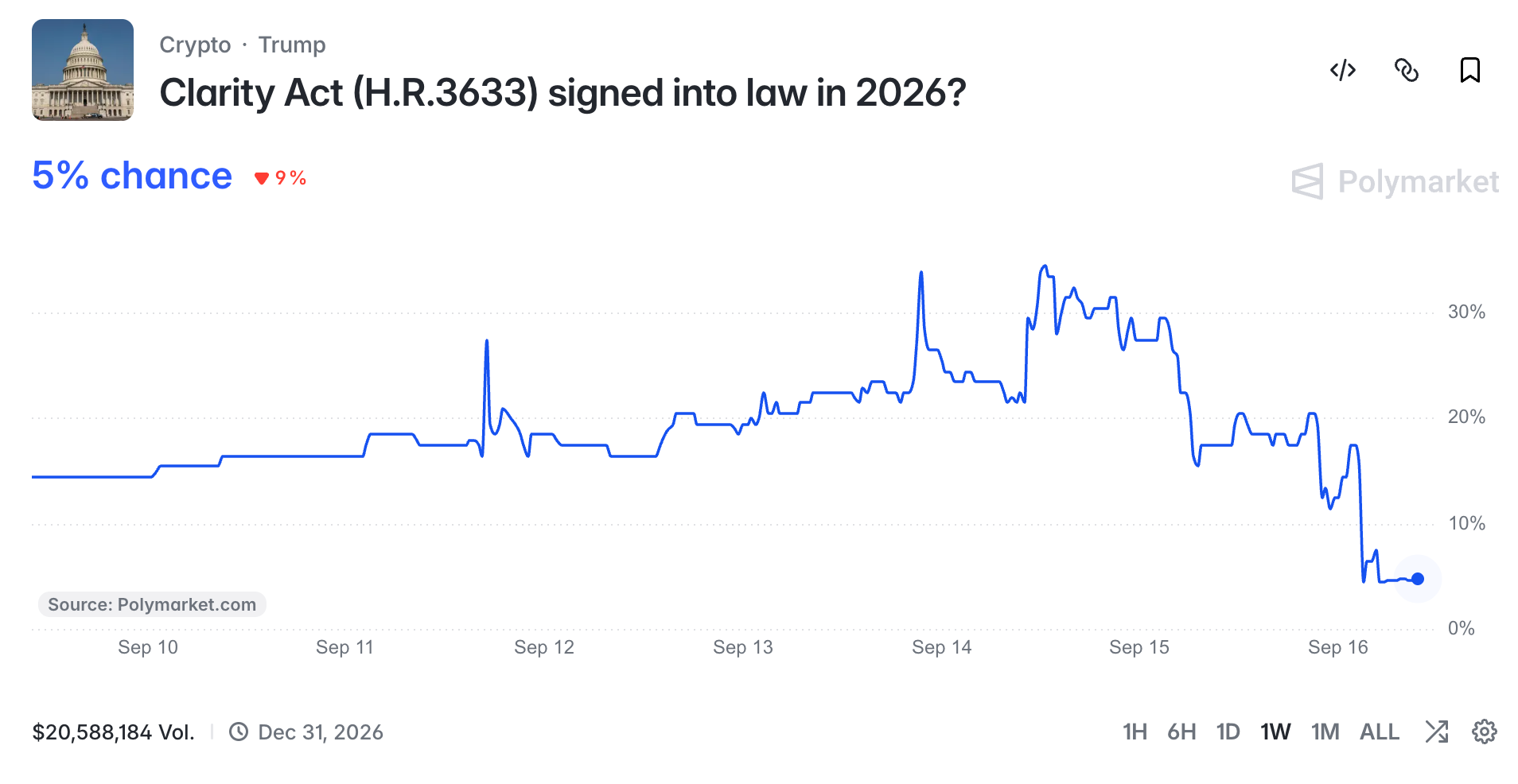
Polymarket's odds also reflect this reality. As of publication, the probability that "the bill can pass within the year" has dropped to about 5%.
Without CLARITY, Regulation Won't Grind to a Halt
Although the CLARITY Act is temporarily stalled, the U.S. crypto industry will not return to a state of "no regulation." On the contrary, the most realistic path in the short term is to continue relying on the SEC and CFTC to advance their respective regulatory frameworks.
After last night's vote results were announced, multiple industry insiders who personally participated in the CLARITY Act's legislative process — including Coinbase founder Brian Armstrong, Ripple CEO Brad Garlinghouse, and Hyperliquid Policy Center CEO Jake Chervinsky — publicly stated that the SEC and CFTC will continue to develop relevant rules to fill the legislative gap left by CLARITY's failure to advance.
In fact, both agencies are already taking action. The SEC is recently advancing Regulation Crypto Assets (Reg Crypto), attempting to establish a clearer regulatory path for crypto project issuance and fundraising, while also pushing for regulatory clarity on new business areas such as securities tokenization. On the CFTC side, through initiatives like Crypto Sprint, it is continuing to advance rules related to crypto spot markets, derivatives, tokenized collateral, and blockchain market infrastructure, and gradually relaxing restrictions on registered entities participating in digital asset markets.
The two regulators appear to have developed a certain默契 (tacit understanding) on regulatory boundaries. The SEC is responsible for redrawing the boundaries of securities, rules for issuance and tokenization markets, while the CFTC is continuously expanding its actual coverage in futures, perpetual contracts, spot commodities, and market infrastructure. The two sides then strengthen regulatory coordination through Project Crypto, gradually piecing the two systems together.
Of course, these administrative regulatory actions still cannot fully replace CLARITY — administrative agencies can take the first step, but it is difficult for them to replace congressional legislation. Regulatory rules, exemptions, and enforcement standards may all adjust with changes in the government and regulatory agencies. What CLARITY was originally meant to solve is precisely the long-standing lack of clear legal boundaries for digital assets. CoinDesk cited SEC Chairman Paul Atkins' view on this: "Without congressional legislation as a foundation, newly introduced crypto rules can hardly have sufficient long-term stability."
Therefore, CLARITY's failure is more like pushing U.S. crypto regulation back to a familiar state. Regulators can continue to move forward, but market structure legislation that can truly provide long-term certainty will still have to wait for the next political window.
18 Months of Effort, Fell at the Final Step
Since last year, negotiations surrounding the CLARITY Act have lasted for 18 months. During this period, the two parties engaged in repeated contests over a series of disputes including digital asset market structure, regulatory authority, DeFi boundaries, and banking services. The bill text gradually took shape through rounds of revisions and compromises. Now, just one step away from truly entering the Senate debate stage, it ultimately stalled at a procedural vote — during a political window made more sensitive by the upcoming congressional turnover, and over a disagreement point of extremely high political sensitivity.
For the crypto industry, this by no means signals the end of the road ahead. The SEC and CFTC will continue to advance regulatory rules, and the industry will continue to build and continue to push for a better regulatory environment. It's just that for those who waited 18 months, hoping the U.S. would finally establish a set of long-term market rules for digital assets, CLARITY stopping when it was close enough to the finish line is indeed a great pity.
Related Reading:





