






IOSG: HIP-3's Expensive Entry Ticket, a Moat That Can't Be Bought


- Core Thesis: Hyperliquid's HIP-3 builder market has become highly concentrated and is contracting overall. The leader Trade[XYZ] accounts for 97.8% of volume but declined 44% month-over-month, while challengers collectively earned only $747,000 in fees, with operating returns far below passive staking. The sole exception, Entropy, held its lead for just one week.
- Key Factors:
- Ten teams have registered HIP-3 perpetual DEXs in total: four are still trading, five have shut down, and one never launched; each locked up approximately $40 million in HYPE staking.
- HIP-3's share of Hyperliquid perpetual volume fell from 57.1% to 25.8%, primarily because core perp volume doubled rather than a pure loss of share.
- Trade[XYZ] recorded $64.6 billion in 30-day volume, down 44.2% month-over-month; roughly half of the decline came from a genuine pullback in storage and AI sector trading, and the other half from its own share loss.
- Settlement asset became a life-or-death line: all venues settling in non-USDC stablecoins have shut down, while survivors all use USDC, forming a 6-to-6 record.
- No price competition: fee rates across all equity-type venues have hit bottom, with measured rates of 0.427 bp for Trade[XYZ] and 0.400 bp for Entropy; cumulative deployer fees for all venues outside the leader total just $747,000.
- Each asset slot is worth approximately $39,900, and staking yields far exceed operating income (Paragon's annual staking yield is roughly 14 times its fee revenue), making it difficult for challengers to sustain value through fees alone.
- The only variables with predictive power are settlement asset, oracle design, and funding rate design. Entropy, leveraging its self-built oracle, led on Nebius for just one week before being overtaken.
Original author: Mario Chow, IOSG Ventures
Ten teams have registered their own perpetual markets on Hyperliquid, most of them locking up roughly $40M in HYPE to do so. One of them accounts for 97.8% of the volume, and it just fell 44% in a single month. This article sets out to answer what the other nine actually bought. Every figure comes from on-chain data, not from announcements.
Every number in this article is pulled directly from Hyperliquid's public API: perpDexs, metaAndAssetCtxs, the daily candleSnapshot covering all 519 registered assets, delegatorSummary, userNonFundingLedgerUpdates, and clearinghouseState{dex}.
"30 days" refers to the complete UTC calendar days from August 15 to September 13, 2026; "the previous 30 days" refers to July 16 to August 14; "7 days" refers to September 7 to 13. HYPE is priced at $79.73. The routing data in Section 7 is taken from Flowscan, because builder code volume cannot be aggregated from the public API.
Summary
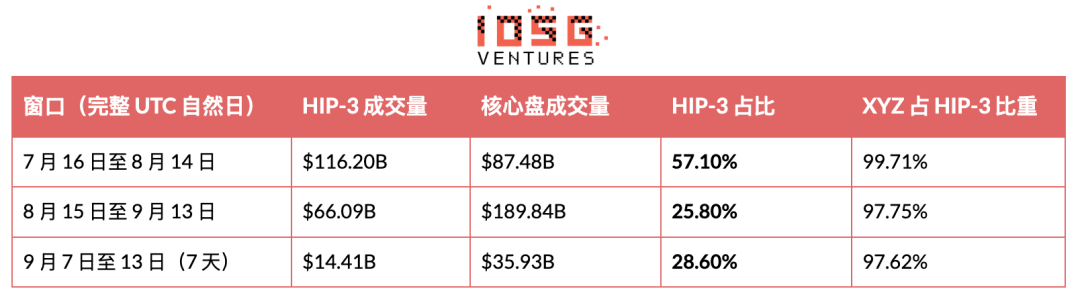
· HIP-3 has once again become a minority within Hyperliquid. Builder-deployed markets accounted for 25.8% of perpetual volume over 30 days, down from 57.1% the previous month. This shift is mainly driven by the denominator: core order book volume more than doubled, while HIP-3 itself declined.
· The leader is contracting. Trade[XYZ] did $64.60B in 30-day volume, down 44.2% month-over-month, with 7-day average volume falling from a peak of $5.36B/day in early August to $2.01B/day. Roughly half of this decline corresponds to the pullback in real-market trading in storage and AI names; the other half is the venue's own. It has not outperformed the core order book on any single day since August 18.
· Entropy (io) led for a full week in a head-to-head market, then gave it back. Its share on Nebius traced a path of 8.7%, 53.1%, 20.4% over three consecutive weeks, and its own volume has now fallen for three straight weeks. The contrarian signal is in open interest: OI rose 37% against the trend, to $51.4M.
· The settlement asset remains a life-or-death line, and the record still stands at 6 to 6. Every venue settling in a non-USDC stablecoin has stopped trading; every one still alive settles in USDC.
· Asset listings can't be defended. At the current auction floor price, an asset slot costs about $39,900, and buying up all of Paragon's live markets would cost only about $1.04M — equivalent to two weeks of Trade[XYZ]'s fee revenue.
· No one is competing on price. Every equity-related venue runs deployerFeeScale = 1.0 plus Growth Mode, with measured fees of Trade[XYZ] 0.427 bp and Entropy 0.400 bp. Every venue besides the leader, alive or dead, has earned a combined lifetime total of just $747,000 in deployer fees.
The Ten Deployers Present
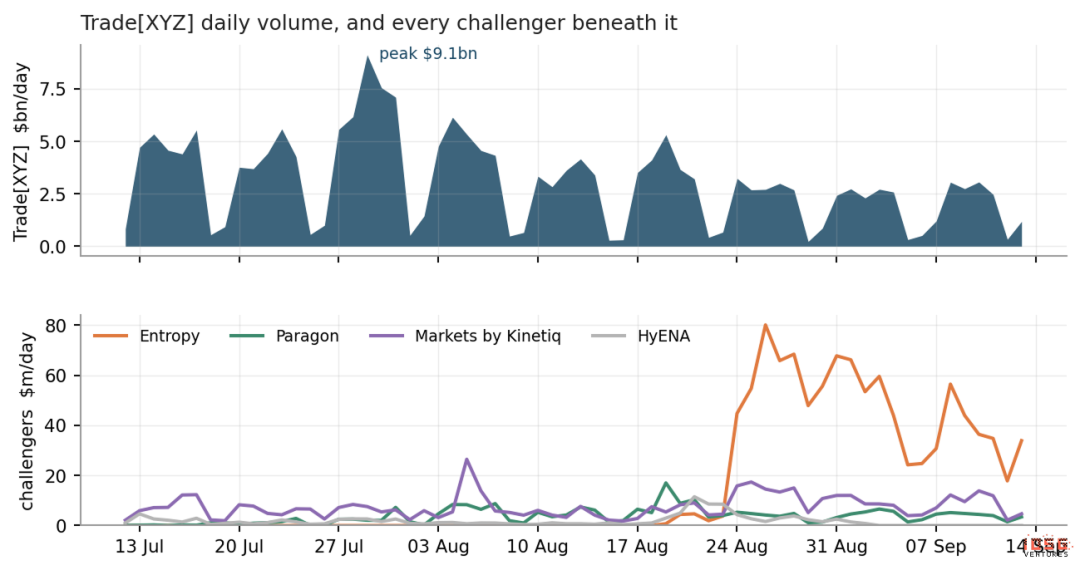
▲ Trade[XYZ]'s daily volume, and all the challengers beneath it. The vertical scales of the two charts differ by roughly 100x.
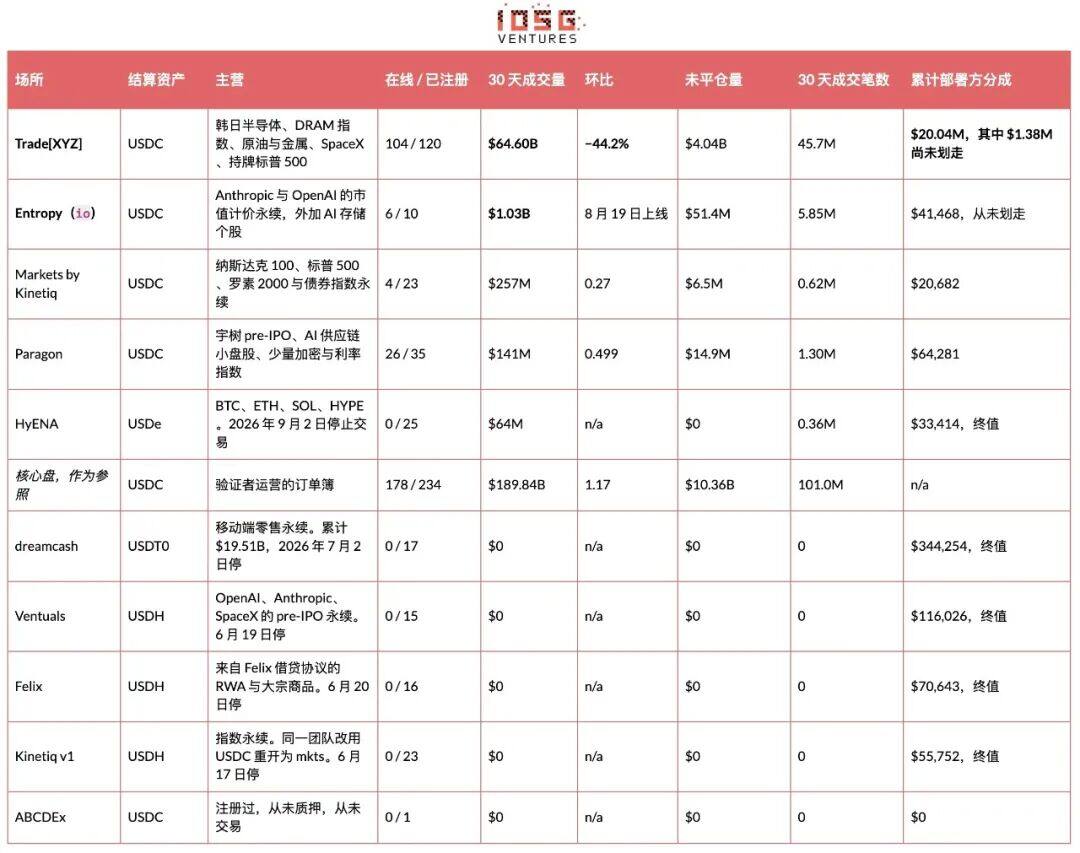
"Trade count" is the sum of the n field across daily candles within the window. The public API cannot derive the number of unique traders.
Historically, only ten teams have ever registered a perpetual DEX, and there has never been an eleventh. Four are trading, five have stopped, and one never opened. Trade[XYZ] accounts for 97.8% of HIP-3 volume over 30 days and 97.6% over the past 7 days.
The challengers can be summed up in a few sentences. Entropy did $1.03B in 26 days across six live markets, relying on a self-built oracle rather than an asset list. It is the only venue that has ever led on a market where the leader also quotes. Paragon is the only challenger whose order book actually looks like an order book, with 26 live markets and a well-spread tail, and it still rose 49.9% for the month even as Trade[XYZ] moved into five of its symbols at once. Markets by Kinetiq bought 23 symbols, with 95% of volume concentrated in two index perpetuals. HyENA is finished: all markets delisted, open interest at zero, lifetime earnings of $33,414.
HIP-3's Share, and Why It's Easily Misread
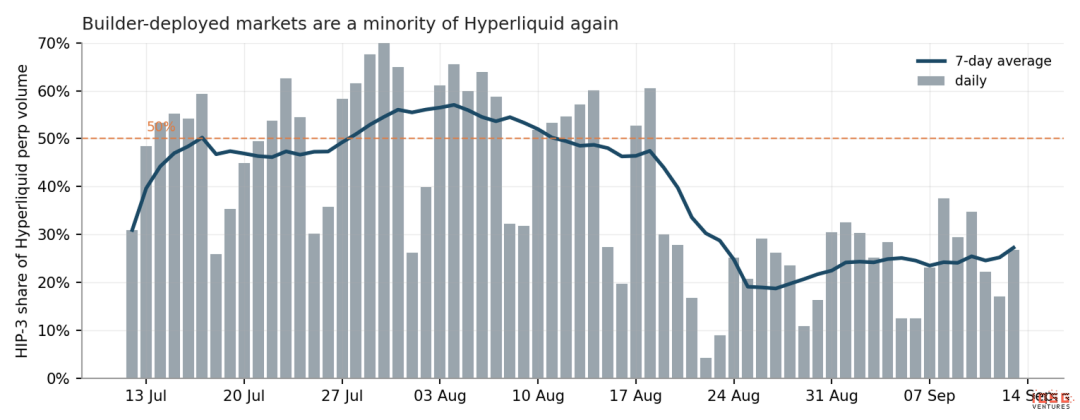
▲ HIP-3's share of Hyperliquid perpetual volume, measured daily.
The 7-day average crossed 50% in mid-July, touched nearly 57% in early August, then fell below 30%, and has not climbed back since August 20. On August 18, one builder's volume exceeded Hyperliquid's entire validator set. It has not done so since.
This ratio actually describes its denominator. The numerator is an equity order book, the denominator is a crypto order book, and the leg that moves is the crypto one. The 57% was read during a quiet crypto period; the 26% was read from the same equity order book hitting a market move, with core perpetual volume up 117% over the same period. In the most recent seven days, the share even returned to 28.6% while Trade[XYZ] kept shrinking. Before citing any HIP-3 share, first clarify what crypto was doing during that period.
What really matters is absolute volume, and absolute volume is deteriorating. Trade[XYZ] did $64.60B in 30-day volume, down 44.2% month-over-month, with 7-day average volume falling from $5.36B/day in early August to $2.01B/day and its own order book drawing down 62%. Its largest market, SK Hynix, fell to $8.50B. Both legs of the share decline are real. And as the following section will show, most of the HIP-3 leg isn't a competition problem at all.
The Main Driver of the Volume Decline Is the Storage Sector Going Quiet, Not Share Loss
Reading the 44% decline directly as "the leader is losing" is the most convenient explanation, but the data doesn't support it. The test is simple: if the decline were caused by competition, we would see the underlying symbols trading as usual, just with Trade[XYZ] capturing a smaller slice. What actually happened is that the symbols themselves went quiet.
There was no sell-off. Relative to early August, when volume peaked, every major market in the order book is priced higher today.
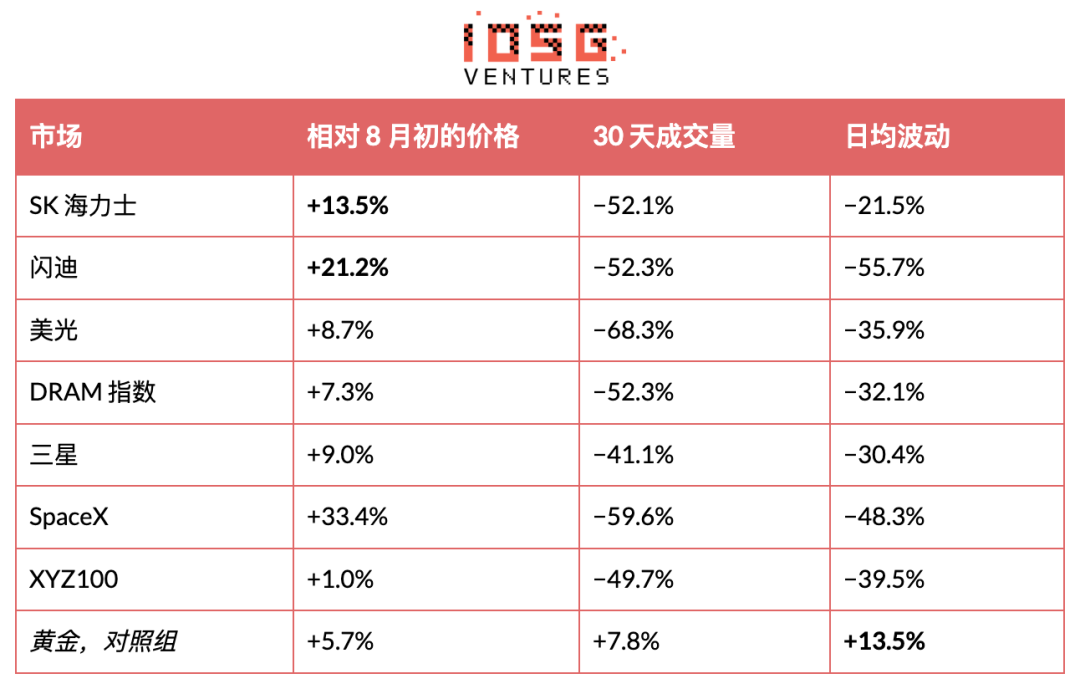
What really collapsed is how far these symbols can move in a day, and the venue's volume tracks it almost in lockstep.
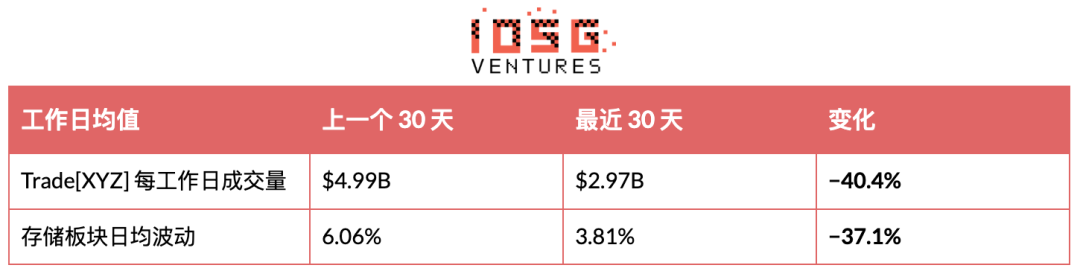
All of the above is on a weekday basis, because equities markets are closed on weekends while Trade[XYZ] trades through them, and including weekends would significantly exaggerate this relationship. Looking at weekdays only, the correlation between the storage sector's average daily volatility and the venue's daily volume is +0.47 over a 45-day sample. Gold is a natural control: it was the only major market whose intraday volatility rose this month, and its volume rose along with it. Silver is the exception that doesn't fit the pattern.
But volatility is only a proxy. A more direct test is to compare against the real stock volume of the same nine symbols, and the answer is: traditional markets explain only about half.
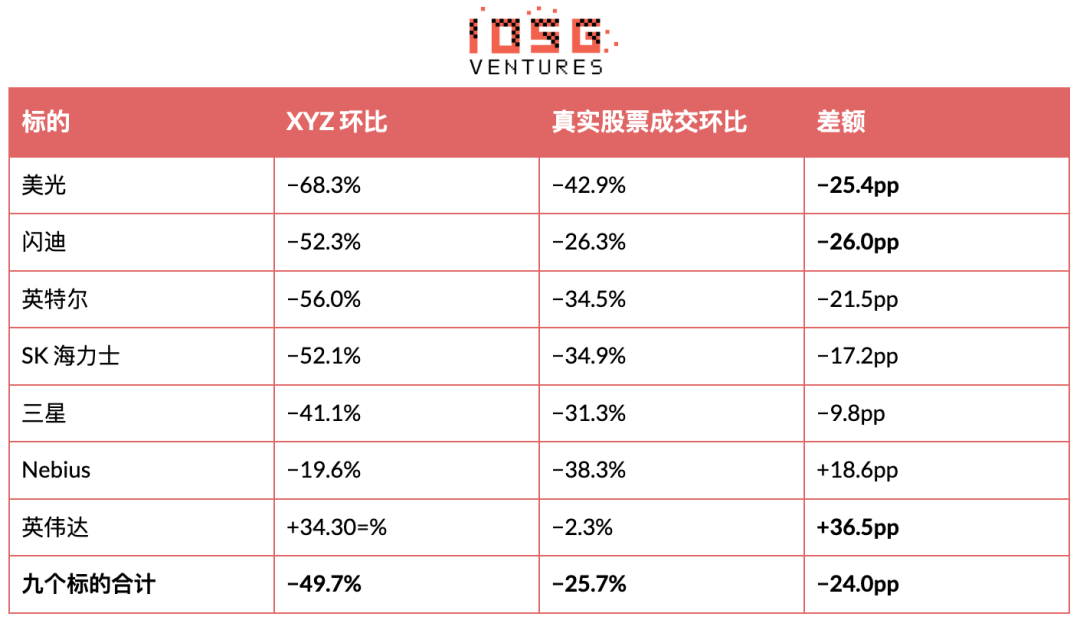
Real volume in storage and AI names did collapse 25.7% — that half is real. But XYZ fell 49.7%, roughly double. The extra 24 percentage points didn't come from the sector.
And the biggest gaps are precisely in its core: SanDisk −26.0pp, Micron −25.4pp, Intel −21.5pp, SK Hynix −17.2pp. It actually outperformed the real market on Nvidia (+36.5pp) and Nebius (+18.6pp), but both of those books are small.
Competition can't explain the gap either. Entropy's SanDisk volume over the full 30 days was $523M, while XYZ's own SanDisk book was down $6.14B, so challengers captured at most about 8% of it.
What's left looks more like capital rotation. Over the same period, Hyperliquid core perpetual volume rose 117% while HIP-3 fell, and the combined total still rose 26%. The money didn't leave Hyperliquid; it just rotated from equity books back to crypto books.
An anchor on scale. Over the same 30 days, these nine symbols did $2,004.7B in volume on their respective exchanges, while XYZ did $23.5B on them — 1.2%. XYZ's entire 104 markets combined, at $64.60B, amount to just 3.2% of these nine names' real volume. The highest penetration is SK Hynix at 9.1%, the lowest is Broadcom at 0.1%, and this curve itself explains what the business is: high penetration in assets crypto-native traders can't otherwise reach, low penetration in US large-caps anyone can buy.
So the decline is both things at once: about half is sector beta, the other half is its own. The calculations in Section 6 use only realized volume and don't ask where it came from, so the fee accounting isn't affected. But separating the two halves matters: the sector half will come back, the venue's own half may not.
The Shakeout, and the Only Variable With Predictive Power
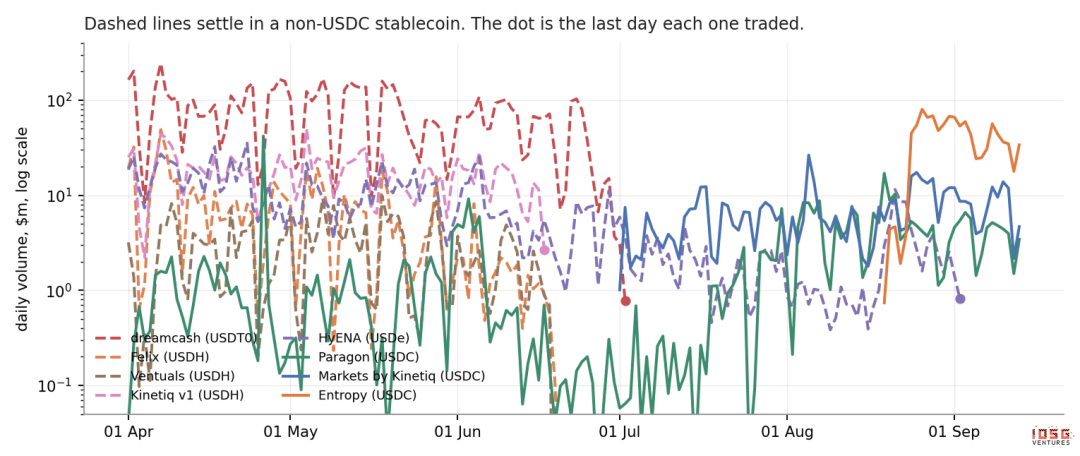
▲ Daily volume of each HIP-3 venue, log scale. Dashed lines denote settlement in a non-USDC stablecoin; the dot marks its last day with volume.
Six venues have stopped trading to date, and the variable that separates them isn't asset selection, team quality, or historical volume — it's the settlement stablecoin.
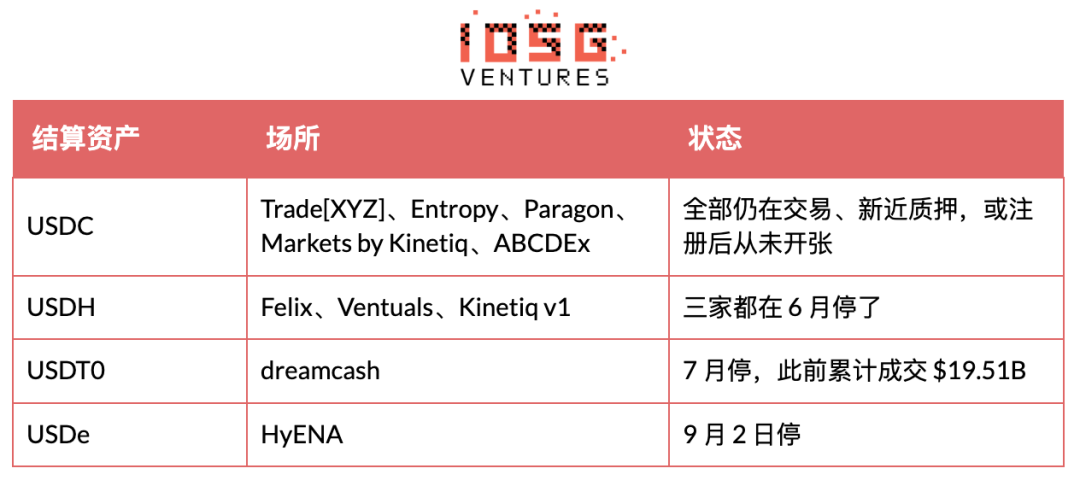
The mechanism itself is plain: traders have to specifically go swap into a different stablecoin before they can place their first order, and they can't be bothered. Felix is the clearest example. The small fee discount that once supported USDH was wiped out the moment Growth Mode launched, leaving that settlement asset with nothing but friction.
Kinetiq is the controlled experiment. The only operator that survived after shutting down, it did so by killing its USDH venue and reopening the exact same index products on USDC. Historical volume predicts nothing: dreamcash did $19.51B, more than the entire June cohort combined, and still stopped. Entropy entered in August with more capital than any prior entrant, and showed no hesitation in choosing USDC.
What Actually Determines the Settlement Asset, and What Doesn't
Reading USDC's sweep as a protocol arrangement is natural, but Hyperliquid's own documentation says the opposite. Under Aligned Quote Assets v2 (enabled on USDC in late August, with Coinbase as treasury deployer and Circle as technical deployer), roughly 90% of the cost-adjusted reserve yield on USDC on Hyperliquid goes to the protocol and flows into the Assistance Fund. Interest is calculated in 30-day tranches, paid on the 8th day after each tranche ends, so the first payment won't arrive until early October and not a cent has landed yet.
What AQAv2 explicitly does not do is favor HIP-3. The documentation is blunt: there is no preferential treatment in trading fees or volume counting, and other quote assets continue to be supported on HIP-3 perpetuals. The fee benefits belong to AQAv1, which gives venues' collateral assets lower taker fees, higher maker rebates, and higher volume counting — and USDC isn't in AQAv1 and structurally can't be, because that tier requires the stablecoin to be exclusive to Hyperliquid. What AQAv2 actually privileges points toward event contracts and validator-operated perpetuals, and requires later upgrades — not the market measured in this article.
So the settlement asset question was settled by liquidity and a corporate action, not by fee design. USDH ceased operations on July 17, 2026, holders redeemed 1:1 into USDC, and Coinbase acquired its brand assets and became USDC's treasury deployer. Among stablecoin supply on Hyperliquid today, USDC accounts for 98.3%, USDT 1.2%, and the remnants of feUSD, USDe, and USDH about one-thousandth each. A venue settling in another asset isn't losing out on fees. It's asking its traders to leave the only pool with depth.
Sizing AQAv2 comes with the caveat that no official figures have ever been published. USDC on Hyperliquid is $6.77bn; with SOFR around 3.6% and a 90% split, this line points to roughly $200M a year. Third-party estimates based on a $5bn base land between $135M and $160M. What can't be determined externally is the cost adjustment in the AQA rate, which is a validator-reported oracle whose level isn't public, so every figure here is an estimate rather than a measurement.
HyENA adds a second mechanism. Because it listed crypto assets, it was locked out of Growth Mode, so it quoted around 5 bp on the same symbols where the core book beneath it quoted around 3 bp, with worse execution quality. It spent about $0.88M on asset slots and earned $33,414 in its lifetime.
Stopping isn't the same as exiting. HyENA has delisted all 25 markets and open interest is at zero, but its stake is still 508,915 HYPE, about $40.6M, with no withdrawal initiated in twelve days. Felix and dreamcash both withdrew their stakes in full and now read zero, and Ventuals is down to just 7,967. A venue that has delisted all its markets yet keeps $40M staked on-chain is either slow to unwind or holding the deployer slot for something else.
What exactly killed Ventuals deserves its own paragraph, because the next generation of products is designed around it. Insufficient liquidity was only a symptom; the mechanism was in the funding rate: pre-IPO perpetuals have no convergence anchor, and the funding rate at one point ran to roughly 8,700% annualized, meaning longs would get liquidated regardless of whether the mark price was right. Entropy caps its annualized funding rate around 10% and settles to the TWAP of its own mark price rather than chasing an external price. Its contract design as a whole can be read as a patch list targeting Ventuals' specific cause of death. Look at any pre-IPO book by checking the funding rate and settlement design first, then the asset list.
Trade[XYZ]'s Order Book Composition, and Why It Doesn't List OpenAI
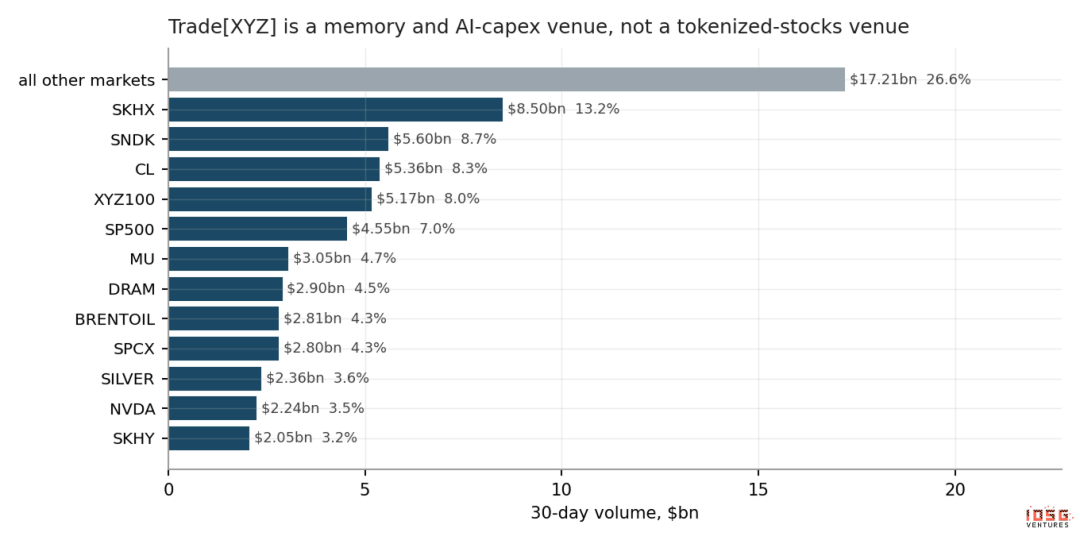
▲ Trade[XYZ]'s largest markets by 30-day volume.
The top ten markets account for 66.7% of the book, and the tail beyond the top six alone is $32.4B. Nvidia accounts for 3.5%. Apple, Tesla, Alphabet, and Microsoft combined account for 3.3% — a quarter of SK Hynix alone. The US megacaps that the standard tokenized-equities narrative loves to talk about are not this business.
What Trade[XYZ] actually runs is a 7×24 venue for trading storage and AI capex, plus crude oil, metals, and index products: Korean and Japanese semiconductors, a synthetic DRAM index, SpaceX, its own XYZ100 basket, a licensed S&P 500. Its turf is the set of assets crypto-native traders can't reach anywhere else at 3 a.m. And that is precisely the turf Entropy chose to attack, entering via SanDisk and Nebius, not Apple.
<





