The 10-year U.S. Treasury yield broke through 5%, with two narratives swirling in the market: "a 2023-style brief peak" or "a 2000s-style trigger for a financial crisis"


- Core View: Hit by the Iran war, the 10-year U.S. Treasury yield surged to the critical 5% threshold, with the market engaged in intense debate over whether it has peaked for now or entered a long-term elevated era. The answer will profoundly affect borrowing costs and the direction of the midterm elections.
- Key Elements:
- The 10-year U.S. Treasury yield touched 5.012% intraday, the highest since 2007, before falling back to close at 4.960%.
- Escalating Middle East tensions drove Brent crude oil up sharply to $105.68 per barrel, reinforcing inflation expectations, and the market almost uniformly expects the Federal Reserve to raise rates this week.
- Mortgage rates have already been pushed back up to nearly 7%, and Treasury Secretary Bessent's unconventional suppression measures have had little effect.
- PGIM believes that aside from an economic recession, it is difficult to find catalysts for falling rates; Bank of America believes that the Federal Reserve's firm signal on controlling inflation will help push down long-end rates.
- The AI investment boom is driving a stock market rally, with tech companies treating AI as an existential strategy and responding to financial conditions differently from traditional companies.
Original Author: Zhao Ying
Original Source: Wallstreetcn
The U.S. 10-year Treasury yield, the benchmark for trillions of dollars in global assets, has surged to 5% amid the shock of the Iran war—a level widely regarded as an alarming tipping point. Apart from a brief spike to 5% in 2023, the last time the 10-year Treasury yield hovered above 5% was on the eve of the global financial crisis.
Overnight, the 10-year Treasury yield climbed as high as 5.012% intraday, the highest intraday level since 2007, before retreating to close at 4.960%. The touch of this key threshold is forcing investors to confront a core question: Is the bond market entering an entirely new era?
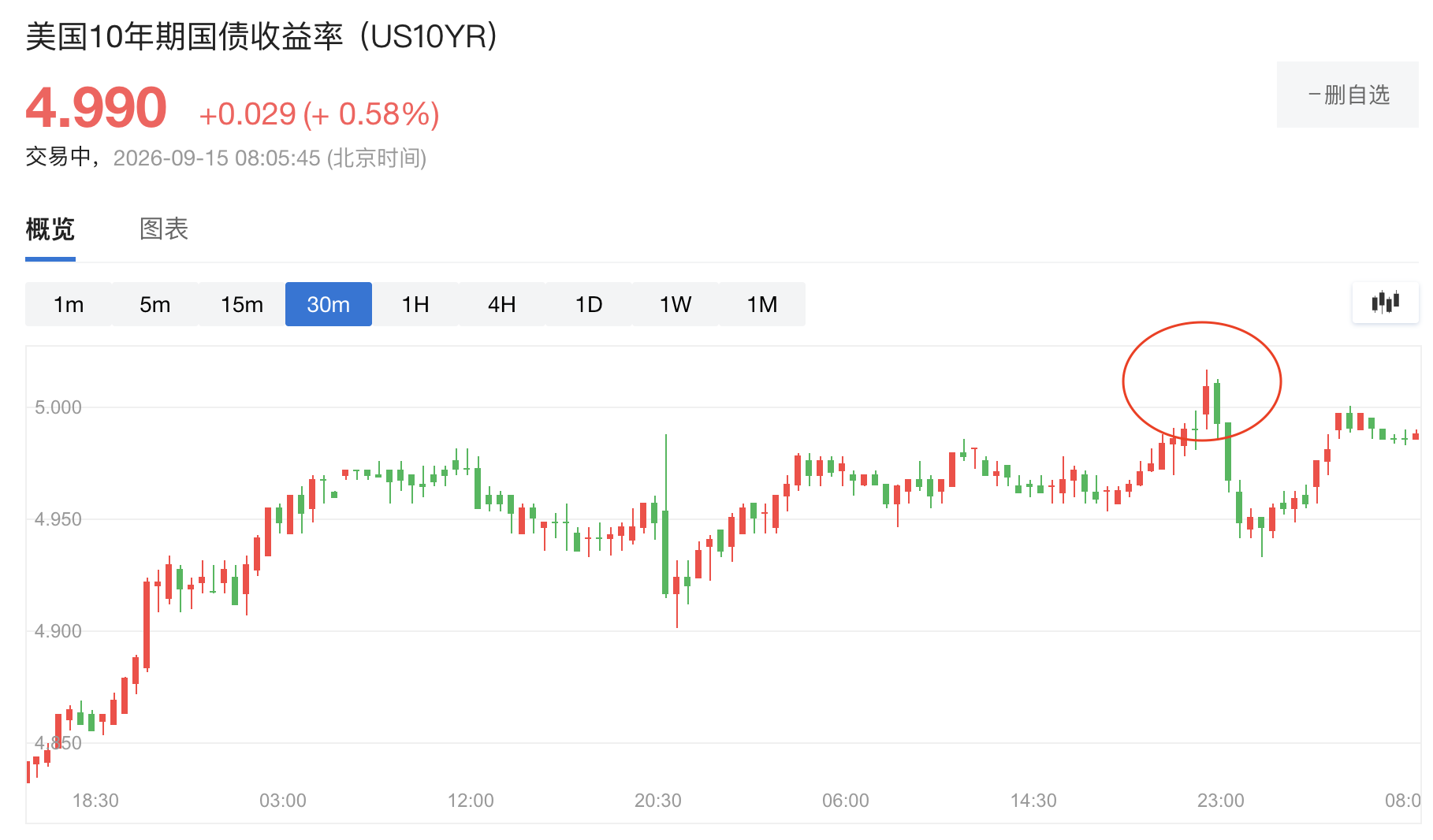
Two diametrically opposed narratives currently dominate the market. One holds that 5% will prove to be a cyclical peak, as it was in October 2023, with yields subsequently falling back; the other fears that yields will decisively break through this threshold, replicating the prolonged elevated yield environment of the 2000s and even the 1990s. The answer will have profound implications for borrowing costs for consumers, businesses, and the U.S. government alike, and could shape the trajectory of the upcoming midterm elections.
War Shock Combined with Inflationary Pressure Pushes Yields to Key Threshold
The direct trigger for this round of yield increases is the surge in energy prices driven by escalating tensions in the Middle East. Brent crude jumped nearly 9% last week after Iran-backed Houthi forces effectively seized control of another key shipping chokepoint off Yemen's western coast. As of Monday, Brent crude was up slightly by 1% at $105.68 per barrel.
Rising energy prices have reinforced market expectations of persistently elevated inflation. Stronger-than-expected inflation data released on Friday led investors to near-unanimously expect the Federal Reserve to raise rates at its Wednesday meeting and continue tightening monetary policy thereafter. Trump has repeatedly publicly called on the Fed to cut rates, putting Fed Chair Warsh in a dilemma, while market expectations for rate hikes continue to climb.
The 10-year Treasury yield is a key driver of interest rates across the economy, and its recent rise has pushed mortgage rates back up to nearly 7%. Treasury Secretary Scott Bessent has previously taken unconventional measures to try to suppress yields, but with little effect so far.
Two Historical Scenarios, the Market Remains Divided
Monday's intraday price action reminded some investors of October 23, 2023—when the 10-year yield similarly touched 5% in early trading before sharply retreating to above 4.8% the same day, displaying the typical behavior of investors rushing to buy bonds once this milestone was touched.
However, this pullback was notably smaller than in 2023, leading many investors to believe that a clean break above 5% in the coming weeks or months is not out of the question.
Greg Peters, Co-Chief Investment Officer at PGIM Credit, said: "I keep asking myself, 'Okay, what's going to be the catalyst for rates to go down?' Other than a recession, it's hard to find an answer. Current conditions are very conducive to yields staying high or even moving higher."
On the other hand, Meghan Swiber, Senior U.S. Rates Strategist at Bank of America, takes a different view: "If the Fed hikes this week and signals that it will do whatever it takes to control inflation, we think that would actually help push long-end rates lower."
Debt Scale and Supply Pressure Provide Structural Support for Higher Yields
Some investors believe this round of yield increases partly reflects the economy's normalization—a return to the state before the 2008 financial crisis, before the era of massive central bank bond purchases and ultra-low interest rates.
But the current situation also has its unique features. Total U.S. federal debt recently surpassed $40 trillion, doubling from a decade ago. An expanded debt load means increased Treasury supply, potentially depressing bond prices and pushing yields higher. The Treasury Department, under Bessent's leadership, has recently begun increasing buybacks of long-term bonds, but relative to the total stock of Treasuries, these purchases remain negligible.
Rep. David Schweikert (R-Ariz.) wrote on social media Monday: "Today's numbers should frighten Congress."
AI Boom and Stock Market Rally Partially Offset the Impact of Higher Rates
Several analysts noted that the stock market boom driven by enthusiasm for AI investment has somewhat buffered the economy from the impact of higher yields.
Eric Winograd, Chief Economist at AllianceBernstein, said: "Normally, higher yields and borrowing costs might discourage corporate investment. But many tech companies now view investing in AI as an existential strategic choice. I think they respond to financial conditions very differently from other businesses."
This factor has made the market relatively optimistic about whether the economy can withstand 5% yields without slowing rapidly, and has lent more support to the narrative that "yields will remain elevated for a long time."