Tiger Research: The $62 Billion Gap, South Korea's Missing Corporate Crypto Market


- Core Viewpoint: South Korea's crypto market ranks among the top globally in trading volume, but regulatory restrictions bar corporate participation, leaving demand highly dependent on retail investors. If corporate accounts were permitted, the upper limit of corporate crypto asset holdings could reach 82 trillion Korean won by 2030, generating approximately 570 billion Korean won in annual revenue — only then can the market enter its next phase.
- Key Elements:
- The Korean won contributes roughly 30% of global crypto trading volume, peaking above 50%, yet Dunamu, the largest crypto company, is valued at only one-seventh of Coinbase.
- Institutional trading volume accounts for over 80% at Coinbase in the U.S., while corporate demand in South Korea is essentially absent, leaving the market without an institutional foundation.
- The corporate account opening plan has been delayed since 2025, with the first phase yet to launch, and corporate capital still struggles to enter.
- Estimates project that corporate crypto asset management scale could reach approximately 82 trillion Korean won by 2030, with annual revenue from trading, custody, and prime brokerage of about 570 billion Korean won.
- Insufficient liquidity: A 10 billion Korean won order incurs round-trip slippage of 213.2 basis points across South Korea's three major exchanges, compared to just 12.2 basis points on Binance.
- Demand outflow: From 2021 to 2026, South Korea's B2B stablecoin payments totaled approximately $620 million, with some companies settling through entities in Hong Kong and other jurisdictions.
- Corporate entry could extend to financial services including payments, remittances, custody, taxation, and anti-money laundering, driving the market's transition from trading to application.
Key Takeaways
- South Korea's crypto market ranks among the largest by trading volume globally, but regulatory restrictions bar corporate participation, leaving demand heavily dependent on retail investors. Once corporate accounts are permitted, the demand base will broaden significantly, giving the market a chance to enter its next phase.
- According to estimates, by 2030, the upper limit of crypto assets held by South Korean corporations could reach KRW 82 trillion. Businesses such as trading, custody, and prime brokerage could generate approximately KRW 570 billion in annual revenue.
- If opening is further delayed, South Korea's demand and business opportunities will be pushed overseas. Signs of outflow are already emerging in payments and asset management. Once overseas markets establish customer relationships and operational experience first, even if South Korea opens up later, the related business may not necessarily flow back.
Lacking Institutional Participation, South Korea's Crypto Market Faces a Growth Ceiling
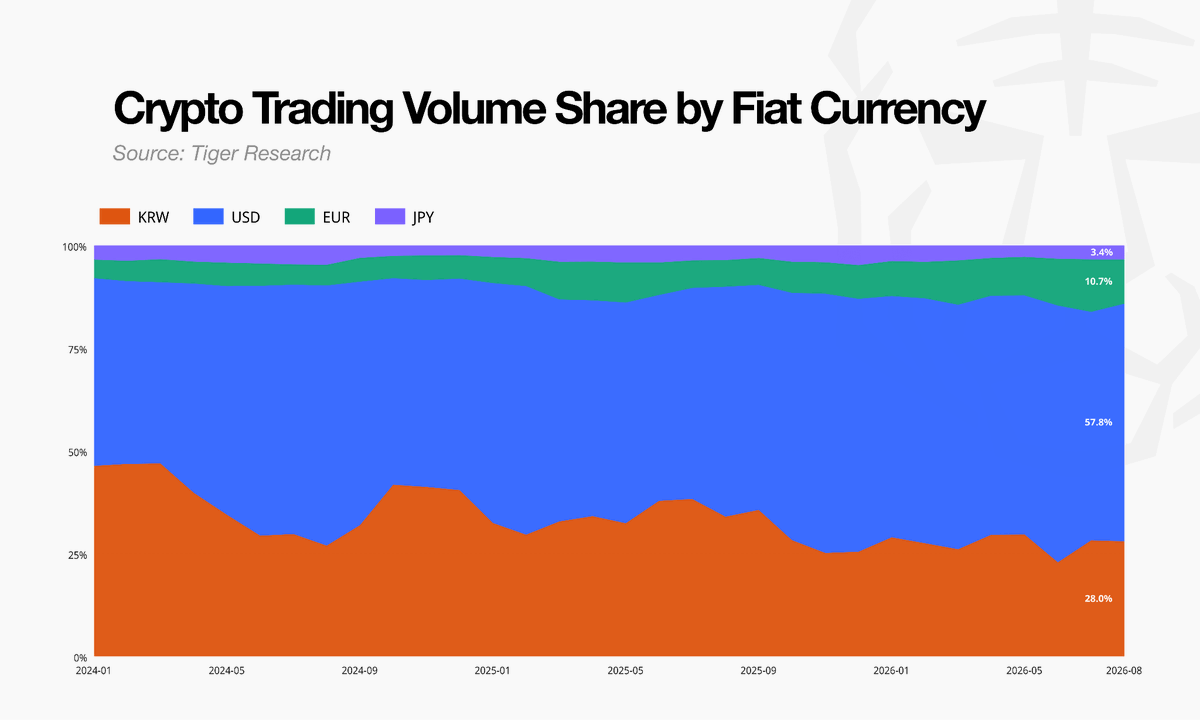
South Korea is one of the most active crypto markets in the world. In fiat terms, the Korean won has contributed roughly 30% of global crypto trading volume in recent years, second only to the US dollar; at its peak, its share exceeded 50%, briefly surpassing the dollar. Given South Korea's population and economic size, this level of activity is unusual.
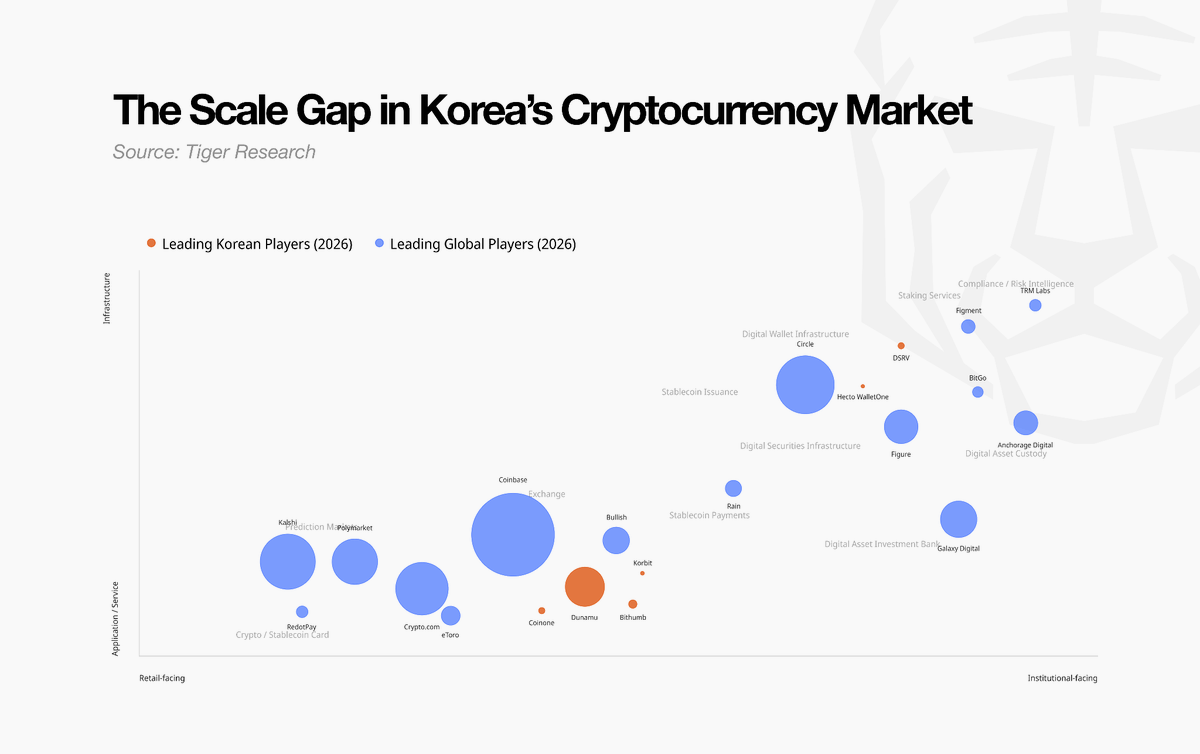
However, the domestic crypto industry has not grown in tandem. The valuation gap between South Korean and major global crypto companies clearly reflects this disparity. Capital market sizes and business scopes vary across countries, so direct comparisons have limitations, but the gap remains striking. Dunamu (operator of Upbit), South Korea's largest crypto company, is valued at roughly one-seventh of Coinbase.
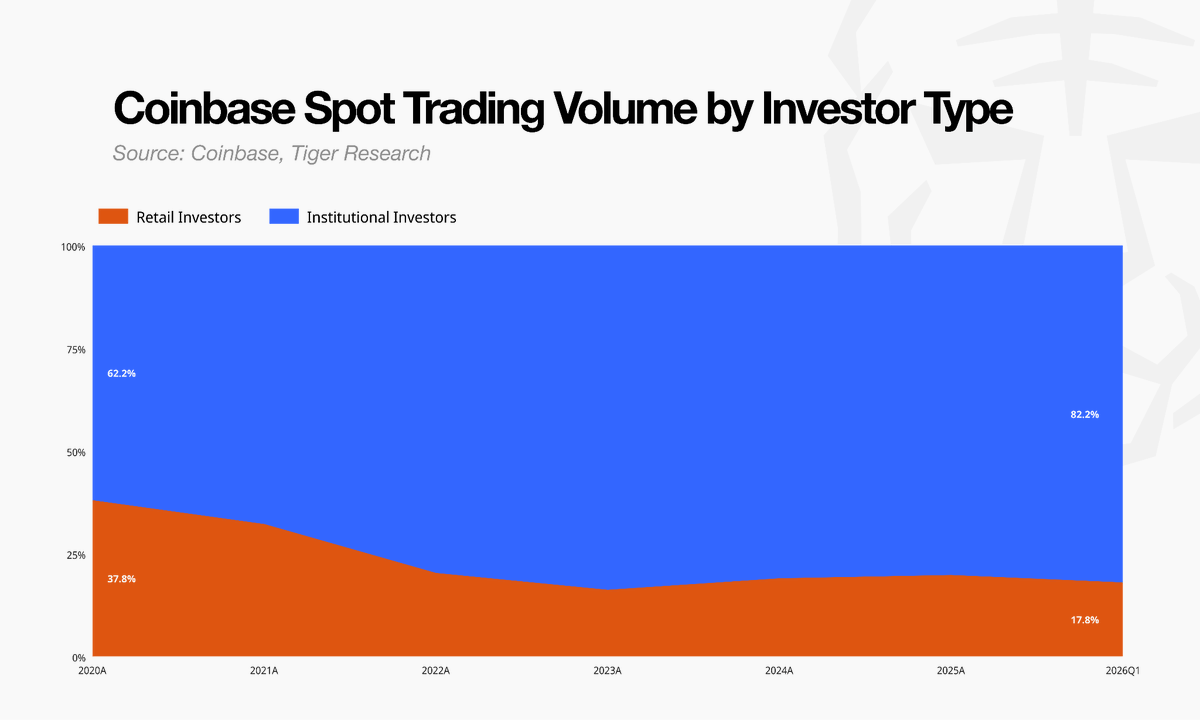
South Korea's market is sustained by retail investors, while regulation keeps small and medium-sized enterprises out. The US market structure is different: institutional players account for over 80% of Coinbase's trading volume, with institutional demand forming the market's foundation. Although South Korea generates considerable trading volume, corporate demand is largely absent, making it difficult for the industry to advance to the next stage.
Corporate Accounts Repeatedly Delayed, KRW 82 Trillion Market Remains on Paper
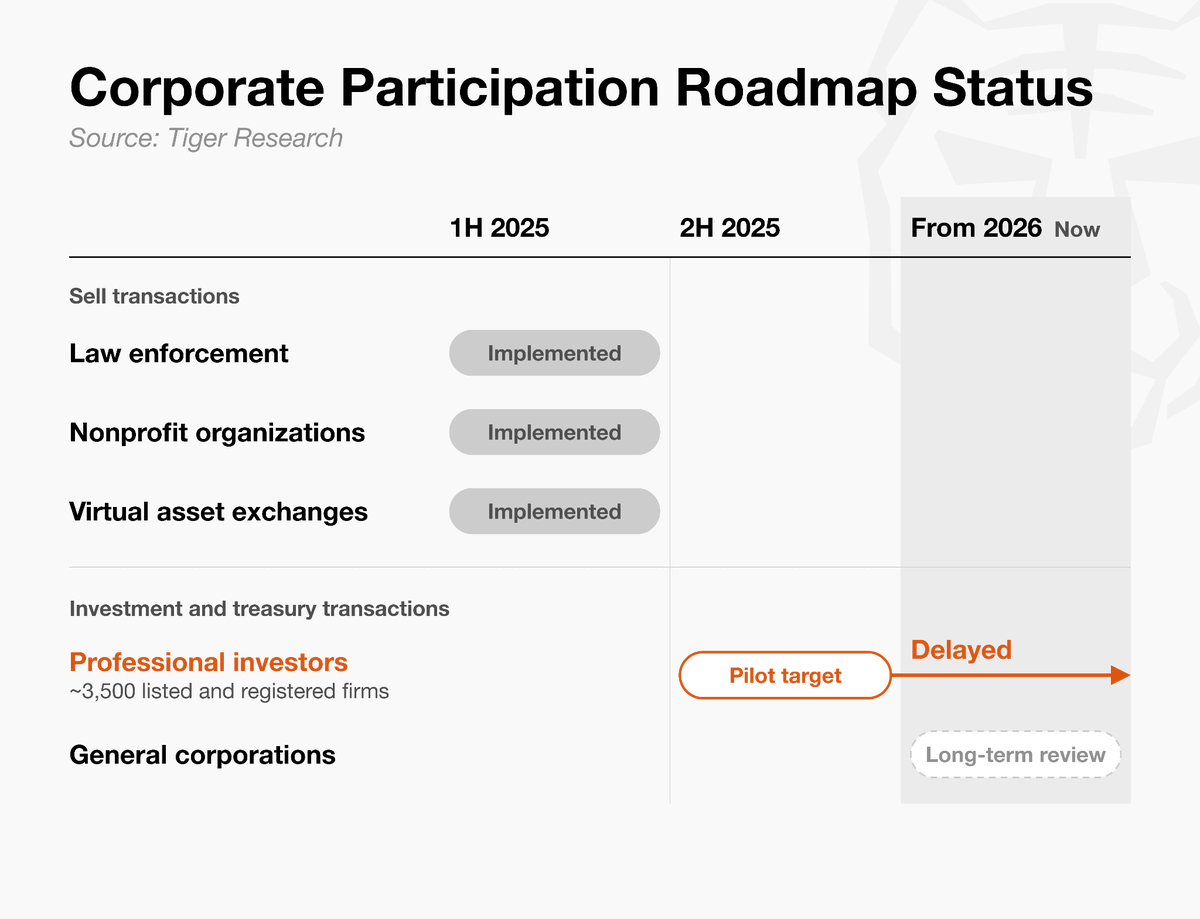
Corporate account opening has fallen behind the original plan. In 2025, South Korea's Financial Services Commission planned to first allow approximately 3,500 listed companies and registered professional investment entities to trade crypto assets for investment purposes, then gradually expand access. The first phase has yet to launch, and there is no timeline for broader corporate access. Corporate capital therefore still struggles to enter South Korea's crypto market.
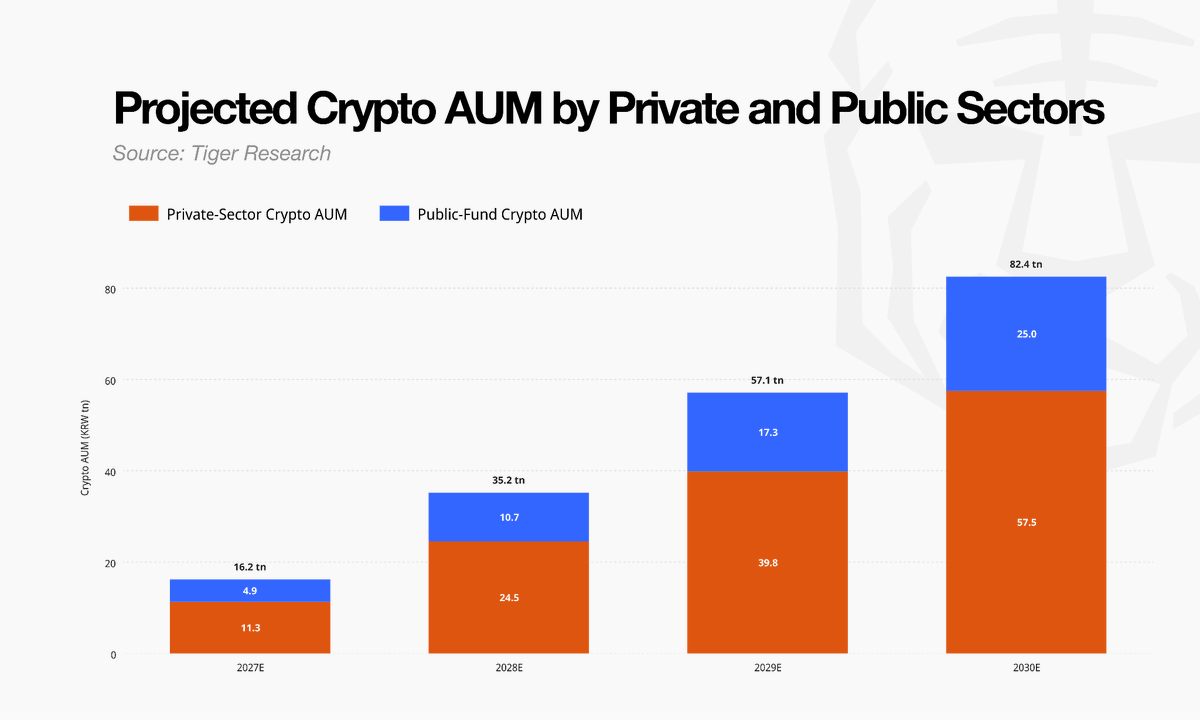
Once corporate accounts are opened, the demand side will broaden significantly. Based on the assets under management of private financial institutions and public funds such as pension funds, and referencing the allocation ratios of more mature corporate-participation markets like the US in 2027, the upper limit of corporate crypto assets under management in South Korea is estimated at approximately KRW 16 trillion.
As corporate participants increase, the market can continue to expand. Starting from 2028, the model incorporates both asset expansion and higher allocation ratios: private financial institutions at the 5% investment cap discussed in South Korea, and public funds more conservatively at 2%. Under these assumptions, corporate crypto assets under management would reach approximately KRW 35.2 trillion in 2028, KRW 57.1 trillion in 2029, and up to KRW 82 trillion by 2030. This is a potential market ceiling; the actual scale still depends on the pace of regulation and market conditions.
Corporate-Facing Financial Services: Annual Revenue of Approximately KRW 570 Billion
Once corporations enter, the market will not remain at the trading level alone. Large orders require reliable execution, assets require secure custody, and treasury and risk management are also needed. Services such as custody and prime brokerage will develop accordingly, no longer relying solely on centralized exchange fees.
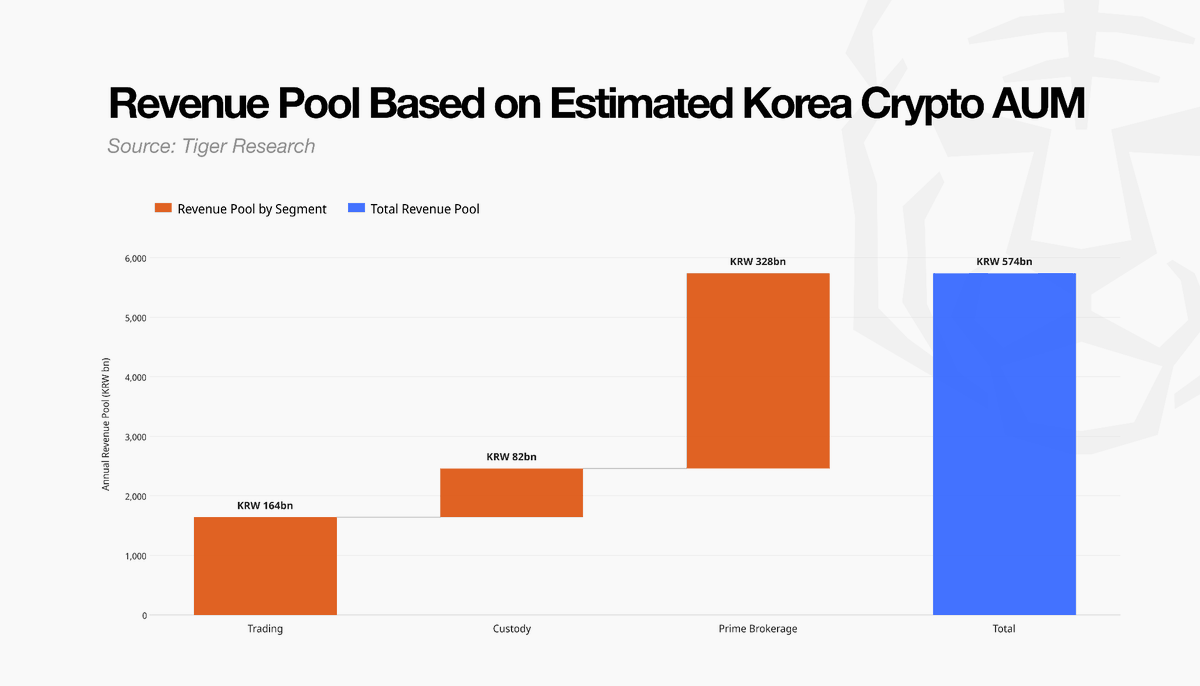
Referencing overseas corporate market revenue models, by 2030, if corporate assets under management reach KRW 82 trillion, annual revenue would be approximately KRW 570 billion, including trading fees as well as custody, execution, and treasury management revenue.
The larger the corporate asset scale, the stronger the demand for such services. Institutional businesses such as custody and prime brokerage are expected to provide South Korea's crypto industry with new revenue sources beyond retail trading fees.
Beyond Investment: The Industry Chain Is Poised to Extend Outward
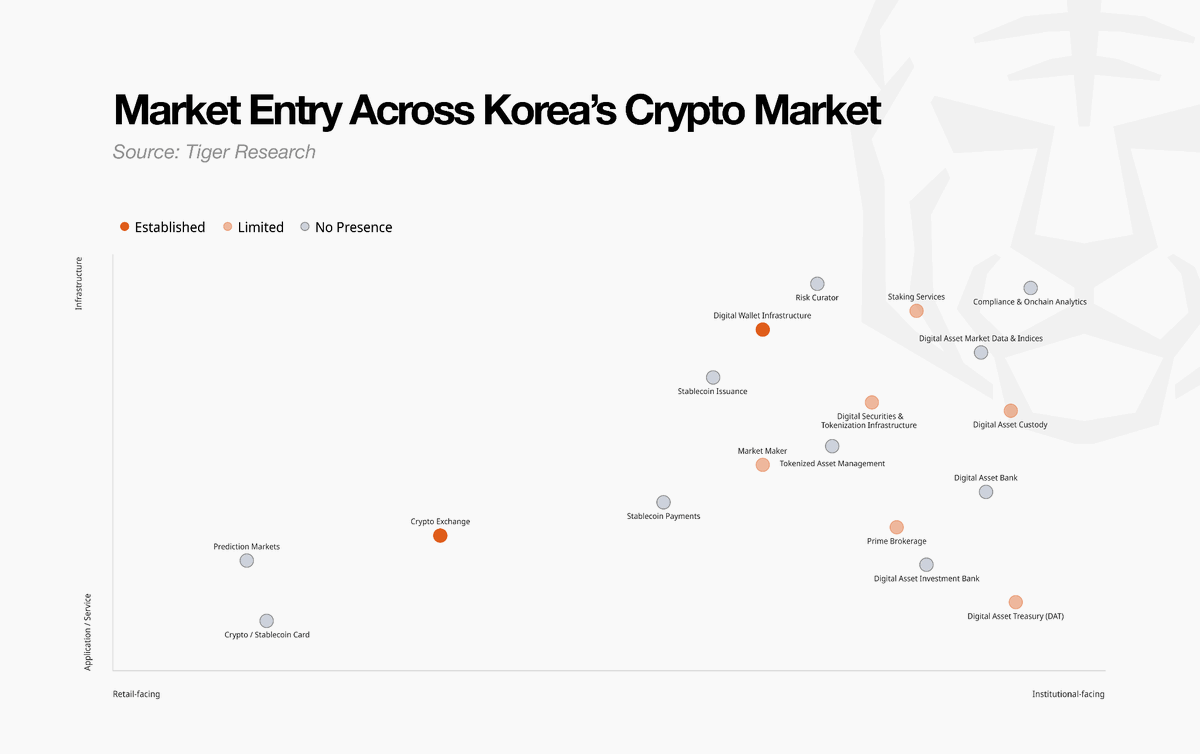
Corporate accounts serve not only investment trading but also companies conducting business with crypto assets. Stablecoin payments and remittances are the most direct examples. Such businesses require corporations to trade crypto assets directly and settle in Korean won. South Korea's restrictions on corporate trading also suppress related business.
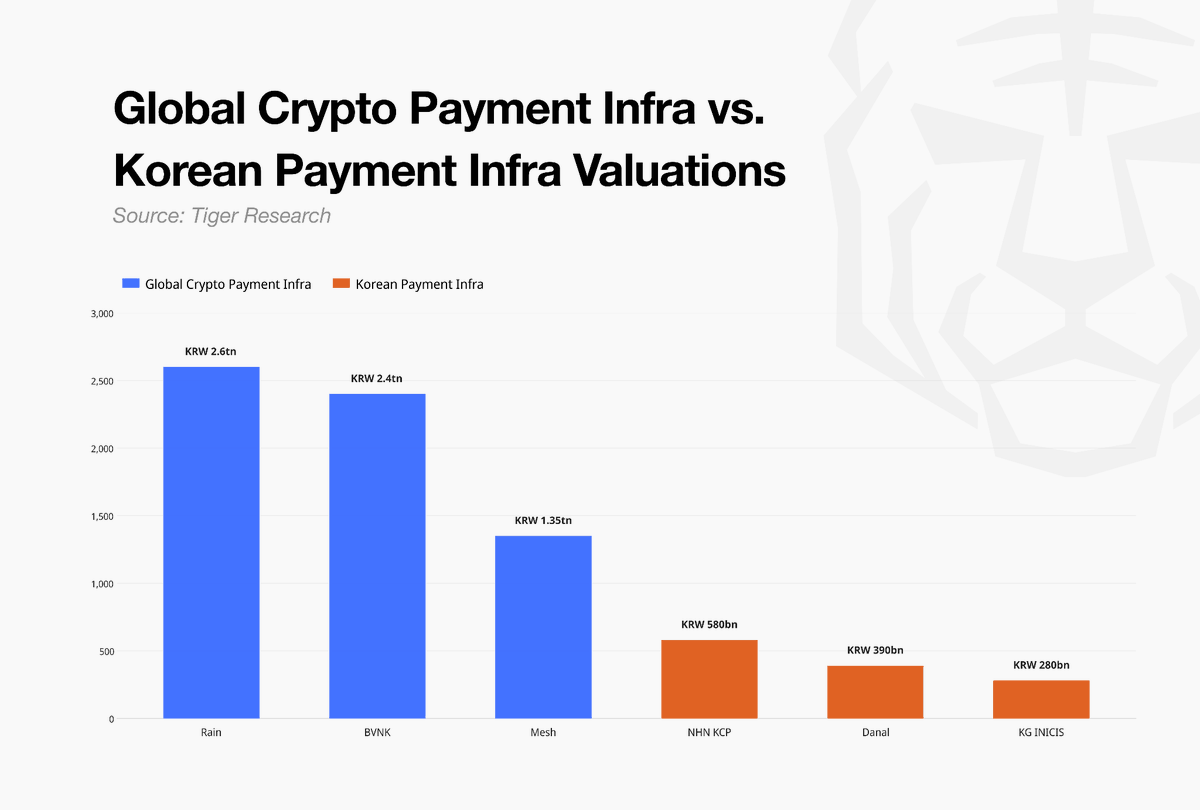
Overseas, a number of payment and settlement infrastructure companies have already grown, such as Rain, BVNK, and Mesh. Valuation methodologies differ between public and private companies, so direct comparisons are not appropriate, but several companies in this sector have reached valuations in the trillions of Korean won.
Once corporate accounts are opened, South Korea could also develop similar businesses. Payment and fintech companies could offer crypto payments and remittances, and other enterprises could use crypto assets for receipts, payments, and settlement. Only then would South Korea's crypto industry have a chance to expand from a "trading market" to an "application market."
Corporate Entry Needed for Liquidity to Match Trading Volume
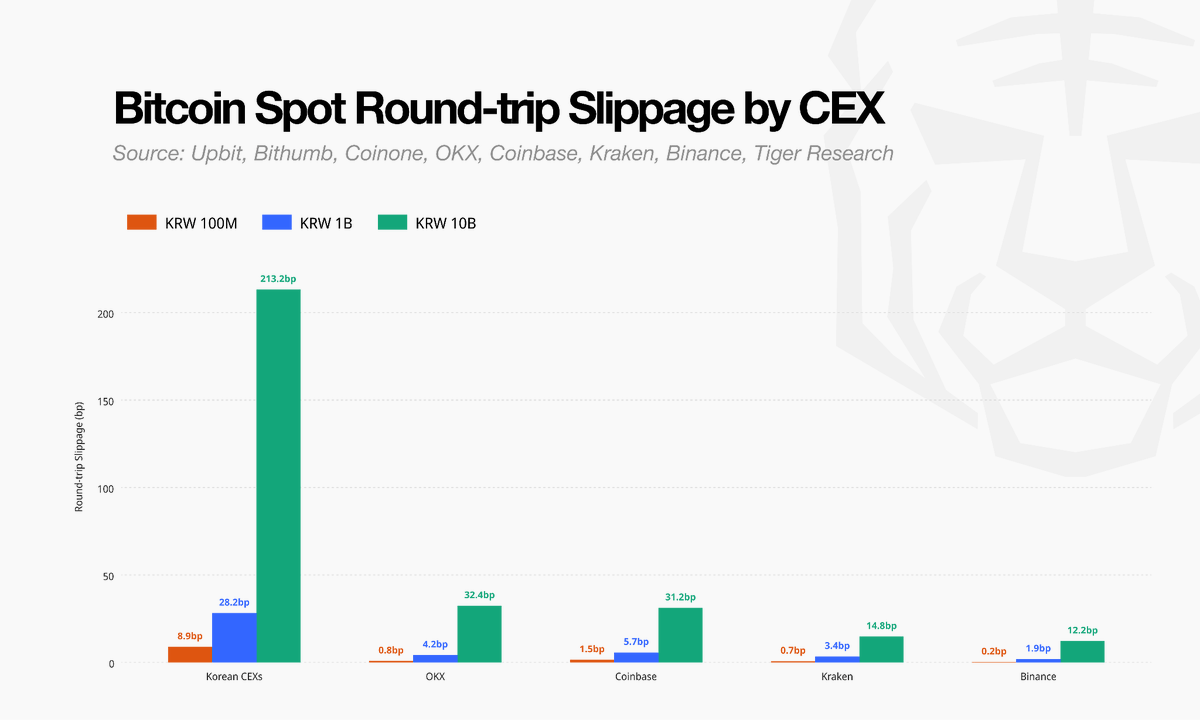
High retail participation has driven up South Korea's trading volume, but the ability to absorb large orders remains weaker than major global exchanges. Bitcoin spot trading calculations over the past week show that a KRW 10 billion order would incur a round-trip slippage of 213.2 basis points across South Korea's three largest exchanges combined; under the same conditions, Binance would incur only 12.2 basis points. The larger the order, the more pronounced the gap.
This indicates that South Korea's market depth does not match its trading volume. Trading is active, but the order book may not be deep enough to absorb large orders, and price impact rises with order size. High trading volume does not equal the ability to execute large trades.
Corporate accounts would help optimize the participant structure and attract professional liquidity providers. As the order book deepens, the price impact and trading costs of large orders would decline, potentially improving trading efficiency for both corporations and retail investors.
The Later the Opening, the Sooner Opportunities Take Root Overseas
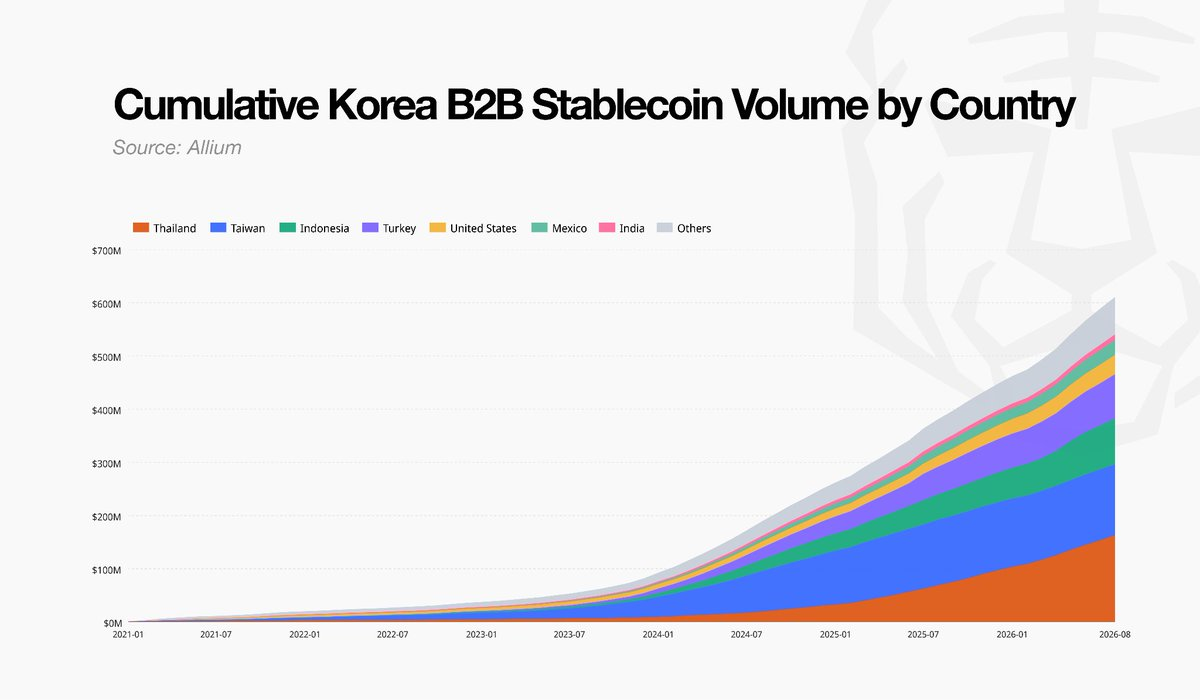
With corporate accounts long overdue, domestic demand is already shifting outward. Allium data shows that from January 2021 to September 2026, B2B stablecoin payments between South Korea and other countries amounted to approximately $620 million. This data excludes centralized exchange deposits and withdrawals and investment-related transactions, counting only payments for goods and services. This shows that corporations have long been using stablecoins for payments and settlement beyond investment.
A considerable portion of demand has already landed overseas. Some import-export companies find it difficult to process stablecoins in South Korea, so they rely on overseas entities or partners in places like Hong Kong for exchange and settlement. Hyperithm provides crypto asset management for corporate clients in Japan, and Mirae Asset Securities is expanding its digital asset business in Hong Kong. South Korea's demand and business capabilities have already been converted into business in overseas markets with more complete regulatory frameworks.
If this trend continues, companies going abroad will accumulate not only customers and revenue but also business relationships and operational experience. Once payment networks and business relationships are established overseas, even if South Korea opens up later, these activities may not quickly migrate back. Companies are also more willing to continue investing in markets where they have already accumulated customers and experience. Delaying corporate accounts not only postpones capital entry but may also allow businesses that should have grown in South Korea to take root overseas first.
Next Step: Open Corporate Accounts
The significance of corporate accounts is not just about bringing corporate capital into the crypto market; it could also give rise to an entirely new financial services market. As mentioned, by 2030, corporate crypto assets under management could reach an upper limit of approximately KRW 82 trillion, with annual revenue from trading, custody, and prime brokerage of approximately KRW 570 billion. Once corporate capital enters, demand for trading, custody, and asset management support will also rise.
The impact could also spill over beyond financial services: payments, remittances, accounting, tax, security, anti-money laundering, and data services could all scale up as corporations use crypto assets. The key question is whether these opportunities stay in South Korea. If they remain domestic, South Korean companies can retain revenue and operational experience; if trading stays onshore, capital flows are easier to track, and tax and market supervision have better leverage.
South Korea does not lack trading volume or demand; what it lacks is the ability for corporations to enter. With demand confined to the retail level, financial services and related industries struggle to grow. If corporate accounts can be implemented, existing demand can connect with industry expansion, and the market can transform from a "retail market" into one where corporations and industries can also participate.