Oracle Delivers Better-Than-Expected Earnings: Why Did It Gap Up 7.5% but Close Lower? The Supplier That Drove the Rally


- Core View: Oracle's earnings comprehensively beat expectations, with cloud infrastructure revenue and a $90 billion capital expenditure guidance igniting hardware supply chain stocks. However, RPO quality concerns, negative free cash flow, debt expansion, and the Ellison share sale controversy caused its own stock to gap up and close lower, as the market questions its ability to convert "orders to cash."
- Key Elements:
- Oracle's FY2027 Q1 revenue was $19.345 billion, up 30% year-over-year; cloud infrastructure revenue was $7.4 billion, up 121% year-over-year; full-year revenue guidance is at least $90 billion.
- Capital expenditure guidance of $90 billion to $95 billion ignited the supply chain, with Hewlett Packard Enterprise up 12.44% and Dell up 11.98%, making server hardware the strongest sub-sector of the day.
- Oracle's stock gapped up 7.5% before closing down 1.74%, with intraday volatility exceeding 10%; CoreWeave and Nebius traced nearly identical curves.
- RPO of $664 billion increased by $209 billion year-over-year, but nearly half points to the same customer and excludes cost information—representing a revenue ceiling that requires years to realize.
- Free cash flow was negative $5.4 billion, of which $11.36 billion came from customer prepayments; net debt stood at $132.1 billion, and adding back depreciation while excluding interest from EBITDA masks the heavy-asset burden.
- The Ellison 10b5-1 sale plan was canceled just one day after being disclosed; the stock rose about 2% in weekend grey market trading, reflecting the market's high sensitivity to founder share sales.
- On the day, hardware led gains while software was absent; Adobe fell on guidance that failed to beat expectations. AI is shifting the software valuation anchor from revenue growth to capital efficiency, with value migrating toward both the infrastructure layer and the workflow layer.
Last Friday, September 11, the first trading day after Oracle released its latest earnings report, its stock gapped up 7.5% to $164.43, touching an intraday high of $165.99. Almost simultaneously, its supply chain took off collectively: Hewlett Packard Enterprise rose 12.44%, Dell rose 11.98%, both leading the S&P 500; Super Micro Computer rose 7.28%, Arista rose 5.61%, onsemi rose 8.51%, Vertiv rose 3.60%, with server hardware becoming the strongest-performing sub-sector of the day.
But Oracle, which ignited all of this, failed to hold its gains: the stock fell back from its intraday high, closing at $150.28, down 1.74% for the day, with an intraday swing of more than 10%. AI compute cloud service providers CoreWeave and Nebius, which also require substantial capital expenditure, similarly rose about 4% intraday before both turned negative at the close, tracing nearly identical intraday curves to Oracle.
1. $90 Billion in Massive Capital Expenditure Is the Guarantee of Certain Revenue for the Supply Chain
The fiscal 2027 first-quarter earnings report, released after the close on September 10, was quite solid, with growth coming almost entirely from the cloud business. Quarterly revenue was $19.345 billion, up 30% year-over-year, above expectations of approximately $19.14 billion; adjusted earnings per share were $1.92, above the expected $1.74. Cloud revenue was $11.6 billion, up 62% year-over-year, already accounting for about 60% of total revenue, of which cloud infrastructure (OCI) revenue was $7.4 billion, up 121% year-over-year, while traditional on-premises software revenue declined 3%. The delivery side was equally impressive: 850 megawatts of new data center capacity added during the quarter, more than 300,000 GPUs delivered, infrastructure utilization reaching 97.9%, and expiring GPU contracts renewed or resold at prices averaging about 20% higher than the original contracts. Full-year guidance was for revenue of at least $90 billion and adjusted earnings per share of $8.1.
But what truly ignited the supply chain was a single capital expenditure guidance comment on the earnings call. The earnings call was held at 5 p.m. Eastern Time on September 10, and the CFO's statement was: "Full-year capital expenditure is still expected to be $90 billion to $95 billion, of which net cash capital expenditure will not exceed $70 billion." — This $90 billion to $95 billion in real money will ultimately become racks, switches, liquid cooling systems, and power equipment. This money is a cost on Oracle's financial statements but revenue on its suppliers' statements, and the market immediately gave its answer that day:
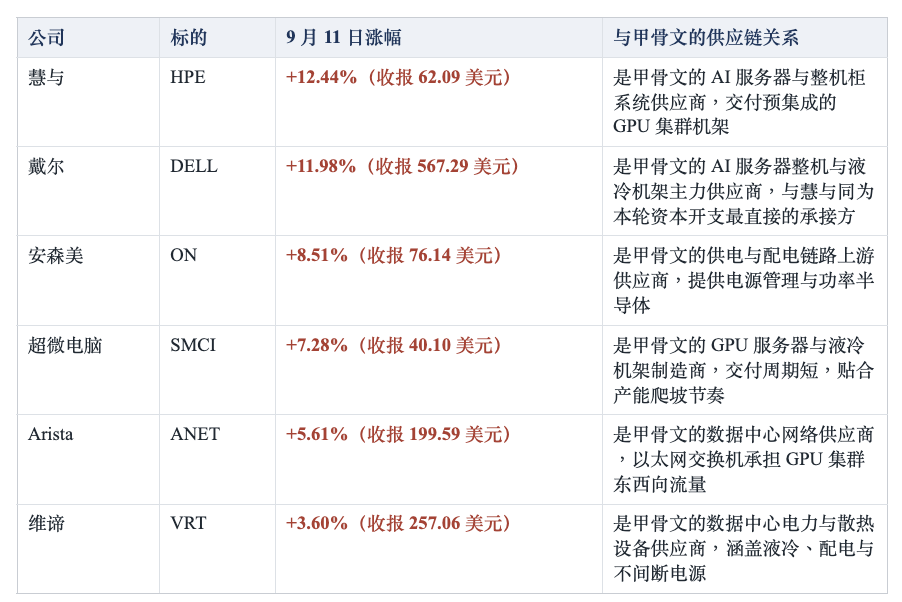
Note: Gains and closing prices are based on the September 11, 2026 close. The last column summarizes supply chain roles based on publicly disclosed business scopes; Oracle has not disclosed its supplier list, and some companies may not have a confirmed direct supply relationship with Oracle.
2. Why Did Oracle's Stock Rise First and Then Fall? RPO, Free Cash Flow, and Ellison's Share Sale
Since the earnings report comprehensively beat expectations, why did the stock close lower after gapping up 7.5%? The answer is not in the impressive figures at the top of the income statement, but hidden in the details of the later tables, and in a 10b5-1 filing that was disclosed alongside the earnings and then withdrawn over the weekend.
Remaining performance obligations (RPO) are the most tempting and most easily misinterpreted "IOU": The $664 billion in remaining performance obligations refers to the amount of signed contracts not yet recognized as revenue, up $209 billion year-over-year, with more than $30 billion in new AI cloud contracts signed in a single quarter. This figure has three layers of meaning that need to be viewed separately: it is the ceiling of revenue rather than revenue itself, and when it converts depends on when capacity is delivered; it contains no cost information, and there is no direct conversion relationship between order size and shareholder returns; its quality depends on the counterparty and terms, and the market generally estimates that nearly half of this $664 billion points to the same customer. In other words, the larger the orders, the higher the demands on delivery capability and customer concentration — it is a check that will take years to cash.
The improvement in free cash flow partly comes from book prosperity "embellished" by prepayments: Fiscal 2027 first-quarter free cash flow was negative $5.4 billion, which, although significantly better than the market expectation of negative $9.56 billion, on closer examination of the composition of operating cash flow reveals that $11.36 billion came from customer prepayments. Although this money genuinely arrived, in nature it is a liability corresponding to future services that need to be delivered, rather than profit already earned. Alongside this are arrangements such as customers bringing some of their own hardware and suppliers participating in financing — they do indeed shift part of the financing pressure away, and net cash expenditure after deducting these factors was about $18 billion, lower than the $28.5 billion in reported capital expenditure; but this also means that how much cash these rapidly growing AI orders will ultimately leave for shareholders remains an unanswered question for now.
The 82-year-old chairman's one-day "change of heart," with the stock up about 2% in weekend gray-market trading: On September 10, alongside the latest quarterly report, a share sale plan was also disclosed, from the company's executive chairman and chief technology officer, 82-year-old Larry Ellison: he had established a 10b5-1 trading plan as early as June 22, allowing for the sale of up to 50 million Oracle shares. In an earnings report featuring negative free cash flow, record capital expenditure, and a just-completed $20 billion equity offering, combined with the information that "the founder plans to sell $7.5 billion," a negative market interpretation is not hard to imagine.
The turning point came over the weekend. On September 12, Oracle's investor relations website published a statement titled "Larry Ellison Cancels His Plan to Sell Oracle Stock," with the original wording: "Larry Ellison, Executive Chairman of the Board and Chief Technology Officer, has canceled his 10b5-1 plan to sell Oracle stock. No Oracle stock was sold under the plan, and he has no other plans to sell any Oracle stock he holds." From disclosure to cancellation, only one day passed. In weekend off-exchange gray-market trading after the news was announced, the stock rose more than 2% at one point.
3. Is a 19x P/E Valuation Expensive? PE and EV/EBITDA Analysis
Based on Oracle's fiscal 2027 guidance — revenue of at least $90 billion and adjusted earnings per share of $8.1 — the current stock price corresponds to a forward P/E of about 19x. If earnings per share can maintain growth of more than 30% thereafter, the multiple would fall to about 14x a year later and about 11x two years later; while the market consensus estimate for next fiscal year's earnings per share is about $10.97, corresponding to about 13.7x, basically in line with this calculation. This is also precisely why Oracle's PEG is only 0.58, the lowest among peers: dividing the P/E by the growth rate, it is indeed the cheapest among this group of companies. For a company whose cloud infrastructure revenue grew 121% year-over-year and whose remaining performance obligations increased by $209 billion in a year, maintaining such growth is not out of reach.
But the numerator of the P/E ratio is market capitalization, and market capitalization does not include debt. Oracle's net debt has reached $132.1 billion, with an enterprise value of $586.5 billion, about 29% higher than its $454.4 billion market capitalization. Switching to EV/EBITDA, which includes debt, Oracle is at about 17.0x, Amazon at about 17.2x, and Microsoft at about 19.2x — the same set of assets, with a different numerator, and the "cheapness" is more than halved. For a company expanding through debt issuance and equity offerings, valuation metrics that ignore debt will naturally underestimate its true price.
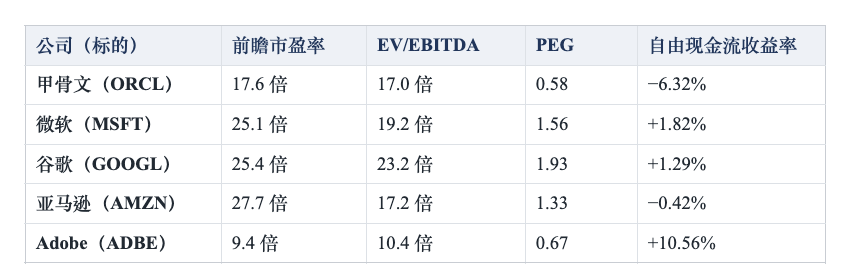
On an EV/EBITDA basis, Oracle's 17.0x is lower than Microsoft's 19.2x and Google's 23.2x, roughly on par with Amazon's 17.2x, placing it in the lowest tier among this group of companies. Considering that its growth rate is far higher than peers, this position is even on the low side — based on market expectations for fiscal 2027, its EBITDA will rise from about $36.5 billion in the previous fiscal year to about $52.4 billion, and on a static basis, the forward EV/EBITDA will quickly fall to just over 11x.
But judging whether the valuation is inflated also depends on what EBITDA excludes. Most of Oracle's $28.5 billion in capital expenditure for the quarter will become GPUs and data center assets, depreciating continuously over the coming years; interest expense for the quarter has also risen from $923 million to $1.428 billion, a growth rate of more than 50%. For a company that is becoming more asset-heavy and expanding through debt issuance, adding back depreciation and excluding interest is equivalent to moving the two heaviest burdens out of sight. More critically, both ends of the ratio are moving: the growth in the denominator, EBITDA, comes from expectations, while the growth in net debt in the numerator comes from already-signed capital expenditure plans — the market expects its net debt to climb above $160 billion by fiscal 2028. Even if EBITDA materializes as expected, the decline in the forward multiple will be slower than the static calculation suggests.
4. Has the Allocation Logic for Software Stocks Changed in the AI Era? Looking at the Valuation Shift from Oracle and Adobe
September 11 also left behind an easily overlooked phenomenon: all the top gainers were hardware, while the software sector was almost entirely absent. The top-performing sub-sectors that day were printed circuit boards and computer wholesaling, while Adobe fell, and Cloudflare and Rubrik also closed lower. Adobe, the software company that released its latest earnings report on the same day as Oracle, provides an almost completely opposite sample: third-quarter revenue of $6.76 billion, up 13% year-over-year, AI-related annualized recurring revenue up more than 150% year-over-year, platform users surpassing 1 billion — yet the stock fell because next-quarter guidance did not exceed expectations. The contradiction is quite stark: AI revenue is growing at triple-digit rates, user scale is expanding by the billion, yet the company's overall growth rate remains stuck at 13%.
AI has shifted the valuation anchor for software companies from "revenue growth" to "capital efficiency," while simultaneously pushing value toward both ends of the industry chain: one end is the infrastructure layer that truly absorbs capital expenditure, and the other end is the workflow layer that cannot be replaced after the model, while the part squeezed in the middle, growing only through seat counts and subscription prices, is seeing its bargaining power weakened.
Oracle and Adobe are precisely samples of these two paths. Oracle chose to turn itself into an infrastructure company, with the chain being "orders—capacity—cash." It does not lack demand; what it lacks is proof of converting demand into free cash flow per share, at the cost of negative free cash flow, rising debt, and continuous dilution. Adobe chose to remain in the software layer, with the chain being "free users—usage habits—willingness to pay." It does not need massive capital expenditure, and its cash flow has always been healthy, but what it lacks is proof of converting users into revenue. The market's attitude toward the two is therefore opposite: toward Oracle, it is belief that demand can be realized; toward Adobe, it is seeing growth but not believing it can be sustained. If AI models ultimately become an increasingly cheap foundational capability, what determines victory may not be the model itself, but the entire workflow layer of post-generation editing, collaboration, asset management, and delivery — a layer that still largely takes place within Adobe's own software.
As for Oracle, the priority of the following sets of data over the total order amount itself: whether capacity utilization can remain high after adding hundreds of megawatts of new capacity — if it falls back with expansion, it indicates that the pace of expansion has exceeded the pace of demand realization; the proportion of customer prepayments in operating cash flow, and the proportion of newly signed contracts using prepayment or customer-supplied hardware structures — a rising proportion indicates that risk sharing is strengthening; when the ratio of capital expenditure to revenue peaks, which is the most direct leading indicator of free cash flow turning positive; the pace at which the single-quarter free cash flow gap narrows, and whether management begins to provide timing guidance for turning positive; the pace of equity dilution and the growth rate of interest expense, and whether they are faster than operating profit growth; whether order customer concentration declines with new contracts, and whether a more detailed delivery and cash flow path is provided at the October investor day.
Disclaimer
This article is for reference only and does not constitute any investment advice or product offer. Data is as of September 13, 2026 (Eastern Time), sourced from public information, and the company does not guarantee its accuracy or completeness. The article contains forward-looking judgments, and actual results may differ materially. Investing involves risk, prices may rise or fall, past performance does not represent future performance, and investors may lose all of their principal. Product availability is subject to local legal and regulatory restrictions. Please evaluate on your own and consult independent professional advice.