






Pre-market Report on September 9: AI Compute Rental Stocks Rise, CoreWeave Gains 11.72%


- Key Takeaways: On September 8, all three major U.S. indices fell, but severe divergence emerged within the AI compute chain — compute rental stocks surged while chip stocks declined; on the same day, AeroVironment reported its first like-for-like year-over-year comparison one full year after consolidation, while the rare earth magnet chain revealed that "what's scarce isn't the mining, but the two processing steps of refining and magnet manufacturing."
- Key Factors:
- The Dow fell 1.18%, the S&P 500 dropped 0.58%, and the Nasdaq declined 0.31%; triple pressures converged as oil prices approached $100, the 10-year Treasury yield rose to 4.8%, and the U.S.-Canada tariff war escalated.
- CoreWeave surged 11.72% in a single day to close at $99.83, despite the contract going to Nebius (up 7.73%); trading volume was 1.79x the daily average, outperforming the sector average by 11.46 percentage points, but the deal's value and capacity were not disclosed.
- The AI compute chain showed clear divergence: CRWV rose 11.72%, NBIS gained 7.73%, IREN climbed 5.04%, while Micron fell 1.61% and Nvidia dropped 2.01% — compute rentals up, chip sales down.
- AeroVironment (AVAV) reports earnings after tonight's close, marking its first like-for-like year-over-year comparison since the May 2025 acquisition; the prior four quarters' 140%–151% year-over-year growth was due to consolidation base effects, with FY2027 guidance at only about 10%.
- China mines 60% of global magnetic rare earths, refines 91%, and produces 94% of sintered magnets; MP Materials is the only producing rare earth mine in the United States, with 2,599 tonnes of praseodymium-neodymium oxide in 2025, doubling year-over-year.
- Five rare earth chain companies ranked by 52-week price range multiple: General Motors 1.69x, UUUU 2.61x, MP 2.65x, USAR 3.84x, METC 6.75x — the closer to a delivered business, the narrower the range.
The previous trading day was September 8 (Tuesday). All three major indices fell: the Dow Jones Industrial Average closed at 52,786.07, down 1.18%; the S&P 500 closed at 7,674.13, down 0.58%; and the Nasdaq Composite closed at 26,423.69, down 0.31%. The star of the day was CoreWeave (CRWV), which rose 11.72% in a single day to close at $99.83 — while the company that actually won the contract that day was its peer Nebius (NBIS), which rose 7.73%. After the market close tonight at 20:00 UTC, AeroVironment (AVAV) will report earnings — its first like-for-like year-over-year comparison since completing its merger in May 2025 and consolidating a full year of results. Today's US Stocks Classroom breaks down the rare earth magnet chain: China mines 60% of the world's magnetic rare earths, yet refines 91% and produces 94% of sintered magnets. All data in this article is based on the September 8, 2026 US stock market close, and all times are in UTC.
September 8 Close: All Three Major Indices Fall, Dow Leads Declines
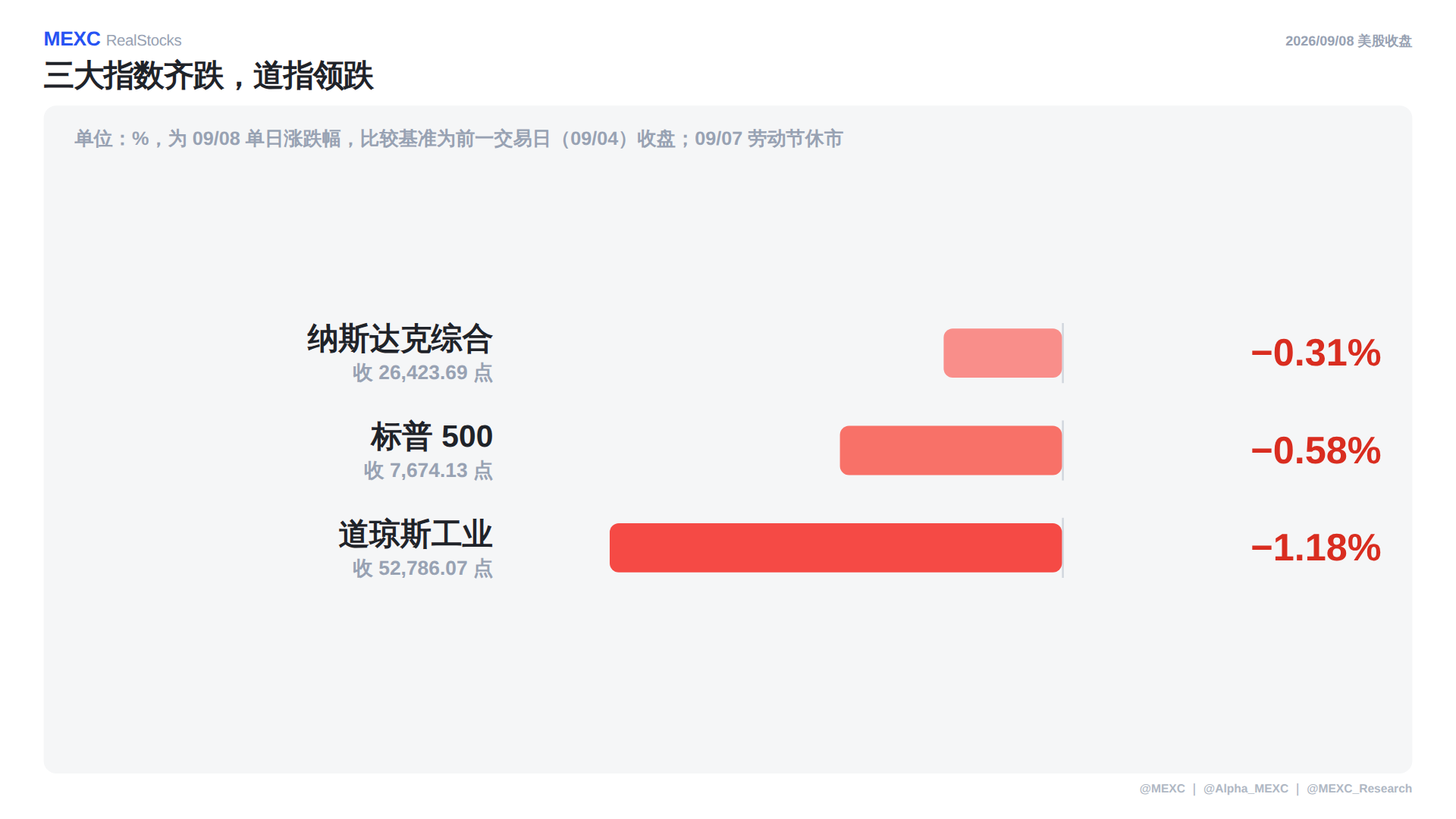
September 8 was the first trading day after the Labor Day long weekend, and none of the three major indices closed higher. The Dow Jones Industrial Average fell 1.18% to 52,786.07, the steepest decline among the three; the S&P 500 fell 0.58% to 7,674.13; and the Nasdaq Composite fell 0.31% to 26,423.69, the smallest decline.
Three themes ran through the entire session: oil prices approaching $100 per barrel, the 10-year US Treasury yield rising to around 4.8%, and the escalating US-Canada tariff war. These three themes are not the same thing, but they point in the same direction — costs and discount rates rising simultaneously, which hurts indices with higher weightings in large-cap stocks the most. That's why the Dow led the declines while the Nasdaq fell the least.
Beneath the index level, the divergence between sectors is more worth watching than the indices themselves. Chip stocks bucked the trend: Intel rose 9.05% to $104.47 as the market digested how server chip shortages are giving it back pricing power; Qualcomm rose 3.17% to $174.09 on news of landing a custom AI chip partnership with Amazon. Software stocks weakened on the same day: ServiceNow fell 4.99% to $134.21, while Salesforce and Intuit each fell about 4%, as the market worries that a new generation of general-purpose models will directly eat into vertical software's business. On the same trading day, hardware was rising while applications were falling — this contrast says more about what capital was thinking that day than the fraction of a percentage point in the indices.
Separately, GameStop's common stock fell 1.41% to $18.89, with its Q2 report released only after the close: revenue of $790.2 million and operating income of $160.2 million, a record high for the same period. After-hours numbers don't affect that day's closing price, and the two should be read separately.
There are no US economic data releases tonight. This week's macro weight falls on the last two days: August PPI and initial jobless claims on Thursday at 12:30, August CPI on Friday at 12:30, and the Fed's September FOMC meeting scheduled for next Tuesday and Wednesday. In other words, tonight the market's attention is not on macro but on individual earnings reports.
Star of the Day CoreWeave (CRWV): The Contract Went to a Rival, the Gains Stayed at Home
CoreWeave (CRWV) is an AI cloud compute company with a market cap of $54.5 billion. On September 8 it closed at $99.83, up 11.72% in a single day, adding about $5.7 billion in market cap in one day. Volume was 50.88 million shares, 1.79 times its average daily volume. The stock price sits at about 40% of its 52-week range.
Its news flow that day was unusual: Palantir named Nebius its preferred sovereign AI infrastructure partner, and the contract was not with CoreWeave. But the market read this partnership as a demand signal for the entire compute rental sector — the result being that Nebius, which received the endorsement, rose 7.73%, while CoreWeave, which did not, rose 11.72%.
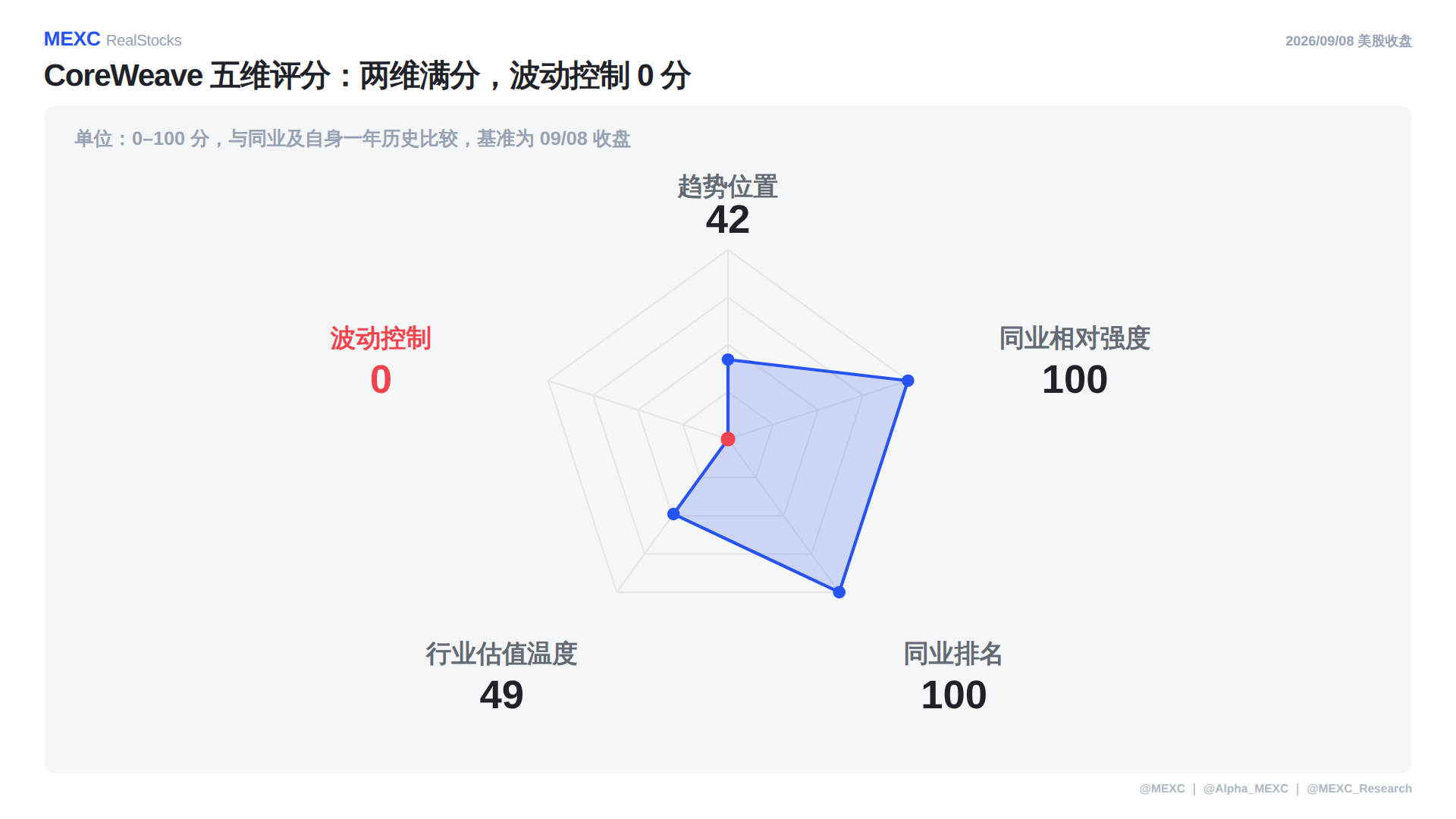
The five-dimension scoring makes the nature of this day very clear. Peer relative strength scored 100, peer ranking scored 100 — both perfect scores, meaning nothing in its category was stronger that day; industry valuation temperature scored 49, trend position scored 42, both in the lower-middle range; volatility control scored 0, the only zero among the five dimensions.
The zero is not a scoring error. It corresponds to a Beta of 7.41 — for every 1% the broad market moves, this stock moves 7.4% on average. Divide +11.72% by 7.41, and you get roughly 1.6% in broad-market terms. By that measure, the day's gain is not as outstanding as it appears on the surface. High-beta stocks' gains and losses are inherently amplified, and comparing them directly to low-beta stocks is unfair — this is a conversion you should always do first when reading any single-day gain.
Another aspect worth noting: this endorsement did not disclose the amount or committed capacity. With no amount and no capacity, it is closer in nature to a qualification than an order, and actual usage will only be visible through subsequent earnings disclosures. This is not negative news, but it determines how long this news can support the pricing.
The Same AI Compute Chain Split Into Two Sides That Day
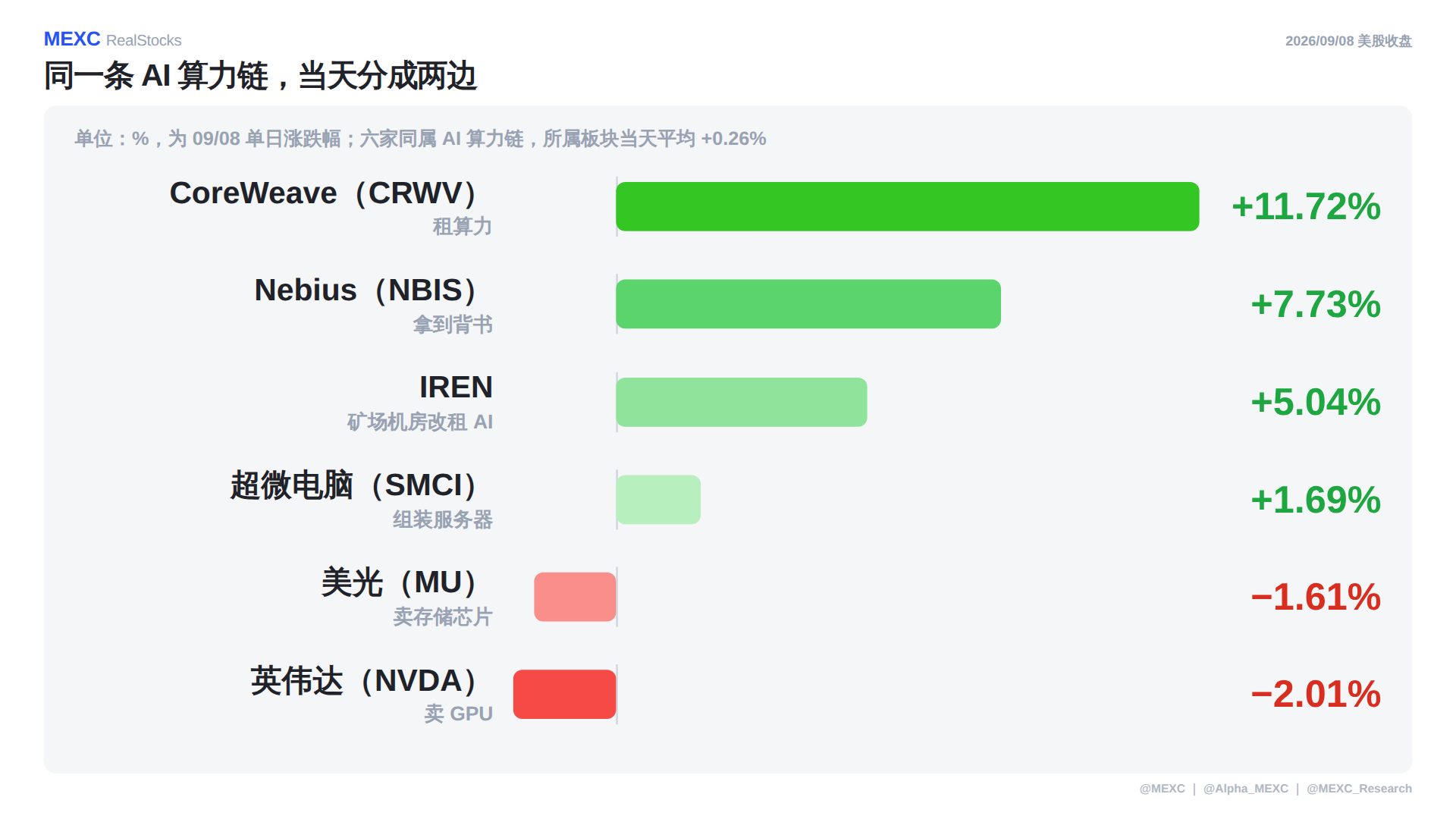
Putting the six companies on the same AI compute chain together, the day's picture is very clean: CoreWeave (CRWV) rose 11.72%, Nebius (NBIS) rose 7.73%, IREN rose 5.04%, Super Micro Computer (SMCI) rose 1.69%, while Micron (MU) fell 1.61% and Nvidia (NVDA) fell 2.01%.
The four above rent compute and assemble servers; the two below sell chips. Compute renters rose, chip sellers fell — the same chain, split into two sides that day. This is not because chip demand has deteriorated, but because the news itself points to demand for compute rental, not new chip procurement commitments. Where the news lands determines who gets repriced.
And precisely because of this, this day cannot be described as "the AI sector rose collectively." CoreWeave's sector rose only 0.26% on average that day — if the whole sector were rising, its 11.5-percentage-point outperformance wouldn't hold. Sector averages and sector divergence are two levels of information, and conflating them will get the conclusion backwards.
The supporting player is IREN, up 5.04% that day. Its business is converting mining farm facilities to rent to AI training, so that day it followed AI cloud rather than coin prices — its cohort peers COIN fell 3.09% and MSTR fell 4.40%. Which sector a company belongs to and what it gets priced by on a given day can be two different things.
One-Minute Concept: How to Judge the Quality of a Read-Through
When one company's news is treated by the market as demand evidence for an entire sector, that's called a read-through. CoreWeave's gain on September 8 was a classic read-through: the news was about Nebius, but the pricing landed on CoreWeave.
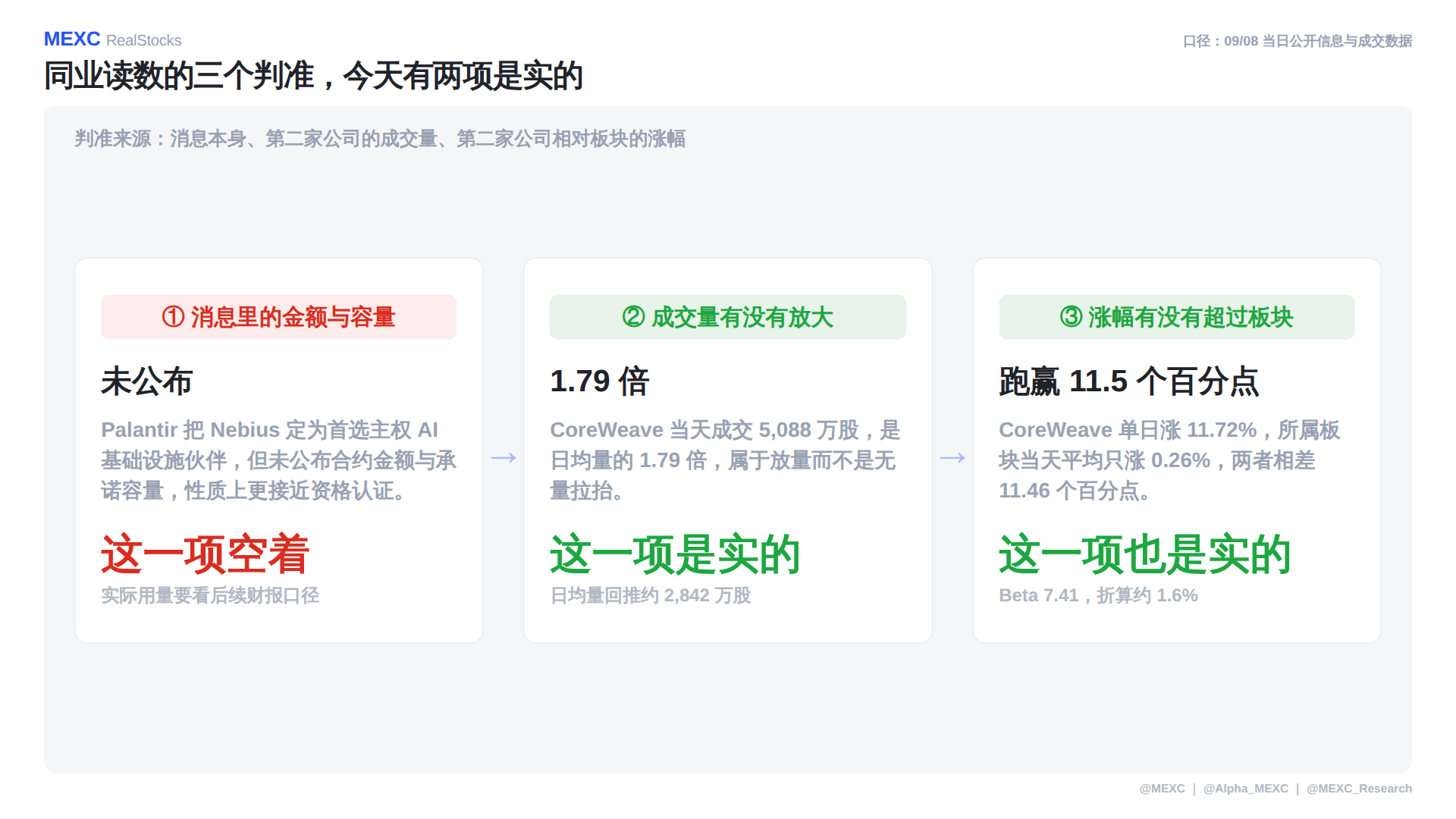
The problem is that read-throughs vary greatly in quality. Some read-throughs are backed by real incremental demand; others are just sentiment spillover. To distinguish the two, you can look at three numbers.
First, does the news include an amount and capacity? A partnership that specifies contract value, committed capacity, and delivery timelines allows you to calculate the incremental impact on the entire sector; one that only says "preferred partner" does not. Today's answer to this item is not disclosed, so the first item is blank.
Second, has the second company's trading volume increased? If only the price moved without volume, it means a small amount of capital is pushing it; if volume clearly expanded, it means new capital has genuinely come in to reprice it. Today CoreWeave traded 50.88 million shares, 1.79 times its average daily volume, which implies an average daily volume of about 28.42 million shares — this item checks out.
Third, has the gain exceeded the sector average? If the entire sector rose together, that's a broad market or industry-level matter with little to do with this news; if only it clearly outperformed, then the news has indeed been priced in. Today CoreWeave outperformed its sector by 11.46 percentage points — this item also checks out.
Two of three items check out, one is blank — that's the complete picture of this read-through on September 8: capital genuinely came in, but the partnership supporting it has no quantifiable content yet. What needs verification going forward is the actual usage figures in subsequent earnings reports.
What to Watch Tonight: AeroVironment (AVAV) After-Hours Earnings
AeroVironment (AVAV) will report earnings after the close at 20:00 UTC, with the earnings call at 20:30. Chewy (CHWY) and Signet (SIG) also report pre-market the same day, but tonight's main event is AVAV.
It is the primary supplier of small military drones for the US, and after completing its acquisition of BlueHalo in May 2025, it added a space, cyber, and directed energy line. It sits toward the consumables end of the supply chain — selling equipment with low unit prices, replenished in batches, with volumes driven by operational intensity, rather than large platforms ordered once a decade. So its revenue rhythm is closer to a consumables business than an engineering project. This positioning means that when reading its earnings, quarter-to-quarter fluctuations will inherently be larger than for major platform suppliers.
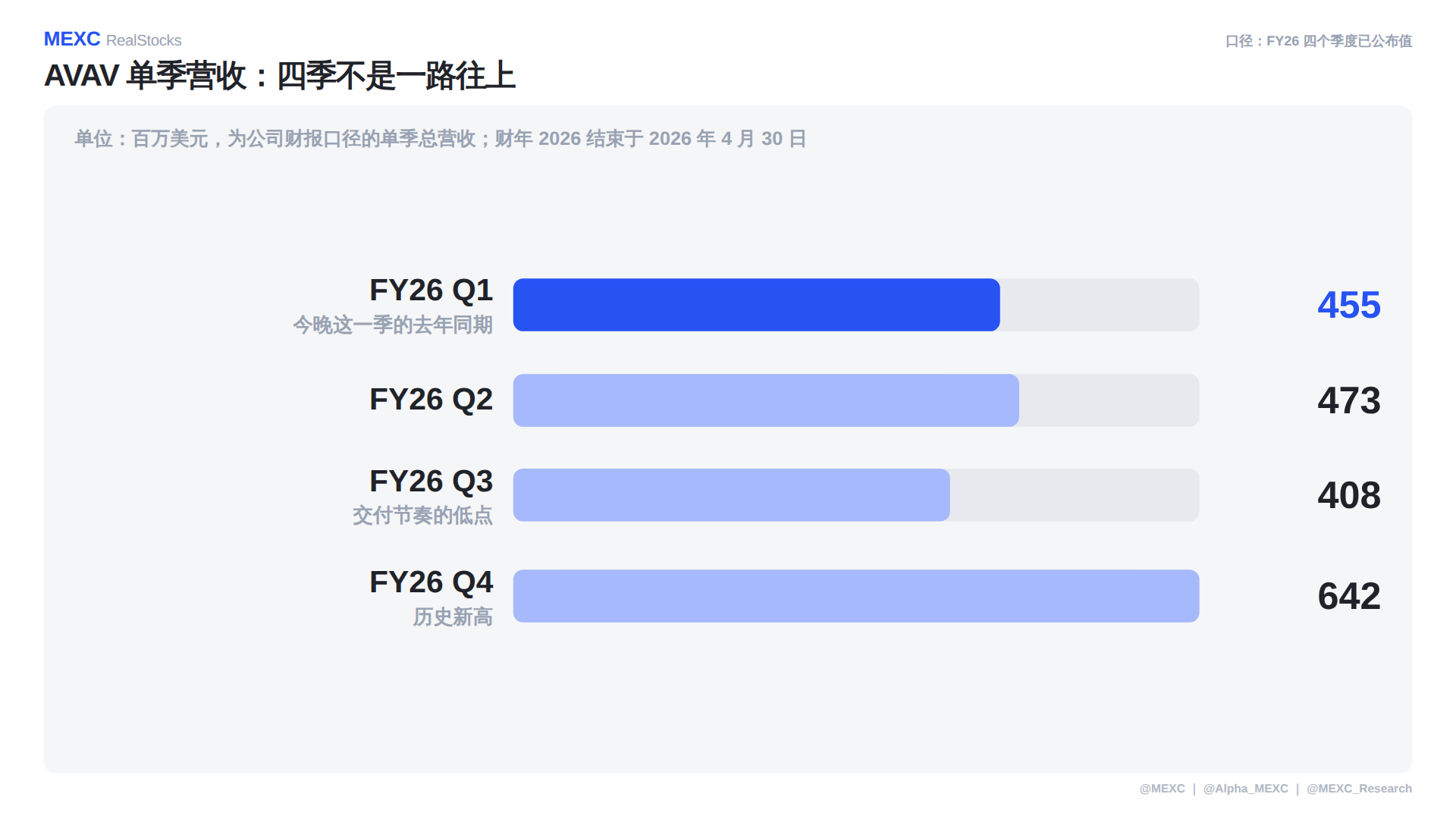
Look at absolute figures first, not year-over-year comparisons. Fiscal year 2026's four quarters (the fiscal year ended April 30, 2026) had total revenues of $455 million, $473 million, $408 million, and $642 million respectively. These four quarters did not move steadily upward: Q3 dropped to $408 million, then Q4 surged to a record high of $642 million — delivery timing between quarters is very uneven, and looking at any single quarter in isolation can be misleading.
Tonight's quarter ended August 1, with the year-ago period at $455 million. Whether revenue can hold this line matters more than whether the year-over-year number looks good — the reason will be explained clearly in the next section.
The company's own guidance for fiscal year 2027 full-year revenue is $2.125 billion to $2.225 billion, roughly +10% year-over-year. At the two ends of the range, the low end corresponds to +7.5% and the high end to +12.5%.
Triple-Digit Growth Was Propped Up by Consolidation; Guidance Is Only 10%
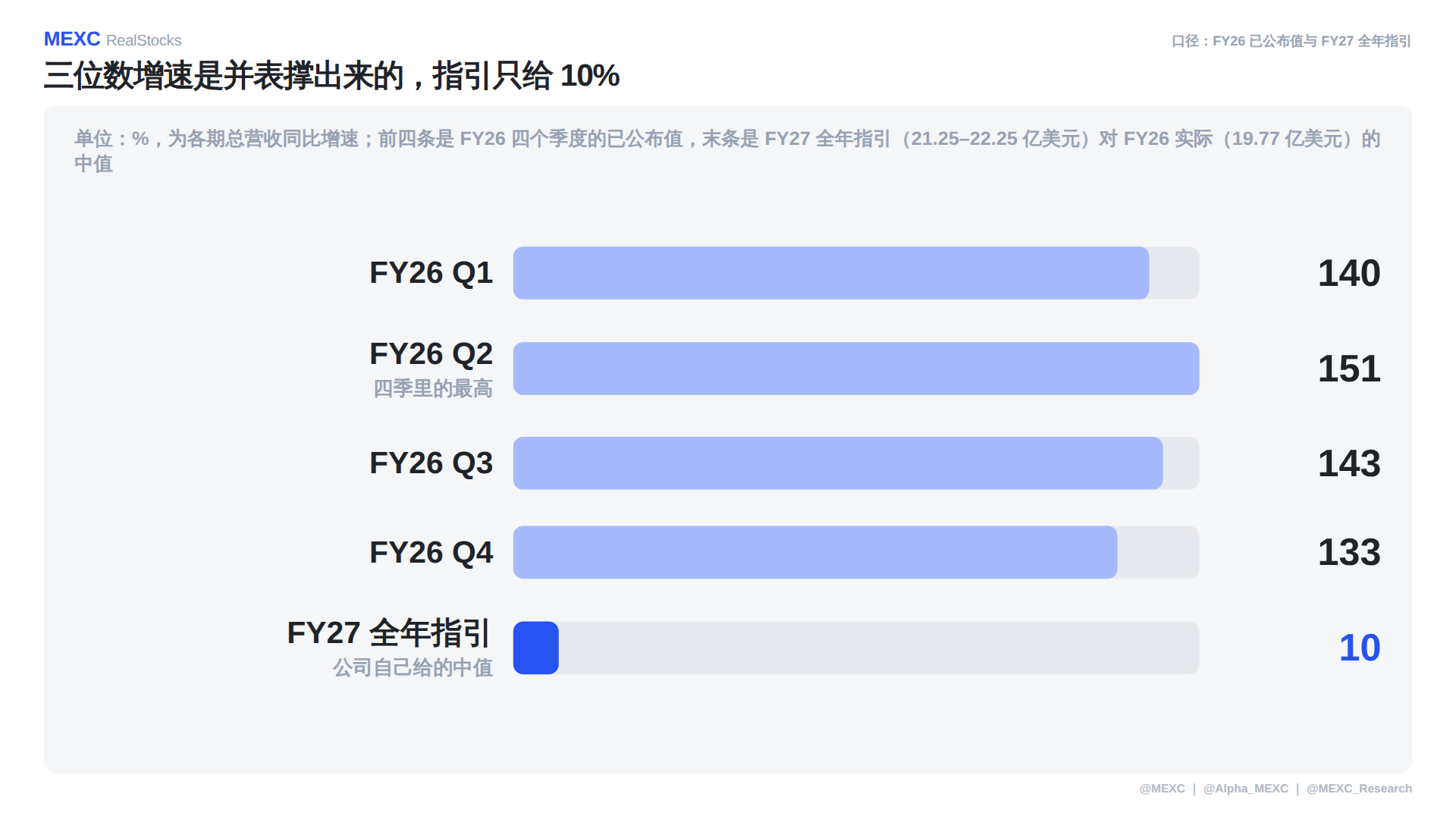
Lay out the comparison basis and the gap becomes very stark: fiscal year 2026's four quarters had year-over-year total revenue growth of 140%, 151%, 143%, and 133%, while the midpoint growth rate calculated from the company's fiscal year 2027 full-year guidance is only 10%.
There is only one reason for the order-of-magnitude difference: the consolidation base effect. The acquisition closed on May 1, 2025, and from that day the acquired company entered the consolidated financials. So for every quarter of fiscal year 2026, the numerator includes the new business while the denominator does not — that's where the triple-digit figures come from, and it has nothing to do with the pace of organic growth. In accounting, this phenomenon is called the consolidation base effect, and it appears after any large acquisition, lasting exactly one year.
Tonight's quarter ended August 1 is the first like-for-like year-over-year comparison after a full year of consolidation: both numerator and denominator include the new business, so what pops out is the true organic growth rate. The company itself puts this full-year figure at around 10%.
So the two numbers 133% and 10% cannot be placed side by side and compared as "growth has collapsed." They are on different bases: the former is a realized year-over-year figure with a denominator that excludes the acquired company; the latter is a full-year guidance midpoint with both numerator and denominator including it. Placed together, the only correct reading is "the base effect is over," not "growth is gone."
For tonight specifically, there are two lines to watch. First, check revenue against the $455 million line — the year-ago level and also the denominator for the first clean year-over-year comparison; falling below it would signal organic growth is retreating. Second, check whether two items have been updated: whether gross margin can hold last quarter's 32% (the prior two quarters were only 21% and 22%), and whether the company has changed its prior guidance that free cash flow will be negative this fiscal year and that growth will be weighted toward the second half.
US Stocks Classroom: Rare Earths Aren't Rare — What's Rare Is the Two Steps That Turn Them Into Magnets
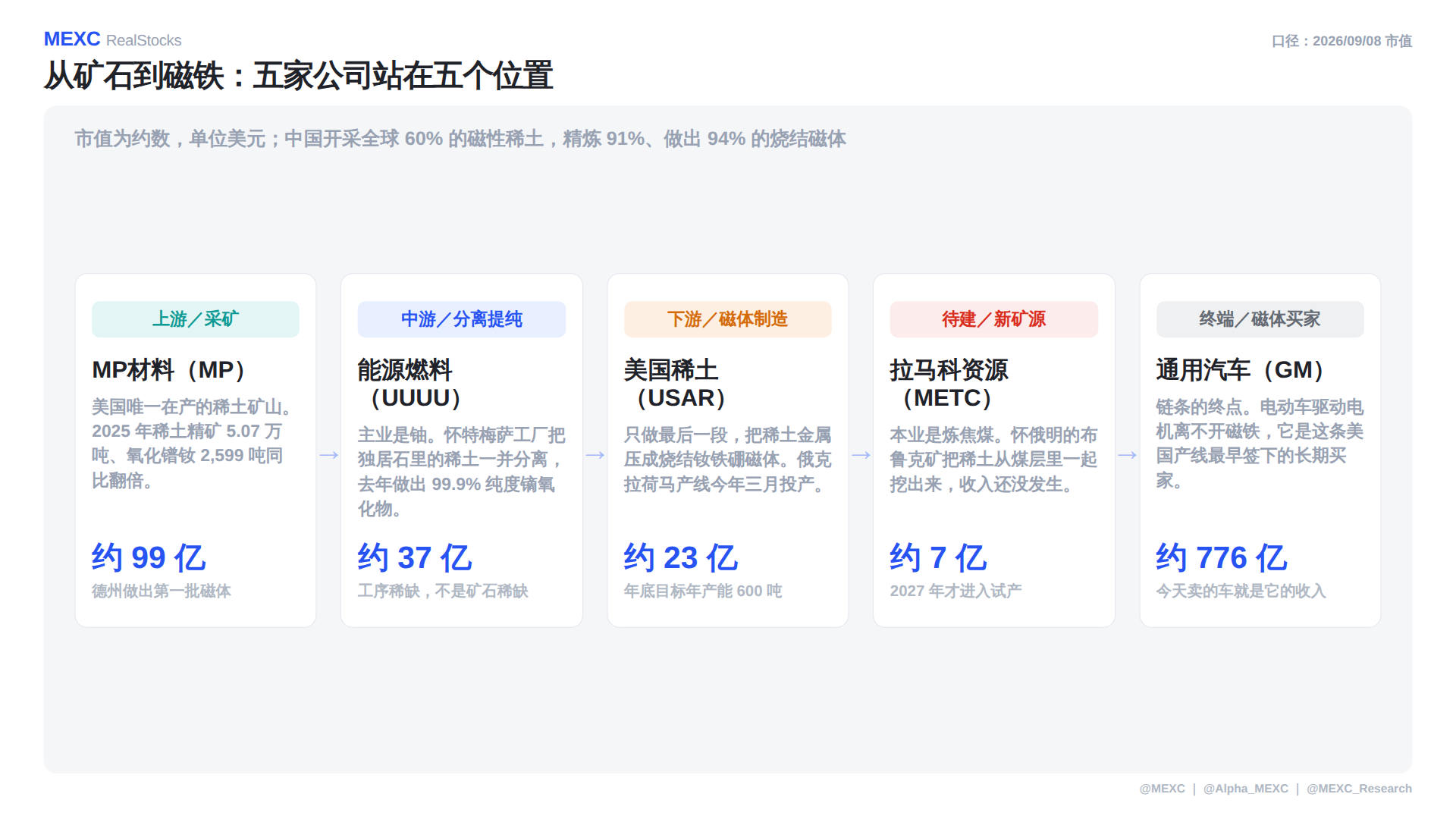
Wednesday's sector breakdown covers rare earth magnets. It opens with a set of numbers: China mines 60% of the world's magnetic rare earths, yet refines 91% and produces 94% of sintered magnets. From mining to magnets, China's share increases by 34 percentage points.
Put these three numbers together and the conclusion emerges: what's scarce isn't the ore — it's the two steps that turn it into magnets. Rare earth elements are not low in abundance in the Earth's crust; they can be mined all over the world. What's difficult is separating the seventeen elements with extremely similar chemical properties one by one, then pressing the separated metals into sintered magnets usable in electric motors. These two processes are the bottleneck.
Following this chain, five companies sit at five different positions.
MP Materials (MP), with a market cap of about $9.9 billion, sits at upstream mining. It is the only producing rare earth mine in the US, producing 50,700 tonnes of rare earth concentrate and 2,599 tonnes of neodymium-praseodymium oxide in 2025 (more than doubling year-over-year from about 1,300 tonnes last year), and produced its first batch of neodymium-iron-boron magnets in Texas.
Energy Fuels (UUUU), with a market cap of about $3.7 billion, sits at midstream separation and purification. Its main business is actually uranium; its White Mesa mill in Utah separates rare earths alongside processing monazite, and last year it produced dysprosium oxide at 99.9% purity. It is the most direct example of the statement "it's the process that's scarce, not the ore."
USA Rare Earth (USAR), with a market cap of about $2.3 billion, sits at downstream magnet manufacturing. It only does the last stage, pressing rare earth metals into sintered neodymium-iron-boron magnets; its Oklahoma production line began operating in March this year, targeting 600 tonnes of annual capacity by year-end.
Ramaco Resources (METC), with a market cap of about $700 million, sits at a new mine source yet to be built. Its core business is coking coal, and its Brook Mine in Wyoming extracts rare earths alongside coal seams, but it won't enter trial production until 2027 — meaning this link has no revenue today.
General Motors (GM), with a market cap of about $77.6 billion, sits at the end of the chain. EV drive motors can't do without magnets


