






BIT Investment Opportunities Thematic Forum Held in Hong Kong, Exploring Market and Asset Allocation Opportunities in the Next Phase


- Key Takeaways: Against the backdrop of Bitcoin rebounding to $80,000, the BIT forum focused on the new phase of digital asset allocation, arguing that with the macro debt-liquidity cycle converging with Bitcoin's own cycle, a new upward cycle is beginning, and the industry is transitioning from conceptual narratives to institutional validation.
- Key Elements:
- BIT特邀分析师Markus Thielen identified a Bitcoin price cycle pattern of "35 months of gains, 12 months of corrections" and concluded that the market is currently at the triple intersection of debt expansion, the end of dollar strength, and Bitcoin completing its correction, signaling the start of an upward cycle.
- Based on the current scale of U.S. Treasury debt, Bitcoin's fair value stands at approximately $100,000, meaning current prices remain relatively low.
- The tech giants (Magnificent Seven) saw their combined market cap evaporate by approximately $2.4 trillion in June 2026, with cash flows in the AI sector tightening, and capital showing a divergence toward safe-haven assets such as gold, Bitcoin, and RWA.
- RWA development faces four major limitations: limited asset variety, insufficient liquidity, lack of cross-chain interoperability, and insufficient compliance and policy guidance. The monthly trading volume of tokenized U.S. stocks is approximately $9.22 billion—less than one-180th of Nasdaq's average daily trading volume.
- The Hong Kong Securities and Futures Commission has only approved three cryptocurrency spot ETFs—BTC, ETH, and Solana—meaning only ETH and Solana remain viable public chains capable of supporting large-scale RWA and stablecoin distribution.
- Analyst Ni Da predicts that the Federal Reserve is likely to hold rates steady this year, and Bitcoin's bottom structure is basically complete. Even if it tests lower levels again, it would likely find support in the $57,000–$58,000 range.
On the afternoon of August 26, during the Bitcoin Asia 2026 conference, BIT (formerly Matrixport), a global digital asset financial services group, hosted an investment opportunities forum in Hong Kong. Under the theme "Traditional Capital Markets, Digital Assets, and More Possibilities," the forum brought together over ten speakers, including institutional investors, family office representatives, renowned stock commentators, media, and academics, for in-depth dialogues on macroeconomic cycle observations and digital asset allocation strategies. During the week of the forum, Bitcoin was experiencing a strong rebound, briefly breaking through the $80,000 mark to hit a three-month high. Driven by shifting macroeconomic liquidity expectations and improving market risk appetite, discussions intensified over whether digital assets had emerged from their阶段性 trough and entered a new window for allocation. More than two hundred investors, institutional representatives, and industry partners from Hong Kong and around the world attended the event.
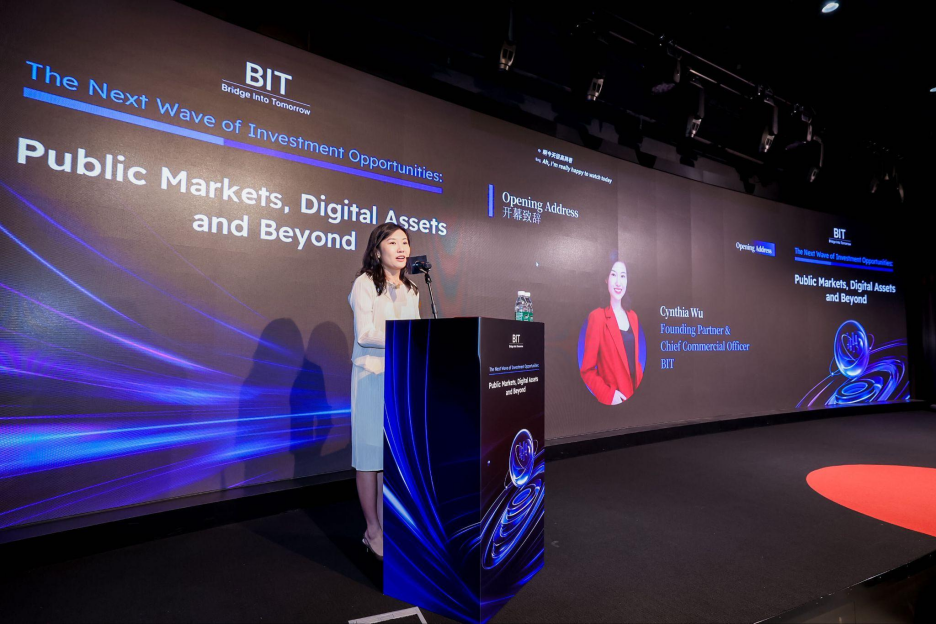
Setting the Macro Tone: From Digital Assets to Multi-Asset Allocation, Deciphering the Merrill Lynch Clock and Asset Rotation Patterns
The forum opened with remarks from Cynthia Wu, Founding Partner and Chief Commercial Officer of BIT. Over the past seven-plus years, BIT has consistently built its business on a foundation of security and risk management, continuously refining its trading, custody, and operational systems. Throughout this period, BIT's business has revolved around the core principle of "providing clients with long-term, sustainable financial services on the basis of controlled risk." This year, BIT has extended this approach to a broader range of asset classes, formally transitioning into a multi-asset digital financial platform: in February, it launched US stock spot trading services, subsequently adding margin trading and options. The cumulative trading volume of these products has now reached approximately $4 billion. Embedding risk management throughout business development allows BIT to continually provide long-term services to clients. This journey would not be possible without the lasting trust of clients and the support of partners in infrastructure, products, and services, and BIT itself remains in a state of continuous learning and development. Going forward, the platform will also introduce HKD deposit and withdrawal services and Hong Kong stock trading, further refining its service system in bridging traditional finance and digital assets.
Following the opening, Markus Thielen, a contributing analyst at BIT, delivered an in-depth presentation on macroeconomic cycles, systematically reviewing historical patterns while clarifying for investors where asset values are headed next. Based on his analysis of nearly fourteen years of Bitcoin market price history, Markus extended beyond the market consensus of the "four-year halving" cycle to distill a price pattern of "35 months of appreciation, 12 months of correction": a price break below the one-year moving average typically corresponds to a bear market phase, while a reclaim of the one-year line and the 21-week moving average, coupled with signals such as the monthly RSI approaching cyclical lows, fading demand for put options, and a breakout of long-term downward trends, often signals the end of the correction and the start of a new upward cycle. However, he emphasized that Bitcoin's own price cycle, when叠加 with the longer-term macroeconomic "debt-liquidity super cycle," exhibits periodic interplay rather than a simple linear relationship: US Treasury scale and Bitcoin prices do not rise and fall in sync; rather, debt trends determine the long-term upward slope, the US dollar and liquidity determine when the move begins, and Bitcoin's own price cycle dictates the specific rhythm of the rally and correction. In his assessment, the market is currently at a "triple confluence": debt continues to expand, the dollar's strength is ending, and Bitcoin has just completed roughly a 12-month correction. He therefore believes a new upward cycle lasting approximately two to three years is underway. He shared an intuitive valuation anchor from his research: based on the current scale of US debt, Bitcoin's fair value should be around $100,000, suggesting the current price level remains relatively low.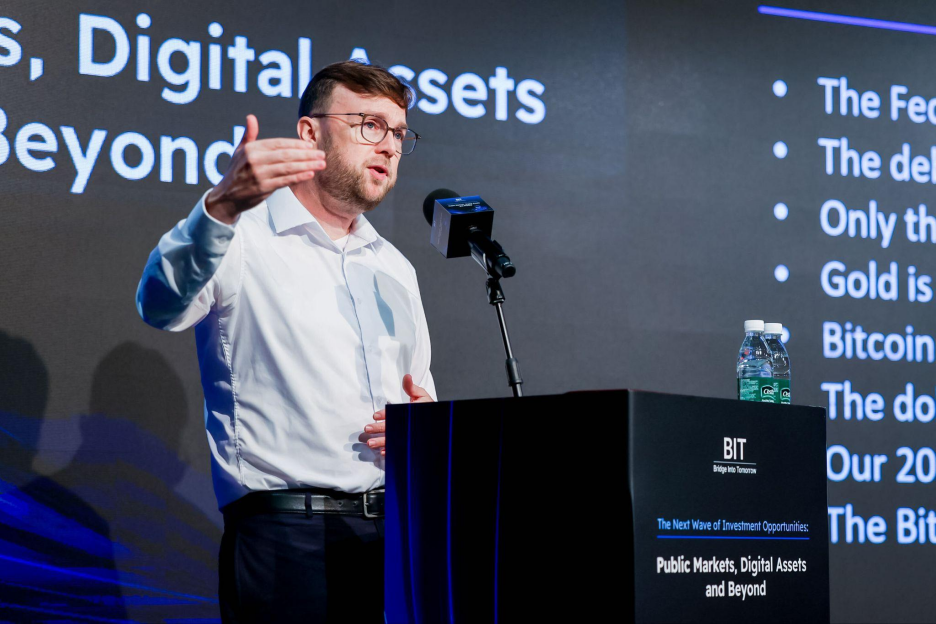
Panel Discussion: As Valuation Logic in the AI Sector Is Being Rewritten, Where Will Global Capital Flow Next?
The first panel, moderated by Sunny, CEO of PANews, brought together Elio Cui, Head of Brokerage at BIT; Ming ZHAO, CEO of AVS; Crystal He, CEO of Delin Family Office; and 孙子大户, a renowned Hong Kong stock commentator and full-time trader. The discussion centered on the tightening cash flow situation of AI giants: Can AI continue to attract long-term capital inflows, or has capital rotation already shifted toward new directions?

The discussion began with the fact that the "Magnificent Seven" tech stocks lost approximately $2.4 trillion in combined market value in June this year alone. Panelists explored whether AI capital expenditure guidance would slow, and whether cash flows could cover such massive spending amid continuously expanding debt levels across these companies. Viewed through a longer technology cycle lens, this correction resembles another benign clearing-out similar to the 2000 internet bubble—the sector itself will not disappear, but only companies that can truly navigate cycles will survive and solidify.
On where capital should be allocated next, panelists' views diverged between "defensive certainty assets" and "structurally high-volatility assets": some capital remains willing to stay in high-growth tracks like AI for excess returns, while other funds are rotating toward gold, RWA, and quality assets with stable cash flows to hedge against uncertainty—with gold continuing to attract strong demand amid geopolitical uncertainty. Elio offered an explanation: as market expectations shift toward rate hikes or a Fed pivot, capital tends to move from high-volatility, high-growth assets toward scarcer, higher-certainty assets like gold and Bitcoin—which is why he is currently focusing on gold, Bitcoin, RWA, and quality cash-flow infrastructure companies. He is bullish on the growth potential of stablecoins and RWA, but candidly acknowledged that RWA development still faces a common challenge: issuance volumes are large, yet trading remains thin. Crystal He further confirmed this from an institutional investor perspective: while trillion-dollar institutions like BlackRock and Franklin Templeton are making long-term plays in this space, four limitations persist—a narrow range of asset types (roughly 40% of the $31.4 billion in issuance is US Treasuries), insufficient liquidity, predominantly single-chain development lacking cross-chain interoperability, and the ongoing need for compliance and policy guidance.

Tokenized US stocks, the RWA category with the highest issuance volume, face similar challenges. On the surface, the strong wealth effect and appeal of US equities have allowed a broader range of investors to access this asset class for the first time. But the more fundamental driver is actually "lowering the barrier to entry," rather than the novelty of the asset itself—tokenization has given users who previously couldn't open brokerage accounts a first-ever ticket to buy US stocks. According to industry data, in June 2026, the monthly on-chain trading volume of tokenized US stocks across all networks was approximately $9.22 billion, translating to a weekly average of about $2.1 billion—still less than 1/180th of the Nasdaq exchange's single-day trading volume (approximately $383.7 billion). This shows that even after lowering the barrier, the question of whether liquidity and the underlying assets can truly be honored has never been genuinely validated by the market: when large-scale buying, selling, or redemptions are needed, investors often discover that the liquidity of the underlying US stocks behind the tokens is not as ample as imagined. This phenomenon reflects a deeper reality—trading channels that directly connect to US capital markets with genuine underlying assets and abundant liquidity remain difficult to replace in the short term.
Fireside Chat: The Web3 Industry Is Transitioning from Freely Evolving Conceptual Narratives to an Institutionalized Phase of Verifiable Trust
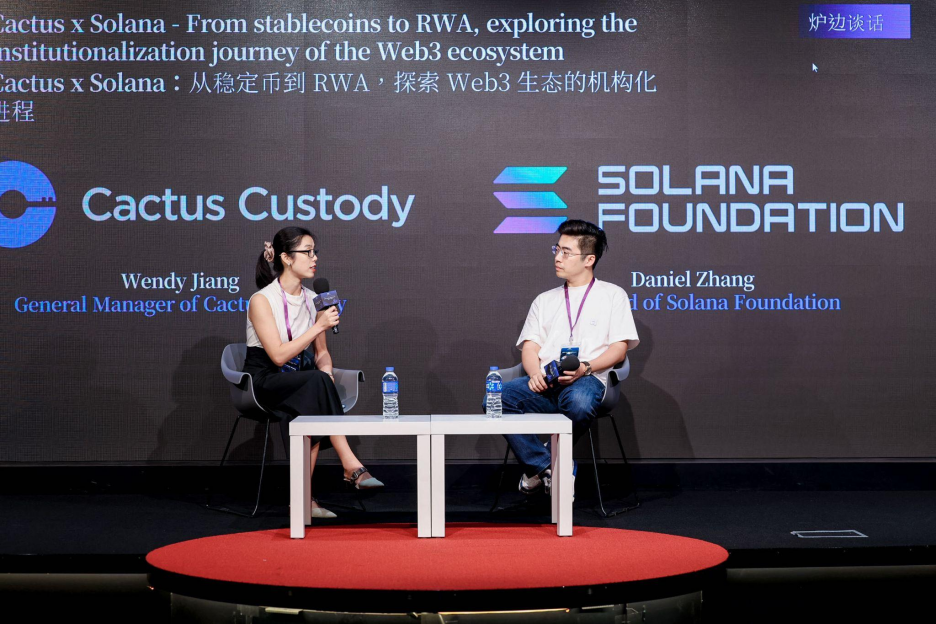
Wendy Jiang, General Manager of Cactus Custody (a BIT subsidiary), and Daniel Zhang, Head of the Solana Foundation's Chinese-speaking region, discussed the public chain ecosystem and the institutionalization path of stablecoins and RWA. As the Web3 industry transitions from a phase of free growth centered on "competing narratives and concepts" to an institutionalized phase dominated by institutional capital and trust built on verifiable records, the competition among public chains is no longer about whose story is more compelling, but rather who can demonstrate a security track record and genuine capital activity that withstand the test of time and regulatory scrutiny. Daniel noted that the Hong Kong Securities and Futures Commission has currently approved only three cryptocurrency spot ETFs—BTC, ETH, and Solana—with the Solana ETF being the first of its kind launched in Hong Kong globally. Moreover, under Hong Kong's regulatory framework, the number of tokens approved for retail investor trading remains very limited, meaning that in practice only ETH and Solana remain viable public chains capable of supporting long-term, large-scale RWA and stablecoin distribution. He also proposed a professionally insightful evaluation standard: to assess whether a public chain has genuine economic vitality, one should not merely look at total stablecoin issuance, but rather at the "velocity of money"—measured by transfer volume, Solana currently ranks in the global first tier alongside Ethereum. Wendy used the analogy of a "highway" to describe the role of custodians as "service areas" in the process of institutional capital flowing into public chain ecosystems—the greater the traffic (institutional capital) on the road, the more comprehensive the refueling stations and service facilities needed. Both agreed that the "window period" for new public chains has closed, as the track records recognized by institutions and regulators are difficult for latecomers to replicate.
Flagship Discussion: The New Phase of Digital Asset Investment—From "Whether to Allocate" to "How to Allocate"
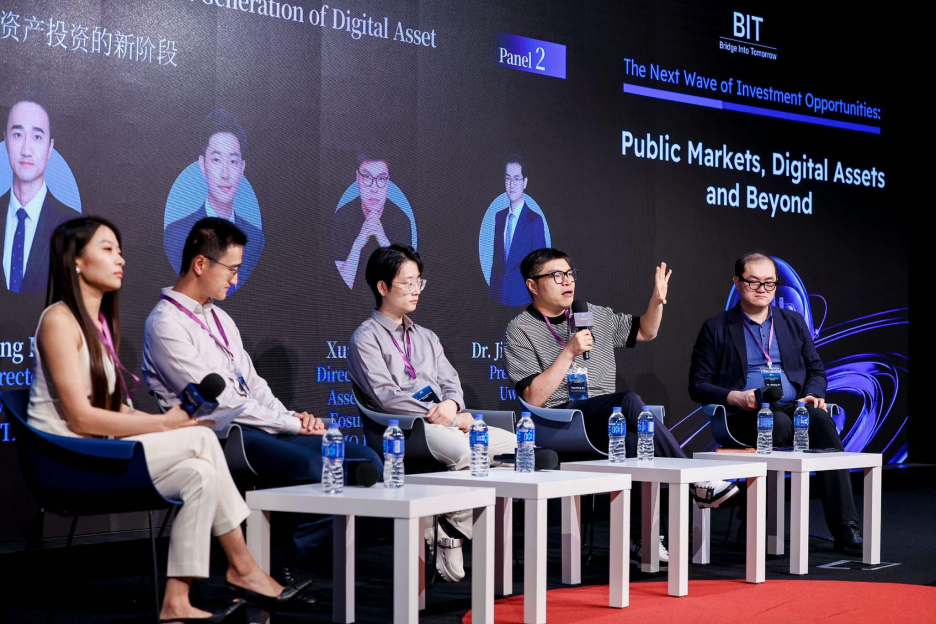
The second panel, moderated by Megan Xiao, Head of Structured Products at BIT, brought together 丁珑, Investment Director of TDTC; Charles, CIO of B7 Capital; 胡烜峰, Director of Digital Assets at Fosun Wealth Holdings; and 于佳宁, President of Uweb, to discuss the new phase of digital asset allocation. In the past, the key question was "Will BTC go up?" Today, investors are more troubled by "I'm bullish on the direction but can't time the entry." Managing this price exposure and achieving multi-asset allocation through structured tools is gradually emerging as a new approach. Against this backdrop, the panelists offered their professional perspectives.
President 于佳宁 of Uweb first addressed investor psychology: he observed that his students are transitioning from speculators to multi-asset allocators, no longer fixated on waiting for the "final dip." He outlined four allocation themes: "carbon-silicon symbiosis, longevity multiplication, quantum leap, and deglobalization." Mr. 胡 from Fosun Wealth approached it from an asset attributes perspective: crypto assets are evolving from "speculative concepts" into containers for packaging traditional assets on-chain, with institutional-grade custodians serving as the key infrastructure that enables institutions to genuinely "enter" the market and allocate to global assets. Charles offered a quantitative trading perspective, noting that while the Sharpe ratio of crypto strategies is higher than traditional markets, their stability is lacking; the increasing presence of market makers and institutions is compressing arbitrage returns, and HFT capacity is too small. "The era of riding a single direction with one strategy is coming to an end," he argued, advising that asset allocation should include a portion of stable-return products uncorrelated with Beta, rather than staking everything on the coin price itself. 丁珑 of TDTC added an industry perspective: "Mining to produce assets" and "balance sheet management" are two entirely different matters. Miners must not only assess the stability of their electricity sources but also leverage structured products from platforms like BIT to manage and enhance cash flows.
Megan concluded from BIT's structured business perspective: digital asset allocation is no longer a simple "Buy & Hold" but a dynamic management process anchored by structured tools—"identifying the right trend" matters, but "anchoring the right tools and execution paths" determines whether one can navigate through cycles. BIT's structured products are the concrete embodiment of this "tools + path" approach: by productizing professional strategies such as volatility management and yield enhancement, ordinary investors can access structural returns that were previously only available to institutions, without having to build complex positions themselves. This represents one solution to the question of "how to allocate."
Closing Dialogue: A Conversation with 倪大—From Fed Policy to Whether Young People Should Use Leverage

The final session of the forum featured a dialogue between Elio Cui, Head of Brokerage at BIT, and Phyrex 倪大, a prominent KOL in the Web3 industry and on-chain data and macroeconomic analyst, addressing the most hotly anticipated topics of the day and delving into 倪大's unique insights.
On the Fed and Treasury policy path for the second half of the year—a topic of intense market focus—倪大 offered a view that diverged from mainstream expectations: he believes the Fed is highly likely to hold rates steady this year—"neither hiking nor cutting." 倪大 analyzed the economy from a more grassroots perspective: from supply chain transmission in oil prices, to the drag of immigration deportation policies on employment data, to the reality that US debt levels are too high to withstand further tightening, and even the new Fed Chair quietly dropping forward guidance—all these signs, in his view, point to "rates wanting to move lower."
On the most market-watched question—"Why did Bitcoin suddenly break above $80,000 in the last two days?"—倪大, as a seasoned trader, offered his solid observations on market liquidity: the trading volume in this rally was actually not exceptionally high. A more accurate description would be "fewer sellers, more buyers"—an imbalance in supply and demand pushed prices up, rather than a burst of incremental capital inflows. As for the bottom of this cycle, 倪大 clearly has his own "ledger": he believes the bottom structure has essentially been completed. Even if another retest occurs, it would likely be in the $57,000–$58,000 range, with the probability of breaking below $51,000 now quite low. Supporting this view are his observations of Bitcoin spot ETF flows and institutional holding behavior: recent ETF flows have shifted from阶段性 net outflows to sustained net inflows, most long-term high-net-worth institutions and listed companies holding Bitcoin have not engaged in large-scale selling in recent months, and some institutions that previously reduced positions have now stopped selling and turned to stabilization—these signals collectively point to institutional recognition of current price levels.
On the sharp question debated online—"Should young people use leverage?"—倪大 refused to lecture from a position of superiority. He candidly acknowledged that for young people with limited capital, leverage is indeed one of the few realistic paths to amplify returns, within acceptable risk limits. But the real challenge has never been whether one dares to use leverage—it's whether one can maintain the ability to "stay at the table." That is the skill that requires long-term learning and practice. Speaking of the "cards in his own hand," he revealed that he has been using the options leverage and margin trading tools on BIT's US stock platform to dollar-cost average into index ETFs like VOO and QQQ. It is precisely the safe and stable leverage ratio settings on the BIT platform that allow him to enhance capital efficiency.
From the macroeconomic debt cycle to stablecoin infrastructure, from the competitive landscape of public chains to real drawdown data in quantitative strategies, and from a veteran trader's candid interpretation of Fed policy and leverage philosophy, the forum demonstrated its professional depth, presenting attending investors, institutional representatives, and industry partners with a panoramic view of the next wave of investment opportunities. As the attending guests consistently affirmed, "The market never lacks opportunities—what it lacks is the ability to understand them at the right time, in the right way."
About BIT
BIT (formerly Matrixport), founded in 2019, is a leading global digital asset financial services group. Headquartered in Singapore with offices across seven countries and regions worldwide, BIT connects traditional finance with digital asset markets through robust governance, technological capabilities, and compliant operations.
BIT provides comprehensive digital asset services to global institutions and professional investors, covering trading, custody, asset management, liquidity, and financing services, while also supporting the on-chain introduction and application of Real World Assets (RWA). Its entities hold relevant licenses and operate under local regulation in Singapore, Hong Kong, Switzerland, the UK, the US, and Bhutan, including Singapore's Major Payment Institution (MPI) license and the collective asset management license issued by Switzerland's FINMA.
The group currently manages over $6 billion in assets, with monthly trading volume exceeding $7 billion, cumulative interest payments to clients surpassing $2 billion, and a valuation exceeding $1 billion. It has been featured on the "2024 Hurun Global Unicorn List" and the "2025 Singapore Fintech Unicorn List."
Disclaimer
1. This content is solely a summary of the event and general information sharing. It does not constitute investment advice, financial advice, tax advice, or any offer, solicitation, or recommendation for any securities, digital assets, or other financial products.
2. The speakers' remarks, views, and data contained herein represent the personal positions of the speakers and have not been independently verified by BIT. They do not represent the opinions of BIT or its affiliated entities. BIT makes no representations or warranties as to their accuracy, completeness, or timeliness.
3. This article may contain forward-looking statements and descriptions of future markets, businesses, or products. Such statements are based on assumptions as of the publication date, are subject to uncertainties, and actual results may differ materially. The launch timing and availability of related businesses and products depend on regulatory approvals and internal arrangements and may


