BTC Returns to $80,000 After 100 Days: "Bull Run" or "Last Dance"?


- Key Takeaways: After 100 days, BTC has returned to $80,000, posting a 25% weekly gain and swinging market sentiment from fear to extreme greed. This rally is driven by a confluence of policy tailwinds, ETF inflows, and improving macro liquidity, but is fundamentally driven by short covering, leading to intense bullish-bearish divergence, with short-term pullback risks coexisting alongside long-term bullish logic.
- Key Elements:
- Three Policy Tailwinds: Trump hosted a crypto meeting at the White House to support legislation, the SEC proposed raising the funding cap to $75 million, and the U.S. Treasury doubled its long-dated bond buyback scale to $4 billion—all boosting market sentiment.
- Capital Flows: Spot Bitcoin ETFs saw net inflows of $1.92 billion for the week, with combined Ethereum ETF inflows reaching $2.6 billion—a roughly 10-month high; BlackRock's IBIT has accumulated over $62 billion in net inflows.
- Liquidation Wave: Approximately $3.5 billion in leveraged positions were liquidated within 24 hours, with over 90% being shorts; this rebound has been characterized as driven by "short covering" rather than new buying demand.
- On-Chain Signals: After prices rose above the short-term holder cost basis, 43,300 BTC in profitable positions were transferred to exchanges—the largest profit-taking event of the year, with SOPR rising to 1.01.
- Bullish View: Strive CEO stated that scarce assets benefit in the AI era, with the Bitcoin-to-gold ratio hitting a May high and anticipating the "strongest cycle ever"; Standard Chartered raised its price target to $126,000.
- Bearish View: Analysts warn of the fragility of leverage-dependent rallies, flagging overheating signals in funding rates; the Fed's hawkish stance holds rates steady with CPI at 3.4%, and any rate hike could erase price gains.
- Key Level: $80,000 serves as a short-term watershed—holding above it could target $85,000–$90,000; if lost, $65,000–$69,000 represents a realistic pullback support zone.
Original: Odaily Planet Daily (@OdailyChina)
Author: jk
According to OKX market data, after a full 100 days, BTC has once again climbed above the $80,000 mark, currently trading at $80,700.
Over the past week, bulls have sounded the charge: BTC surged violently from $64,000, with intra-week gains peaking at 25%, showing remarkable momentum; ETH followed closely, breaking through several key resistance levels in succession and currently holding firm around the $2,500 mark. The ETH/BTC ratio even touched 0.0334, hitting a multi-month high not seen since February this year. The altcoin camp has also been firing on all cylinders, with widespread weekly gains exceeding 30%. SOL has returned to the $100 level, while HYPE broke through $83, setting a new all-time high.
All signals point to the same narrative: Crypto Summer is knocking at the door.
However, beneath the celebration, divisions are equally sharp. One camp declares "the starting point of a new bull run has arrived," while the other worries this is merely a technical rebound driven by short covering that could abruptly end at any moment. Odaily Planet Daily will break down the underlying logic of both the bulls and bears, using data to reveal the truth behind this tug-of-war.
Objective Data: Sentiment, Fund Flows, and Key Indicators
Last week, the Fear and Greed Index approached "Extreme Greed" territory. According to Coinglass data, the cryptocurrency Fear and Greed Index currently stands at 74, approaching the threshold of the "Extreme Greed" zone, marking its highest level since December 2024. Just a week ago, the index was still hovering near the "Fear" zone. This dramatic reversal in sentiment is itself a warning signal worth heeding. Historically, periods when retail investor FOMO sentiment erupts collectively often coincide with windows of intensified short-term volatility.
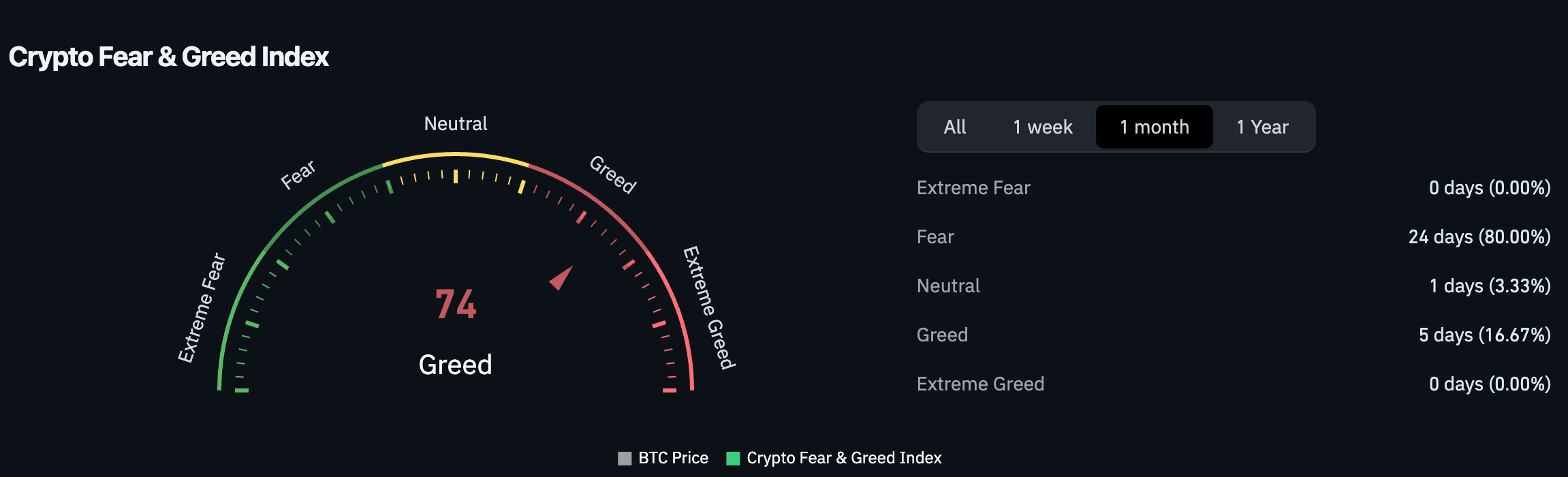
Cryptocurrency Fear and Greed Index, Source: Coinglass
Meanwhile, ETF inflows are making a strong comeback: According to SoSoValue data, for the week ending August 21, US spot Bitcoin ETFs recorded net inflows of $1.92 billion, marking the largest single-week inflow since the peak of the previous bull market in October 2025. Combined with Ethereum spot ETFs, the two collectively attracted $2.6 billion in net inflows for the week, with trading volume tripling compared to previous weeks, recording the strongest capital inflow in about 10 months. BlackRock's IBIT remains the primary driver of inflows, with cumulative net inflows having surpassed $62 billion.
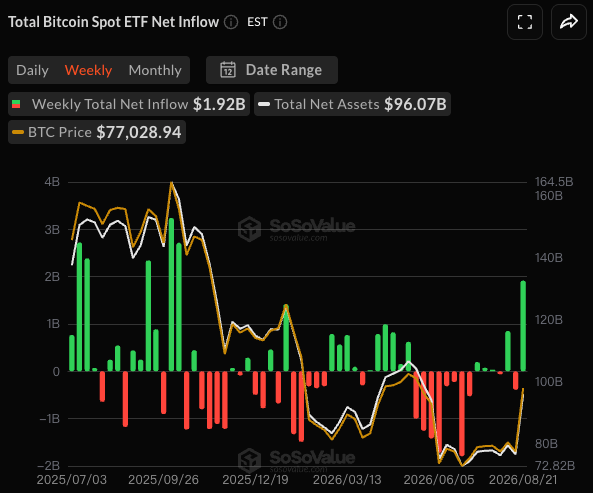
Spot Bitcoin ETF Net Inflows, Source: SoSoValue
The core drivers of this rally primarily stem from a triple convergence of positive factors at the US policy level.
First, the Trump administration held a crypto summit at the White House, sending strong signals of support. On August 19, Trump personally presided over the meeting, inviting industry executives from Coinbase, Ripple, Kraken, Robinhood, along with the heads of the SEC and CFTC. During the meeting, Trump explicitly stated that the government has "completely ended the war on cryptocurrency," urging Congress to quickly pass a fair version of the CLARITY Act to establish a clear regulatory framework for digital assets and ensure America maintains its global leadership in Bitcoin, cryptocurrency, and related fields. He also revealed that the US has discussed plans to accumulate a large-scale Bitcoin and other cryptocurrency reserve. This high-profile endorsement directly boosted market expectations for a favorable policy environment, reinforcing bullish confidence among both institutions and retail investors.
Second, the SEC simultaneously relaxed crypto restrictions, injecting substantial compliance room into the industry. On August 18, the SEC proposed the Crypto Asset Regulation rule, marking its first attempt to establish permanent rules specifically for crypto asset fundraising. The proposal creates two exemption paths: startups can raise up to $5 million within four years, while a general funding channel would allow up to $75 million annually, accompanied by principles-based disclosure requirements and a safe harbor mechanism that could potentially exempt certain tokens from being classified as securities after fulfilling management commitments. This move significantly lowers the barriers to compliant fundraising, attracts capital back to the US, alleviates the suppression of innovation caused by previous regulatory uncertainty, and provides clear rule expectations for the market.
Finally, the US Treasury announced an expansion of its Treasury buyback program, improving the risk asset environment from a macroeconomic perspective. The Treasury decided to at least double the liquidity support buyback scale for 10- to 30-year Treasury bonds, increasing individual operations from $2 billion to at least $4 billion, with the plan taking effect on September 9. This move aims to address the surge in long-term Treasury yields and liquidity pressure, directly pushing Treasury yields lower and weakening the dollar. Against the backdrop of a easing interest rate environment and a depreciating dollar, capital tends to flow toward risk assets like Bitcoin, creating a resonance effect of "de-dollarization" and "devaluation trades," further amplifying the upward momentum in the crypto market.
These three factors compound each other: a friendly policy environment provides narrative support, relaxed regulation opens up growth space, and improved macro liquidity offers capital momentum. The accumulation of multiple positive catalysts, combined with the substantial short positions previously built up in the market, ultimately triggered a wave of liquidations rarely seen in crypto history. According to The Kobeissi Letter, approximately $3.5 billion in leveraged positions were forcibly liquidated in the past 24 hours, with over 90% coming from shorts. Multiple analysts have pointed out that this rally is largely driven by "short covering" rather than an organic influx of new bullish capital.
According to CryptoQuant data, prior to this breakout, Bitcoin's price had been persistently below the short-term holder cost basis (approximately $68,700). This rally pushed the price above that cost level for the first time; short-term holders subsequently transferred 43,300 BTC in profit to exchanges, marking the largest profit-taking event of 2026. The short-term holder SOPR indicator also rose to 1.01, its highest level since April.
Bullish Arguments: Strive CEO Calls It the "Strongest" Cycle
The bullish camp primarily argues that long-term macro fundamentals will inevitably drive Bitcoin higher, and the trend of the next cycle is already emerging.
Matt Cole, Chairman and CEO of asset management firm Strive, stated on social media that Bitcoin's relative strength against the dollar and gold signals that the next Bitcoin cycle "will be the strongest one in history." Cole's core argument centers on the "scarcity narrative": in an AI-driven era of abundance, the market's pursuit of scarce assets is becoming a powerful structural tailwind, driving more capital toward scarce monetary assets like gold, silver, and Bitcoin.
He specifically noted that the Bitcoin-to-gold ratio currently stands at 16.73 ounces of gold per Bitcoin, the highest level since May, reflecting that Bitcoin has simultaneously broken out against both the dollar and gold this week, and this breakout is "highly explosive." He believes that when Bitcoin becomes the strongest-performing asset in capital flows, it will attract a disproportionate share of incremental capital inflows. Cole also candidly acknowledged that short-term pullbacks are inevitable, but he expects buyers to actively step in and buy the dips. These structural forces make him "more bullish on Bitcoin than ever before."
Other analysts also hold relatively optimistic views. Dominick John, an analyst at Zeus Research, believes the rally will continue in the near term, driven by renewed ETF inflows and improved macro liquidity. His target is first reclaiming $80,000, and if the breakout is confirmed valid, looking toward the $85,000–$90,000 range. Should ETF inflows and macro liquidity remain supportive, $100,000 is not out of the question.
Bridgewater Associates founder Ray Dalio also reiterated his positive view on Bitcoin in a recent article published on August 21. Dalio believes that a series of recent phenomena in the US Treasury market—Japan reducing its Treasury holdings, long-end Treasury yields and the dollar weakening simultaneously, and Treasury Secretary Bessent announcing an expanded Treasury buyback program—all align with the debt cycle patterns described in his book How Countries Go Broke. Against the backdrop of a US Treasury crisis, he advocates reducing bond positions, allocating 10%–15% of portfolios to gold, and holding "a bit of Bitcoin."
Geoff Kendrick of Standard Chartered has upgraded his risk assessment, stating that the possibility of retesting the $126,000 all-time high within the year is "greater," and that his previously set year-end target of $100,000 "may have been set too low."
Bearish and Cautious Arguments: Beware of Leverage-Driven False Breakouts
In contrast to the optimism of the bullish camp, multiple analysts emphasize that behind this rally may lie fragile support levels.
On the macro front, the Federal Reserve under new Chairman Kevin Warsh maintains a hawkish stance. The July FOMC meeting voted 9-3 to hold rates steady, with three votes leaning toward a rate hike; meanwhile, July CPI remains elevated at 3.4%. This stands in stark contrast to the logic of previous Bitcoin bull markets driven by rate cuts. Should rates rise, Bitcoin could give back all of its gains—this is one of the core pillars of the bearish argument.
Rachael Lucas, crypto analyst at BTC Markets, stated that understanding the drivers behind such historic gains is crucial. She noted that such violent momentum is typically the result of a combination of short covering, spot demand, and derivatives positioning, rather than a single catalyst. What truly matters is not the number itself, but whether spot trading volume and ETF inflows are confirming this rally, or whether it is actually being amplified by leverage. Lucas further pointed out that spot-driven rallies can provide more solid structural support for the next leg up, while leverage-intensive rallies leave the market more vulnerable to sharp drawdowns.
She advises investors to closely monitor spot ETF flow data, acknowledging its inherent lag, while also tracking derivatives positioning, funding rates, and open interest levels, as these indicators can reveal how much leverage has accumulated during this rally. She specifically cautioned that following a move of this magnitude, overheated funding rates and persistently elevated open interest often serve as early warning signals for a leverage-driven pullback. Broader macro risks, particularly hawkish repricing of rate expectations or a stronger dollar, could also dampen market enthusiasm.
Gold advocate Peter Schiff posted on X that Bitcoin's rally above $72,000 is "a false breakout, not a real one," bluntly stating "sell Bitcoin, buy gold." He argues that the market has misread the signal from the Treasury's unexpected expansion of its buyback program: investors have been assuming that a return to loose monetary conditions would boost both gold and Bitcoin, but in reality "only half of that is correct." He believes the true beneficiary will be gold, not Bitcoin, and that this rally is essentially a mechanical short squeeze rather than a breakout driven by genuine demand. However, according to tracking records, Schiff has repeatedly predicted Bitcoin's "death" or collapse since 2011, and his track record of predictions has been notably inaccurate.
Conclusion: Short-Term Risk of Leverage-Driven Pullback, But Long-Term Bullish
In summary, the market currently presents a classic "bull-bear interwoven" landscape: On one hand, strong ETF inflows, on-chain valuation metrics indicating prices are not in historical top territory, and structural bullish logic from institutional figures like the Strive CEO all support the assessment that "this is not a short-term peak, but rather a support foundation for the next leg up." On the other hand, the fact that this rally is primarily driven by short covering rather than incremental buying, the rapid shift in market sentiment toward "Extreme Greed," and the Fed's continued hawkish stance on the macro front are all risk factors that cannot be ignored.
From a technical standpoint, $80,000 is widely recognized as the key short-term level. If it can be effectively reclaimed and held, $85,000–$90,000 becomes the next target, with $100,000 not out of reach. However, should the price fail to hold this level amid weakening ETF flows or renewed macro risks, the $65,000–$69,000 support range (corresponding to the 200-day moving average and short-term holder cost basis) could become a more realistic pullback target.