






泡沫退潮后的加密VC:逃离者退场,深耕者加仓


- 核心观点:加密货币行业正从投机驱动的“代币叙事”转向由真实营收支撑的“金融科技”阶段。尽管市场情绪低迷、代币价格惨淡,但稳定币、预测市场和永续合约等赛道已实现产品市场契合,行业正迎来成熟期的结构性重塑。
- 关键要素:
- 行业经历泡沫:The Sandbox虚拟土地价格从45万美元跌至1000美元,跌幅99.8%,反映元宇宙和NFT叙事退潮。
- 资本与用户背离:链上用户创新高,但2025年Q4仅8只新基金成立,季度投资规模40亿美元,仅为2021年一半。
- 稳定币爆发:总供给超3000亿美元,年转账46万亿美元,Circle上市首日涨167%,Bridge被Stripe收购。
- 估值错位:DeFi应用贡献73%链上手续费,但公链占据91%协议市值;应用市盈率仅17倍,公链达4000倍。
- 退出路径多元化:并购规模86亿美元,11起IPO,代币回购月付9600万美元,行业首次同时拥有并购、IPO和代币三条退出通道。
Original Author: Saurabh Deshpande, Joel John, Siddharth
Original Translation: Saoirse, Foresight News
History is a cruel poet with a penchant for rhyme.
In 2002, a New York Times column noted that after the dot-com bubble burst, Herman Miller's stock price had hit rock bottom. The article suggested that once venture capital flowed back, buying quality hardware companies would be a wise move, and their stock prices would rise accordingly. Between 2000 and 2002, global markets lost a collective $10 trillion in market capitalization.
Unfortunately, in the metaverse world, there are no targets like Herman Miller worth buying.
However, you can bid on a virtual plot of land next to Snoop Dogg in The Sandbox. At its peak in 2021, this land sold for $450,000; its current listing price is only slightly above $1,000, a decline of 99.8%.
This article is not about finding value investment opportunities in the metaverse. We hope to review the pendulum swing of human market psychology over the past three decades from the perspective of technology and venture capital. The market's story is much like life: birth, death, rebirth, interspersed with a batch of "zombie" entities barely surviving.
We have been writing about the crypto industry for over a decade, and both the industry and we have matured together. In more professional terms, it's called "entering a mature stage." For the first time in a long while, we feel the industry's direction is shifting, and we've summarized this feeling into a few points:
- Crypto is now fintech.
- It's just backend infrastructure.
- Tokens must generate revenue, and that revenue must be used to buy back the tokens.
- Perhaps, this was just a bubble all along?
People have vastly different interpretations of the decline of the metaverse, NFTs, and the WAGMI narrative. This article is the product of our internal discussions and repeated debates with some fellow VCs in the industry about this sector shift.
How do you explain an industry reaching an all-time high in users while prices are mired in a trough? Why do founders find it incredibly difficult to raise funds even as on-chain participant numbers hit new highs? Why has crypto become a topic people avoid, with far less hype than AI, defense, aerospace, healthcare, or even legal tech?
In 2022, people talked about crypto more because of the industry's endless fraud scandals; by 2026, when people mention it, it's out of genuine concern.
This article outlines the current state of crypto venture capital, its future direction, and interprets the current industry overcapacity against historical parallels. This piece serves both as an industry memoir and a call to build the future together.
Cultivating Liquidity
Multiple data points indicate the crypto industry is in a landmark year. Institutions hold over $175 billion in crypto assets through exchange-traded products; over the past twelve months, on-chain projects have generated $11 billion in fees; the GENIUS Act is about to end a decade-long regulatory limbo; industry exits have hit new highs, with $8.6 billion in M&A deals and 11 IPOs completed.
These signs should be fertile ground for venture-backed seed projects. But talk to founders currently raising funds, and you'll find: the market simply lacks liquidity. According to Galaxy Research, only 8 new venture funds were created last quarter, the lowest since 2020; quarterly investment volume has fallen back to $4 billion, translating to roughly $16 billion annually, only about half of the $31 billion invested in 2021. Institutions are recognizing this asset class, but the venture capital used to incubate new sectors and assets hasn't caught up.
One interpretation suggests the crypto industry is already efficient enough and no longer needs large-scale capital injections. Another perspective is to confront the parts of the industry's development that have broken down. To figure out where the problem lies, we must first trace how the industry got here.
Liquidity was once a privilege reserved for companies that spent years honing real value. The median time for tech companies to go public today is 14 years; during the dot-com era, this cycle was compressed to 5 years, with valuations supporting long-term viability. Apple went public in 1980 with a valuation of $1.8 billion; before Meta (then Facebook) went public, it had 901 million monthly active users, $3.7 billion in revenue the previous year, and was barely eight years old, yet its IPO valuation reached $104 billion. At that time, about 40% of internet users had used Facebook. Why did this happen?
In the early days, the scale of funds flowing into tech private markets was far smaller than today. There was a clear priority: VCs bore all the risks of screening founders, expanding sectors, and company management in exchange for lower company valuations, relying on IPOs for subsequent exits. In 1980, to bring a 40x return to its LPs, Sequoia Capital had to sell all its Apple shares, cashing out only $6 million. In that era, no one could hold long-term because tech investment itself was viewed as a high-risk category, almost like a Meme coin for the wealthy.
Source: Collaborative Fund
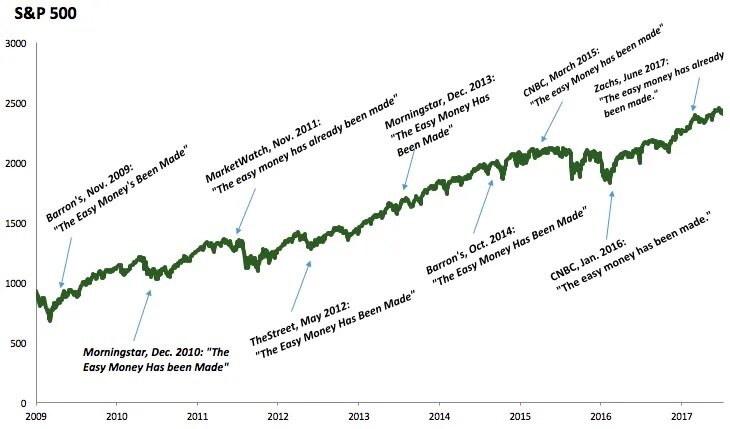
Historically, market skepticism towards the tech industry has been recurrent. In 1987, the New York Times even suggested that pizza shops might divert investment away from the tech sector. In 1991, as the first generation of Silicon Valley tech workers entered middle age, Time magazine published an article titled "My Silicon Valley, How Old and Weary." In 2002, after the dot-com bubble burst, NBC declared the asset class was severely overcapitalized. By 2013, being a VC became a lifestyle, and the market saw a proliferation of "zombie VCs," with many people merely playing the role of venture capitalists.
Pizza Tokens Can't Be Eaten
The crypto industry's maturation is occurring at the tail end of decades of tech waves. Investors once agonized over whether to invest in pizza businesses, yet tech assets themselves have consistently stood strong.
From 2013 to 2016, traditional venture capital was almost non-existent in the industry. Ordinary people could only participate through exchange accounts, and the investment target was the network itself. The first batch of funds dedicated to Bitcoin emerged, with Pantera's 2013 fund establishing a Bitcoin cost basis of only $65.
Issuing a token in that era was almost equivalent to creating a new public chain: teams forked code, maintained infrastructure, and had to convince exchanges to list them. The ICO merged fundraising and listing into one event. Developers wrote their own smart contracts, paid audit fees, and then negotiated listing terms with exchanges; if an exchange refused to list, there was no liquidity, and the project was essentially dead.
Raising funds from the public was indeed feasible initially. In 2014, Ethereum raised $18 million this way, building the foundational infrastructure that all EVM chains still rely on today. But later, the public were left with only empty concepts and tokens; the products and infrastructure needed to create value for these tokens were severely lacking.

For a time, tokens were flying everywhere.
The narrative looked wonderful. In June 2017, ICO funding surpassed industry venture capital for the first time; by July, ICO funding was four times that of VC; by December, the market widely proclaimed ICOs would completely kill venture capital. (It seems people really wanted VCs to disappear).
If all VCs did was connect money to startups, that claim might hold, but the real data tells a different story.
More than half of ICO projects died within 120 days of their token issuance; academic research indicates that nearly 80% of projects during this period were outright scams. The entire ICO cycle raised a total of $28 billion. We proved that large-scale global capital coordination was possible, but we failed to establish a reasonable pricing mechanism for early-stage projects without revenue, nor did we have accompanying regulatory oversight. During the frenzy, everyone rushed in without thinking; when the heat faded, there was neither profit nor answers.
Crypto VCs were forged in this hubristic atmosphere. Teams stopped raising directly from the public and instead raised from a select group of capital providers, promising future token issuance. The SAFE agreement with token warrants became the relatively secure fundraising tool. For founders, this gave them time to think slowly about what was suitable for tokenization; for VCs, it allowed them to provide public market liquidity to projects that couldn't easily get traditional private valuations.
For funds entering at the seed stage, if a token rose 4x after listing, unlocking just 25% of their position would recoup their entire cost, with the rest being pure profit. Consequently, founders only needed to prove one thing: the token could list quickly and manage unlocks well to avoid massive sell pressure. Incentives tilted entirely towards liquidity rather than long-term project value. Fund portfolios valued the listing event more than products that could sustainably create value.
Investors realized they could exit before the project actually worked, significantly speeding up capital turnover. Founders also saw this was the key to convincing investors, so they pushed for the earliest possible token listing. Early token listings made funds whole, but the token itself became the core product. Tokens were no longer a tool to fund ongoing project development but a means to realize returns for the various parties on the cap table.
Mistakes of the Past
Most tokens, whether governance or utility tokens, fail due to one or both of the following reasons:
- The business model itself is flawed, or non-existent;
- Unlike equity, tokens do not represent a legal claim against the enterprise.
Tokens are great at coordinating different global stakeholders towards a common goal. But the industry learned a costly lesson: having a token doesn't mean a project inherently has long-term viability. Tokens are suitable for project cold starts and for companies to subsidize, essentially cultivating new user behaviors.
Uber subsidized rides, food delivery platforms offered free delivery – all using VC money to build user habits; once the habit formed, the company could charge users, creating sustainable revenue, directly linking user behavior to company income.
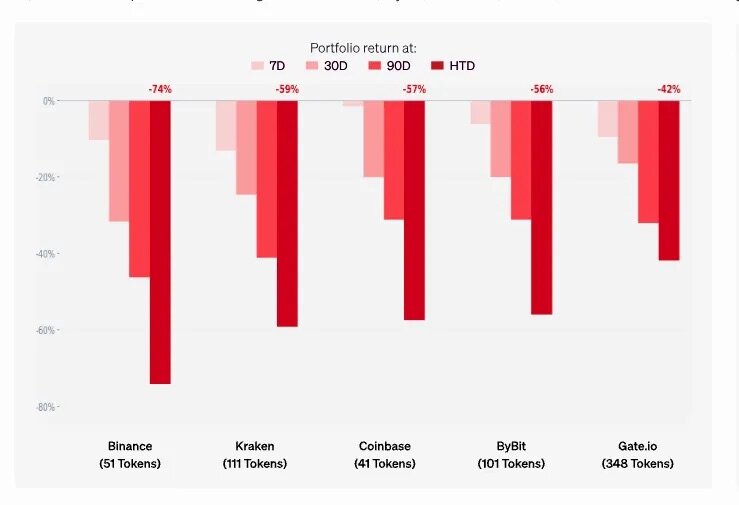
But for many crypto projects, user behavior can hardly be converted into project revenue. In various "X-to-earn" projects, once token rewards ended, users left immediately because the product had no real demand. Many DePIN projects repeat the same cycle: subsidizing supply without ever seeing real demand. Even if tokens successfully help a project cold start and accumulate real users, it's still not enough. For a token investment to be successful, the token must have a legal claim on the project's operational results.
Source: Delphi Token State Report
Equity and tokens are fundamentally different; equity represents a legal right in the enterprise. If a board acts against shareholder interests, shareholders can seek legal recourse. Friend.tech's protocol generated tens of millions in fees, but token holders received nothing because they had no legal claim to those earnings. Token trading prices show a significant discount compared to equity, and often this discount is justified.
If the advantages of early token liquidity and price discovery can be achieved through tokenized equity, investors could retain the benefits of the token model while gaining true ownership and legal protections.
As a result, the token industry has undergone two major shifts:
- Some projects have switched back to equity when the market clearly misprices their business value, with Across Protocol being a prime example;
- All leading projects that emerged in 2026 have, in some way, tied business revenue to their tokens.
In the 90s, just "being on the internet" held value; in the late 2000s, "mobile" commanded a valuation premium; in the late 2010s, it was "going on-chain." After the tide recedes, the industry must confront a difficult question: of the numerous projects born during the era of abundant liquidity, which ones truly possess value? The crypto industry is now facing its own reckoning. Peter Pan from 1kx offers a poignant summary:
"Applications failed not because they used token incentives, but because they weren't good businesses to begin with. The crypto industry's original sin is the lack of sufficient sustainable innovation to generate profitable projects or protocols with genuine product-market fit." – Peter Pan, Research Partner, 1kx
The era of cheap liquidity is over; what remains? What has the massive influx of capital actually produced? Some sectors have already achieved solid product-market fit (PMF), and any discussion of crypto VC must involve these sectors.
Tangible Achievements
Three sectors have already achieved sustainable product-market fit. We have also been researching and visiting teams to find the next batch of sectors poised for PMF.
Stablecoins
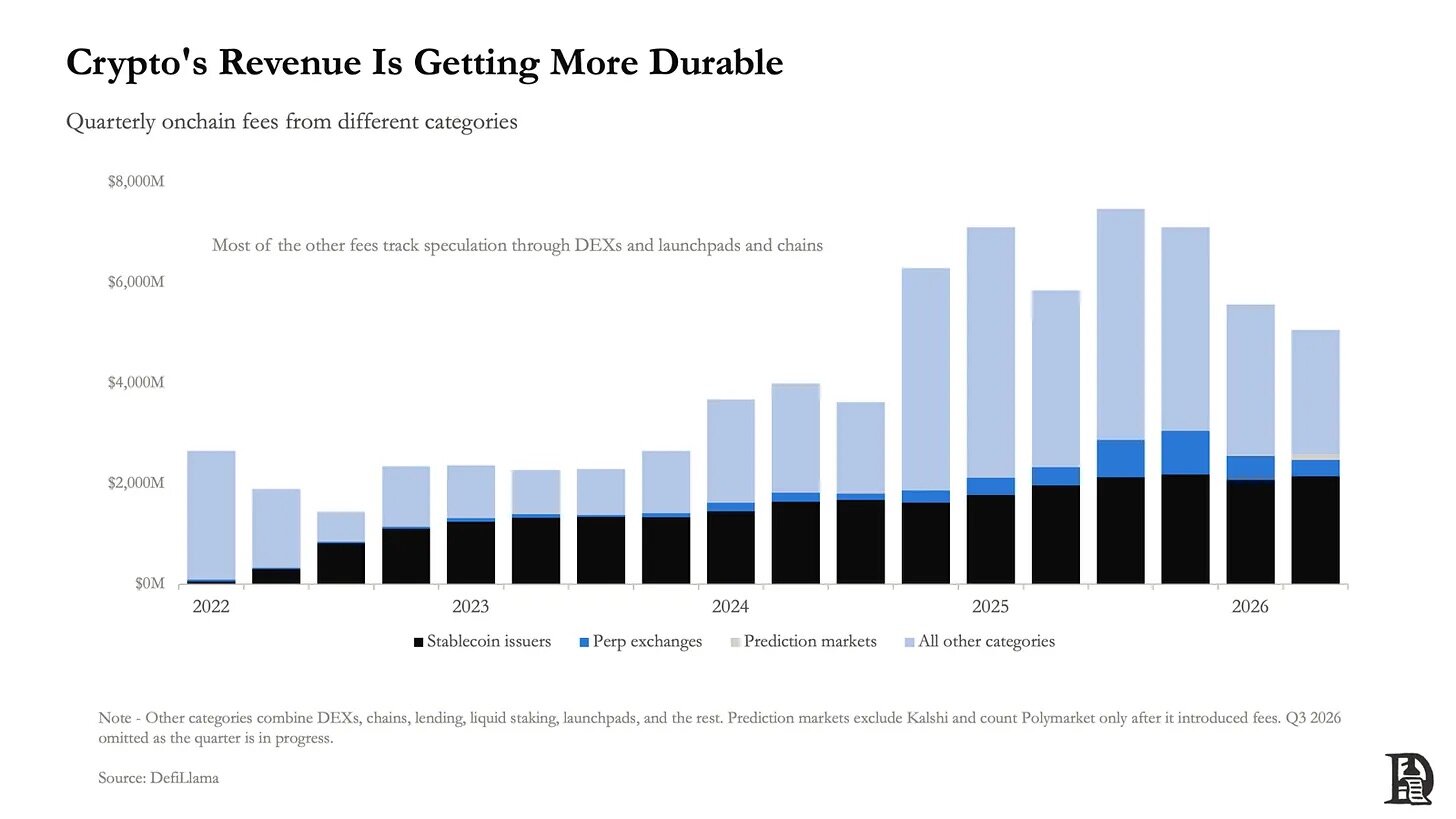
The total supply of stablecoins has surpassed $300 billion, with annual transfer volumes of $46 trillion. Excluding bot trading, the real transaction volume is around $9 trillion. Collectively, all stablecoin issuers are now the 17th largest holder of US Treasury bonds. Circle completed its IPO, with its stock price surging 167% on the first day; several banking consortiums have also started issuing their own stablecoins. The stablecoin issuance business now belongs to the domain of growth equity funds, industry acquirers, and bank strategy departments. The funds that have benefited were those that bet on stablecoins when they were still just an idea. The seed investment window has shifted upstream, towards applications built on top of stablecoins. Ethena received seed funding during this period and became a major industry winner; Bridge was acquired by Stripe less than three years after its founding.
Prediction Markets
ICE has invested up to $2 billion in Polymarket; Robinhood has turned event contracts into its 11th business line to surpass $100 million in revenue; Susquehanna is also building prediction market operations. The world's largest exchange operator, a top retail brokerage, and a large quantitative firm all entering within 12 months signals that value discovery for this sector is complete.
Perpetual Futures Exchanges
Hyperliquid accounts for 44% of on-chain perpetual contract trading volume, with a team of just 11 people, and last year generated more profit than most public exchanges; Coinbase's $2.9 billion acquisition of Deribit also set a valuation benchmark for the entire industry.
These three sectors now generate billions of dollars in annual revenue. Just 4-6 years ago, seed investments in them were considered pipe dreams. In 2020, Polymarket was still seen as a novelty toy; Circle was long ignored by the market as a payment company; when Hyperliquid launched, the market believed the perpetual contract space was already adequately solved.
Every crypto bear market brings some positive changes. The hope in 2018 was infrastructure iteration, with faster public chains and cheaper block space; the narrative in 2022 was institutional entry. Both prophecies came true. The dawn of this bear market lies in the fact that you no longer need to believe in vague predictions. These three sectors succeeded precisely because blockchain architecture offers capabilities traditional systems cannot: 24/7 dollar settlement without correspondent banks; exchanges holding client assets that clients can verify themselves.
Any asset's market can aggregate global liquidity. Revenue is no longer bought through subsidies. Leading applications have compressed token incentives from $2.8 billion to under $10 million, while fee income continues to rise.
Traditional financial giants entering the space is the strongest evidence that these sectors are real. Robinhood's launch of event contracts, tokenized stocks, and even its own public chain shows they see the potential to build new hundred-million-dollar revenue lines. Robinhood's crypto-related moves are essentially about creating more value for its shareholders.
In 2017, crypto was a niche, obscure technology; today, it can genuinely make money for Robinhood.
Traditional public financial companies will chase high-profit areas, and currently, that's where the profits are. However, the industry's external perception remains poor: half of the tokens listed on major exchanges last year fell over 80%. Token prices have completely diverged from the business entities behind them. The massive overbuilding of infrastructure over the past decade is finally starting to pay off at the application layer, much like how the over-laying of fiber optics during the internet era gave rise to the application age.
Investments that yield high venture returns often bet on immature sectors. The next batch of sectors achieving PMF will likely emerge around mature ones; as mature sectors scale, they create new demands at their edges. The stablecoin ecosystem needs credit, brokerage, and treasury management products built around dollar assets; the perpetual contract base is starting to expand into stocks, commodities, and index trading. The task for early-stage funds in 2026-2027 is to position themselves before the product and revenue data for these sectors is fully out.
Architect demonstrates how quickly edge sectors can explode: it's the first regulated AI computing power derivatives exchange in the US, surpassing $1 billion in trading volume within just a few months of launch.
So what's fundamentally different about the 2026 investment cycle compared to 2020 or 2018? A large part comes from changes in regulation and industry sentiment. Stepping back from the charts, policy and public perception are far more favorable than in the past. In the early 2000s, US social networking founders benefited from domestic regulatory





