Neocloud Economic Model Explained: Demand Is Not the Issue, Capital Efficiency Determines the Winner


- Key Takeaway: The generative AI compute gap has fueled the rise of new cloud providers (Neoclouds), but massive capital expenditures and debt expansion now put them to the test on both demand lock-in and capital efficiency. The speed of capacity buildout, return on capital per unit, and financing costs will determine who comes out ahead in the next phase.
- Key Elements:
- CoreWeave's backlog has reached $104 billion, but it posted a net loss of $626 million in Q2, with $9.4 billion in capital expenditures — interest on debt is the main drag on profits.
- Nebius saw revenue grow 454% year-over-year with a 77% gross margin, and its contract payback period has shortened to 22 months. Customer prepayments are expected to cover 50%–60% of capital expenditures in 2026.
- Cerebras' cloud service revenue grew 281% and surpassed hardware revenue for the first time, but its $25.4 billion in remaining performance obligations is constrained by capacity buildout bottlenecks.
- The common challenge facing all three: demand far exceeds supply, but capacity must be built in advance — driving depreciation, debt, and negative free cash flow to rise in tandem.
- As tech giants like Meta expand their in-house chip development, Neocloud providers must prove they are more than temporary compute gap-fillers. Long-term competitiveness will depend on financing costs and return on investment.
Original title: Neocloud Economics
Original author: APP ECONOMY INSIGHTS
Editor's note: Generative AI continues to drive surging demand for compute, and industry discussions are shifting from "is there enough GPU supply" to "who can convert power, chips, and data centers into usable compute at the lowest capital cost." As order growth and compute shortages become consensus views, a more critical question emerges: Are new cloud providers—which must invest billions before revenue materializes—actually building next-generation AI infrastructure, or are they front-running future demand with debt and capital expenditure?
App Economy Insights' How They Make Money series uses the latest earnings reports from CoreWeave, Nebius, and Cerebras to break down three new cloud models:
CoreWeave rents out NVIDIA GPUs under long-term contracts, with backlog reaching $104 billion—yet hefty capital expenditures and interest costs continue to weigh on profits.
Nebius gains stronger pricing power through its self-built AI cloud platform, with customer prepayments and shorter payback cycles improving capital efficiency.
Cerebras is pivoting to cloud-based inference with its self-developed chips, with cloud revenue now surpassing hardware—though backlog conversion remains constrained by capacity buildout.
All three companies face the same dilemma: demand far exceeds supply, but capacity must be built in advance, causing capital expenditure, debt, and depreciation to rise in tandem. A massive backlog does not equal revenue, let alone cash flow.
As tech giants like Meta expand their own custom chips and GPU clusters, new cloud providers must also prove they are not merely temporary stopgaps for compute shortfalls. The next phase of competition will hinge not just on revenue growth, but on three factors: speed of capacity deployment, return on capital per unit, and financing costs.
Demand is already locked in. Capital efficiency will determine who ultimately wins.
The following is the original article:
AI Has Created a Massive Compute Gap
Market demand for compute has outstripped what the large cloud computing companies can supply.
This gap has fueled the rise of the Neoclouds—specialized providers built around AI infrastructure. Their focus is on securing power, dedicated data center capacity, and clusters of AI accelerators, rather than replicating the sprawling software ecosystems of AWS, Azure, or Google Cloud.
This week, three neocloud providers with distinct business models reported earnings, offering a clear look at how each is tackling the compute bottleneck with different strategies:
CoreWeave: Specializes in renting out NVIDIA GPU clusters, scaling through long-term contracts with enterprise customers.
Nebius: An AI cloud platform built from scratch atop international data center infrastructure.
Cerebras: Designs its own chips and is transitioning to offering cloud-based high-speed inference services.
The business logic of all three companies is somewhat counterintuitive. Compute infrastructure must be funded and built months in advance before it can generate revenue, so free cash flow is often negative. Debt, leases, depreciation, and customer concentration matter almost as much as revenue growth.
Here's what this week's disclosures show.
CoreWeave's Near-Term Capacity Is Essentially Sold Out
CoreWeave is the purest expression of the neocloud model. It purchases NVIDIA GPUs, deploys them in data centers, and rents out compute capacity to customers such as OpenAI, Microsoft, and Meta.
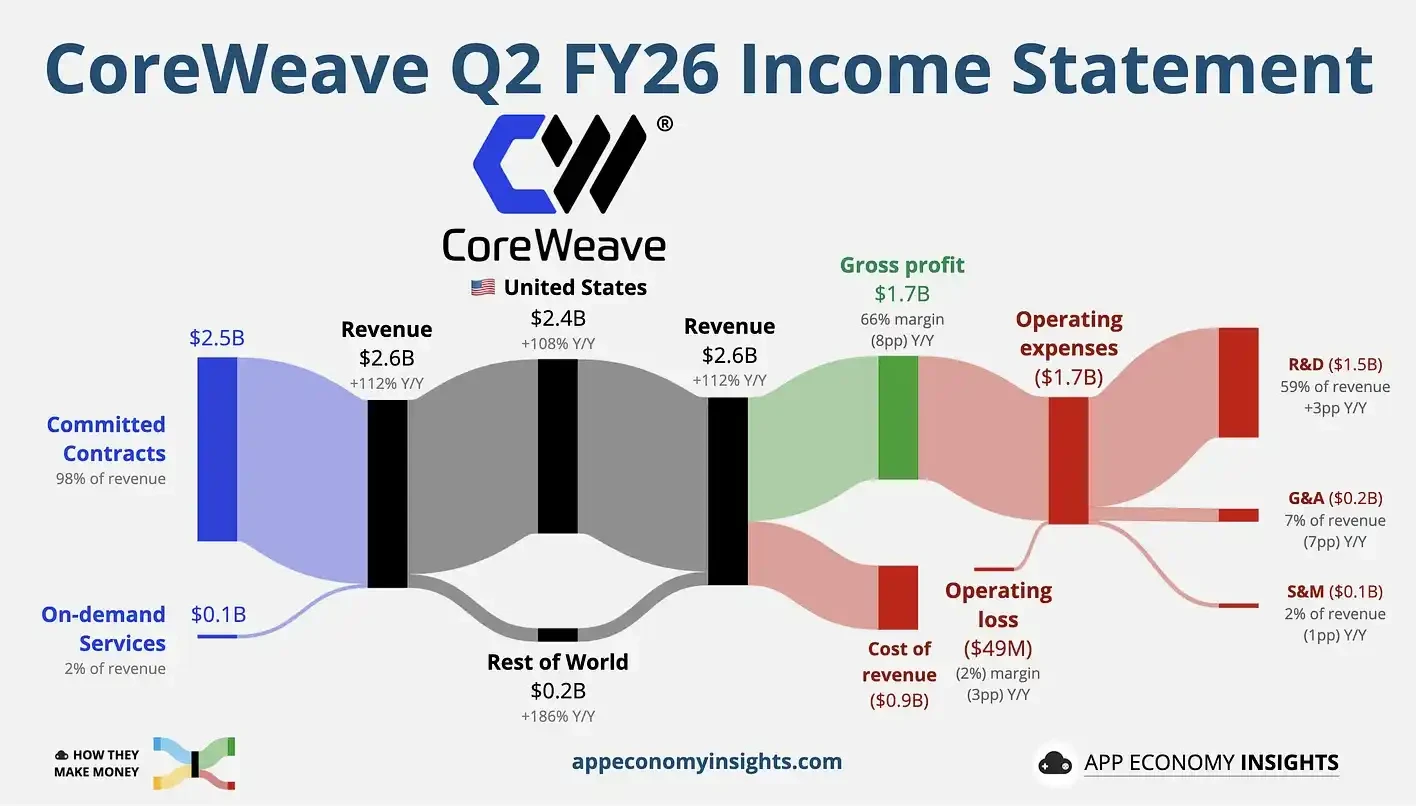
Most of CoreWeave's compute is already reserved by customers. Long-term committed contracts contributed 98% of Q2 revenue, while on-demand usage accounted for just 2%.
Revenue grew 112% year-over-year to $2.6 billion, but gross margin fell 8 percentage points to 66%, as data center rent, power, and other expansion costs grew even faster than revenue.
CoreWeave recorded an operating loss of $49 million and a net loss of $626 million. Interest expense of $640 million—directly tied to GPU-backed debt financing—weighed heavily on profitability.
And the income statement only tells part of the story. CoreWeave's Q2 capital expenditure reached $9.4 billion, more than triple its quarterly revenue.
What do these numbers mean?
Demand growth continues to outpace capacity expansion: Backlog reached $104 billion, up 246% year-over-year. Early in Q3, the company signed an additional $25 billion in customer commitments. Near-term capacity is effectively sold out.
Margins may be nearing an inflection point: CoreWeave absorbed gross margin compression to accelerate new capacity deployment, but adjusted operating margin improved from 1% in the prior quarter to 5%. Management expects contribution margins on newly signed contracts to be 5 to 10 percentage points higher than recent contracts, before factoring in the approximate 25% price increase implemented in July.
The revenue mix is improving: Annualized recurring revenue from storage, CPU, networking, and software has exceeded $400 million. Contracted annualized recurring revenue for managed inference jumped from $1 million to over $100 million in a single quarter.
Growth remains extraordinarily expensive: CoreWeave raised its 2026 capital expenditure guidance to $35–$39 billion, targeting over 1.85GW of active power capacity by year-end.
Key takeaway: Against a targeted exit annualized revenue run-rate of $19 billion by end of 2026, the $104 billion backlog looks almost disproportionately large. But backlog conversion remains constrained by physical capacity. CoreWeave's investment thesis ultimately depends on whether it can convert power and GPUs into revenue fast enough—without financing costs eroding margin improvements.
Nebius Is Beginning to Gain Pricing Power
Nebius didn't start out as a typical AI infrastructure startup.
Rooted in Yandex: Nebius emerged from the 2024 split of Russian tech giant Yandex. Its Nasdaq-listed Dutch holding company sold its Russian operations for $5.4 billion and retained a smaller set of international businesses, which subsequently formed Nebius.
A public company reborn: The remaining entity retained its Nasdaq listing, renamed itself Nebius Group, and returned to leadership under Yandex co-founder Arkady Volozh.
Pivoting to AI infrastructure: Rather than rebuilding its former internet conglomerate, Nebius leveraged its existing engineering talent, cloud expertise, and capital base to build a cloud platform purpose-built for AI.
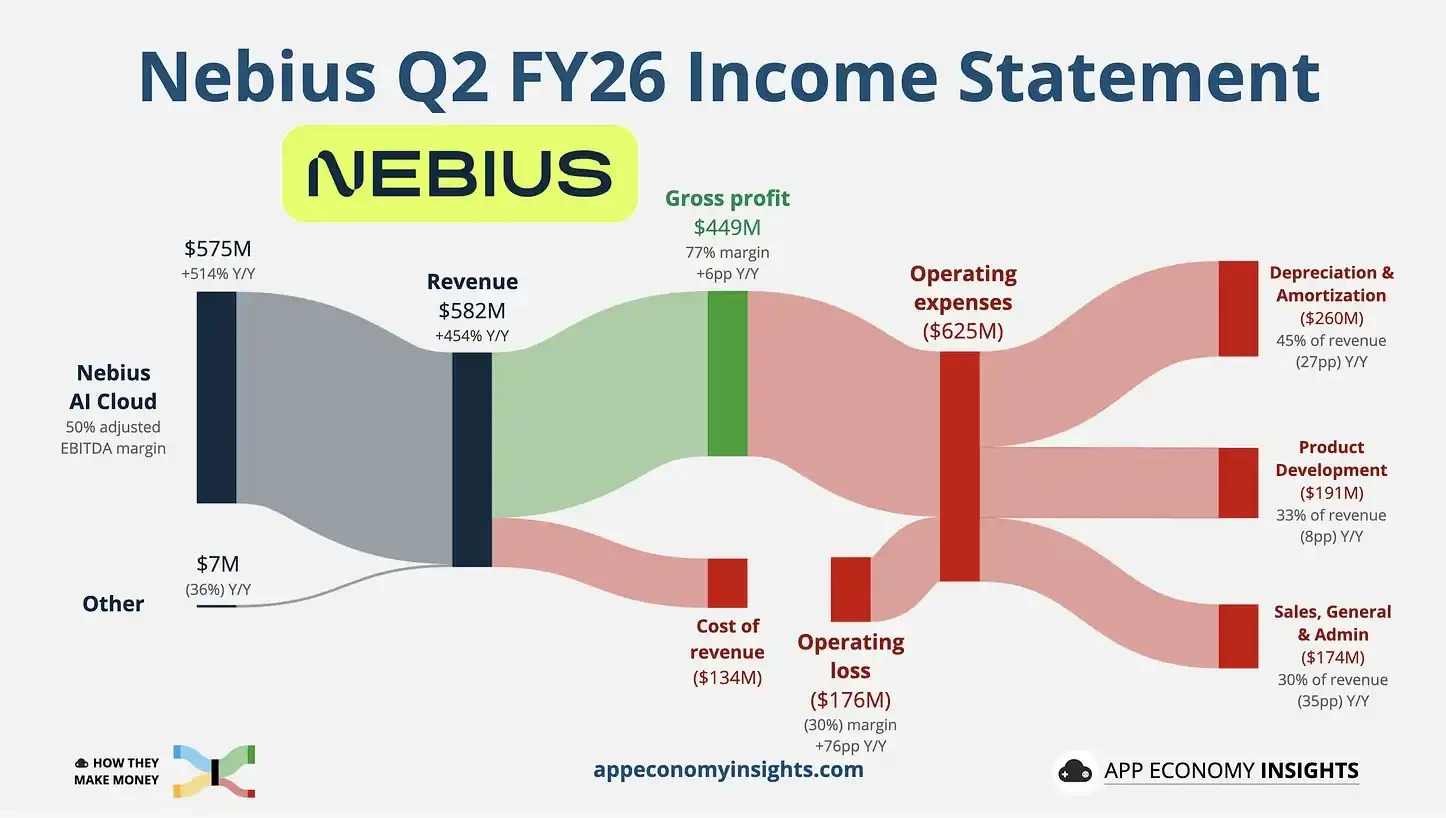
Nebius rents out GPU compute through its own cloud platform. In Q2, AI Cloud revenue reached $575 million, accounting for 98% of total revenue.
Revenue grew 454% year-over-year to $582 million, with gross margin improving 6 percentage points to 77%. Adjusted EBITDA reached $236 million, corresponding to a 41% margin.
Nebius recorded an operating loss of $176 million. As billions of dollars in new infrastructure begin hitting the income statement, depreciation and amortization alone reached $260 million.
What do these numbers mean?
Compute prices are rising: The four newly signed AI cloud contracts averaged over $1 billion in contract value each, with value of $20–$25 million per megawatt. Shorter-duration compute contracts have reached as high as $40–$50 million per megawatt.
Payback periods are accelerating: Management estimates that contracts signed in Q2 will recover their associated capital expenditure and operating costs in approximately 22 months—a significant improvement from the previous two-to-three-year payback period.
The scale of expansion is enormous: Nebius' Q2 capital expenditure reached $5.7 billion, nearly ten times its quarterly revenue. The company still expects full-year capital expenditure of $20–$25 billion.
Customers are helping fund the buildout: Nebius expects to receive over $9 billion in customer prepayments in 2026, covering approximately 50%–60% of related capital expenditure.
Key takeaway: Nebius is deploying capital at an unprecedented scale, but rising prices, shorter payback cycles, and customer prepayments are improving the economics of every additional megawatt of capacity. In the long run, this capital efficiency may matter more than the 454% revenue growth rate.
Cerebras Transitions to the Cloud
Cerebras is the outlier among the neocloud providers. Rather than purchasing NVIDIA GPUs, it designs its own wafer-scale processors and commercializes them in two ways: selling systems and renting out compute through Cerebras Cloud.
The company's revenue mix is shifting rapidly. Q2 revenue grew 74% year-over-year to $180 million. Cloud and other services revenue rose 281% to $126 million, while hardware revenue declined 23% to $54 million.
The company recorded an operating loss of $477 million—but this figure needs context. Cerebras went public in May, generating significant stock-based compensation expenses. Excluding these factors, its core operating loss was just $34 million, far below the GAAP figure of $477 million.
Core results exclude stock-based compensation, customer warrant expenses, and certain pass-through items. As the stock-based compensation granted around the IPO gradually vests, this expense pressure is expected to normalize over the coming quarters.
GAAP gross margin was only 14%, but core gross margin reached 41%—up approximately 9 percentage points year-over-year, though down from 46.5% in Q1. One factor: to meet cloud service demand, Cerebras temporarily needs to lease back systems it previously sold.

What do these numbers mean?
Cloud services have become the growth engine: Core cloud revenue nearly tripled to $128 million, surpassing hardware revenue for the first time.
Guidance has improved: Cerebras raised its FY2026 core revenue guidance to $880–$890 million, while also lifting gross margin and operating margin expectations.
Capacity remains the primary bottleneck: The company has over 600MW of data center capacity either operational or under contract through 2027. Core gross margin is expected to bottom out in Q3, then recover as new capacity comes online and reliance on high-cost leased compute diminishes.
Demand far outpaces current revenue: Remaining performance obligations reached $25.4 billion. OpenAI remains its anchor customer, but converting this backlog into revenue will require significant infrastructure investment.
Key takeaway: Cerebras is transforming from a chip vendor into a high-speed inference cloud provider. Stock-based compensation and other accounting adjustments obscure this progress, but the real test lies ahead: as new capacity comes online, can the company convert its massive backlog into revenue while repairing margins?
What to Watch Next
All three neocloud providers face the same paradox: market demand already exceeds available compute, but meeting that demand requires deploying massive capital before revenue arrives.
The compute shortage is also pushing big tech to build their own capacity. Meta is expanding custom silicon and multi-gigawatt-scale GPU clusters, while SpaceX has begun selling access to its Colossus cluster.
The longer-term question: once big tech's AI capacity is fully online, will neoclouds continue to exist as indispensable infrastructure partners—or were they merely a temporary outlet for a short-term compute gap?
The next phase of competition will hinge on three factors: capacity, margins, and financing capability. Neoclouds need to convert contracted demand into truly operational infrastructure, improve returns on investment as utilization rises, and raise capital for the next round of expansion—all without debt or equity dilution destroying the economics of the entire business model.
Demand is already locked in. Capital efficiency will determine who wins.