






Sandisk Fiscal Q4 2026 Results: Revenue Surges 372%, but SNDK Stock Declines After Earnings


- Key Takeaways: Sandisk reported record fiscal Q4 2026 results, with AI data center demand and rising NAND prices driving revenue and profits far beyond expectations. Yet shares fell nearly 8% in after-hours trading, reflecting that investors had already priced in extremely high expectations.
- Key Elements:
- Quarterly revenue reached $8.965 billion, up 51% sequentially and 372% year-over-year, surpassing the LSEG estimate of $8.39 billion. Non-GAAP EPS came in at $39.25, above the expected $34.45, with non-GAAP gross margin at 84.6%.
- Approximately one-third of the sequential revenue increase came from bit shipment growth, while two-thirds came from higher NAND prices, reflecting robust AI storage demand and tight supply.
- Data center segment revenue totaled $2.977 billion, up 103% sequentially and 1,298% year-over-year, accounting for 38% of bit shipments (versus just 12% a year ago), driven by enterprise SSD demand.
- Edge segment revenue reached $5.432 billion, up 48% sequentially, with AI PCs and on-device AI applications driving higher storage capacity per device. Consumer segment revenue was $556 million, down 32% sequentially, reflecting uneven growth.
- Fiscal Q1 2027 guidance calls for revenue of $10.3 billion to $10.8 billion and non-GAAP EPS of $44 to $46, above LSEG expectations, though slightly lower gross margin guidance drew market attention.
- The company has signed multi-year agreements with eight customers covering a minimum of $93.9 billion in contracted revenue, with approximately half of fiscal 2027 bit supply covered by agreements, enhancing demand visibility and cash flow stability.
- Investor Day is scheduled for August 13, 2026, with focus on the sustainability of enterprise SSD demand, NAND pricing trends, and the capacity ramp of BiCS8/BiCS10 technology.
Sandisk reported record fiscal Q4 2026 results. AI data center demand, rising NAND prices, and an improved product mix drove revenue and profits well above Wall Street expectations. However, SNDK shares fell in after-hours trading as investors had already priced in extremely high growth expectations and were hoping for a more surprising earnings guidance.
When did Sandisk report its fiscal Q4 2026 earnings?
Sandisk reported its fiscal Q4 2026 and full-year results after the U.S. market close on August 5, 2026. The quarter ended on July 3. Investors can access the company's official fiscal Q4 2026 earnings presentation and investor relations page for complete financial statements, presentation materials, and conference call resources.
Did Sandisk beat market expectations?
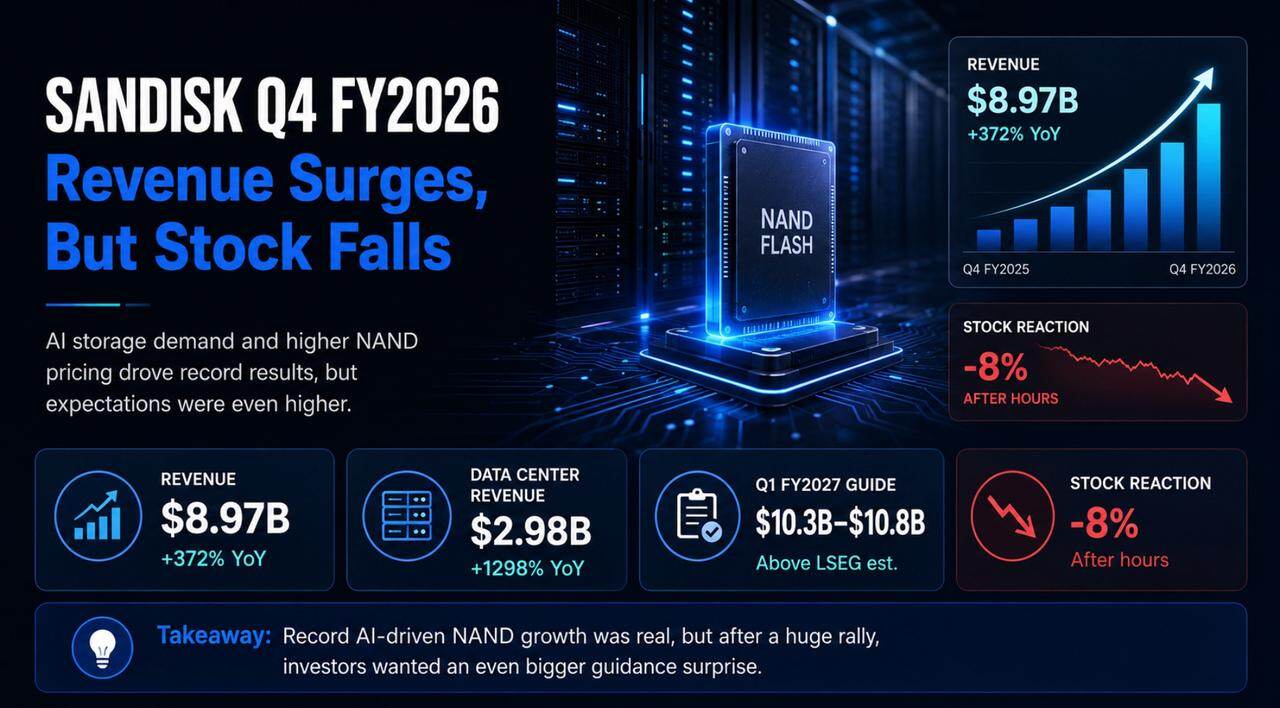
Yes. Sandisk's quarterly revenue came in at $8.965 billion, up 51% quarter-over-quarter and 372% year-over-year, exceeding the roughly $8.39 billion expectation from analysts surveyed by LSEG. Non-GAAP diluted earnings per share reached $39.25, above the LSEG estimate of approximately $34.45. Non-GAAP gross margin rose to 84.6%, with adjusted free cash flow of approximately $5.04 billion. The quarterly results also surpassed Sandisk's own guidance provided earlier. The company had originally guided for revenue of $7.75 billion to $8.25 billion and adjusted earnings per share of $30 to $33. Sandisk reported GAAP EPS of $43.97, but that figure includes approximately $804 million in equity securities gains. To gauge the company's underlying operational performance, the $39.25 non-GAAP EPS is the more informative metric.
What were the main drivers of Sandisk's revenue growth?
Sandisk's growth came from both higher shipment volumes and a significant increase in NAND prices. Management stated that roughly one-third of the sequential revenue increase came from volume growth, with the remaining two-thirds attributable to higher pricing. This is a critical point. Sandisk is benefiting from growing AI storage demand, but the rapid improvement in revenue and margins also reflects tight NAND supply and rising average selling prices.
Data center revenue more than doubled
Data center segment revenue reached $2.977 billion, up 103% quarter-over-quarter and 1,298% year-over-year. Sandisk said data center products accounted for 38% of the company's bit shipments this quarter, compared to just 12% a year ago. The company is increasing shipments of enterprise SSDs to hyperscale cloud and AI infrastructure customers. AI training and inference systems require storing, reading, and processing vast amounts of data with low latency. This demand is driving sales of high-capacity enterprise SSDs and other flash storage products.
Edge business remains the largest revenue source
The Edge business includes products for PCs, smartphones, tablets, automotive systems, and other devices. Quarterly Edge revenue reached $5.432 billion, up 48% quarter-over-quarter and 392% year-over-year. Management expects AI PCs, premium smartphones, and on-device AI applications to gradually increase the storage capacity required per device.
Consumer business revenue declined
Consumer business revenue fell to $556 million, down 32% quarter-over-quarter and 5% year-over-year.
This shows that Sandisk's current growth is not evenly distributed across all segments. Data center and Edge products are driving overall expansion, while memory cards, portable drives, and other consumer products remain more exposed to weak discretionary spending.
What guidance did Sandisk provide for fiscal Q1 2027?
Sandisk expects fiscal Q1 2027 revenue to be in the range of $10.3 billion to $10.8 billion. The company also guided for non-GAAP diluted EPS of $44 to $46, non-GAAP gross margin of 83% to 85%, and non-GAAP operating expenses of $520 million to $540 million. At the midpoint, the guidance implies revenue of $10.55 billion and adjusted EPS of $45, both above the LSEG consensus of approximately $10.47 billion in revenue and $43.12 in EPS. However, Reuters noted that the profit guidance came in below forecasts from some other data providers. The more accurate takeaway is that Sandisk delivered another strong guide, but it did not exceed every high expectation in the market.
Why did SNDK shares fall after the earnings report?
Despite Sandisk beating expectations and growing revenue, SNDK shares fell nearly 8% in after-hours trading. This market reaction was more about expectations than weak quarterly performance. Before the earnings release, Sandisk's stock had already risen nearly 470% in 2026. After such a massive run, investors were looking for guidance to surpass the most optimistic forecasts. The expected slight decline in gross margin also drew market attention. Sandisk's adjusted gross margin was 84.6% in the fourth quarter, but the next quarter's guidance is 83% to 85%. This level is still very high, but it does not suggest significant sequential margin expansion. Therefore, the share price decline does not change the fact that Sandisk beat market expectations this quarter. It reflects the difficulty of a fast-rising stock continuing to meet even higher expectations after investors have already priced in strong AI demand, NAND price increases, and margin expansion.
Can Sandisk's long-term contracts reduce NAND industry cyclicality?
Sandisk is shifting more of its business from short-term procurement arrangements to multi-year customer agreements. The company said its agreements with eight data center and Edge customers correspond to $93.9 billion in minimum contracted revenue under minimum price conditions. These agreements have a weighted average term of more than four years and include approximately $16.5 billion in financial guarantees. Sandisk expects roughly half of its bit supply will be covered by these agreements in fiscal 2027, with that proportion rising to about two-thirds in fiscal 2028. The contracts feature both fixed and floating pricing mechanisms, with price floors and caps designed to provide stronger protection amid market price fluctuations. These agreements cannot eliminate all risks inherent in the NAND cycle. Customer demand, contract execution, new industry capacity, and the future pricing environment remain highly important. However, compared with the traditional quarterly procurement model, long-term agreements may provide Sandisk with better demand visibility and more stable cash flows. Sandisk also increased its share repurchase program by $14 billion. The company bought back approximately $4.5 billion in shares during the fourth quarter and retains roughly $15.5 billion in remaining buyback authorization.
What should investors watch next?
Sandisk will hold its Investor Day on August 13, 2026. The company may further elaborate on its fiscal 2027 strategy, long-term financial targets, and AI data center storage plans at the event. Key questions worth focusing on include: whether enterprise SSD demand can continue to grow faster than Sandisk's available supply, whether current NAND pricing levels are sustainable, and whether the company can maintain gross margins near current levels as it expands production. Investors should also watch the production ramp of BiCS8 and BiCS10 NAND technologies, the economic benefits of new long-term agreements, and the balance between data center growth and weak consumer demand.
Explore U.S. stocks and stock-related markets on MEXC
Sandisk's earnings show how AI infrastructure spending, semiconductor supply, and NAND pricing can affect individual stocks and the broader technology market. MEXC offers access to various U.S. stock-related market products. Users can register and access MEXC U.S. stock products, and review the U.S. stock trading guide to learn how to directly trade supported U.S. stocks on the platform. The MEXC xStocks ecosystem page also offers tokenized U.S. stock products via the spot market. These assets are designed to track the value of specific listed companies, allowing eligible users to gain price exposure related to U.S. stocks through blockchain tokens. Derivatives-focused users can also explore select U.S. stock and multi-asset contract markets. Product availability, trading hours, and regional eligibility may vary. Tokenized stocks and stock contracts carry different rights, ownership structures, and risk profiles compared with directly holding traditional company shares.
Frequently Asked Questions
When did Sandisk report its fiscal Q4 2026 earnings?
Sandisk reported its fiscal Q4 2026 results after the U.S. market close on August 5, 2026. The fiscal quarter ended on July 3.
Did Sandisk beat market expectations?
Yes. The company's $8.965 billion in revenue and $39.25 adjusted earnings per share both exceeded the LSEG consensus estimates reported by Reuters.
Why did Sandisk's stock fall after the earnings report?
SNDK shares fell because the company, while delivering strong guidance, did not surpass every forecast on the street. Meanwhile, the stock had already risen nearly 470% during the year. The market reaction primarily reflected extremely high expectations rather than underperformance by the company.
What is Sandisk's guidance for the next quarter?
Sandisk expects fiscal Q1 2027 revenue of $10.3 billion to $10.8 billion and non-GAAP diluted EPS of $44 to $46.
When is Sandisk's Investor Day?
Sandisk's Investor Day is scheduled for August 13, 2026, at 9:00 AM Eastern Time.


