Gate Research: The TradFi Battle of Crypto Exchanges, Gate CFD's Cross-Asset Breakthrough


- Core Thesis: Crypto exchanges are transforming from single digital asset markets into comprehensive trading accounts that use stablecoins as the core capital language and cover multiple asset classes. Through rapid deployment of CFD, stocks, and ETFs, Gate has established a leading scale in the TradFi derivatives segment, with the competitive focus shifting to cross-market capital efficiency and comprehensive service capabilities.
- Key Elements:
- Low volatility and a lack of narratives in the crypto market have driven capital to seek price opportunities in traditional markets such as gold, forex, and equities. CFD fills this demand gap through price-difference settlement and margin mechanisms.
- Stablecoins serve as a unified margin unit, significantly reducing friction in cross-market capital allocation. However, unified accounts also concentrate risk correlations between crypto volatility and TradFi gaps, requiring users to strengthen risk isolation awareness.
- A CryptoQuant report shows that Gate's TradFi perpetual trading volume surged from $3.4 billion to $295.8 billion in Q1 2026, a roughly 87-fold increase, with cumulative year-to-date volume reaching $368 billion by June—$70 billion ahead of second-place Binance.
- Gate has listed 663 CFD trading assets covering stocks, indices, forex, precious metals, and energy, while also advancing real stocks, ETFs, and IPO Access to build a product ladder spanning from short-term high-frequency trading to mid-to-long-term allocation.
- CoinGlass data indicates that Gate's average daily crypto derivatives open interest in H1 2026 reached $10.23 billion, ranking third globally with a 9.1% market share, providing a liquidity foundation for multi-asset expansion.
- The platform's capital structure shows a tiered path: trading capital is supported by crypto perpetuals and CFD, account capital extends retention through stablecoins and stock ETFs, and professional capital achieves custody and strategy allocation through API, copy trading, OES, and Gate Wealth.
- Gate CFD copy trading accumulated over $95 billion in trading volume in its first quarter, with institutional users growing 69.29% year-over-year, indicating that strategy replication and institutional services are becoming the professional extension of multi-asset accounts.
Introduction
Over the past few years, the growth of cryptocurrency exchanges has been built on a relatively clear logic: BTC, ETH, and long-tail tokens as asset supply; spot and perpetual contracts as core products; stablecoins as the settlement medium; and high volatility with 24/7 trading attracting global traffic. This model has shaped the trading habits of crypto users. Funds are denominated in stablecoins like USDT, positions can be long or short, traders focus on leverage, liquidity, and execution speed, and accounts operate 7×24 hours.
However, as the crypto market enters a phase of low volatility, sparse narratives, and shrinking liquidity, a single-asset market struggles to continuously accommodate all trading demand. Interest rate decisions, non-farm payroll data, geopolitical conflicts, gold as a safe haven, crude oil supply and demand, tech stock earnings, and global indices often present more direct price opportunities outside the crypto market. For users accustomed to managing funds in stablecoins, the biggest pain point is the need to repeatedly open accounts, exchange fiat currency, transfer funds, and settle across crypto platforms, forex brokers, securities accounts, and banking systems to participate in these market moves. Fragmented capital pathways mean fragmented trading opportunities.
CFDs (Contracts for Difference) are precisely what fills this gap within crypto platforms. They don't require users to physically buy an ounce of gold, a barrel of crude oil, or a share of stock. Instead, settlement is based on the difference in the underlying price movement. Users can express directional views through long or short positions and can amplify exposure using margin. For exchanges, CFDs are not merely an additional trading channel; they connect traditional financial price discovery, stablecoin margin, and the crypto-native trading experience into a single account system.
Since 2026, leading crypto exchanges like Gate have accelerated their entry into the TradFi space. Gate has integrated CFDs, perpetual contracts, tokenized products, real stocks, ETFs, IPO Access, and wealth management into a multi-asset framework. While product structures and access rules vary across exchanges, the underlying direction converges: crypto exchanges are transforming from single digital asset markets into comprehensive trading accounts that use stablecoins as the funding language and offer diverse risk exposures as product supply.
1. Overview of the Crypto CFD Market
1.1 The Nature of CFDs: From Trading an Asset to Trading a Price
The core of a CFD is the settlement of the price difference between opening and closing a position. Take gold CFDs, for example — users don't physically withdraw gold. With US stock CFDs, users typically don't become shareholders of the underlying company. What users gain is exposure to the profit or loss resulting from price fluctuations, allowing them to go long or short. The platform organizes trading through margin, spreads, commissions, overnight interest, and risk control mechanisms.
This mechanism makes CFDs particularly suitable for high-frequency price observation, event-driven trading, and cross-market hedging. It condenses markets that previously involved different exchanges, varying delivery rules, and separate account opening processes into a relatively unified order interface and margin language. However, relative uniformity doesn't mean complete homogeneity. The opening and closing hours, holidays, liquidity depth, and corporate actions of traditional markets still factor into CFD trading rules. While crypto assets trade 24/7, stocks, forex, indices, and commodities have their own market hours. When traditional markets are closed but crypto markets remain operational, quote interruptions, gaps, and repricing risks at the next trading session can amplify.
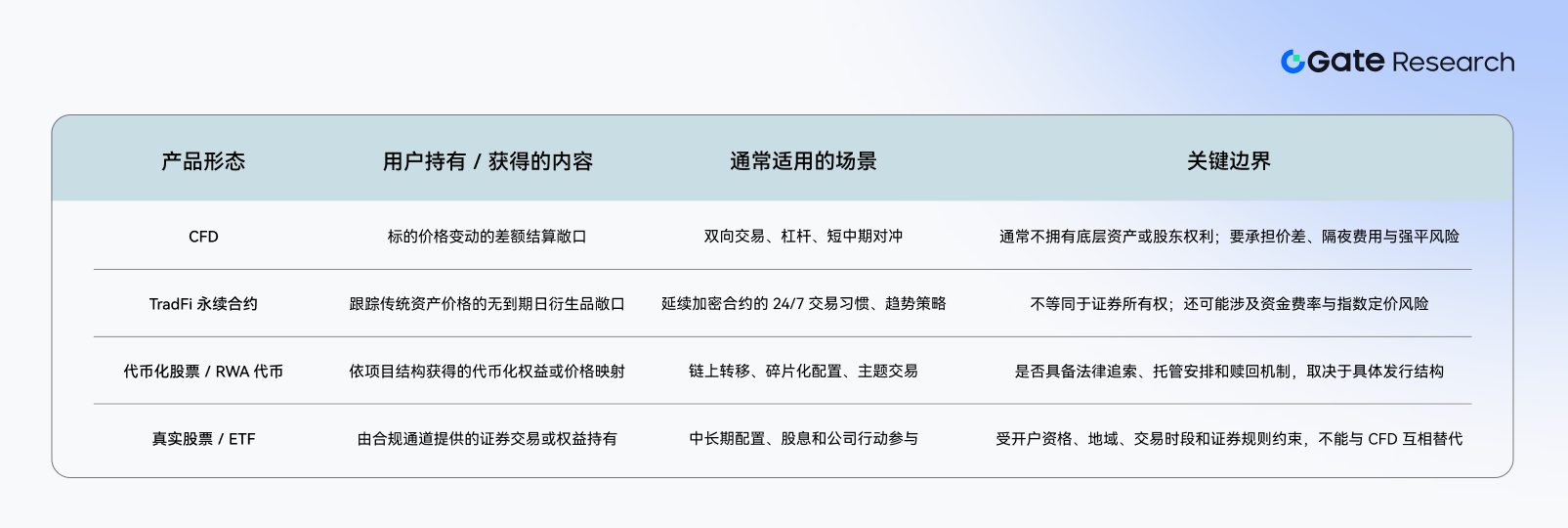
Distinguishing TradFi products by form serves two purposes. First, the value of CFDs lies in obtaining price exposure with lower capital and operational barriers, not replacing asset ownership. Second, competition in multi-asset accounts is about enabling different products to work in concert across appropriate cycles and risk appetites. Short-term traders need efficient execution and risk control; allocation-oriented users focus more on underlying rights and holding costs; institutional users require custody, limits, and verifiable clearing and settlement arrangements.
1.2 Stablecoins: The Common Funding Language Enabling the Crypto CFD Market
Without stablecoins, crypto platforms integrating traditional assets would still be constrained by fiat currency deposits and withdrawals, cross-currency conversions, and regional payment networks. Stablecoins first convert trading funds that were previously scattered across USD, HKD, EUR, JPY, and on-chain assets into a relatively unified, rapidly transferable margin unit within the platform. For users, the key experience is reducing the intermediate steps between crypto accounts and traditional markets — no longer needing to convert USDT into fiat in a bank account, transfer that fiat to another broker, and only then establish a trading position.
The European Central Bank has noted that stablecoins currently primarily serve trading in higher-volatility crypto assets, with limited use for real-world payments. This precisely illustrates the realistic starting point of crypto CFDs: leveraging the high liquidity of stablecoins within existing crypto trading accounts to give users exposure to TradFi prices.
Using stablecoins as margin brings about three direct changes.
First, faster capital deployment. USDT within the same account can be transferred between spot, crypto perpetuals, gold, forex, or stock-related products, reducing the waiting time and operational costs of traditional cross-account transfers.
Second, simpler account management. Users can track P&L, set risk budgets, and compare returns across different markets using a dollar-pegged asset, avoiding frequent conversions between multiple fiat currencies. However, this doesn't mean users are no longer exposed to currency risk. If the underlying asset is a non-USD currency, overseas stock, or a commodity priced in another currency, the asset's price itself may still be affected by exchange rate fluctuations.
Third, improved margin efficiency, but also concentrated risk. Cross-margin reduces idle capital, yet it also means crypto volatility, TradFi price gaps, stablecoin liquidity, and platform risk controls can interact within the same account. The more unified the account, the more critical risk isolation and position management become. Users cannot treat different assets as the same risk class simply because they share a settlement currency.
From a platform perspective, stablecoins function as a form of account-layer infrastructure. They connect trading, collateral, clearing, yield products, and payment functions. If this funding layer can be managed with compliance, transparency, and sufficient liquidity depth, multi-asset trading can become a genuinely usable service rather than just a short-term display of quotes.
1.3 Demand-Side Shifts: Why Crypto Users Are Starting to Need Gold, Forex, Stocks, and Indices
Crypto users are entering CFDs because their existing trading methods are seeking richer forms of market expression.
First, there's the mismatch of market cycles. The crypto market is characterized by high beta, high volatility, and narrative concentration. When major coins are range-bound and the altcoin cycle fades, accounts still hold significant stablecoins awaiting use. Meanwhile, macroeconomic data, central bank decisions, energy supply-demand dynamics, and earnings seasons continually drive volatility in forex, precious metals, indices, and stocks. CFDs allow users to redirect their trading attention to another set of price cycles without leaving their existing account.
Second, there's the spillover of risk management needs. The correlation between crypto assets and risk assets isn't constant, but during sharp shifts in risk appetite, tech stocks, the dollar, rate expectations, gold, and crude oil often collectively influence crypto market sentiment. Hedging doesn't eliminate risk, but it allows traders to convert a singular "long-only crypto" view into relative value or multi-asset positions. For example, users holding high-beta crypto assets might look to gold for safe-haven trades; users bullish on the AI supply chain but concerned about token price volatility might want to express that thesis through stocks, indices, or ETF-related products.
Third, there's the migration of trading methods. The crypto market has cultivated a large user base familiar with leverage, candlestick charts, take-profit/stop-loss, grid trading, copy trading, and APIs. Their need for traditional assets isn't necessarily long-term holding; it's more likely applying familiar technical analysis, trend-following, event-driven, or arbitrage frameworks. For this group, the decision to use CFDs hinges on whether the product offers sufficient depth, predictable costs, stable risk control, and tools that match their habits.
Fourth, there's the access friction for global users. Users in different countries and regions face variations in identity verification, fiat on-ramps, cross-border capital flows, minimum deposits, and product availability when opening overseas securities or forex accounts. Crypto platforms reduce operational friction through stablecoin accounts, indeed expanding user reach. But they cannot eliminate geographic restrictions. Whether a product is available to a user still depends on local laws, platform entities, KYC rules, and risk ratings.
1.4 Supply-Side Evolution: From Crypto Exchanges and CFD Brokers to Comprehensive Account Platforms
The core competencies of traditional CFD brokers are pricing, liquidity access, margin risk control, client suitability, and compliance operations. Crypto exchanges, on the other hand, excel in stablecoin liquidity, global users, digital asset trading habits, API ecosystems, and round-the-clock product operations. These two types of players originally served different users through different funding rails. The rise of crypto CFDs represents the convergence of these two capability sets.
From a product evolution perspective, the market can be divided into four stages:
• Internal crypto leverage stage. Platforms offer spot leverage, delivery contracts, and perpetual contracts around BTC, ETH, and altcoins, competing primarily on leverage limits, order book depth, fees, and matching engine performance.
• External broker tool stage. Users access forex, gold, or index markets through third-party terminals like MT5, with crypto platforms serving as referral, funding gateway, or distribution partners. A clear separation remains between these products and the main account.
• Embedded CFD stage. Platforms integrate TradFi instruments into their App or Web interface, allowing USDT fund transfers, unified trading interfaces, and basic risk controls.
• Cross-asset comprehensive account stage. CFDs are no longer a standalone section but form a product ladder alongside perpetuals, tokenized assets, stocks, ETFs, asset management, custody, APIs, and cross-exchange clearing and settlement. At this point, competition shifts to whether capital, strategies, and risk controls can efficiently migrate across different assets.
These four stages aren't strictly sequential replacements. All of them can coexist in today's market. Traditional brokers continue to compete on their strengths in compliance and trading infrastructure. Crypto platforms are leveraging stablecoins and user access to build out traditional asset capabilities. Tokenized products offer another avenue of on-chain composability. Notably, leading crypto platforms are positioning CFDs within a comprehensive account strategy rather than treating them as a niche trading add-on.
Based on public information, competition is taking at least three routes:
• The TradFi route of crypto platforms. Platforms like Gate start with their existing user base and USDT accounts, integrating forex, metals, indices, commodities, and stock-related products into the crypto experience. Gate currently lists stocks, tokenized stocks, CFDs, and perpetual contracts as distinct TradFi product types, all settled in USDT.
• The multi-asset route of traditional brokers. These players typically have longer operating histories in forex, commodity, and stock CFDs, with more mature pricing, client suitability, trading terminals, and licensing frameworks. However, they may lack crypto users, stablecoin balances, and on-chain capital deployment capabilities.
• The tokenization and on-chain finance route. This direction emphasizes issuing, custodianing, and transferring stocks, bonds, funds, or commodity rights as tokens, suitable for asset holding and composability. But it demands higher standards for underlying legal arrangements, asset segregation, redemption mechanisms, and secondary market liquidity, and cannot simply be equated with CFDs.
Therefore, crypto platforms versus traditional brokers is not a simple substitution relationship. The former's strengths lie in account access, stablecoins, and crypto-native tools; the latter's strengths lie in mature traditional finance compliance and trading processes. Future market share will likely be determined by who can more reliably integrate both capability sets.
1.5 The Competition Behind a Single CFD Trade: Pricing, Margin, and Execution Quality
Users see a price chart and an order button, but behind a single CFD trade lies at least four layers of capability.
The first layer is the underlying asset and price source. Stocks, indices, forex, and commodities each have different benchmarks, trading hours, and liquidity structures. Platforms need to clarify price references, spread formation, handling of abnormal quotes, and rules when markets are closed. Whether quotes approximate tradable market prices matters more than the "number of instruments" displayed on the page.
The second layer is the margin and risk engine. Leverage amplifies small price movements into larger account P&L swings. Platforms must establish initial margin, maintenance margin, risk limits, liquidation rules, negative balance protection, and mechanisms for extreme market conditions. For users, starting with the loss they can afford is the right approach to position sizing.
The third layer is the cost structure. Crypto perpetual contracts commonly incur trading fees and funding rates. CFD costs may primarily manifest as spreads, commissions, overnight interest, and adjustments for corporate actions like dividends or stock splits. A product without a funding rate doesn't mean there's no cost to holding a position, and vice versa. Only by combining holding period, spreads, slippage, and overnight fees can you compare the true cost of different products.
The fourth layer is execution and clearing. Around major macroeconomic data releases, earnings announcements, or weekend market opens, prices can move rapidly. At such moments, whether orders fill, how much the actual fill price deviates, whether stop-losses trigger as expected, and whether the system remains stable directly determine the product experience. For institutional and quant teams, API stability, latency, rate limits, account segregation, custody, and clearing arrangements often matter more than fee rates alone.
From a platform business model perspective, the value of CFDs extends beyond trading fees. Longer trading hours, richer event scenarios, and higher margin utilization rates present opportunities to increase user capital retention and cross-product usage. During crypto market downturns, users can trade gold, oil, forex, or indices. When risk events occur, users can construct hedges across different assets. When medium-to-long-term allocation needs emerge, platforms can also accommodate ETFs, stocks, or wealth management services. This is why CFDs have become a key entry point for comprehensive account strategies.
However, platform revenue and user value are not inherently aligned. Higher leverage, more frequent trading, and longer overnight positions may increase platform activity but can also increase user trading costs and loss risk. A mature CFD market should be built on transparent pricing, clear fees, appropriate leverage, and understandable risk disclosures to foster long-term trust, rather than simply attracting trading with high leverage multiples and short-term incentives.
2. The Crypto CFD Market Enters a New Competitive Landscape
The crypto CFD market is moving from being a "category supplement to crypto contracts" into a "cross-asset comprehensive account" competitive phase. Platform outcomes will no longer be determined solely by leverage multiples or short-term trading volumes but by four quantifiable capabilities: tradable asset coverage, open interest and margin accumulation, user base upgrading, and cross-market infrastructure efficiency.
2.1 Evolution of the CFD Competitive Landscape: From Crypto Exchange to Cross-Asset Brokerage Platform
The competitive logic of crypto CFDs has gone through three stages:
The first stage was internal crypto leverage. Platforms centered on digital assets like BTC and ETH, competing primarily on perpetual contracts, leverage multiples, fees, and matching engine performance. During this period, user capital and trading opportunities largely remained within the crypto market itself.
The second stage brought traditional asset price exposure into crypto accounts. Gold, forex, crude oil, stocks, and indices began entering crypto platforms through CFDs, with stablecoins like USDT serving as margin and capital transfer mediums. For instance, Gate's integration of stock, forex, gold, commodity, and index CFDs into its App and Web platforms demonstrates that leading exchanges view TradFi as a new growth direction.
The third stage involves the convergence of multi-asset, multi-mode trading, and multi-tier users. Market competition shifts from "who can list CFDs" to "who can enable capital to trade, allocate, hedge, and manage within a unified account." What matters at this stage is no longer a single product but the complete chain:
1. Low-friction deposits and margin transfers via stablecoins;
2. Coverage of different holding periods through CFDs, perpetual contracts, and spot tokens;
3. Serving professional users through APIs, copy trading, quant funds, and wealth management;
4. Supporting capital retention with reserve funds, custody, risk controls, and compliance capabilities.
Consequently, the new round of competition among crypto platforms is fundamentally about account access, asset breadth, and capital efficiency. CFDs are merely the front-end product form; the true moat lies in whether a platform can connect liquidity, margin, and user demand across different markets.
2.2 Competitive Landscape Shift: Gate Goes from Follower to Leader in Two Months
Among the five platforms that have disclosed data, Gate accounts for 39.4% of total trading volume, leading Binance by 7.5 percentage points. In absolute terms, Gate's volume exceeds Binance's by $70 billion, a lead of 23.5%. Gate's volume is approximately 2.06 times that of MEXC and reaches 4.13 times the combined volume of Bitget and Bybit.
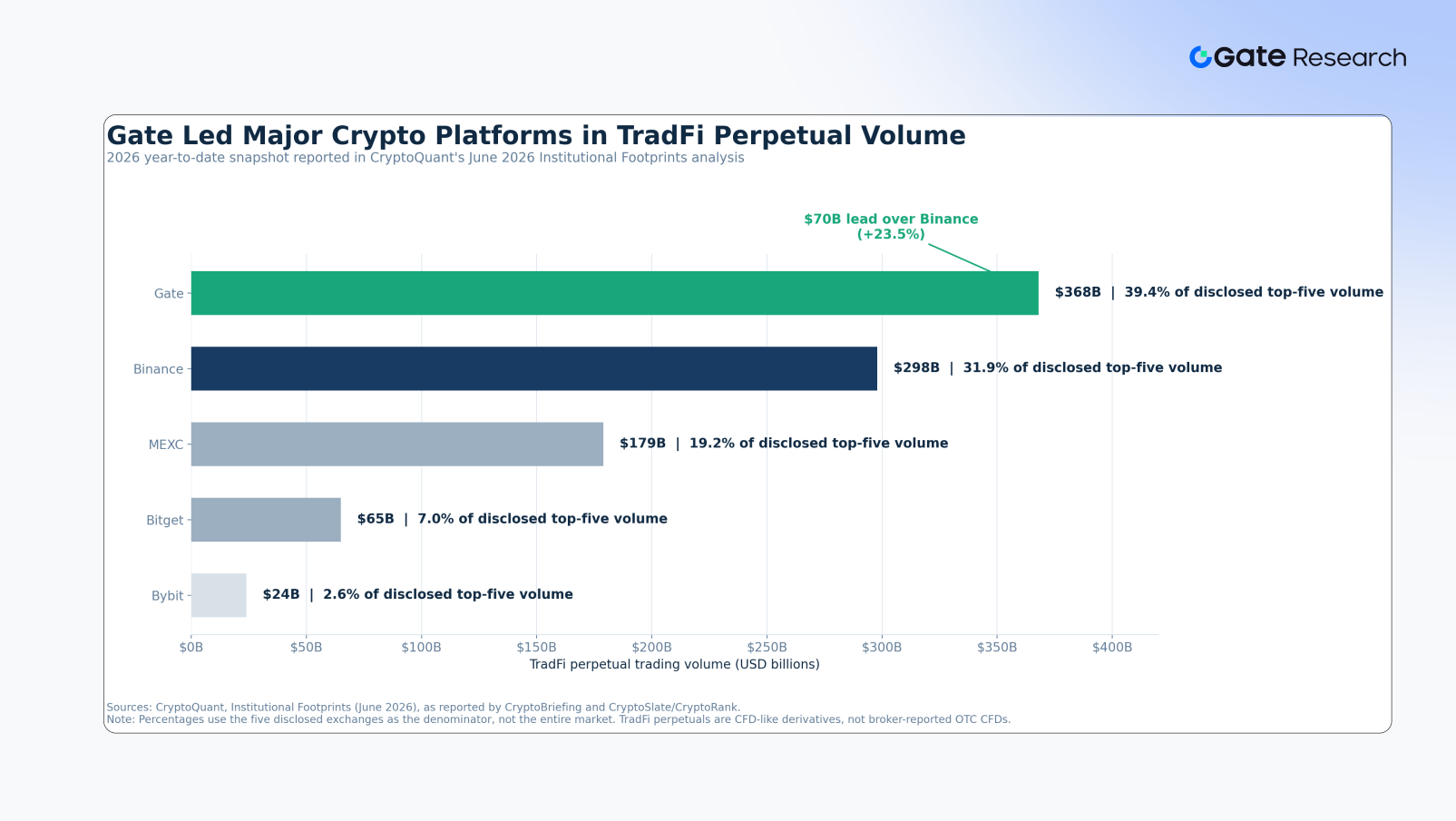
Note: Percentages use the combined disclosed volume of $934 billion across the five platforms as the denominator and do not represent the entire exchange market share. The ranking is a year-to-date snapshot from CryptoQuant's June 2026 report and is not a unified H1 ranking from other data providers.
This ranking indicates that Gate has evolved beyond being a challenger with broad product offerings. It has established a scale advantage