






Besides the stock god fund suffering heavy losses, how did other hedge funds perform in July?


- Key Takeaway: During the July pullback in AI stocks, quantitative funds showed significant performance divergence—RIEF rose 9.2% while Qube declined. Monthly returns do not represent the entire industry and should be evaluated alongside specific strategies and year-to-date performance.
- Key Factors:
- Situational Awareness fund sold most of its public stock positions in July due to financing pressure, with its portfolio value falling 67% that month, while Citadel took over some of those positions, with its stock fund gaining 14.2% over the same period. (Reported by Reuters)
- Among the seven systematic products reported by Business Insider, Renaissance Technologies' RIEF rose 9.2%, while Qube's Torus strategy closed lower. This list represents a limited sample rather than an industry-wide survey.
- BarclaysHedge estimates show that the technology hedge fund sub-index fell 3.99% in July, convertible arbitrage rose 1.46%, and the multi-strategy index edged up 0.60%, highlighting clear divergence across categories.
- RIEF's year-to-date return as of end-July was only 4.5%, while Graham Capital's Tactical Trend posted a year-to-date return of 23.7%, showing significant differences between monthly rankings and year-to-date rankings.
- A positive monthly return only indicates that a specific system generated gains in that particular month and cannot be used to infer that "machines understand the market better." Interpretation should incorporate strategy labels, models, and risk budgets.
In the last week of July, the AI-themed fund Situational Awareness sold most of its public stock positions to the large hedge fund Citadel. An investor letter seen by Reuters on July 31 showed the fund's portfolio value fell 67% that month.
Five days later, according to investor information cited by Reuters on August 5, Citadel's equity-focused fund rose 14.2% in July. In the same round of AI stock drawdown, one fund deleveraged under funding pressure, while another took on some of the public positions.
That statement is only half right. In July's return table, there are systematic products that recorded positive returns, as well as samples that adjusted positions after tech holdings declined. Packing them all into the label "quant" risks losing the most important distinctions.
Does This Rally Represent the Quant Industry?
According to Business Insider, the products singled out this time come from five managers. The seven systematic products it listed are just a limited return sheet, not a census of the quant industry.
Within this small list, Renaissance Technologies' Renaissance Institutional Equities (RIEF) rose 9.2% in July. Among the products listed in the same report, Qube's Torus strategy was the only one to close lower. The blue bars on the chart look tidy, but they can't draw conclusions for the entire industry.
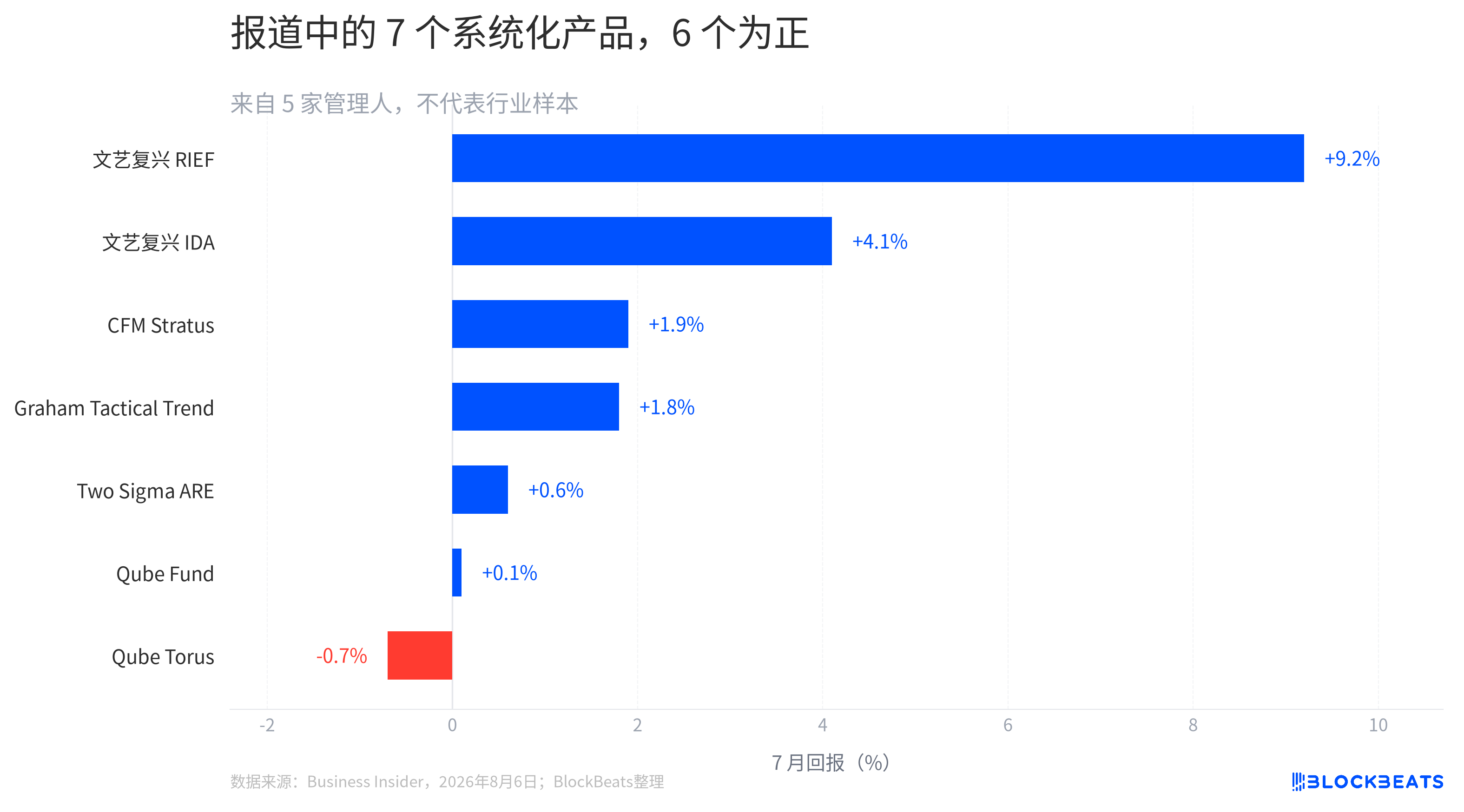
The truly useful part of these numbers is pulling "quant" from an abstract label back into specific products. For RIEF, Renaissance Technologies' Institutional Diversified Alpha, and Two Sigma's Absolute Return Enhanced, the media report did not disclose their models, asset scope, or risk budgets. What the outside world can see is only the monthly returns cited by the media.
A positive monthly return cannot automatically translate into "machines understand the market better." It simply means that in that particular month, these systems recorded positive returns.
The Same Month, Sub-Indices Were Also Splitting
On Business Insider's multi-strategy fund scorecard, most products closed lower in July. However, the hedge fund data platform BarclaysHedge's preliminary estimates for the same period showed the multi-strategy sub-index rose 0.60%. The two readings don't contradict each other; they sample different data sets with different statistical methodologies.
The numbers on BarclaysHedge's page only cover data that had been submitted at the time, and will continue to adjust as more funds report. It is better suited to answering "which strategy categories came under pressure" than to labeling any single private fund.
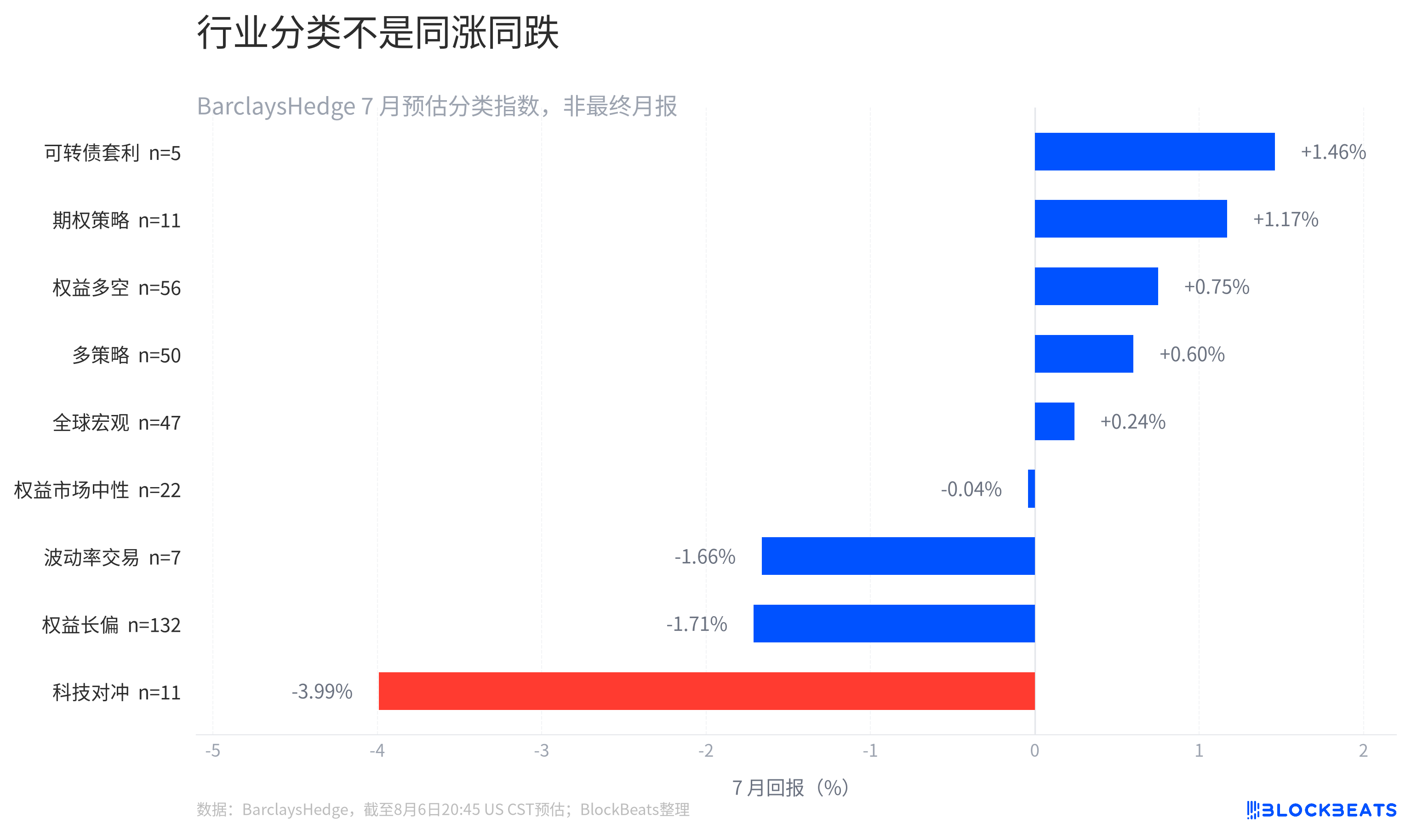
According to BarclaysHedge's estimates, the technology hedge fund sub-index fell 3.99% in July, while convertible arbitrage rose 1.46%. In the same month, the monthly performance of categories such as equity long bias and convertible arbitrage showed clear divergence. This category table reminds readers that each return must be read within its specific strategy label.
This also explains why "multi-strategy slowdowns across the board" cannot be stated too definitively. Business Insider's sample has its news value; BarclaysHedge's index has its coverage scope. Both should be read within their respective boundaries.
Is One Month's Surge the Same as Year-to-Date Performance?
Not necessarily. According to Business Insider, RIEF's July performance was the most striking, but its year-to-date return through the end of July was only 4.5%. The report described this rally as recouping losses from the previous six months.
The same report also showed that hedge fund manager Graham Capital's Tactical Trend strategy had a year-to-date return of 23.7%, yet its monthly gain was not as eye-catching as RIEF's. London-based quant firm Qube's Torus strategy closed lower for the month but still returned approximately 18% year-to-date. When monthly rankings and year-to-date rankings are placed on the same chart, the positions quickly shift.
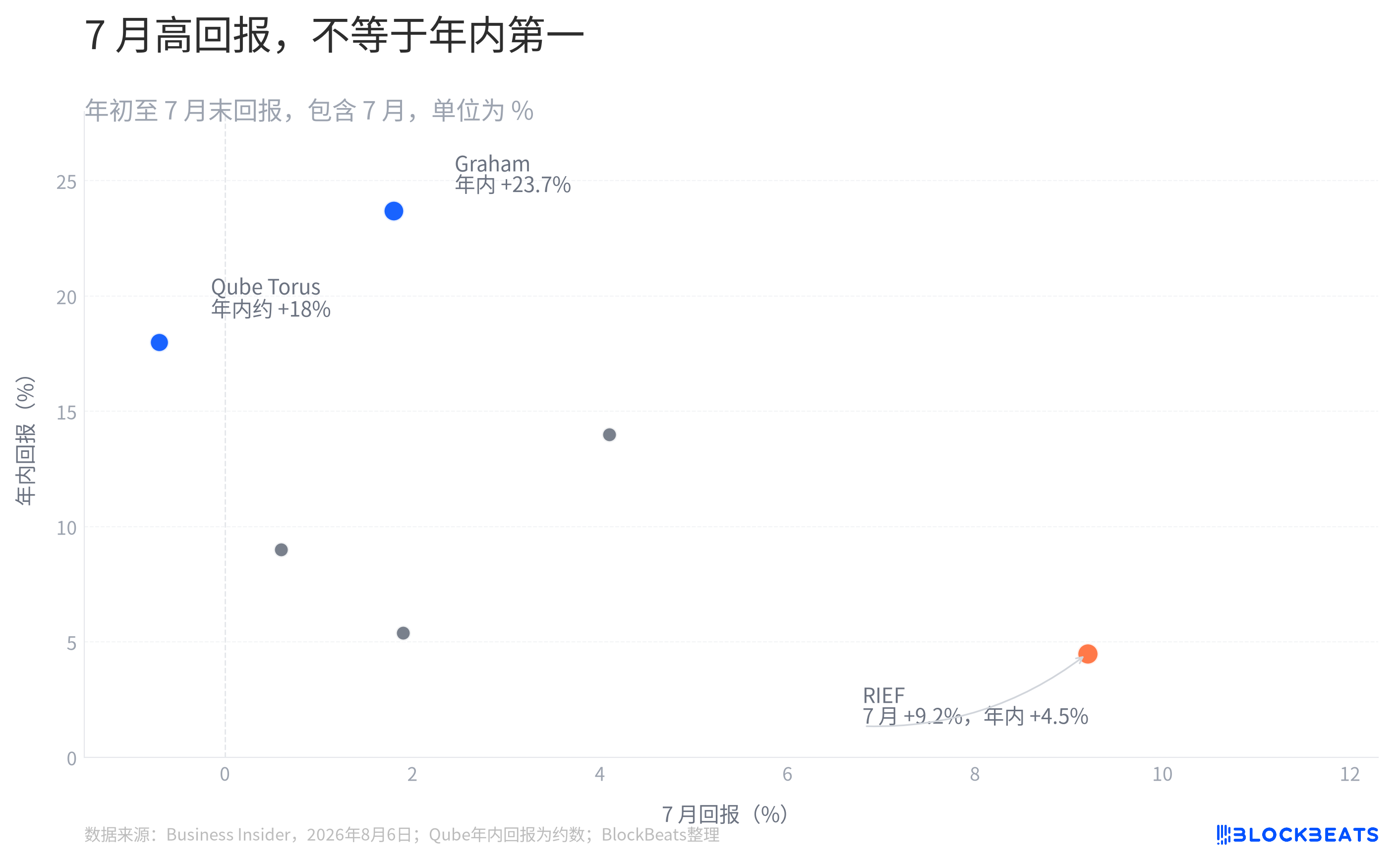
This chart is not proving that the two sets of numbers are independent of each other. The year-to-date return through end of July inherently includes July. It simply reminds readers that a monthly ranking is like a snapshot—when the lens is pulled back, the trajectories and ordering distort together.
Beyond the Rankings, an Asset Sale
Reuters reported on July 31 that Situational Awareness, following the AI stock drawdown and deteriorating liquidity, sold most of its public stocks and stated it had removed portfolio leverage. The report did not state as confirmed fact whether a formal margin call was received, so the safer characterization is that this was a deleveraging disposal under funding pressure.
According to Reuters on August 5, Citadel took on some of those public positions, with discounts exceeding 10% on portions of them. In the same month as the sale, according to investor information cited by Reuters, Citadel's equity-focused fund rose 14.2%.
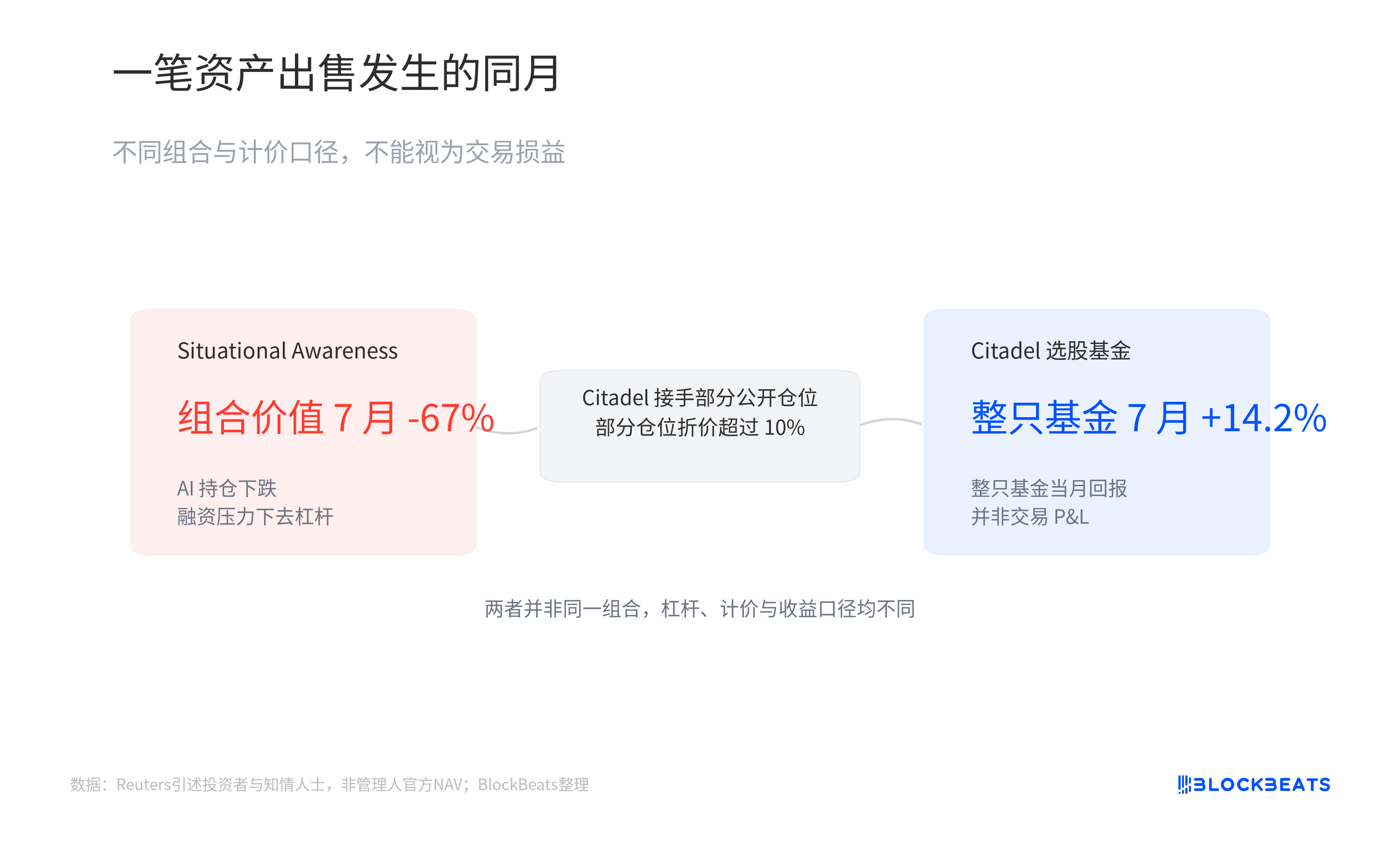
The two figures cannot be subtracted into a single trade's profit. Situational Awareness disclosed portfolio value changes; the Citadel figure reported by media is a full fund's monthly performance. Positions, leverage, and valuation methodologies all differ. Putting this footnote alongside the chart brings us closer to the event itself than framing the asset disposal as a magical arbitrage.
Breaking this return table apart, differences in systematic trading, positioning direction, and funding methods may manifest as divergent returns within the same bout of volatility.


