AWS accounts for 60% of total revenue, Amazon delivers a Q2 with no weaknesses


- Key Takeaway: Amazon reported a net income of $62.6 billion in Q2 2026, primarily driven by $53.4 billion in non-operating investment income (from Anthropic) rather than improved business operations. Operating income of $27.5 billion better reflects actual business performance, with AWS contributing 60.5%, while surging capital expenditures pushed free cash flow negative.
- Key Factors:
- The gap between net income of $62.6 billion and operating income of $27.5 billion stems from $53.4 billion in non-operating pre-tax other income, mainly attributable to investments in Anthropic—an investment-related gain rather than an operational achievement.
- AWS revenue grew 36.8% year-over-year this quarter, with operating income reaching $16.6 billion—up nearly two-thirds year-over-year—accounting for 60.5% of the company's total operating income and serving as the core profit pillar.
- As of Q2 2026 TTM, operating cash flow stood at $161.4 billion while net purchases of property and equipment reached $169 billion, with capital expenditures exceeding cash inflows and pushing TTM free cash flow from positive to negative, primarily driven by AI infrastructure investments.
- Advertising services grew 26.2% year-over-year this quarter, with third-party seller services and online stores both growing faster than the same period last year, as the retail foundation and international business continued to improve, alleviating pressure on AWS profits.
- Investment income and capital expenditures coexist: the former inflates book net income while the latter consumes operating cash. These reflect financial realities at different levels and should not be conflated.
On July 30, US time, Amazon released its second-quarter results. Total sales reached $200.6 billion, still showing year-over-year growth according to the company's press release. Retail, third-party seller services, advertising, and cloud computing all continued to move forward, with no obvious weaknesses visible across the entire report card.
What catches the eye most is net income. It reached $62.6 billion, while operating income for the same period was only $27.5 billion. According to Amazon's disclosures, the gap between the two did not come from some suddenly booming new business, but rather from a massive investment-related gain in the lower half of the income statement.
This gain makes the earnings report read like a profit sprint, while also pushing the truly noteworthy questions to the forefront. What exactly did Amazon rely on to make money this quarter, and how much of that money actually remains in the cash ledger?
Where exactly did the $62.6 billion come from?
According to Amazon's consolidated income statement, operating income is the result left behind by retail, advertising, AWS, and other businesses at the operational level. Below the operating income line are interest and other income, the most conspicuous of which is $53.4 billion in pre-tax other income from non-operating items. The company's press release provided only a single qualifier: it primarily comes from its investment in AI model company Anthropic.

What this chart aims to correct is not the numbers themselves, but the way they should be read. The $53.4 billion is not additional cloud services that AWS sold during the quarter, nor is it costs saved through retail operations. It occurs after operating income and belongs to non-operating investment-related items.
This also explains why it cannot simply be deducted from net income to announce an "ex-Anthropic net income." This income is on a pre-tax basis, and Amazon has not separately disclosed its tax burden. Rather than reverse-engineering the number, a more reliable operational benchmark is the $27.5 billion in operating income, which is directly tied to the business performance of each segment.
Why AWS can hold up operating income
Setting investment-related gains aside for now, the acceleration of cloud computing business AWS remains highly conspicuous. Based on revenue recalculated from the financial statements, AWS grew 36.8% year-over-year this quarter.
According to the same financial report, AWS operating income reached $16.6 billion, nearly two-thirds higher than the same period last year.
Based on the segment profits listed in the report for North America, International, and AWS, in the latest quarter AWS alone contributed 60.5% of the company's operating income.
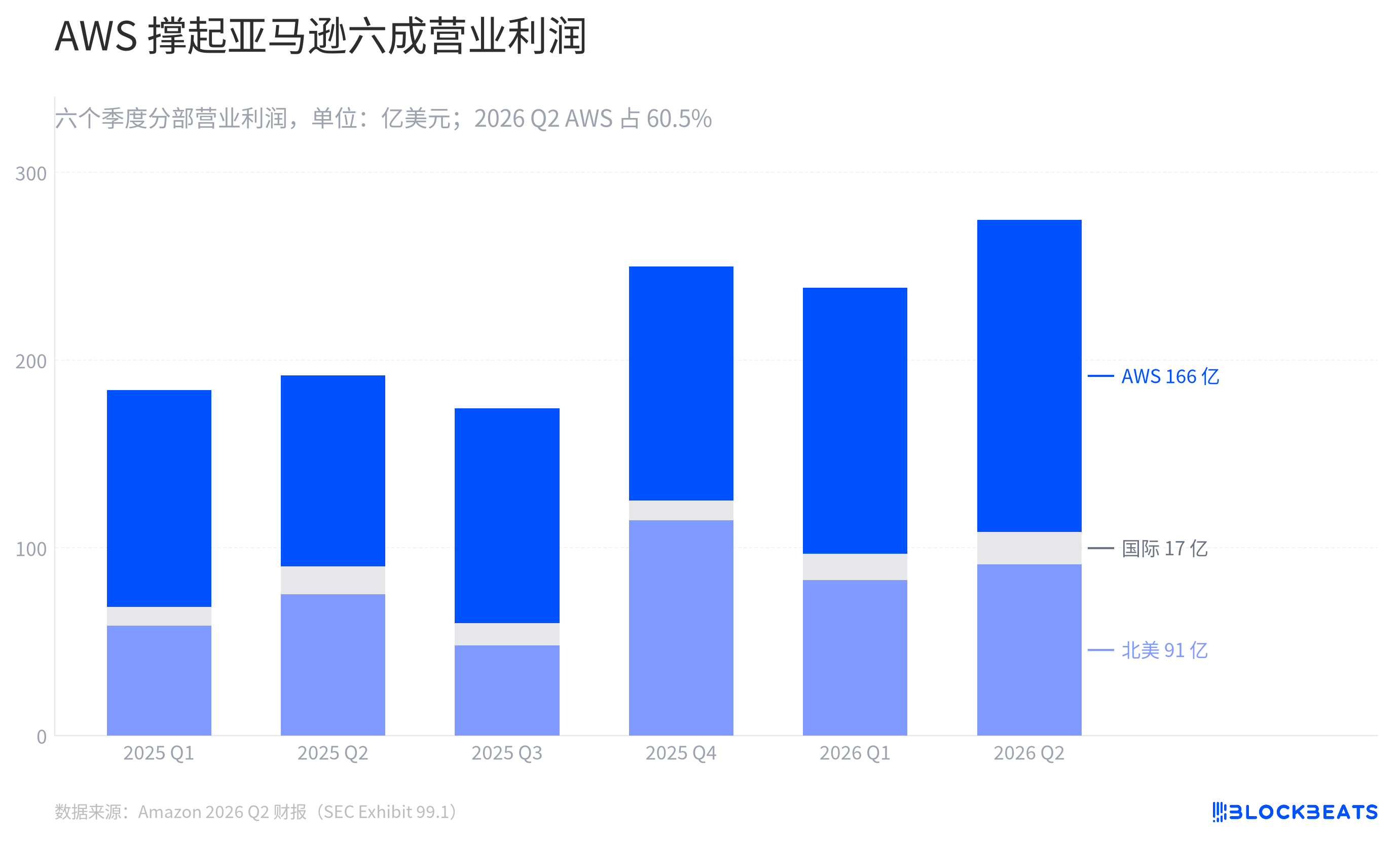
The changes in this chart are more intuitive than a revenue table. Amazon's largest revenue base remains North American retail, but the blue portion has consistently been a key load-bearing wall of the income statement, and its absolute profit rose another notch in the latest quarter. International operations continue to be profitable, and North American operations are also improving, which means AWS doesn't have to bear all the pressure alone. But once you shift your focus to profit rather than sales, AWS's position becomes impossible to ignore.
This is the most practical significance of the cloud business to Amazon. It not only provides a faster-growing segment for the AI narrative, but also creates a thicker operational buffer for simultaneous investments in the retail network, delivery capabilities, and data centers.
Why the money earned didn't stay in free cash flow
A thicker operating income does not mean cash will settle proportionally. Another table in Amazon's press release describes where funds have gone over the past 12 months, rather than expenditures for a single quarter.
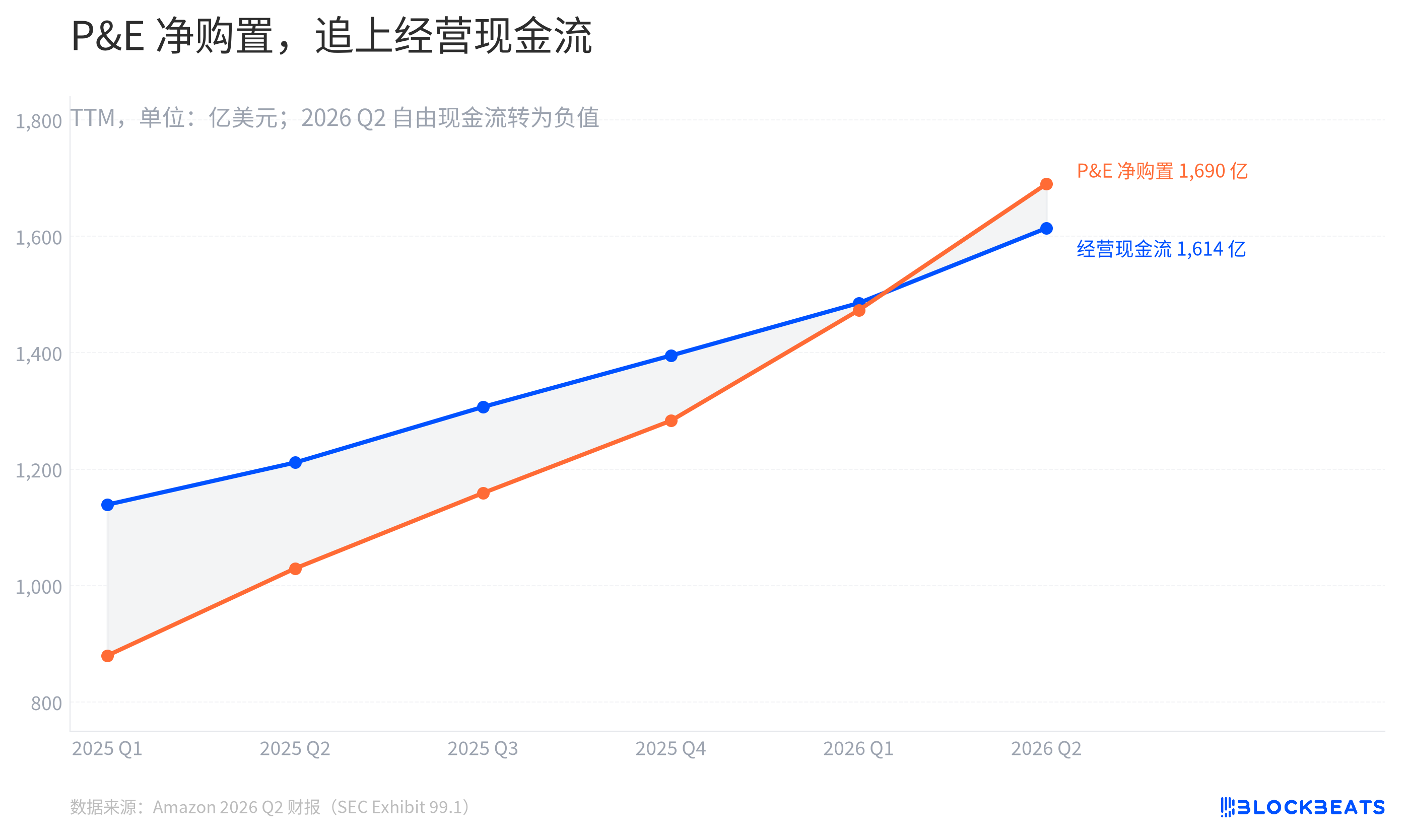
For the trailing twelve months ended Q2 2026, according to the company's press release, Amazon's operating cash flow was $161.4 billion, while net purchases of property and equipment were $169 billion. The two TTM lines crossed at that point, and TTM free cash flow turned from positive to negative.
The "net purchases of property and equipment" here is not just an abstract capital expenditure figure. It includes investments in data centers, servers, and other long-term assets, measured on a basis net of sales proceeds and incentives. The company stated that the year-over-year increase in this expenditure primarily reflects investments in AI. Saying it all equals AI, however, would actually narrow the financial report.
This contrast also gives the $62.6 billion figure more depth. On the income statement, investment gains push net income higher, while on the cash flow statement, infrastructure spending is rapidly consuming cash generated from operations. Both things can be true simultaneously, yet they answer two completely different questions.
Beyond AWS, the foundation is also accelerating
If you only focus on AWS, it's easy to characterize Amazon as a cloud computing company. According to the company's revenue classification table, AWS's year-over-year growth rate has risen from 17.5% to 36.8%.
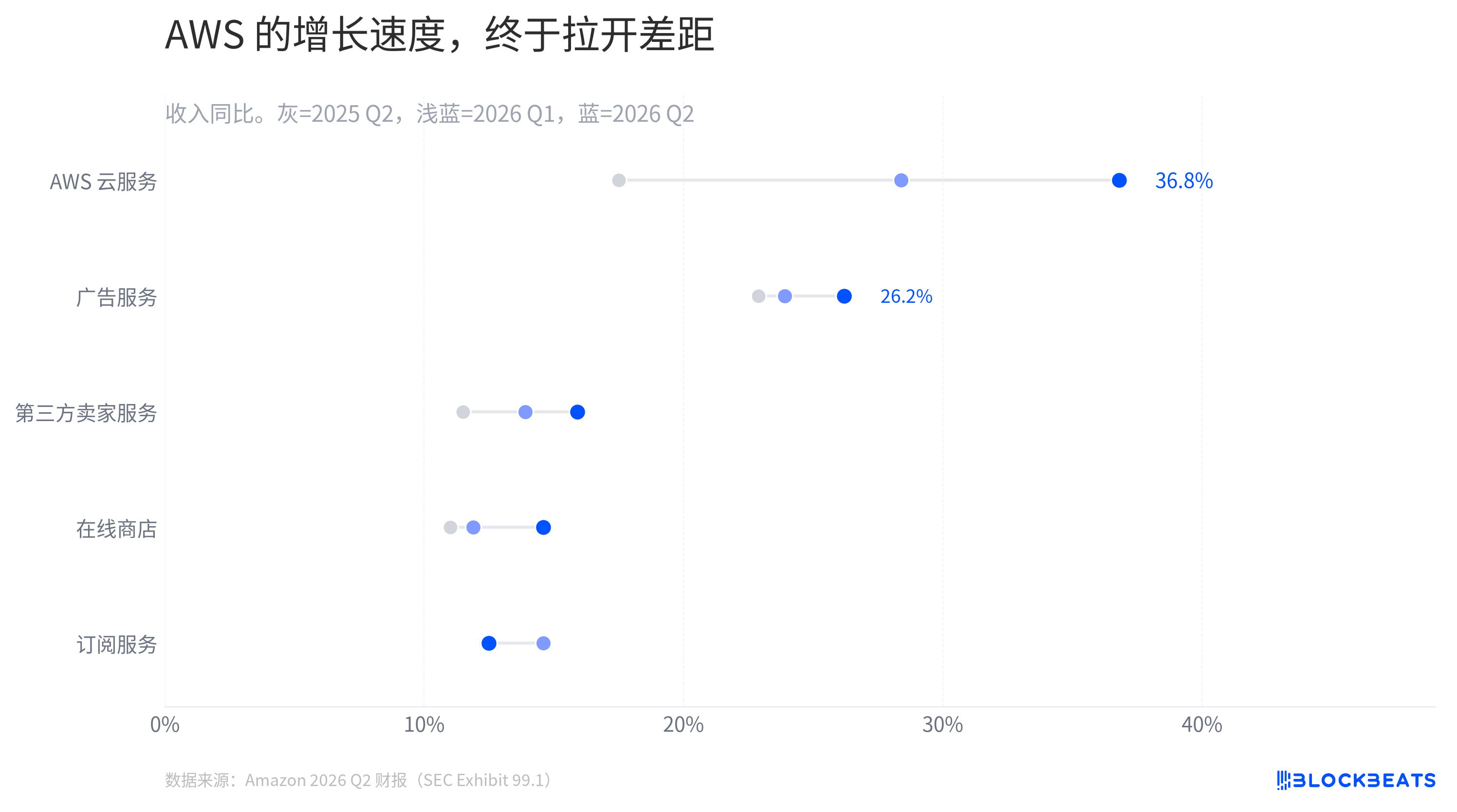
According to the same revenue classification table, advertising services still grew 26.2% year-over-year this quarter. Third-party seller services and online stores may not be growing as fast as AWS, but both have more momentum than they did a year ago. Together, they determine whether the retail foundation can continue to bear the costs of delivery, fulfillment, and customer acquisition.
AWS's blue bars, the non-operating pre-tax other income dominated by the Anthropic investment, and the equipment spending on the cash flow statement all happen to appear in the same quarterly report.