Cross-industry expansion is difficult; neither the leader in prediction markets nor the Perp DEX has successfully replicated a second self.


- Core Insight: The leading platforms in the two major trading sectors—prediction markets and perpetual contract DEXs (Perp DEXs)—have attempted cross-industry expansion, but the results have been suboptimal. The primary reason is the difficulty in replicating the user habits and liquidity of the original track. Holding onto home-field advantage is more important than pursuing a “universal trading platform.”
- Key Factors:
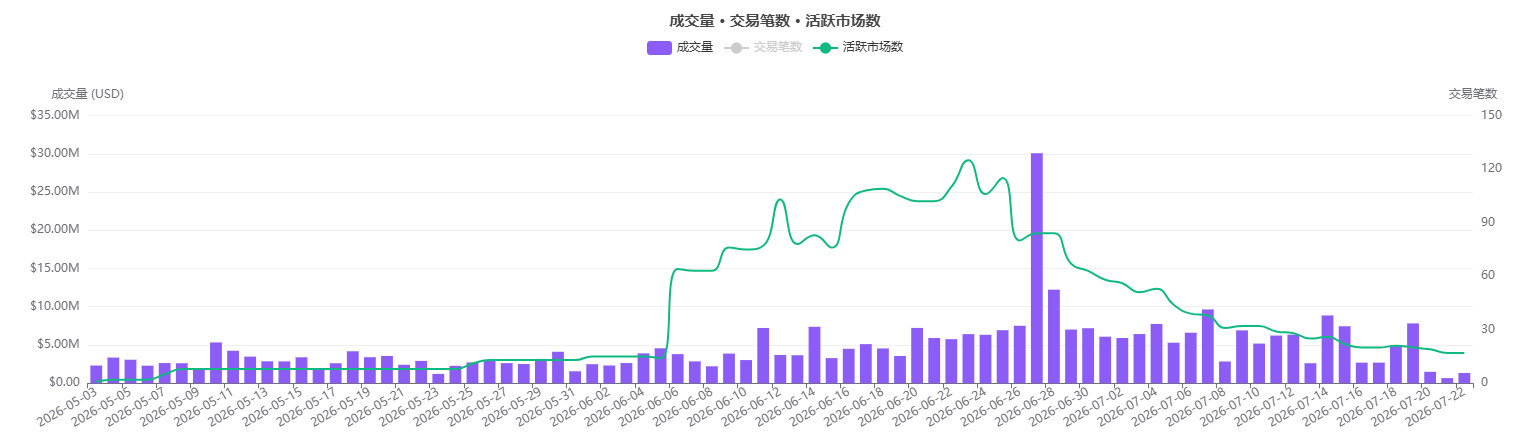
- Hyperliquid entered the prediction market through HIP-4, reaching a peak of 125 active markets, but this number has recently fallen to fewer than 20, a decline of over 85%; trading volume has also dropped from a peak of $30 million to the millions.
- After Polymarket launched perpetual contracts, early daily trading volume was approximately $48 million, but by late July, it had fallen to around $18.2 million, with open interest at only about $26.4 million—just 0.3% of Hyperliquid's volume during the same period.
- Kalshi launched CFTC-regulated crypto perpetual contracts, accumulating a total trading volume of $16.1 billion over six weeks. However, recent daily volume has plummeted from $448 million to approximately $80 million, with open interest remaining only in the tens of millions.
- Differences in user habits are the main cause of failed cross-industry expansion: Perp DEX users prefer high-frequency leveraged trading, while prediction market users trade around sports and political events. Platforms find it difficult to simultaneously change users' original trading methods.
- The liquidity structure differs between event contracts and perpetual contracts: perpetual contract trading consistently revolves around core assets, whereas event contracts continuously conclude upon settlement, requiring repeated re-aggregation of liquidity.
Original Article by Odaily 星球日报(@OdailyChina)
Author: Asher(@Asher_ 0210)

Over the past six months, two of the hottest trading tracks—Prediction Markets and Perp DEXs—have been pushing into each other's territory.
In April, Polymarket announced it would launch Perps, covering cryptocurrencies, US stocks, and commodities. At the end of May, Kalshi officially launched CFTC-regulated crypto perpetual contracts. On the other side, Hyperliquid, the leading Perp DEX, moved into prediction markets through HIP-4, aiming to extend its mature order books, account system, and liquidity advantages to real-world event trading.
Prediction markets have attracted users keen on trading sports, esports, politics, and trending events, while Hyperliquid has built a base of crypto-native traders more inclined towards high-frequency and leveraged trading. At its core, this cross-border expansion by each side is an attempt to leverage their advantages in core users and trading scenarios to enter the other's original domain.
However, months later, the results have been less than ideal. The user habits and liquidity accumulated in the original tracks have not naturally migrated with the expansion of product boundaries.
Hyperliquid: Active Prediction Markets Drop from 125 to Below 20
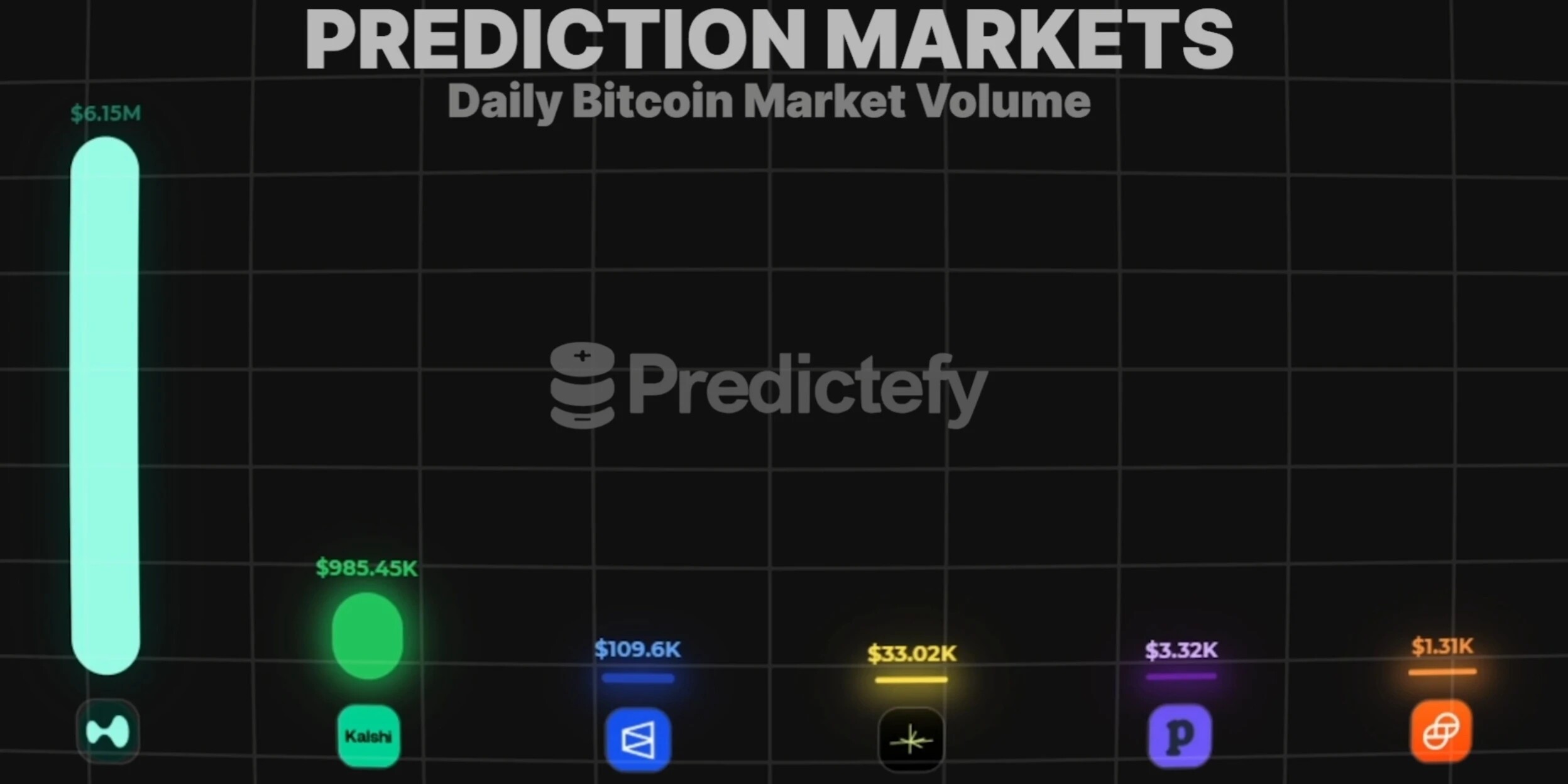
On May 2nd, Hyperliquid launched HIP-4 Outcome Markets on its mainnet, introducing outcome markets to its on-chain trading system. The first batch listed BTC binary outcome contracts, achieving a first-day trading volume of $6.15 million, far exceeding similar prediction events on Kalshi and Polymarket. Furthermore, it completed over 54,000 trades with more than 3,000 unique traders on that day.
The World Cup further amplified this growth spurt. In early June, HIP-4 had only a few dozen active markets, which quickly surged to over 100, peaking at more than 120. Trading volumes rose in tandem, reaching nearly $30 million in daily turnover on June 27th, and remaining above $10 million the following day. As sports events, macro data, and crypto price events were continuously added, HIP-4 briefly moved away from its early dominance of short-term BTC contracts, beginning its expansion towards a more complete event trading platform.
However, the rapid increase in the number of markets did not translate into sustained trading demand. As the World Cup entered its latter stages, the number of active HIP-4 markets began a continuous decline, falling from a peak of 125 to around 50, dropping further to the twenties by mid-July, and recently falling below 20—a contraction of over 85% from its peak. Trading volume also weakened in tandem, with most days returning to the multi-million dollar range and even falling below $1 million recently.
This underscores the fundamentally different liquidity structure between Perps and event contracts. Perpetual contract trading revolves around core assets like BTC and ETH over the long term, allowing market makers, capital, and traders to continuously accumulate within the same set of markets. Event contracts, however, settle upon the conclusion of a game, release of data, or occurrence of a political event, meaning new markets must constantly attract fresh liquidity and trading interest. While Hyperliquid can reuse its matching engine, account, and capital infrastructure, it cannot directly replicate the established liquidity and user trading frequency from its Perp market onto HIP-4.
Polymarket: Perpetual Contract Daily Volume Below $20 Million
Polymarket announced its foray into the perpetual contract market in April and began opening its Perps product to more users in July, offering up to 20x leverage. It currently remains access-restricted via invite codes or a waitlist. The product covers crypto assets like BTC, ETH, and SOL, and has also been extended to some stocks and commodities.
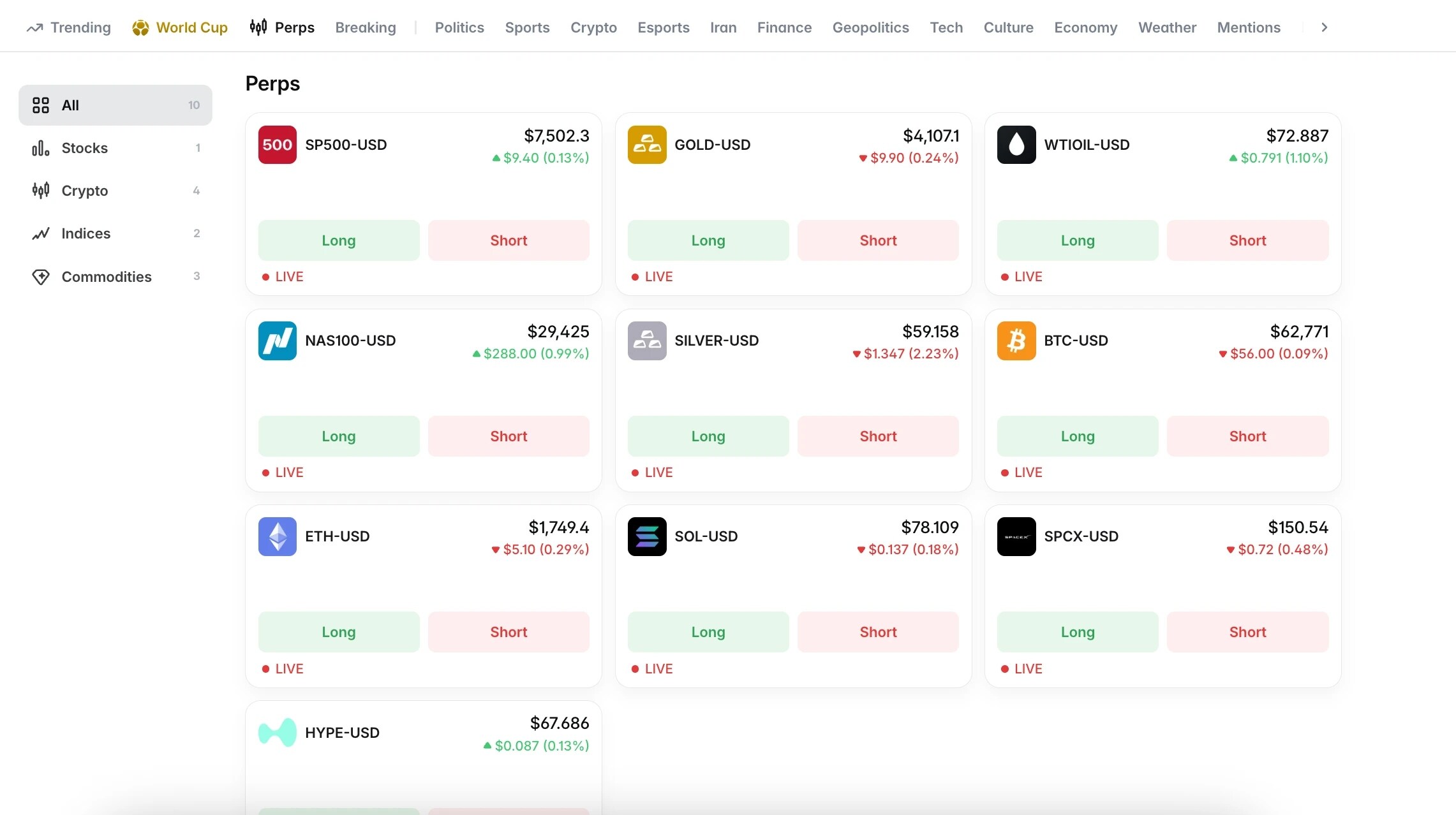
Shortly after its launch, Polymarket Perps' 24-hour trading volume reached approximately $48 million, but this level was not sustained. By late July, daily trading volume had declined to around $18.2 million, with Open Interest (OI) at approximately $26.4 million. Even core trading pairs like BTC and ETH only had OI in the low millions. Compared to its launch period, trading activity on Polymarket Perps has clearly cooled down.
That said, Polymarket Perps is still in an early, invite-only phase, so comparing it directly with mature Perp platforms isn't entirely fair. However, even accounting for this, the current scale disparity is stark. Over the same period, Hyperliquid's OI was approximately $7.7 billion with a 24-hour trading volume of around $1.58 billion, while Polymarket Perps' OI of about $26.4 million represents only roughly 0.3% of the former. Its daily trading volume is also merely about 1% of Hyperliquid's.
Currently, Polymarket's trading volume on Perps seems more like early users trying out a new product rather than the formation of stable trading habits or sustained discussion. At least based on current data, Polymarket has not successfully replicated its prediction market user base and brand advantages into the Perp track, making this expansion attempt less than successful so far.
Kalshi Perps: $16.1 Billion in Volume Over Six Weeks, But Recent Slowdown
Compared to Polymarket, Kalshi's Perps launch was quicker. At the end of May, Kalshi officially launched CFTC-regulated crypto perpetual contracts, initially covering assets like BTC, ETH, SOL, and XRP. By July 9th, roughly six weeks after launch, Kalshi Perps had amassed a cumulative trading volume of $16.1 billion.
The current trading activity on Kalshi Perps has noticeably cooled down compared to its rapid early growth. According to Loris Tools data, the Perps segment on Kalshi saw a daily volume of $448 million on July 20th, but this has fallen to approximately $80 million in the last two days, a drop of over 80% in just a few days.
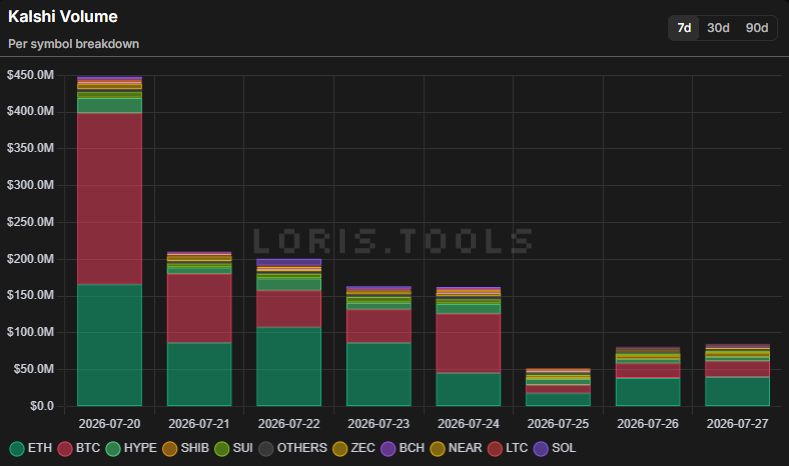
Meanwhile, Hyperliquid's daily Perp volume remains in the tens of billions of dollars. Even comparing Kalshi's recent peak of $448 million on July 20th, its trading scale still significantly lags behind Hyperliquid. With Kalshi's daily volume falling to around $80 million recently, the gap has widened further.
The disparity in Open Interest is even more pronounced. The current OI for the Perps segment on Kalshi remains in the tens of millions of dollars, while Hyperliquid's OI has reached approximately $7.5 billion. Kalshi's cumulative $16.1 billion in volume over six weeks indicates decent traction, but the rapid volume decline and persistently low OI suggest it still has a significant distance to cover before competing effectively with mainstream Perp platforms.
Kalshi's "US-compliant gateway" remains its clearest differentiating advantage. However, this advantage currently solves the problem of "Can US users trade Perps?" rather than "Why should professional Perp traders stay on Kalshi long-term?"
Crossover is Difficult; Defending Home Turf Might Be More Important Than the 'Everything Exchange' Slogan
The true difficulty for Hyperliquid, Polymarket, and Kalshi in their cross-border attempts lies in replicating the long-established user habits and liquidity of their original tracks. Hyperliquid's core users are more accustomed to high-frequency, leverage, and on-chain derivatives trading. Users of Polymarket and Kalshi primarily engage in judging sports, politics, and trending events. Platforms can quickly add new product categories, but they cannot easily make users simultaneously change their established trading methods.
For Hyperliquid, deepening its existing Perp and on-chain asset trading might be more important than proving it can trade everything. For Polymarket and Kalshi, event supply, user mindshare, and prediction market liquidity remain the truly scarce resources. Cross-border expansion can open up new growth horizons, but if new categories fail to generate independent demand, they risk diluting the platform's most valuable core resources.
Ultimately, the so-called 'Everything Exchange' competition might not be determined by who covers the most categories, but by who can continuously accumulate users, liquidity, and market depth in their core tracks. For these platforms with clear existing advantages, making their home turf sufficiently deep might be more critical than constantly expanding their boundaries.