Violent rebound! U.S. stock "tech momentum stocks" record their biggest single-day gain ever, but is the selloff over?


- Core Thesis: On Tuesday, U.S. tech momentum stocks experienced a rare violent rebound. The High Beta Momentum Index recorded its largest single-day gain since the dot-com bubble of 2000. This is essentially a technical rebound driven by a short squeeze, but the internal market structure is weak, casting doubt on the sustainability of the rally.
- Key Factors:
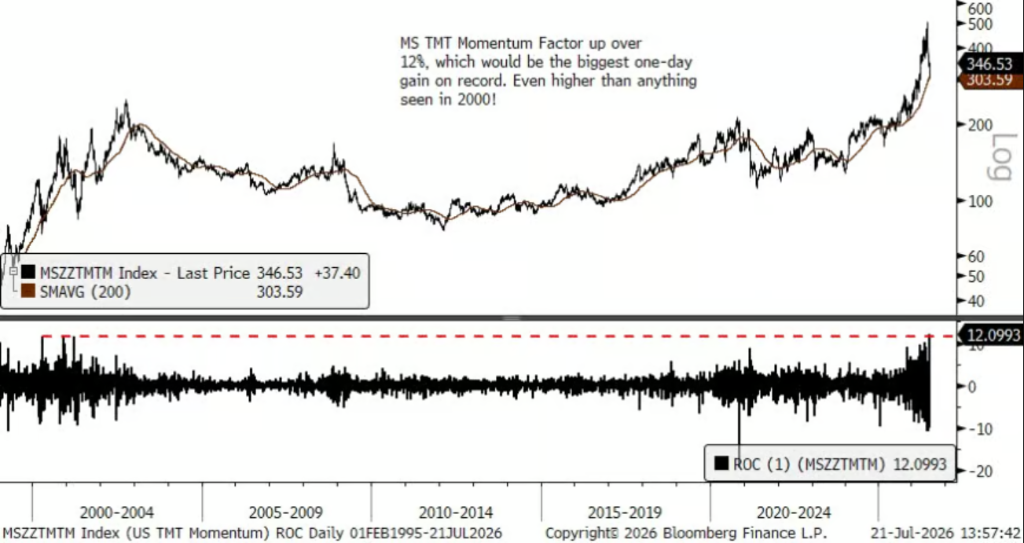
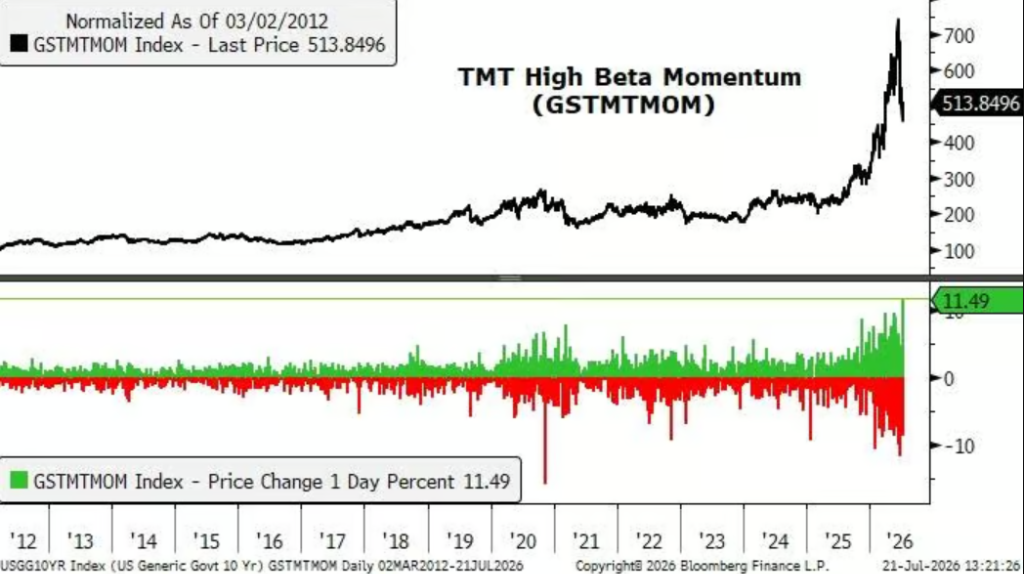
- Goldman Sachs' High Beta Momentum Long/Short Index surged 9.5% in a single day, its strongest performance since 2021; Morgan Stanley's TMT Momentum Factor posted a record single-day gain of over 12%.
- This rebound stems from a short squeeze following a cumulative 33% plunge in momentum stocks. Trend-chasing traders in South Korea and Japan were forced to cover their positions, triggering an upward spiral.
- The quality of the rebound is low: trading volume was 20-30% below the 20-day average. While the S&P 500 rose, more stocks declined than advanced. Market activity scored only 3 out of 10.
- There is a significant divergence in institutional views: BTIG advises selling into strength, believing the rally is hitting a strong resistance zone at 730-750; Goldman Sachs and UBS argue the momentum selloff is nearing its end and suggest gradually adding positions.
- This week's earnings season (113 S&P 500 companies reporting) and AI capital expenditure guidance will be the next key variables, particularly Alphabet's earnings report.
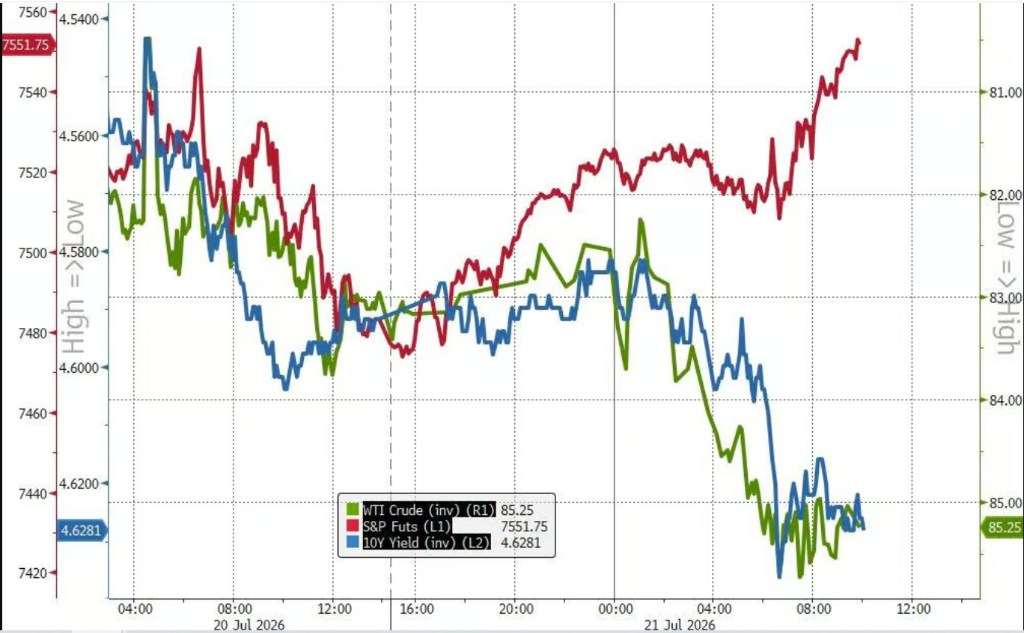
- The bond market is flashing warning signs: long-end yields have risen to two-month highs, credit spreads for mega-cap tech companies have hit new records, and rising energy prices are pushing interest rates higher.
Original Author: Long Yue
Original Source: Wall Street Sights
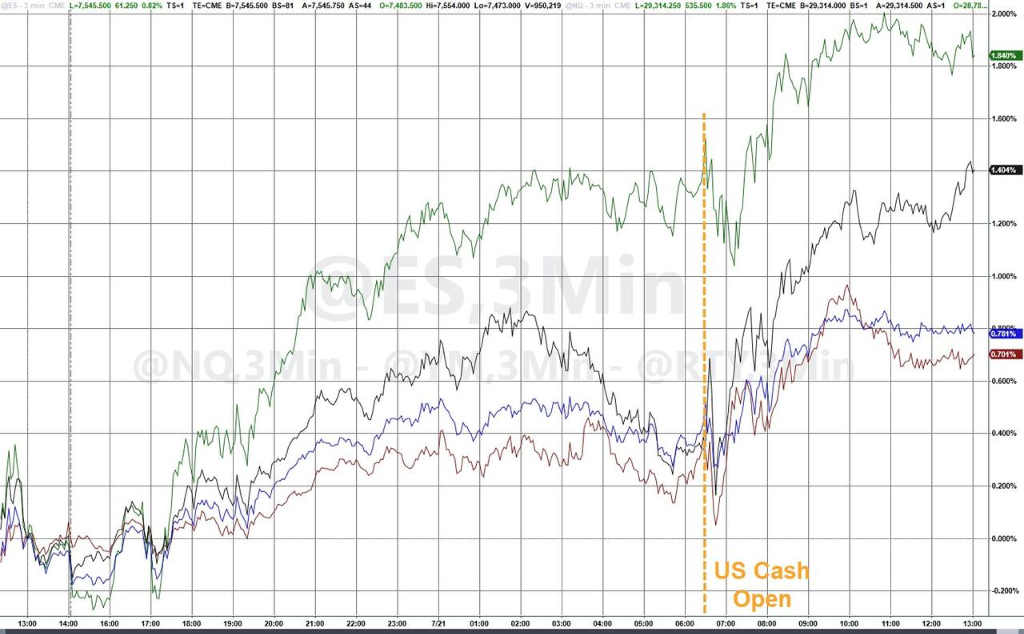
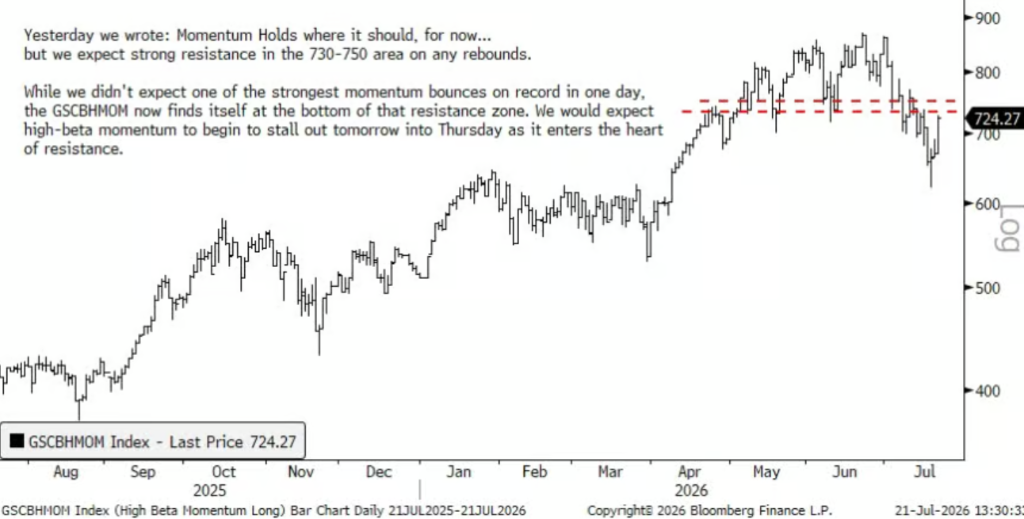
US tech momentum stocks staged a sharp rebound on Tuesday (July 21). Morgan Stanley's TMT Momentum Factor surged over 12% in a single day, its largest daily gain on record, even exceeding any single-day performance during the 2000 dot-com bubble. The Goldman Sachs High Beta Momentum Long Index (GSCBHMOM) rose approximately 8.5% in a day, its strongest single-day performance since April 2025; the Long/Short High Beta Momentum Index (GSPRHIMO) surged 9.5%, its strongest since 2021 and near its highest level since 2003.
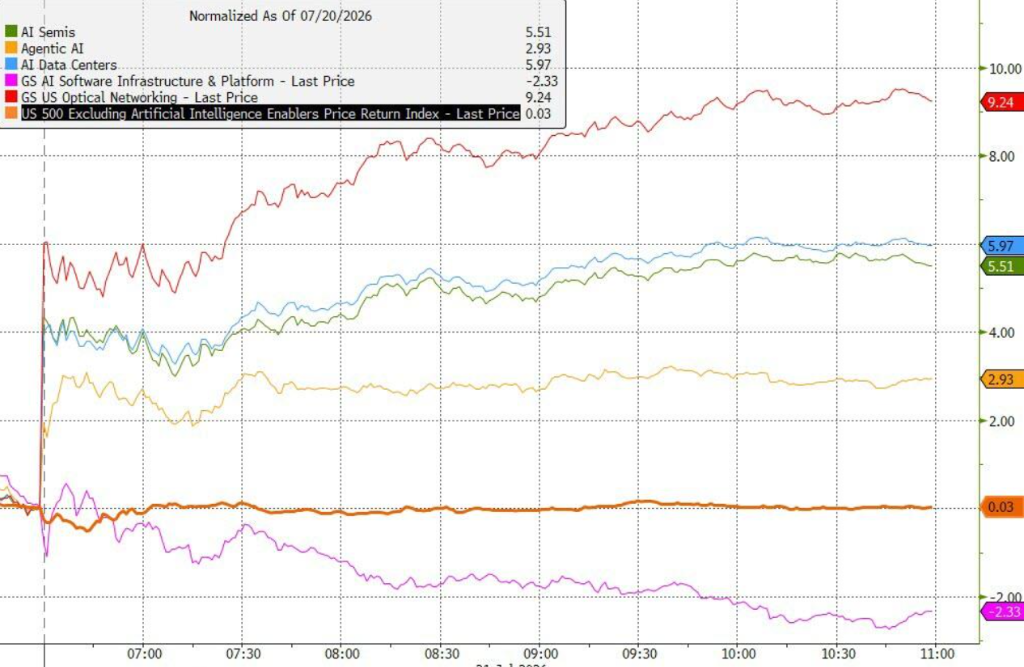
The Nasdaq Composite Index rose about 1.3% on the day, leading the three major indices. The semiconductor sector was the biggest driver – the Philadelphia Semiconductor Index jumped 4.6%, and the VanEck Semiconductor ETF gained about 4.5%. Micron Technology surged over 10%, Intel rose about 8.6%, SanDisk climbed about 14%, Cerebras Systems jumped about 18%, and Cipher Mining advanced over 11%.
This rebound followed three consecutive days of decline and occurred after a cumulative 33% plunge in momentum stocks.
Why This Rebound? Short Sellers Caught in a "Squeeze"
To understand this rebound, one must first grasp the depth of the prior decline.
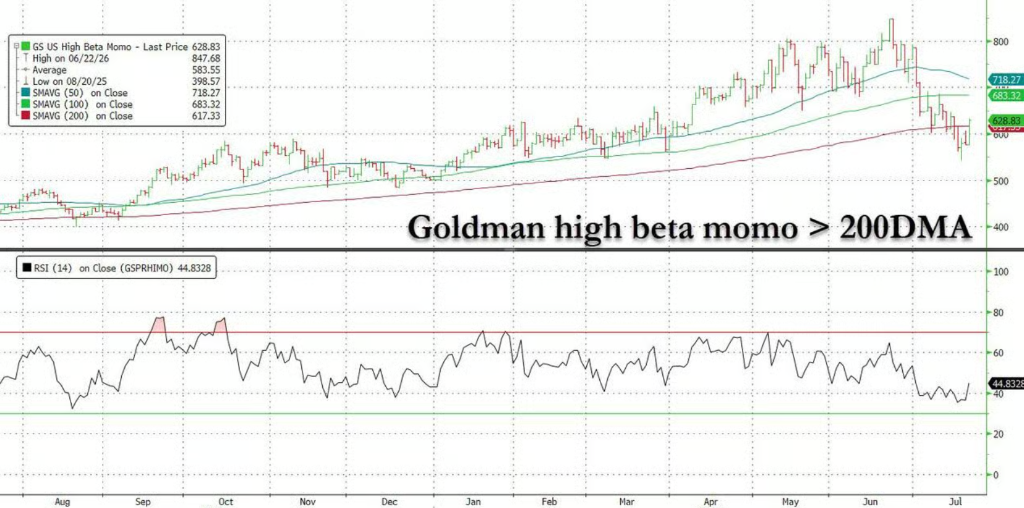
Goldman Sachs data shows that high beta momentum stocks fell 33% in just a few trading sessions, one of the most severe drawdowns since the dot-com bubble burst. The Goldman Sachs High Beta Momentum Index briefly fell below its 200-day moving average, hitting its lowest point since January this year, with oversold conditions the worst since last August.
The deeper the fall, the greater the potential snapback – this is a basic market logic.
Tuesday's rebound was largely a "squeeze" scenario. Numerous investors shorting momentum stocks, especially momentum-chasing retail traders in South Korea and Japan, suffered severely over the past two weeks – South Korea's market even witnessed large-scale margin call events, devastating local retail investors. As these short sellers were forced to cover their positions, buying pressure created a self-reinforcing upward spiral.
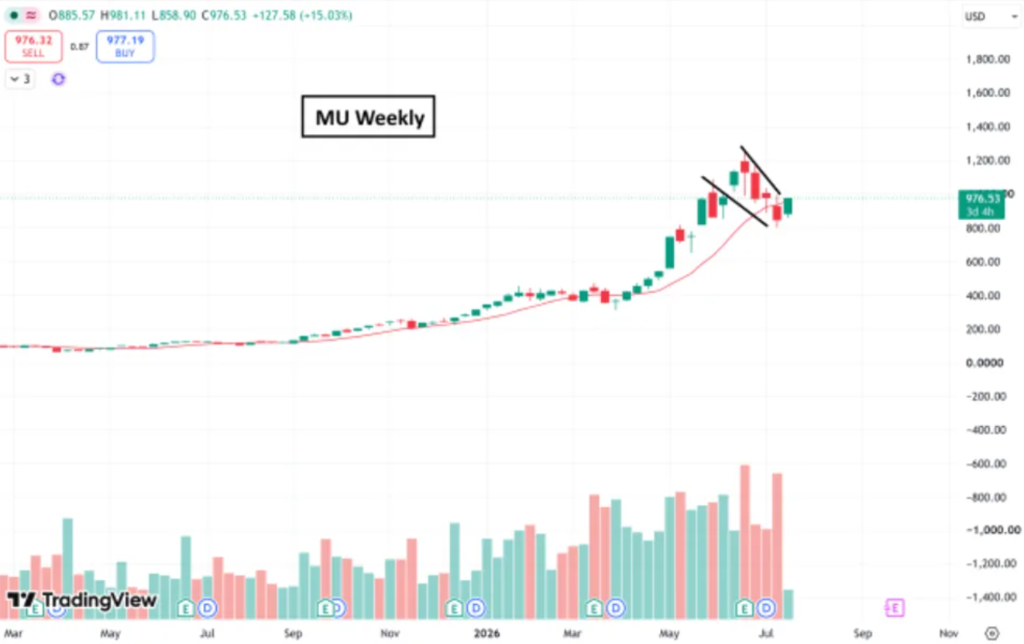
Zacks Investment Research noted that Micron Technology had previously broken below the neckline of a "head and shoulders" pattern on the daily chart, a bearish technical signal. However, on Tuesday, the stock surged over 10%, reclaiming the neckline. "False breakouts often lead to violent reversals in the opposite direction, as late-coming shorts and bears get trapped."
Market Breadth Remains Weak, Rebound's Quality Questioned
The rebound numbers look impressive, but the internal structure is unhealthy.
BTIG strategist Jonathan Krinsky analyzed that overall trading volume on Tuesday was low. Volumes for SPY, QQQ, and S&P 500 cash were 20% to 30% below their 20-day averages. Simultaneously, while the S&P 500 rose nearly 1% on the day, declining stocks still outnumbered advancing ones – marking the most frequent occurrences of price-breadth divergence this year, and Tuesday added another instance.
Goldman Sachs trader data indicated that overall exchange volume was about 17% below the 20-day average, market maker book liquidity was only $6.83 million, and market activity scored just 3 out of 10.
In other words, this rebound looks more like a concentrated explosion in a few heavily-weighted stocks rather than a broad recovery.
Bloomberg macro strategist Michael Ball commented, "It is still too early to declare the correction over." Demand for put options on semiconductor ETFs and previously high-flying AI stocks remains elevated. The negative gamma exposure in Nasdaq, semiconductor ETFs, and related stocks means market makers tend to amplify moves rather than dampen volatility – while amplifying upward moves, this also magnifies downward risks.
BTIG Warns: Rebound Hits Key Resistance, Advises Selling into Strength
Not everyone is optimistic about this rebound.
BTIG's Jonathan Krinsky issued a clear warning, advising to "fade" (sell into strength). He had previously predicted that a momentum stock bounce would face strong resistance in the 730-750 range, and Tuesday's rebound exactly pushed the GSCBHMOM to the lower end of this resistance zone.
Krinsky stated: "Extreme volatility, coupled with historic stock dispersion, signals that the market is undergoing a broader correction." He expects high beta momentum stocks to begin stalling after entering the core resistance zone from Wednesday to Thursday.
Looking at historical data since 1999, there have only been 10 instances where the High Beta Momentum Long Index surged more than 7% in a single day above its 200-day moving average. Three of those occurred this year, three occurred in early 2021, and three in early 2000. Krinsky noted that this "underscores both the rarity of this move and the fact that we continue to see statistical echoes of the 1999-2000 period."
Goldman Sachs, UBS: Momentum Selling Nears End, Suggest Gradual Adding
Contrasting BTIG's caution, Goldman Sachs and UBS both believe the momentum sell-off is in its final stages and advise investors to seize opportunities.
Goldman Sachs' Julia Mensch noted in a report that the firm had flagged the momentum sell-off as being "in the late innings" last week. She wrote: "With positioning significantly cleared (Goldman Sachs prime brokerage data shows momentum exposure at the 64th percentile over the past year and the 93rd percentile over the past five years), and with no new fundamental catalyst behind this sell-off, we see room for momentum to revert towards its long-term trend. This sell-off could be a good opportunity to add momentum exposure or buy AI stocks on the dip."
Michael Romano, Head of Equity Derivatives Sales for Hedge Funds at UBS, expressed a similar view in a client note, believing that improving AI fundamentals are a buy signal. However, he also advised investors to "build positions gradually, rather than going all-in at once."
Romano wrote: "Momentum de-risking has been and remains a compelling narrative. Scaling in is prudent." He expects the momentum sell-off to bottom out by the end of July (if it hasn't already) and stated: "Once the tide turns, I expect liquidity to drive prices to overshoot on the upside."
However, Goldman Sachs also maintained some reservation – given the extremely high recent volatility and the packed earnings season ahead, they suggested investors gain exposure through "limited-loss structures" rather than outright long positions.
Earnings Season is the Next Key Variable
The sustainability of this rebound heavily depends on this week's earnings reports.
According to Reuters, 113 S&P 500 companies (representing approximately 18% of the index's market cap) are reporting earnings this week. Among them, Alphabet's (GOOGL) report is seen as "the most important data point of the week", with the market focused on its full-year 2026 capital expenditure guidance – expectations are for an upward revision, which would provide crucial insights into the trajectory of AI spending.
Adam Turnquist, Chief Technical Strategist at LPL Financial, stated: "The focus now isn't just on the total CapEx; the next focus will be on return on investment and spending quality, which we believe will become a core theme in the second half of the year."
He also noted: "We expect the semiconductor sector to continue experiencing volatility as overbought conditions need to be worked off, profit-taking pressures emerge, and crowded positions need to be cleared. Fundamentally, we don't see anything substantially changed."
According to Reuters, 66 S&P 500 companies have reported so far, with about 88% exceeding analyst earnings expectations. 3M (MMM) surged over 9% in a single day, and General Motors (GM) rose about 5%, both driven by strong earnings beats.
Bonds and Macroeconomics: Another Red Flag
While stocks celebrated, the bond market was sending warnings.
Treasury yields rose across the board on the day, with the 2-year yield up 5 basis points and the 30-year yield up 2 basis points. Long-end yields climbed to two-month highs, erasing the bond gains from last week's weaker-than-expected inflation data.
Oil prices were one driver. Brent crude futures closed back above $90 per barrel for the first time since June 11. Geopolitical tensions in the Middle East escalated – Yemen's Houthi group announced a blockade of the southern Red Sea entrance, causing two oil tankers carrying Saudi crude to turn back in the Red Sea. Kpler's MarineTraffic data showed that even before the blockade announcement, cargo loadings transiting the Bab el-Mandeb strait had fallen 34% over the past two weeks.
Izaac Brook, rates strategist at RBC Capital Markets, commented: "Today's market moves are primarily a result of persistently rising energy prices. The rate volatility was amplified by breaching closely watched technical levels – 4.20% for the 2-year yield and 4.60% for the 10-year yield – and the typical low-liquidity trading environment in the summer."
Bloomberg's Cameron Crise warned that long bond yields are at a tipping point where 5% is turning from resistance into support, with the next obvious target at 5.5% – "This would be jarring for equities, especially if the positive economic surprise pushes yields higher and negatively impacts stocks."
Kevin Boova, Head of IG Credit at Goldman Sachs, also warned that credit spreads for mega-cap tech companies have hit new highs, stating "the hyperscaler cloud/AI/data center space feels a bit vulnerable again."