






Lithography machines are selling like hotcakes—ASML officially announces a 30% capacity expansion


- Core Thesis: ASML's Q2 2026 financial results exceeded expectations, with total net sales of €9.326 billion and net income of €2.918 billion. The company revised its full-year guidance upward for the second time this year to €43-45 billion, primarily driven by a surge in chip demand fueled by the AI infrastructure arms race.
- Key Points:
- Earnings Beat: Q2 net sales of €9.326 billion and net income of €2.918 billion both surpassed analyst estimates. Gross margin reached 54%, exceeding the company's own guidance.
- Demand Drivers: Tech giants like Amazon and Google are investing hundreds of billions of dollars in AI infrastructure, accelerating capacity expansion at memory and logic fabs. Memory customer revenue is expected to grow by 75% in 2026.
- Capacity Expansion Plan: ASML plans to increase EUV and immersion DUV production capacity by 30% each in 2027, and is evaluating a further 30% increase for each in 2028.
- Regional Market Shifts: South Korea remains the largest customer (43% of revenue), while China's share fell from 19% to 14%. However, management expects China's full-year share to remain around 20%.
- High-Margin Business Growth: The installed base management service business contributed €2.762 billion, up 11% quarter-over-quarter. It is expected to achieve over 30% growth in 2026, boosting overall profit margins.
Original author: Su Yang
Original editor: Xu Qingyang
Original source: Tencent Technology
July 15 – ASML released its Q2 2026 financial results. Total net sales reached €9.326 billion, with a net profit of €2.918 billion, both core metrics surpassing Wall Street analysts' expectations.
As the most critical lithography equipment supplier in the wafer fabrication upstream, ASML's surging performance reflects an ongoing arms race across the entire tech industry.
Among them, giants like Amazon, Google, and Microsoft have poured hundreds of billions of dollars into infrastructure, igniting massive downstream demand for high-end AI chips. Wafer fabs, including both logic and memory, have accelerated capacity expansion, pushing lithography machine demand to a fever pitch.
Alongside its impressive Q2 results, ASML sharply raised its full-year guidance for the second time this year, increasing its 2026 total sales forecast to between €43 billion and €45 billion (approximately $49.1 billion to $51.4 billion).
Notably, ASML itself is also driving capacity expansion. The company plans to increase production capacity by 30% in 2027, based on its 2026 capacity plan of approximately 65 Low Numerical Aperture (Low NA) EUV systems, and is studying a further 30% increase in capacity in 2028. Simultaneously, it plans to boost capacity by 30% in 2027, based on its 2026 plan for around 130 immersion DUV systems, and is also evaluating an additional 30% capacity increase in 2028.
Driven by this, ASML has solidified its position as the most valuable listed company in Europe by market capitalization. Since the start of 2026, ASML's share price has risen over 68%, doubling over the past 12 months.
Gross Margin Surges to 54%; Revenue Guidance Sharply Raised
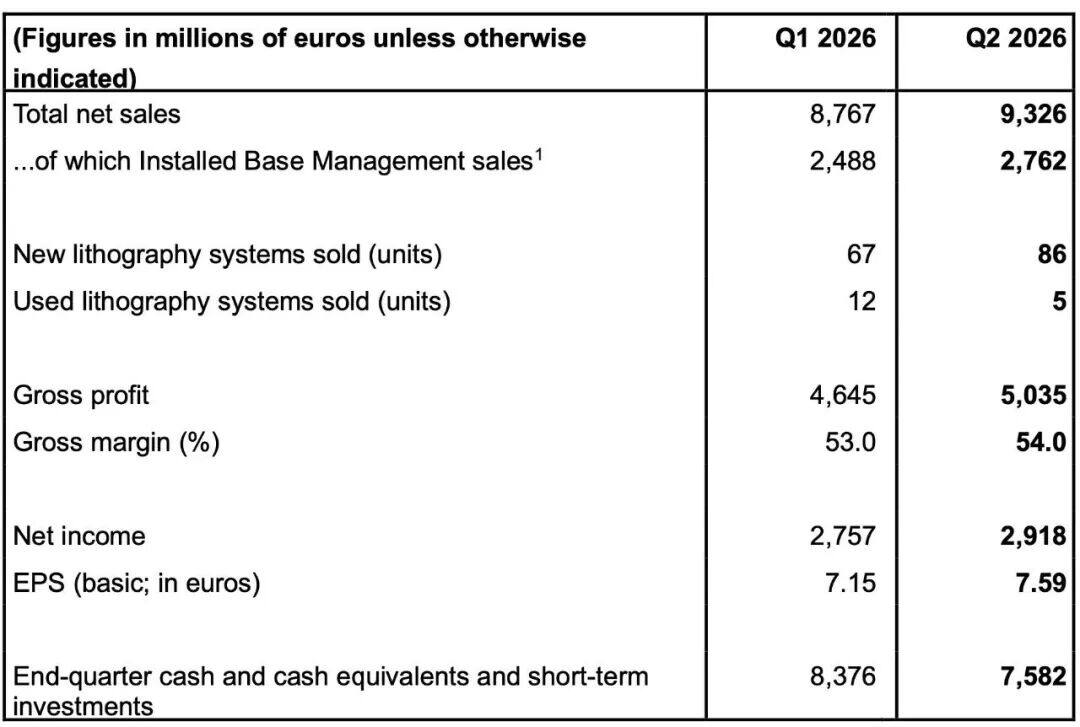
ASML Key Financial Data
Multiple key financial metrics for ASML in Q2 achieved strong year-over-year and quarter-over-quarter growth, also surpassing Wall Street analysts' forecasts.
Total net sales for Q2 reached €9.326 billion, a continued increase from €8.767 billion in Q1; this was a 21.3% year-over-year increase from €7.69 billion in the same period last year, significantly exceeding the Visible Alpha consensus estimate of €8.83 billion and the LSEG forecast of €8.8 billion.
By revenue breakdown, among the €9.326 billion total net sales, equipment revenue was €6.564 billion, and installed base services revenue was €2.762 billion.
Gross profit for the quarter increased to €5.035 billion, with a gross margin of 54%, up from 53% in Q1 and exceeding the company's own guidance. In terms of equipment delivery, ASML sold 86 new lithography systems and 5 used lithography systems in Q2, a significant increase from the 67 new systems sold in Q1.
"Both net sales and gross margin exceeded expectations, primarily driven by higher-than-expected installed base services sales," said Christophe Fouquet, President and CEO of ASML.
Net profit performance was also impressive. Q2 net profit reached €2.918 billion, a steady improvement from €2.757 billion in Q1; this was a sharp 27.5% increase year-over-year compared to €2.29 billion, significantly surpassing the market consensus of €2.6 billion.
Driven by extremely strong order momentum in the first half of the year, ASML made its most aggressive forecast revision of the year. The company significantly raised its full-year 2026 total net sales forecast from the €36 billion to €40 billion range announced in the previous quarter to €43 billion to €45 billion; it also raised its full-year gross margin expectation from 51%-53% to 54%-56%.
Such a magnitude of adjustment is extremely rare in the semiconductor equipment industry, directly reflecting the urgency of downstream customers to secure shipments. For the upcoming third quarter, ASML provided a highly optimistic outlook, forecasting single-quarter sales between €11 billion and €12 billion, with gross margins expected to further climb to 55%-57%.
Memory and Logic Fabs Scramble for Equipment
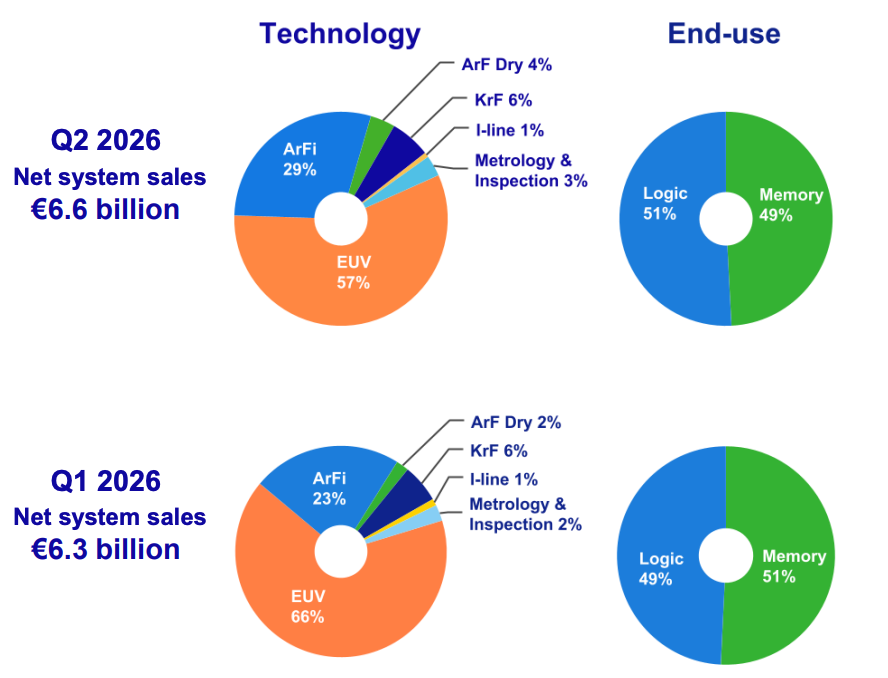
ASML Business Breakdown
In the net system sales mix for Q2 2026, logic chips regained dominance, accounting for 51% of revenue compared to 49% for memory chips. In the previous quarter, memory customer orders had historically overtaken logic customers with a 51% share.
From a technology structure perspective, although the revenue contribution from EUV systems decreased from 66% in Q1 to 57%, it remains ASML's main revenue pillar. In terms of shipments, ASML sold 16 EUV systems in Q2, flat compared to Q1.
In contrast, ArFi (immersion DUV) systems saw a recovery in Q2, with their revenue share increasing from 23% in Q1 to 29%, and unit sales rising from 17 in Q1 to 23, indicating replenishment demand for DUV equipment from fabs.
South Korea Remains the "Top Customer"
Influenced by the interplay of export controls and a global wave of fab construction, ASML's global shipment destinations saw a noticeable shift in Q2.
For the past two consecutive quarters, South Korea has been the single largest market region, contributing 43% of ASML's revenue this quarter. This indicates that memory giants like Samsung Electronics and SK Hynix are maintaining extremely high levels of equipment procurement investment domestically.
At the same time, the Taiwan market experienced a strong rebound, with its revenue contribution jumping sharply from 23% in Q1 to 30%. In contrast, the contribution from the Chinese mainland market declined from 19% in Q1 to 14% in Q2. However, management expects the Chinese mainland's full-year contribution to total revenue to remain around 20%.
"Incremental demand from the Chinese mainland market is primarily driven by the logic chip sector, dominated by local needs," said Roger Dassen. Since ASML raised its full-year overall revenue base in Q2, this means that with the percentage remaining unchanged, the absolute procurement volume from the Chinese mainland market has actually increased correspondingly alongside the overall market.
Because ASML raised its full-year overall revenue guidance in Q2, the absolute procurement value from the Chinese mainland market for the full year is actually still steadily increasing.
Among other regions, the U.S. market contributed 9% of revenue this quarter, down from 12% in the previous quarter; the Japanese market accounted for 4%.
EUV and DUV Lithography Capacity to Increase by 30%
In a video interview following the earnings release, ASML CEO Christophe Fouquet and CFO Roger Dassen provided an in-depth analysis of the underlying industry logic and regional market dynamics behind the results.
Fouquet stated that due to persistently constrained supply of DDR5 and HBM (High Bandwidth Memory) and rising prices, major manufacturers are accelerating capacity expansion across the board. Furthermore, the most advanced memory nodes require significantly higher lithography intensity (including Low NA EUV and advanced immersion tools). Consequently, ASML expects revenue from memory customers to achieve a massive 75% growth in 2026.
Simultaneously, Fouquet emphasized that driven by AI demand, major customers are pushing forward advanced process capacity expansion. Logic chips are also performing strongly, with expected revenue growth of about 25% for advanced foundry logic business in 2026.
Facing unprecedented shipment pressure, Fouquet revealed that ASML plans to ship approximately 65 Low NA EUV tools in 2026, driving a 45% growth in full-year EUV business revenue; meanwhile, immersion system shipments are expected to reach 130 units.
"We plan to increase EUV capacity by 30% in 2027 compared to 2026. Looking ahead to 2028, we have already received a significant number of EUV orders from customers, which prompts us to seriously evaluate the possibility of increasing EUV capacity by another 30% in 2028. As EUV orders grow, DUV also follows, with immersion DUV still playing a crucial role. We plan to increase its capacity by 30% in 2027 and are evaluating a further 30% increase in 2028," Fouquet said.
Regarding Installed Base Management (IBM), which performed notably this quarter, CFO Roger Dassen emphasized it as an incremental segment not fully appreciated by the market. This business generated €2.762 billion in Q2 revenue, an 11% sequential increase, exceeding the company's prior expectations by a full €300 million.
Dassen explained that in the current industry environment of extreme capacity tightness, customers are accelerating the purchase of ASML's upgrade solutions to maximize production line efficiency in the shortest possible time.
Since many upgrades are software-driven, requiring no physical machine downtime or significant tool modification time, customers can achieve immediate productivity gains post-installation. As the installed base of EUV systems continues to expand, the corresponding IBM business scale is also growing. This high-margin business is expected to achieve over 30% growth in 2026, becoming a key contributor to the company's overall profitability.


