






Under immense performance pressure, Coinbase lowers barriers to open registration for Chinese users


- Key Insights: On July 14, 2026, Coinbase opened registration for users with Mainland China national ID cards for the first time. This move aims to address continuous financial losses and tap into one of the world's largest crypto trading markets, the Chinese-speaking market. However, the platform currently faces compliance risks and lacks appeal to Chinese users.
- Key Factors:
- Registration Open: No proof of overseas address is required. Users can complete registration within one minute using their Mainland China national ID card and phone number. As of the time of writing, the registration channel remains open.
- Performance Pressure: Coinbase has reported net losses for two consecutive quarters ($666.7 million loss in Q4, $394.1 million loss in Q1). Retail trading revenue in Q1 dropped 48.2% year-over-year to $567 million.
- Market Competition: Intensified competition in the U.S. market. Over ten compliant exchanges (e.g., Robinhood, Kraken) offer lower fees, leading to user attrition for Coinbase.
- Compliance Risks: In the event of disputes between Chinese users and Coinbase, they may face a situation where neither U.S. nor Chinese law provides adequate protection. While U.S. law permits these activities, cryptocurrency trading itself remains in a legal gray area in China.
- Product Disadvantages: Coinbase cannot support fiat on-ramp and off-ramp for Chinese users. Additionally, its coin listing effect has dissipated, and it lacks competitiveness in areas like Meme coins and derivatives (e.g., tokenized U.S. stocks).
Original by Odaily Planet Daily (@OdailyChina)
Author: Golem (@web3_golem)

On July 14, community users discovered that Coinbase quietly opened registration for users in the Chinese-speaking region—without requiring proof of overseas address. Users could successfully register using just their mainland China ID card and phone number, with the entire verification process taking less than a minute. As of the time of writing, the registration channel has not yet closed.
According to its Q1 2026 earnings report, Coinbase's global crypto trading market share stood at 8.6% (not including the Chinese-speaking market). Coinbase had previously restricted KYC for Chinese users. In April 2025, it briefly opened registration for Chinese users, where users had a chance to succeed by using a Chinese passport plus overseas proof such as a Hong Kong address, but those accounts were soon mass-banned.
Thus, July 14 can be seen as the first time Coinbase has meaningfully opened registration for mainland Chinese users. Coinbase has not yet issued any official statement or explanation, but the market has interpreted this as a significant signal of Coinbase's accelerated push into the international market. According to Gate US stock data, Coinbase (COIN) shares closed up 2.62% on July 14, and are up 0.74% in pre-market trading today.
Under Earnings Pressure, Coinbase Sets Sights on Chinese Users
According to the U.S. National Cryptocurrency Association (NCA), the U.S. is the regional market with the largest share of global crypto trading volume. As of 2026, approximately 67 million American adults hold cryptocurrency, accounting for about 25% of the U.S. adult population. Although precise figures are hard to come by, the Chinese user base and the Chinese-speaking market are undoubtedly among the top three global regional crypto trading markets, with major exchanges like Binance and OKX treating the Chinese-speaking market as a primary service area.
The once "aloof" Coinbase is now quietly opening its doors to Chinese users. This shift is not sudden; the reasons have long been embedded in every past earnings report.
Coinbase has posted net losses for two consecutive quarters: a net loss of $666.7 million in Q4 2025, and a net loss of $394.1 million in Q1 2026. Coinbase attributed the Q1 2026 losses primarily to a weak crypto market, but looking at the longer trend, its revenue has actually been declining since the start of 2025.
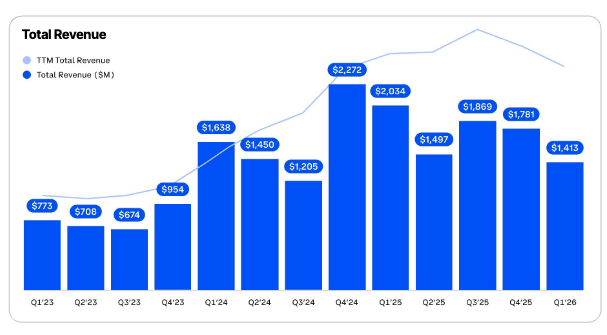
Coinbase Quarterly Revenue
Coinbase's main revenue source remains its transaction brokerage business, with retail users contributing 80% of total transaction revenue. Since 2025, Coinbase's transaction brokerage revenue has shown an overall downward trend, with the retail transaction revenue—which accounts for the largest portion—declining significantly: retail transaction revenue was $1.096 billion in Q1 2025, but fell to just $567 million in Q1 2026, a year-over-year decrease of 48.2%.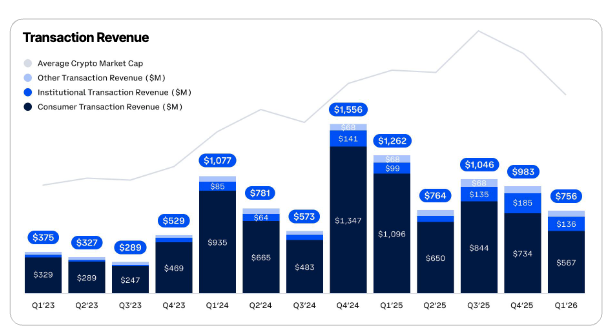
Coinbase Quarterly Transaction Revenue
The downturn in the crypto market and sluggish user trading volume are only part of the reason for the decline in Coinbase's retail transaction revenue. Another key factor is intensified domestic competition and user attrition.
Coinbase's early monopoly in the U.S. market, built on its "compliance advantage," has long since evaporated as U.S. regulation has matured. Over ten exchanges have now obtained licenses to offer crypto trading services to U.S. users, including Robinhood, Kraken, and Binance.US. Without exception, these exchanges charge lower fees than Coinbase. Once security and trust are no longer barriers to entry in the industry, retail users naturally gravitate toward platforms with lower fees.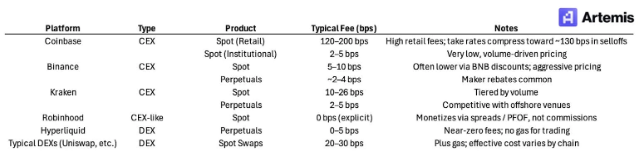
Fee Ratios Charged by Different Exchanges
Facing this impact, Coinbase has begun to vigorously develop businesses beyond spot crypto trading, such as derivatives trading, prediction markets, and tokenized stocks, attempting to rebrand itself as an "exchange for everything." Whether these combined businesses can challenge the position of spot crypto trading in Coinbase's revenue will only be answered after the Q2 2026 earnings report is released.
Under earnings pressure, the stubborn mule that is Coinbase has finally seen the light. Since everyone is coming to the U.S. to poach its users, why shouldn't it venture out into the world? After all, outside the U.S., it's all incremental growth. Therefore, Coinbase's first target is the Chinese-speaking market, one of the top three global crypto trading markets.
Coinbase's move to open KYC for China also exploits a loophole in U.S. law.
Crypto KOL Phyrex (X: @PhyrexNi) stated that Coinbase cannot provide services to countries and regions sanctioned by the U.S. OFAC, and China is not on that list. Therefore, Coinbase providing services to Chinese users is not illegal in the U.S. However, for Chinese users, Coinbase is not compliant in China, and crypto trading itself operates in a gray area. If a dispute arises between a Chinese user and Coinbase, the worst-case scenario is that neither U.S. law nor Chinese law may protect them.
Coinbase's Advantages Are Really Only in the U.S.
Beyond compliance issues, from a product usability perspective, most Chinese-speaking users have already become disillusioned with Coinbase. Its advantages are solely in the U.S., and on the international stage, crypto users have far too many choices. To put it more bluntly, registering for Coinbase now is largely pointless. Most users rushing to register are driven more by a "better to have it than not" mentality.
From 2021 to 2024, the Coinbase listing effect was real. When Coinbase announced support for or listed a token, the token's price often experienced a significant short-term surge. Tokens like LINK, POL, and AAVE all saw sharp increases after being listed on Coinbase.
Back then, Coinbase was the largest compliant exchange in the U.S., and its listing process was extremely strict, possibly listing only a few dozen projects a year. This meant that tens of millions of U.S. investors and institutions could only buy coins compliantly through Coinbase at the time. Consequently, being listed on Coinbase meant an influx of new demand, making the listing effect quite pronounced.
However, with the relaxation of U.S. crypto regulation in recent years and investors having more purchasing channels—including numerous traditional brokerages and DEXs—Coinbase's role as a "gateway for capital" in the U.S. crypto market has weakened, and the listing effect has naturally disappeared.
Coinbase CEO Brian Armstrong confidently stated during the Q1 earnings call, "Customers choose us not because we are the cheapest, but because we offer products that meet their needs." So, setting aside the issue of Coinbase's high fees for retail traders (as high as 1.2%), just looking at the product and user experience, Coinbase not only lacks differentiation but also fails to meet the needs of Chinese users.
First, although Coinbase has opened KYC for Chinese users, it does not support fiat currency on- and off-ramps. This limitation alone is enough to deter most people. Second, looking at the currently popular tokenized U.S. stocks, while Coinbase claims to be developing this business, its supported categories and market share are far behind Binance's bStocks and Hyperliquid—today, Hyperliquid even listed a pre-market contract for the A-share company ChangXin Memory Technologies. Furthermore, Coinbase's product experience and support in areas like Meme coins and prediction markets offer no clear advantages.
Today's Coinbase can only be described as "expensive and useless." To truly enter the Chinese-speaking market, besides quietly relaxing registration, it will need corresponding exclusive token launch events or other wealth-generating opportunities. Otherwise, it will truly be ignored.


