






AI semiconductors are still rising, but why is capital starting to abandon equipment stocks?


- Key Takeaway: The AI semiconductor rally hasn't faded, but capital is diverging. Buyers favor TSMC, TXN, memory, and AMD, while remaining more cautious on equipment stocks and Intel. The focus is on whether TSMC will raise its 2026 growth guidance and capital expenditure signals, which directly impact equipment stock expectations.
- Key Factors:
- TSMC vs. ASML: 70% of respondents believe TSMC's earnings have a greater impact on the sector, as it connects AI revenue to equipment stock order expectations.
- TSMC Expectations: Buyers anticipate its 2026 sales growth guidance could be raised from 30% to over 35%, with some bets approaching 40%. The capital expenditure signal is key.
- TXN Driving Analog Stocks: 55% of respondents believe a positive TXN earnings report would lift other analog stocks, betting its sequential sales growth rate could be revised up to 9%-10%, along with gross margin improvement.
- Memory Optimism Concentrated: 65% of respondents opted to buy memory, betting on demand extending into the first half of 2027 and improved visibility from long-term agreements, though the risk lies in rumors of HBM de-specification.
- AMD vs. Intel: 50% of respondents expect AMD's AI activities to yield bullish results, as its 2026 earnings model is easier to construct; Intel needs to prove its path to success through its foundry business.
TL;DR
- A monthly semiconductor investor roundtable survey shows capital is favoring TXN, memory, and AMD, while remaining more cautious on equipment stocks and Intel.
- 70% of respondents believe TSMC's earnings have a greater impact on the sector than ASML, with the focus on 2026 revenue growth and capital expenditure.
- Sentiment is stronger for TXN and memory, but uncertainties persist around equipment stock orders, HBM rumors, and Intel's foundry business.
A monthly roundtable survey focused on semiconductor investors reveals that the AI semiconductor trend hasn't fizzled out, but capital preferences have clearly diverged. TSMC, Texas Instruments (TXN), memory companies, and AMD are positioned more favorably, while semiconductor equipment stocks and Intel face more skepticism.
The timing of this survey is quite sensitive. TSMC's official calendar indicates the company will hold its Q2 2026 earnings call on July 16. Texas Instruments announced its Q2 earnings call will be held on July 22 at 3:30 PM Eastern Time. According to AMD's official calendar, its Advancing AI 2026 event is scheduled for July 22-23, with the flagship global AI event livestream mentioned in an April announcement taking place on July 23.
Short-term capital isn't looking for a simple "AI demand is strong" narrative but rather wants to see how these companies translate AI demand into revenue growth, capital expenditure, gross margins, customer wins, and order books.
The most direct divergence in the survey is between TSMC and ASML. 70% of respondents believe TSMC's earnings have a greater overall impact on the semiconductor sector, compared to 30% who chose ASML. This result indicates that buy-side investors are currently more concerned about how much AI demand translates into wafer foundry revenue and capital expenditure, rather than just looking at lithography machine order metrics.
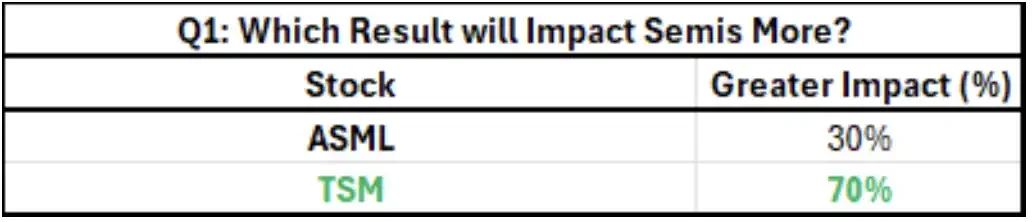
TSMC vs. ASML influence vote: TSMC 70%, ASML 30%.
TSMC Becomes the First Stress Test for Semiconductors This Week
TSMC is placed ahead of ASML because it connects two things simultaneously: AI revenue growth and equipment stock order expectations.
Buy-side expectations in the survey suggest TSMC might raise its 2026 sales growth guidance from the previous "above 30%" range to "above 35%", with some respondents even betting on year-over-year growth close to 40%. The five-year compound annual growth rate for AI sales could also be revised upward, with market discussions previously centered in the mid-to-high 50% range.
These numbers directly influence investor judgment on the sustainability of AI semiconductor demand. If TSMC confirms higher growth, the market will be more inclined to believe that demand for AI servers, advanced process nodes, and advanced packaging continues. If the company merely maintains its previous stance, the market might interpret this as "not strong enough" in the short term.
More sensitive is the capital expenditure. TSMC previously provided a 2026 capital budget of $52 billion to $56 billion. The market now wants to hear if management will provide a clearer medium-term capital expenditure framework, though this remains a buy-side hope rather than a confirmed arrangement.
The pressure on equipment stocks also stems from this. Equipment stocks have seen a pullback over the past two weeks, partly due to investor concerns that if TSMC doesn't signal sufficiently strong medium-term capital expenditure, the order expectations previously priced into equipment stocks might need to be revised down.
ASML's issue isn't a lack of potential positive catalysts. After its recent stock price underperformance, valuation pressure has eased somewhat. However, the buy-side bar in the survey is already high, with 2026 EUV lithography machine shipment expectations pushed to over 100 units. For ASML, the earnings press release itself might not be sufficient; the order books, customer updates, and 2026 cadence discussed during the conference call and subsequent communication are more critical.
TXN Bet on to Drive Analog Semiconductor Momentum
In the analog semiconductor space, Texas Instruments is positioned as a more definitive anchor of optimism.
The survey shows that 55% of respondents believe a positive result from Texas Instruments will trigger buying in other analog semiconductor stocks. 35% believe the positive impact will be largely limited to Texas Instruments itself. Only 10% indicated they would sell regardless of the outcome.
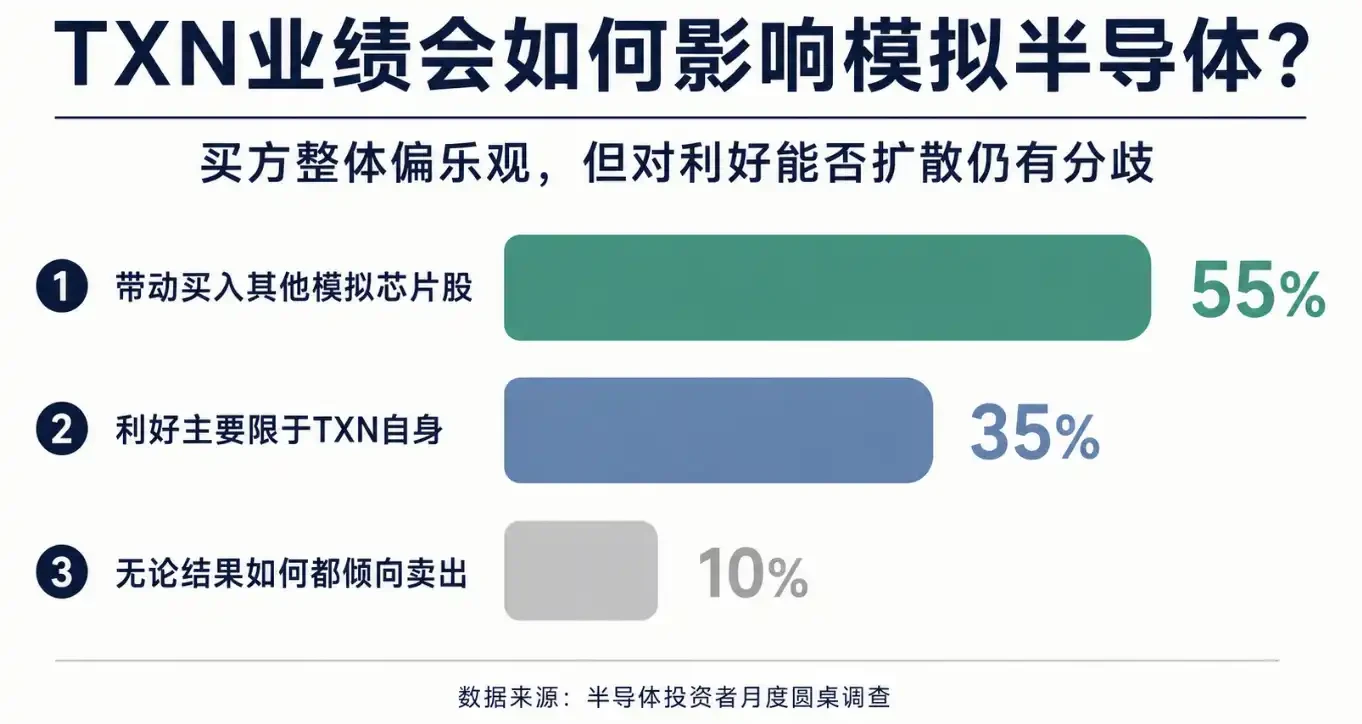
Texas Instruments earnings spillover expectations: 55% believe it will lift other analog stocks, 35% think it's mainly limited to TXN, 10% lean towards selling.
Buy-side bets aren't just on a slightly better single-quarter revenue but on the possibility of simultaneous improvements in analog semiconductor demand, pricing, and gross margins.
Market expectations from the survey suggest the consensus for Texas Instruments' Q3 sequential revenue growth is around 7%, higher than the typical seasonal rate of 5%. Some buy-side participants believe this figure could be revised up to 9% or 10%. Regarding gross margins, the market consensus hovers around 60.25%, with Citi expecting 60.5%, and optimistic investors still waiting for upside surprises.
Three main factors support this judgment: multiple rounds of price hikes gradually feeding into financials, improving capacity utilization, and demand related to 800-volt technology entering a more favorable phase. For analog semiconductors, if revenue recovery is combined with gross margin improvement, earnings leverage will be more pronounced than a simple increase in shipments.
The boundaries are also clear. Whether Texas Instruments' good results can spill over to the entire analog semiconductor sector depends on whether the demand improvement is broad enough, rather than just the company having better pricing, capacity, or product mix. Still, 35% of respondents believe any positive impact might mainly belong to Texas Instruments, indicating the analog sector hasn't gained unanimous bullish sentiment.
Memory Buying Is More Concentrated, but HBM Rumors Remain a Disruption
Memory is another area where optimistic sentiment is concentrated.
The survey indicates that 65% of respondents choose to buy into the memory sector, 30% are constructive but refraining from adding positions, and 5% believe the sector has peaked. This distribution shows that memory has become a relatively crowded but still favored direction within semiconductors.
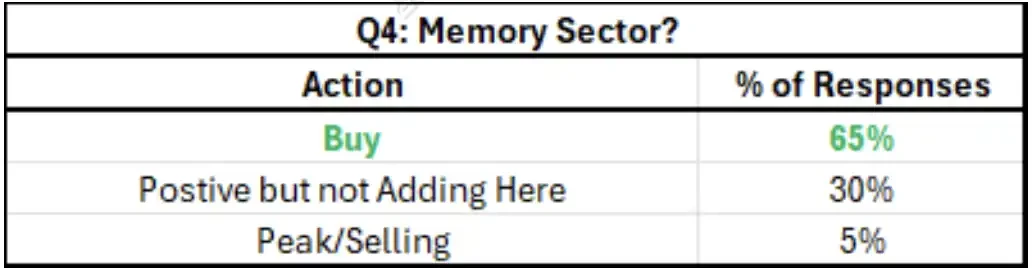
Memory investment stance: 65% buy, 30% constructive but not adding, 5% believe it has peaked.
Optimistic expectations stem from the possibility that demand could extend into the first half of 2027. Long-term agreements (LTAs) are also changing investor perceptions of memory companies. If customers lock in supply through LTAs, visibility into demand, capital expenditure, and free cash flow improves for memory manufacturers, making shareholder returns easier to factor into valuations.
The survey also mentions the possibility that some memory companies could buy back over 20% of their shares. This number is significant for cyclical stocks, as memory has traditionally been valued at a discount due to market fears of a cyclical peak reversal. If cash flow becomes more stable and buybacks more certain, the valuation logic may no longer be treated solely based on traditional cyclical stock metrics.
However, memory also has its controversies. Respondents show a slight preference for NAND and DRAM and are skeptical about HBM "de-specification" rumors. One view is that this could just be a negotiation tactic between customers and suppliers, not necessarily representing true demand deterioration. Another risk is that if high-end HBM specifications or pricing fall short of expectations, bullish sentiment in memory could be impacted.
AMD Can More Easily Tell the 2026 Story; Intel Still Needs to Prove Its Foundry
AMD's AI event on July 22-23 is another focal point in the divergence of semiconductor capital.
The survey shows that 50% of respondents expect the event outcome to be bullish and are preparing to trade long. 40% expect a positive but neutral outcome. 10% are concerned about selling on disappointment.
The market hopes AMD provides several types of information: expansion of the total addressable market for CPUs and GPUs, progress with new customers, average selling price increases, a rebound in Xilinx's high-margin business, and foundry support from TSMC in 2027. More directly, investors want confirmation that AMD is not just a secondary "AI replacement trade" but can form clearer revenue and profit pathways in 2026 and 2027.
This also explains the survey's change in sentiment towards Intel. Buy-side participants prefer AMD and have turned cautious on Intel. The reason isn't that Intel has no chance, but rather the difficulty of the stories each company can tell differs: AMD's earnings model for 2026 is easier to construct, whereas for Intel's stock to appreciate significantly, the market needs much higher confidence in its foundry success path.
Intel's problem remains execution. For its foundry business to gain customer trust, it needs to prove itself simultaneously in process technology, yield, delivery, and economics. As long as this path remains unclear, it's not surprising that capital continues to shift towards AMD.
The underlying tone of this semiconductor divergence is clear: AI demand remains strong, but capital is no longer indiscriminately buying all semiconductor assets. TSMC needs to prove that its growth and capex can still support the equipment supply chain. Texas Instruments needs to show that price increases and utilization can drive analog stocks. Memory needs to demonstrate that LTAs and HBM demand aren't just short-term sentiment. AMD needs to translate its AI opportunity into customer wins, pricing power, and a tangible earnings model.
The areas most prone to problems in the short term remain those where expectations have already been elevated. If TSMC fails to provide a sufficiently clear medium-term capital expenditure signal, equipment stocks could continue to face pressure. If HBM de-specification rumors are confirmed as more than just negotiation noise, memory optimism will cool. If Intel cannot increase market confidence in its foundry success, the trend of buy-side preference shifting towards AMD will likely persist.


