






Morgan Stanley: $1.4 Trillion AI Infrastructure Spend – Can Meta's Compute Cost Pay Off?


- Key Insight: Morgan Stanley research estimates that the five major cloud providers' capital expenditure could reach $1.4 trillion by 2028, expanding available compute capacity to 120GW. However, cost per GW is being pushed higher by factors such as memory and electricity. Meta is the top pick, and whether it can turn its massive computing power into revenue from advertising, APIs, and other sources is key to validating returns.
- Key Factors:
- Capital expenditure forecast for the five major cloud providers in 2028 is raised to $1.4 trillion (up from $1.2 trillion in 2027), with global AI infrastructure investment expected to approach $3 trillion.
- Available compute capacity is projected to increase from 30GW in 2025 to 120GW in 2028, with Meta reaching 21GW and Amazon reaching 35GW.
- Cost per GW is rising due to increases in memory, electricity, and non-data center shell costs. For example, GB200 costs approximately $35 billion, and Vera Rubin roughly $49 billion.
- Meta is listed as the top pick in AI internet, with its AI monetization paths (e.g., API, advertising upgrades, subscriptions) expected to contribute approximately $10 to EPS in 2028.
- Under Meta's API business model assumptions, every 100MW of GB300 capacity could generate approximately $8.59 billion in revenue and $1.91 in incremental EPS, but this relies on high utilization rates.
- Amazon and Google also benefit from the capex cycle. AWS revenue is expected to grow by 40% and 36% in 2027 and 2028, respectively, while Google adds the most new capacity.
- The realization of capital expenditure faces constraints on the supply side (chips, approvals), regulatory side (energy policy), and demand side (customer willingness to pay), making revenue verification the core challenge.
TL;DR
- Morgan Stanley's sell-side research report estimates that the capital expenditure of the five major hyperscale cloud vendors could reach $1.4 trillion by 2028.
- Construction costs per GW are being pushed higher by memory, electricity, and construction, potentially expanding computing capacity from 30GW to 120GW.
- META is listed as the top pick for AI internet, with a $775 price target contingent on the monetization of APIs, advertising, and subscriptions.
In a sell-side research report, Morgan Stanley raised its capital expenditure estimates for the major hyperscale cloud vendors, forecasting total capital expenditure for the five major platforms to reach $1.2 trillion in 2027 and $1.4 trillion in 2028. It continues to list META as the top pick for AI internet, maintaining a price target of $775.
These figures are based on the report's model projections and do not equate to official company guidance. Publicly available Morgan Stanley materials have already mentioned that global AI-related infrastructure investment could approach $3 trillion by 2028, with data center capital expenditure at approximately $2.9 trillion. The specific figure of $1.4 trillion for the five major platforms is derived from the sell-side's separate estimates for major cloud and internet platforms.
The most newsworthy change in this report is the continued upward revision of AI infrastructure spending. By 2028, the available computing capacity of major platforms is modeled to approach 120GW, roughly quadrupling from 30GW in 2025. The construction cost per GW has also been upgraded. Newer generation platforms like GB200, GB300, and Vera Rubin require more memory, electricity, racks, and engineering investment.
For investors, the question has shifted from "Will AI giants spend money?" to "How soon will this money turn into revenue?" META is positioned prominently because it faces higher AI capital expenditure pressure while having more direct monetization avenues like advertising, consumer applications, model APIs, and subscription tools.
$1.4 Trillion in Spending Banks on 120GW of Computing Power
The report raised its capital expenditure expectations for the five major hyperscale cloud vendors by 9% and 10% for 2027 and 2028, to $1.2 trillion and $1.4 trillion respectively. This scope covers AI infrastructure spending by Amazon, Google, Microsoft, META, and related SPCX entities.
Capacity expansion is a primary driver of the spending increase. In this model, the available computing capacity of major platforms rises from approximately 30GW in 2025 to nearly 120GW by 2028. Amazon's total capacity is expected to be around 35GW by 2028. Google is projected to add the most new capacity in 2027 and 2028, while META's capacity is seen rising from about 3.5GW at the end of 2025 to 14GW in 2027 and 21GW in 2028.
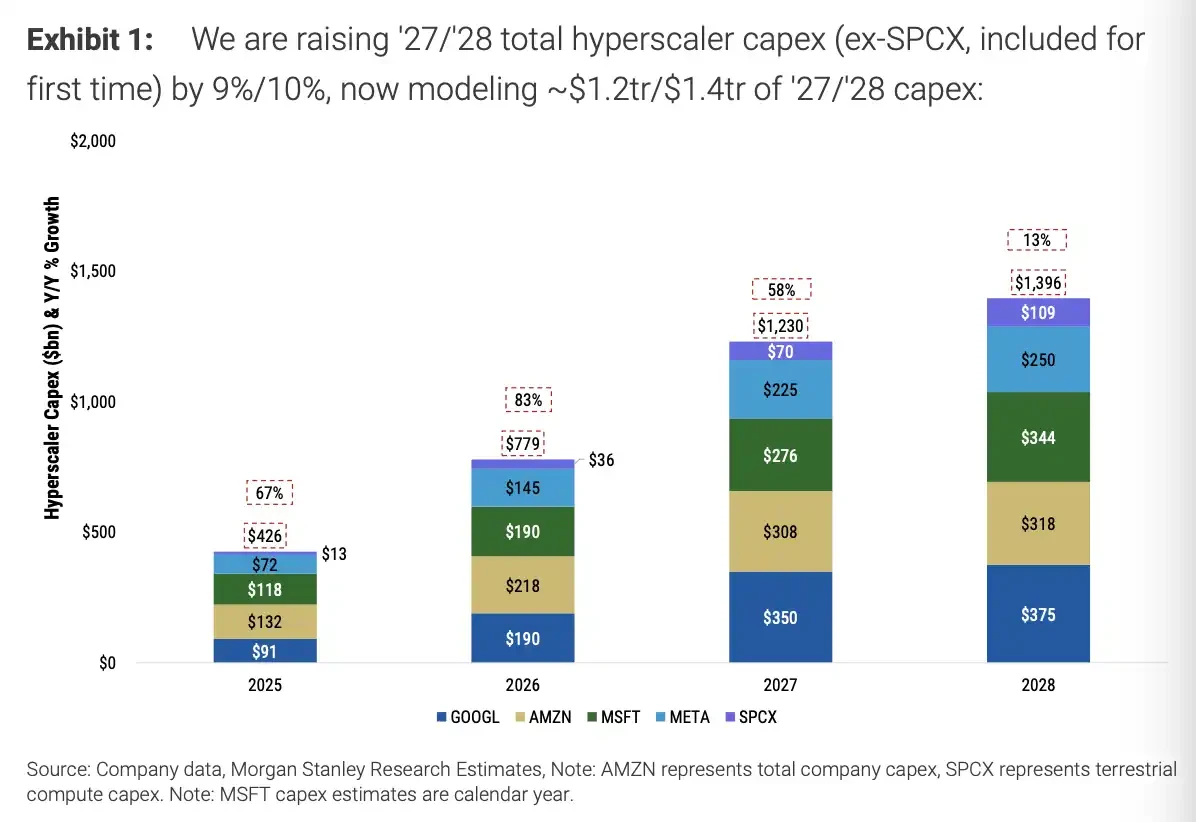
Capital expenditure forecasts for the five major hyperscale cloud vendors. Total spending reaches $1.4 trillion in 2028, with upward revisions of 9% and 10% for 2027 and 2028 respectively.
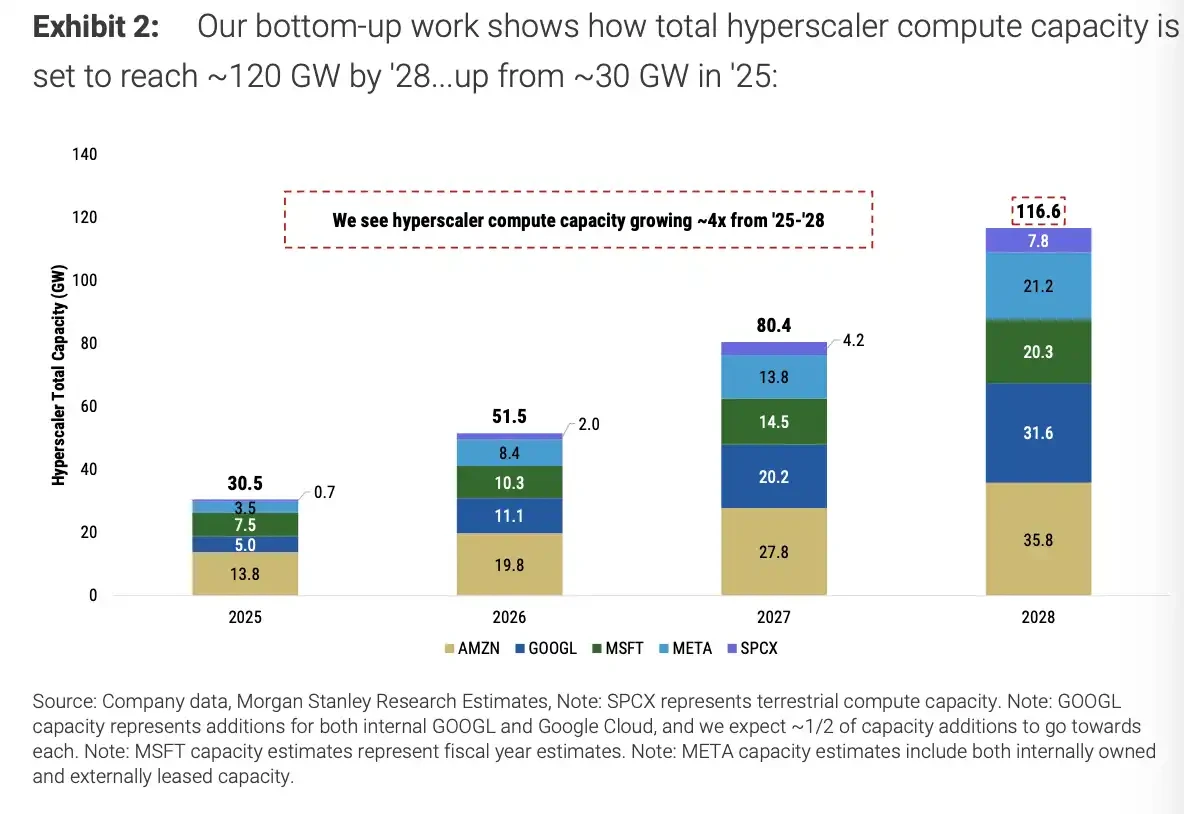
Available computing capacity rises from approximately 30GW in 2025 to nearly 120GW in 2028. META increases to 21GW, while Amazon reaches a total of about 35GW.
It's important to note differences in the scope of META's capital expenditure estimates. In the report's model, META's capex for 2027 and 2028 is raised to $225 billion and $250 billion respectively. Some public secondary reports cite a Morgan Stanley estimate of around $380 billion total for META from 2027 to 2028, which may involve different scopes like total capex, AI infrastructure, gross amounts, or including off-balance-sheet financing.
These differences don't change the main narrative: AI data center spending continues to pressure free cash flow, depreciation, and short-term EPS, while also determining whether future revenue from cloud, advertising, search, APIs, and enterprise tools can materialize. The companies that can convert more computing power into chargeable products will find it easier to justify today's capital expenditure.
Cost Per GW Rises; Memory and Power Infrastructure Raise the Bar
The upward revision in spending is not just about "building more data centers," but also that "each GW is more expensive."
In the report's bottom-up cost model, the construction cost per GW for GB200 is approximately $35 billion, a 16% increase from previous assumptions. For GB300, it's about $39 billion, up 19%. Vera Rubin stands at around $49 billion, a 20% increase. Google's TPU v7 is estimated at about $27 billion, and Amazon's Trainium3 at around $21 billion.
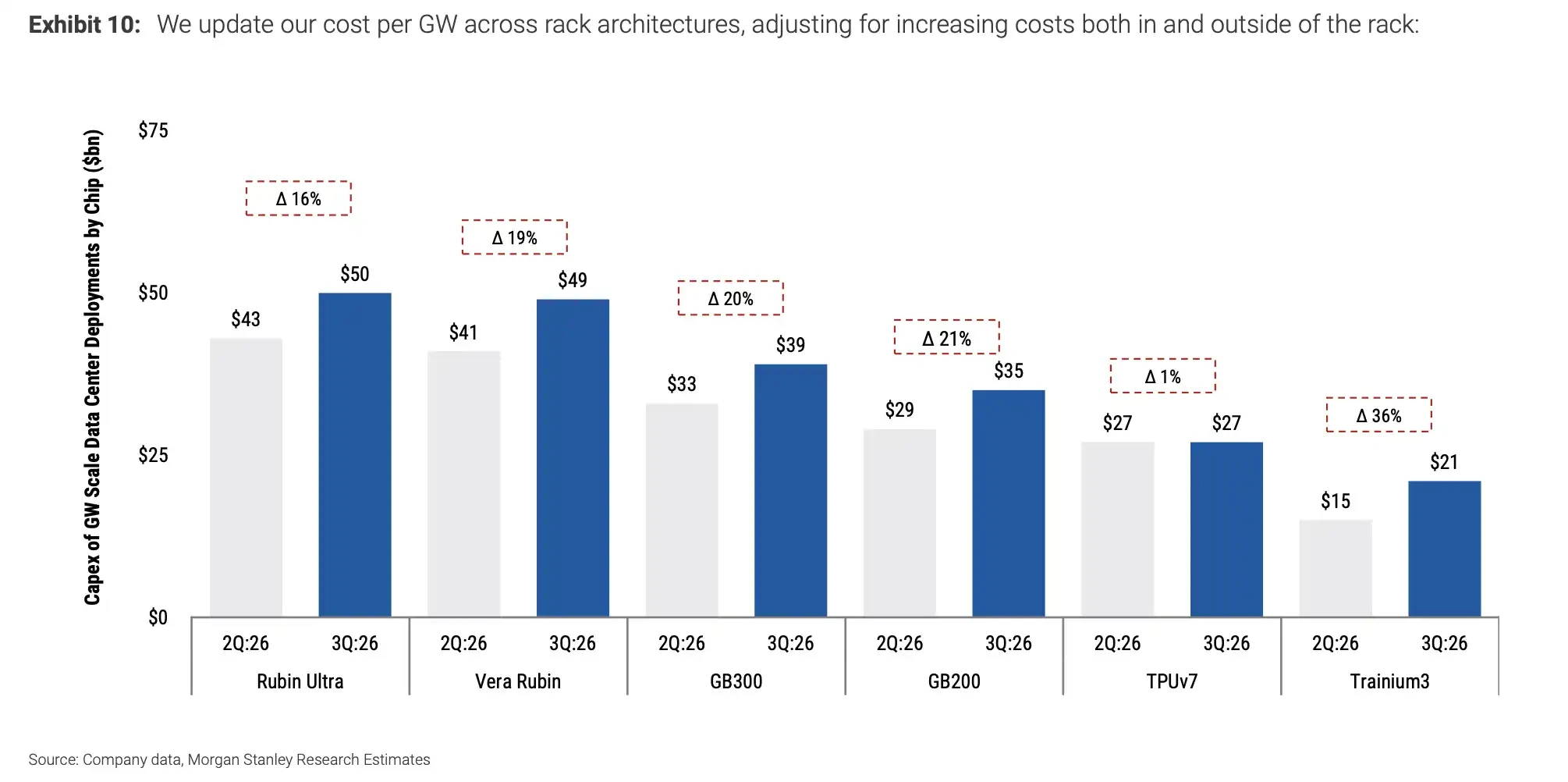
Updated costs for GPU and ASIC GW-scale data center deployment. GB200 is approximately $35 billion, GB300 is $39 billion, and Vera Rubin is about $49 billion.
Cost pressures primarily come from two areas. The memory component in high-end AI systems continues to increase. Additionally, the "shell" costs of data centers, including power, land, cooling, power distribution, and construction, are also rising. The report assumes these related costs increase from roughly $10 million/MW to a range of $11 million to $19 million/MW.
This is also why it's difficult for AI giants' expenditure curves to decline in the short term. While improved chip supply can alleviate some pressure, factors like power availability, racks, construction, skilled labor, and local permitting will continue to extend construction timelines. Some project timelines could stretch to around three years. The larger the capital expenditure, the faster the revenue side needs to demonstrate returns.
META's Focus Shifts to How AI Will Be Monetized
META is listed as the top pick primarily because its potential for AI revenue is more concentrated than most internet companies.
The report breaks down META's potential upside into areas like Meta AI search, new cloud services, API revenue, subscription tools, and advertising upgrades. These could collectively contribute approximately $10 to META's 2028 EPS. In the base case scenario, META's 2028 EPS is $33.41. If some of these options are realized, EPS could have further upside.
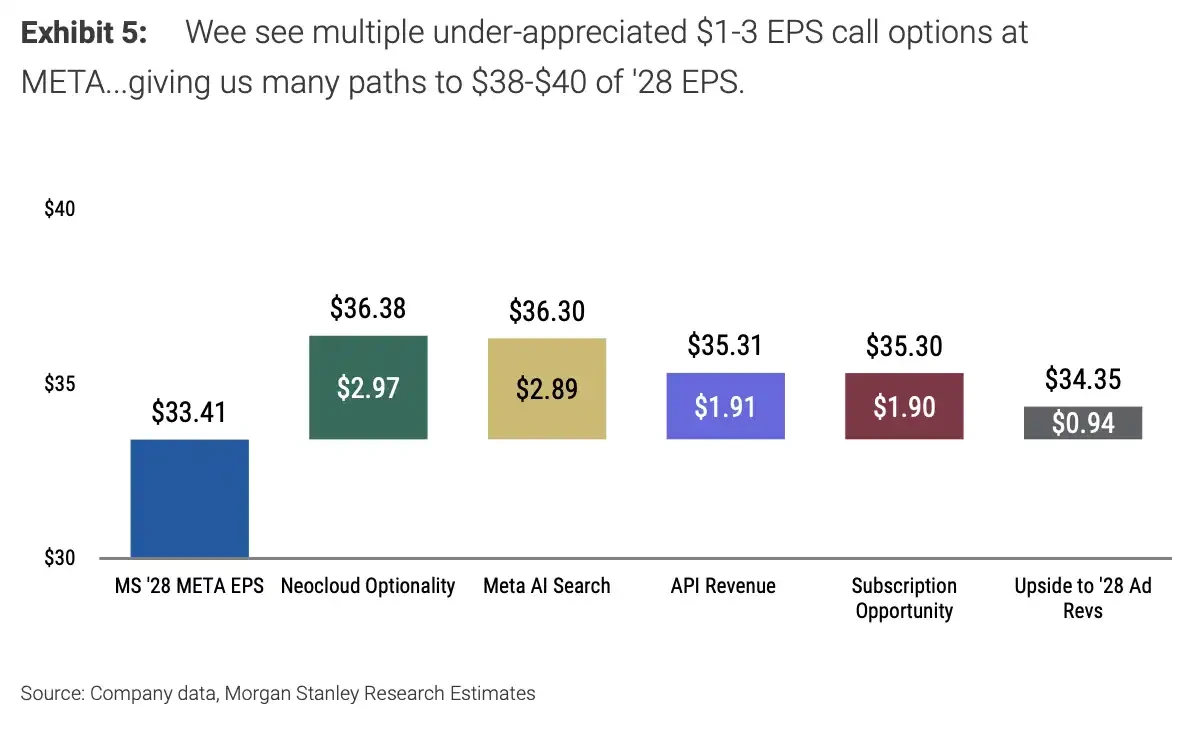
The cumulative contribution of META's five AI upside options to 2028 EPS. The base case EPS is $33.41, with a total upside of approximately $10.
This estimate may not perfectly align with the "four products or catalysts" or "2028 EPS upside of $1 to $3" cited in some public secondary reports. It is better viewed as a scenario-specific calculation in this research report. The portion that actually translates into financial statements depends on product adoption rates, monetization capability, and computing capacity utilization.
APIs are the most direct entry point. Meta announced the opening of the Meta Model API public preview on July 9th. Third-party information from pricing trackers like Artificial Analysis indicates that the input and output prices for Muse Spark 1.1 API are $1.25 and $4.25 per million tokens respectively, below some leading competitors.
The report's model further assumes that every 100MW of GB300 capacity allocated to the API, corresponding to about 53,300 GPUs at 75% utilization, could generate approximately $8.59 billion in revenue, $640 million in incremental EBIT, and contribute roughly $1.91 to 2028 EPS. This calculation relies heavily on high utilization and sustained demand. A low price alone helps acquire customers but cannot guarantee profitability.
Subscription tools also represent a potential entry point. The model assumes that 25% of META's 15 million advertisers pay approximately $200 per month for tools like business agents and coding assistants. This could contribute about $8 billion in revenue and roughly $2 to 2028 EPS. Whether advertisers are willing to pay consistently ultimately depends on whether these tools can deliver higher conversion rates, lower production costs, or stronger automation capabilities.
Amazon and Google Beneficiaries, But Revenue Validation Needed
Amazon and Google are also significant entities in this round of capital expenditure increases, though they serve more as contextual references in this main narrative.
For Amazon, the report raised its AWS revenue growth outlook, projecting 40% and 36% growth in 2027 and 2028, respectively. It also estimates that AWS's backlog increased by approximately $110 billion quarter-over-quarter in Q2, reaching about $475 billion. Since Amazon has not yet released its official Q2 financial report, this backlog figure should be considered a sell-side forecast. Official documents have confirmed that AWS sales grew 28% year-over-year in Q1 2026, OpenAI made an additional $100 billion multi-year commitment, and cash capital expenditure continues to rise.
Google's advantage lies in its full-stack capabilities with the Gemini model, TPUs, and cloud business. The report's model shows that Google is expected to add the most new capacity among major platforms in 2027 and 2028. A short-term pressure is that computing resources may still constrain product scaling, especially when search, cloud services, and model APIs compete for computing power simultaneously.
These threads point to the same real-world issue: AI spending has entered the trillion-dollar level. The market will increasingly and directly ask, "How much revenue does each dollar of capital expenditure generate?" Cloud services, AI search, APIs, advertising tools, and enterprise subscriptions will all become entry points for validating the return on expenditure.
Massive Spending Must Navigate Power, Approvals, and Real Demand
This round of capital expenditure increases has clear boundaries.
The first constraint is supply. Chips, HBM memory, racks, power access, and skilled labor all impact the speed of construction. AI data centers must traverse local approvals, grid upgrades, and construction cycles from planning to commissioning, making it impossible for them to come online linearly as assumed in models.
The second constraint is politics and regulation. The occupation of power, water resources, and land by large-scale data centers may face local resistance. Energy policies and the pace of local approvals could also shift around the 2026 US midterm elections and the November 2028 presidential election.
The third constraint is demand. META's APIs, subscriptions, and advertising upgrades remain upside scenarios. Revenue realization requires actual customer payments and sustained usage. While lower prices than competitors can help attract customers, long-term profitability depends on usage volume, gross margins, and the ROI of the tools.
The $1.4 trillion in capital expenditure paints a picture of a high-cost growth curve. The giants are securing AI computing power ahead of time, and the market will continue to press for answers on when this computing power will translate into revenue and profit. META's $775 price target is built on the gradual realization of AI monetization. The hardest step is turning the EPS upside in the model into cash flow in the financial statements.


