






Nomura Insights: Why Bullish on Japan’s MLCC Release Films?


- Core Thesis: Nomura Securities expects that driven by AI server demand for high-end multi-layer MLCCs, demand for upstream MLCC release film will grow at a CAGR of roughly 10% from 2025 to 2028. While Japanese manufacturers dominate the market, price downside pressure and capacity expansion pace are key variables.
- Key Factors:
- Industry Growth Rate: Nomura forecasts a CAGR of ~10% for MLCC release film demand from 2025-2028, primarily driven by AI server demand for high-capacity, high-reliability multi-layer MLCCs.
- Market Structure: Japanese manufacturers hold over 80% global market share, with Lintec at ~37% and Toyobo at ~32%. Lintec is more focused on the high-end coating segment.
- Earnings Weight: The MLCC release film business accounts for roughly 17% of Lintec’s operating profit, 13% of Toyobo’s, and 3% of Toray’s. While high-margin, it is not their sole profit driver.
- Price Risk: Nomura anticipates a risk of price decline for release films in 2026 due to new capacity coming online from Toyobo and Toray. However, capacity expansion is measured, making a sharp price drop unlikely.
- Capacity Constraints: If Lintec fails to expand capacity in time, it could near full utilization by 2027, potentially ceding some high-end market share to competitors like Toyobo.
TL;DR
- Nomura expects MLCC release film demand CAGR of approximately 10% from 2025-2028, with Lintec receiving a Buy rating.
- AI servers require more high-end multi-layer MLCCs; the release film is critical in slurry coating, printing, and lamination stages.
- Japanese manufacturers hold over 80% market share, but price pressure and expansion pace in 2026 still limit earnings elasticity.
Nomura Securities' July 2nd research report connects AI server demand to an upstream Japanese materials segment: MLCC release films. The firm estimates a compound annual growth rate (CAGR) of approximately 10% for this material's demand from 2025 to 2028, assigning a "Buy" rating to Lintec with a target price of 7850 yen.
MLCCs are multi-layer ceramic capacitors widely used in electronic systems like servers, power supplies, and motherboards. As AI server computing power and power consumption increase, they require more high-capacity, high-reliability multi-layer MLCCs. The higher the number of layers, the greater the requirements for smoothness, cleanliness, and stability of the release film used in the production process.
The key players in this chain are primarily Japanese material companies. According to Nomura's estimates, Japanese manufacturers hold over 80% of the global MLCC release film market share, with Lintec at approximately 37% and Toyobo at about 32%. Lintec is more focused on high-end coating needs, Toyobo is expanding production, and Toray is positioned more upstream in the base film segment.
AI Servers Drive Demand to Release Films
The release film is not a final component of MLCCs, but it plays a crucial role in key manufacturing steps.
During MLCC production, manufacturers first coat a dielectric slurry onto the release film, then dry it before printing internal electrodes and laminating layers. Toray's IR materials illustrate these steps, including "Slurry Casting," "Inner electrode printing," "Release film," and "Base PET film." If the release film surface is not sufficiently flat, it can affect electrode printing precision and interlayer stability.
The change brought by AI servers is the simultaneous increase in both the volume and specifications of high-end MLCCs. TrendForce also noted on June 17th that AI ASICs and accelerator platforms are driving concentrated demand for high-end MLCCs, significantly increasing the usage of certain specifications, and flagged a rising risk of supply tightening in the second half of 2026. This external view cannot directly verify the ~10% CAGR for release film demand, but it supports the demand direction where "AI servers drive high-end MLCCs."
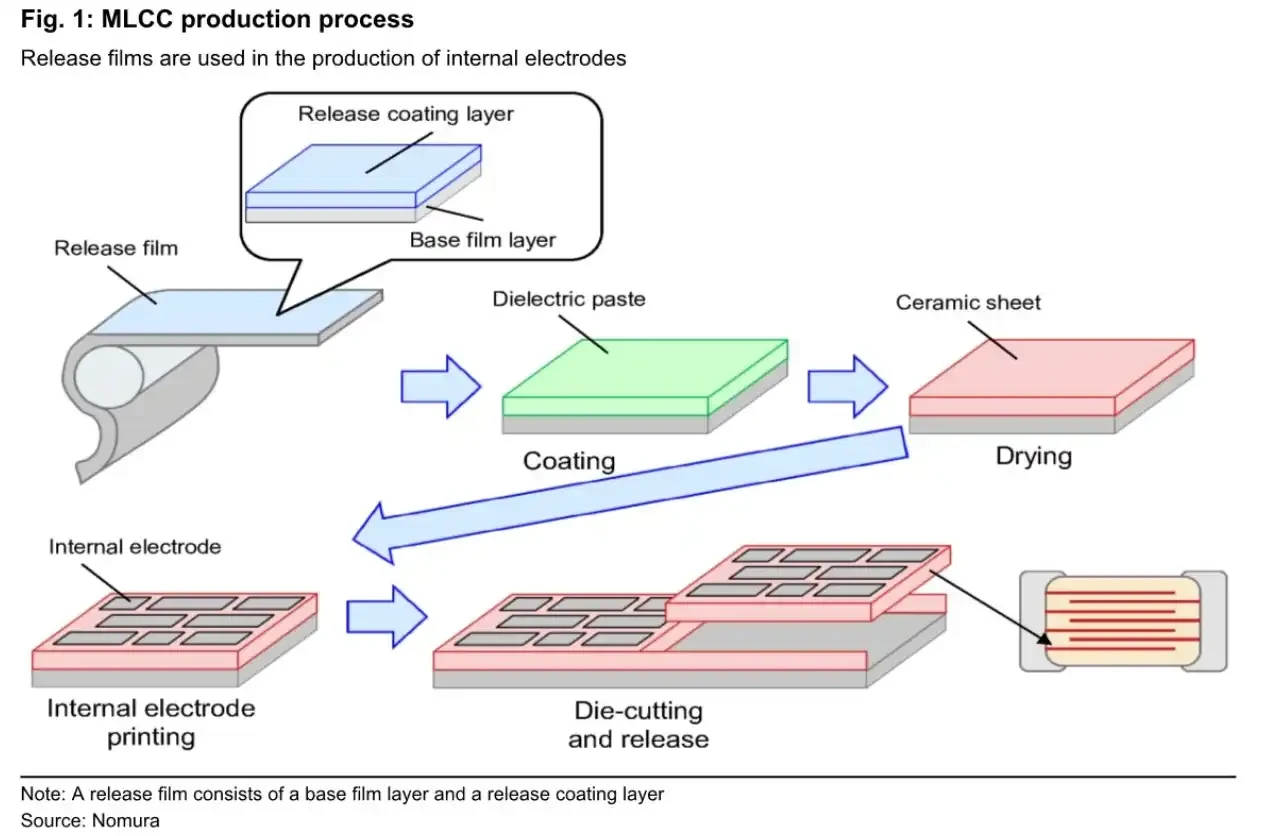
Schematic diagram of the MLCC production process, illustrating the role of the release film from dielectric slurry coating to internal electrode printing and lamination.
The key figure provided by Nomura is a CAGR of approximately 10% for MLCC release film demand from 2025 to 2028. For a mature material segment, this growth rate is notably high, especially against a backdrop of sluggish overall growth in consumer electronics, making AI servers the primary source of incremental demand.
However, demand growth does not directly translate into a company's overall earnings elasticity. According to the report's estimates, MLCC release film-related businesses account for about 7% of Lintec's sales and 17% of its operating profit; for Toyobo, it is about 6% of sales and 13% of operating profit; and for Toray, about 1% of sales and 3% of operating profit. This indicates the business has high profit margins but is not the sole determinant of revenue for these large material companies.
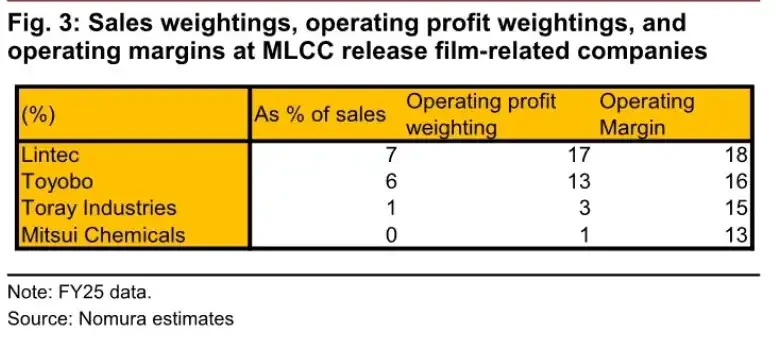
Weight of MLCC release film business in sales and operating profit, along with profit margins: Lintec at 7%/17%/18%, Toyobo at 6%/13%/16%, Toray at 1%/3%/15%.
Lintec and Toyobo Combine for Nearly 70% Market Share
The MLCC release film market is highly concentrated.
In terms of coated end-products, Lintec holds an estimated market share of 37%, Toyobo around 32%, Mitsui Chemicals about 12%, and other players constitute the remaining 19%. Together, Lintec and Toyobo command nearly 70% of the market.
Lintec's primary advantage lies in its high-end coating capabilities. It procures base films externally, performs release coating processing, and delivers them to MLCC customers. In high-end applications like AI servers, Lintec is better positioned to directly benefit from the volume growth of multi-layer MLCCs.
Toyobo's differentiator is its vertical integration, possessing both base film and coating capabilities. According to publicly available company materials, its new release film facility in Utsunomiya has been completed and is operational. Investor materials mention commercial production starting in spring 2025, reaching full capacity by the end of FY3/26. Nomura's report calendar points to Q3 2026 as the full-scale production milestone. If capacity is released as planned, Toyobo could capture more high-end demand after 2027.
Toray occupies a more upstream position. It holds over 50% of the market share in external sales of MLCC release film base films. Public IR materials indicate that Toray's new production line in Gifu started operations in February 2026. According to Nomura's report, after increasing relevant capacity by 1.6 times, there remains room for subsequent sales volume growth.
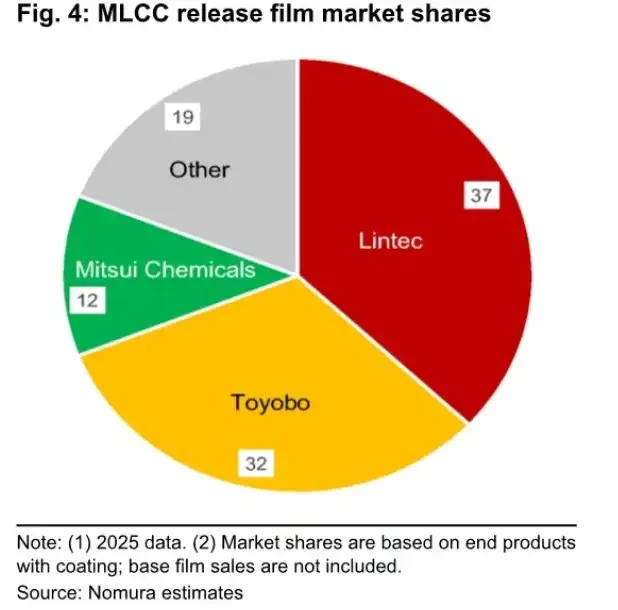
MLCC release film market share: Lintec 37%, Toyobo 32%, Mitsui Chemicals 12%, Others 19%.
This structure also determines that the material growth spurred by AI servers will not be evenly distributed. Lintec appears to be a direct beneficiary of high-end demand, Toyobo is more of a challenger seeking share following capacity expansion, while Toray benefits from increased external sales of its base film.
Behind the 7850 Yen Target Price, Lintec Faces Capacity Pressure
Regarding specific stocks, Nomura's stance is clearest on Lintec, rating it "Buy" with a target price of 7850 yen. The report uses a stock price of 7110 yen as of July 1st, implying a 2026 forward P/E ratio of 17.8 times.
In the same valuation table, Toyobo is rated "Neutral" with a target price of 1800 yen; Toray is also rated "Neutral" with a target of 1170 yen; and downstream MLCC leader Murata Manufacturing is also rated "Buy" with a target of 6000 yen. These target prices and valuation metrics are based on Nomura's research report and are not consensus market expectations.
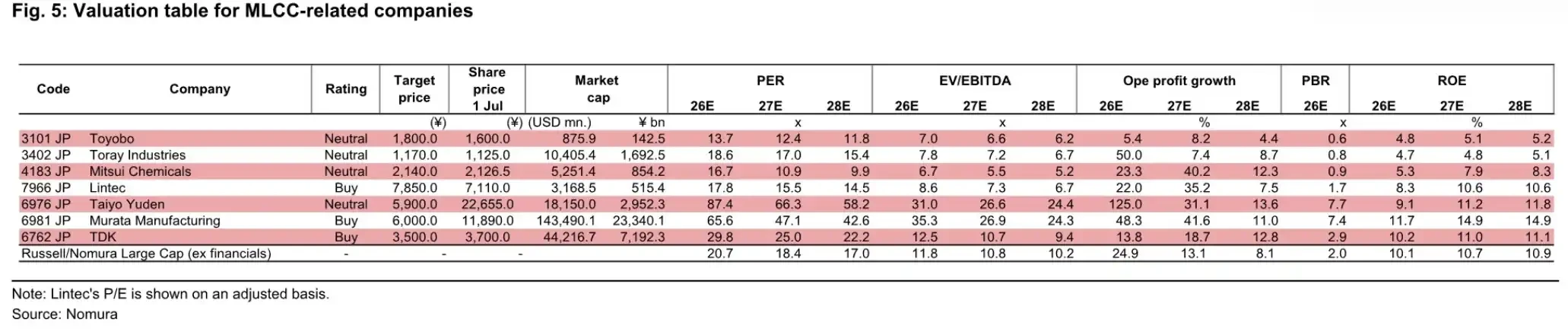
Valuation comparison table for MLCC-related companies, including Lintec, Toyobo, Toray, and Murata Manufacturing, with ratings, target prices, current share prices, and 2026-2028 valuations.
Lintec's weakness lies in capacity. Nomura notes that if the company fails to execute new capacity expansions in a timely manner, it could approach full capacity by 2027. If demand driven by AI servers continues to grow, supply may not keep up with orders, potentially allowing some market share to shift to competitors like Toyobo.
Toyobo's opportunity stems precisely from this situation. After capacity is released, if industry demand maintains an annual growth rate of around 10%, the new capacity can translate into market share gains. Conversely, if demand falls short of expectations, the increased supply could lead to pressure on both pricing and capacity utilization.
Toray's base film expansion acts more as a bottleneck relief for the upstream. Given the high surface smoothness requirements of MLCC release film base films, enhancing base film supply capacity helps support coating manufacturers in expanding shipments. However, Toray's related business constitutes a smaller portion of the group's revenue and profit, making it harder for this segment alone to significantly alter the company's overall valuation.
Volume is Growing, but Prices May Not Necessarily Rise
This is not a straightforward "rising demand, rising prices, rising stock price" story. The main constraints lie in pricing and the pace of capacity expansion.
Nomura judges that there is a risk of price decline for MLCC release films in 2026. With Toyobo's new capacity coming online and Toray's base film capacity increasing, industry supply will rise, and prices may not necessarily follow demand upward. The report simultaneously believes that overall capacity expansion remains relatively moderate, and capacity utilization is not expected to decline sharply. Therefore, the probability of a significant price drop is low, and material manufacturers will still primarily benefit from shipment volume growth.
This judgment hinges on two prerequisites: continued realization of demand for multi-layer MLCCs used in AI servers, and new capacity not significantly overshooting the growth in high-end demand. If end-market capital expenditure slows down, or MLCC manufacturers enter an inventory correction phase, the growth rate of release film demand could fall below the roughly 10% projected in Nomura's model.
A more practical divergence lies in company execution. If Lintec lags in expansion, it might miss out on some high-end orders. If Toyobo's capacity comes online without sufficient demand to absorb it, it could face price and utilization pressure. While Toray holds a high share in base films, the business's contribution to the group is limited.
AI servers have indeed brought the small materials segment of MLCC release films into the market spotlight. However, the realization of earnings performance still depends on whether high-end MLCC orders can sustain their growth, and whether the capacity expansions by Japanese manufacturers are timed just right, rather than prematurely creating new supply pressure.


