WEEX Security Reminder: What Roles Do the Platform, Traders, and Users Play When Copy Trading Incurs Losses?


- Core Insight: Crypto copy trading involves three parties: the platform, the trader, and the user, each bearing different responsibilities. The platform provides the infrastructure, the trader is responsible for the strategy, and the user manages risk. Losses are mostly due to market risk and should not be simply blamed on the platform.
- Key Elements:
- The platform (e.g., WEEX) provides the trading system, matching services, copy trading functions, and historical data display, but does not participate in trading decisions or modify positions. Its core role is to ensure safe and stable trading.
- The trader's responsibility is to formulate and execute strategies for opening positions, closing positions, and setting stop-losses. Their trading judgments cannot guarantee a 100% win rate; losses caused by market fluctuations are a normal part of trading risk.
- Users who choose different leverage ratios, capital allocation percentages, and stop-loss settings can achieve vastly different results even when following the same trader. Users are responsible for managing their own funds and risks.
- It is recommended that users focus on a trader's historical consistency, maximum drawdown, and risk control capabilities before following, rather than just looking at short-term returns, to facilitate long-term follow-up.
- Copy trading is a tool to lower the learning curve, not a guarantee of returns. Users should adhere to risk control principles and view market volatility and platform services rationally.
Copy trading allows many beginners to learn from the trading strategies of experienced traders, making it a relatively popular method in the crypto market in recent years. However, whenever the market experiences significant volatility, causing copy trading accounts to incur losses or even liquidate, some people immediately blame the platform.
In reality, a successful copy trade involves three distinct roles: the platform, the trader, and the copy trader. Only by understanding the responsibilities of each can one view the trading results more rationally and help reduce disputes arising from misunderstandings.
The Platform Provides Trading Services, Not Trading Decisions
When many people first encounter copy trading, they mistakenly believe that since the platform offers a copy trading feature, it implies the platform is also participating in the trades.
This is not the case.
Taking WEEX as an example, the platform provides the trading system, matching services, and copy trading functionalities, allowing users to decide whether to replicate a specific trader's operations based on their own judgment. Additionally, the platform displays the trader's public historical data to help users understand their profit performance, trading records, and certain risk indicators before copying. It also continuously enhances platform security through risk warnings, user appeal review mechanisms, and measures like the Protection Fund.
However, the core function of these services is to provide infrastructure and information reference for trading, not to formulate strategies for traders, nor to artificially decide when to open or close positions, or modify the trader's position direction.
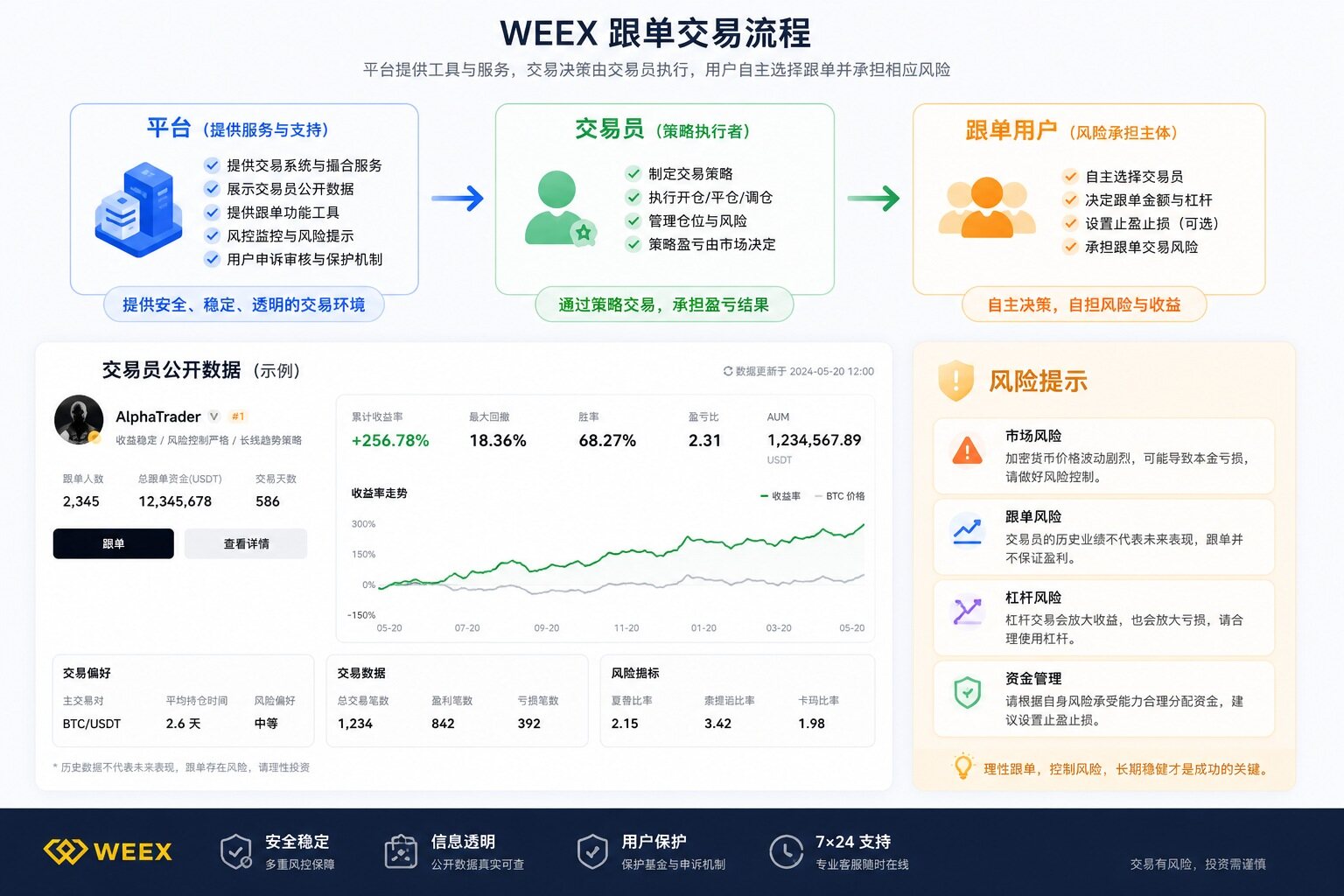
In other words, the platform's responsibility is to ensure trading can proceed safely and stably, not to determine the trading outcome itself.
The Trader is Responsible for the Strategy, and Every Profit or Loss Comes from Trading Judgment
The biggest characteristic of copy trading is replicating the trader's operational logic.
When to open a position, when to reduce it, whether to continue holding, when to take profits or cut losses – these are all strategic decisions belonging to the trader.
A trader might achieve consistent good returns based on accurate market predictions, but could also experience consecutive drawdowns due to rapid market changes. This is a reality any trader in financial markets must face; no strategy can maintain a 100% win rate indefinitely.
Therefore, when a trader's judgment is flawed, accounts following their strategy will naturally be affected. This risk stems from the trading itself, not from any artificial intervention by the platform in the trading process.
For users preparing to copy trade, rather than focusing solely on short-term returns, it is better to spend time observing the trader's historical stability, maximum drawdown, position style, and risk control ability. These metrics often better indicate whether a trader is suitable for long-term follow than a single high return.
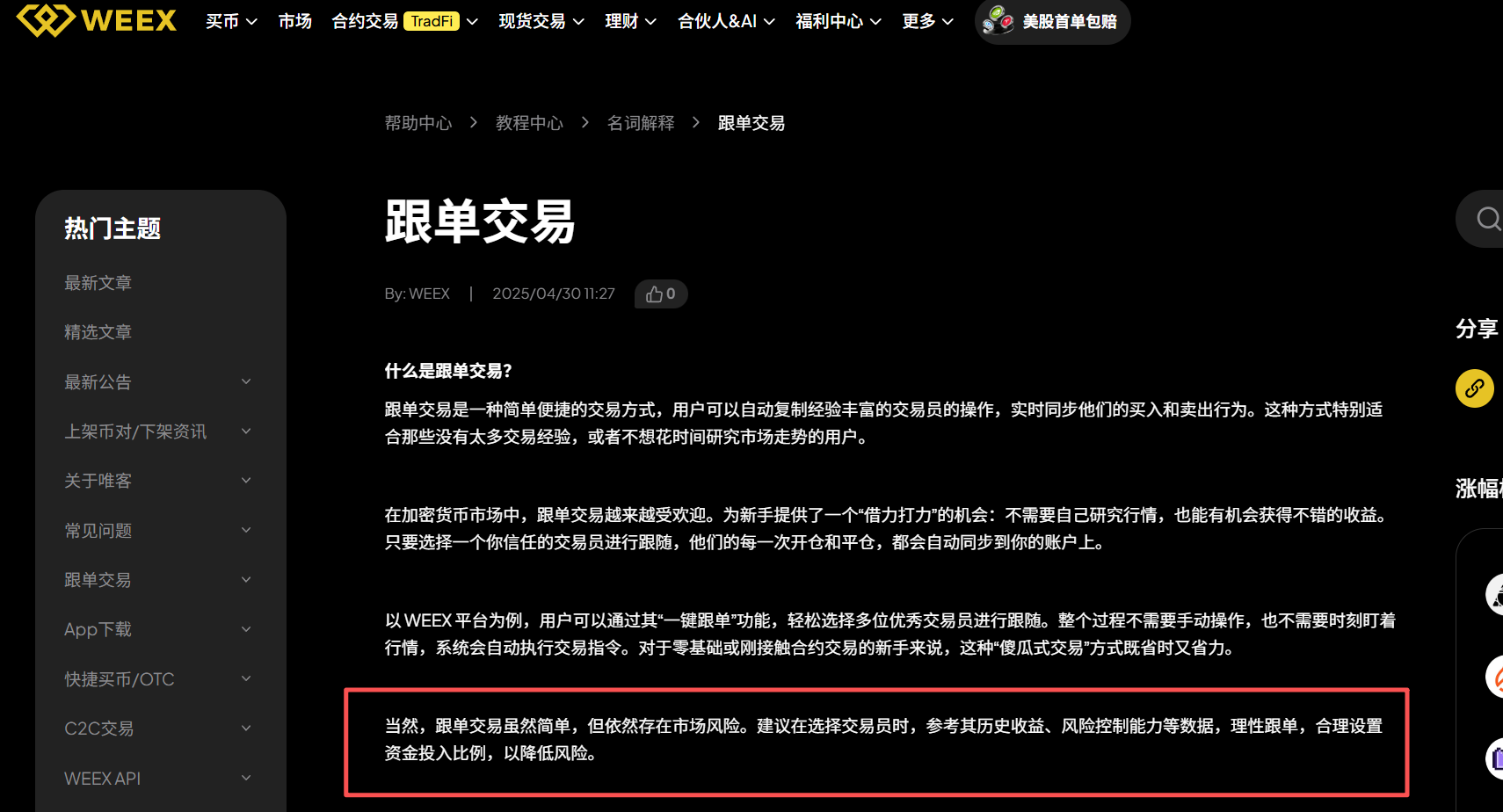
Users are Also a Crucial Part of Risk Management
What is easily overlooked is that even when following the same trader, different users can end up with significantly different trading results.
Some choose higher leverage, hoping to amplify returns; some invest almost all their funds, aiming for a single higher payoff; others fail to set stop-losses based on their own capital, leading to premature liquidation during volatile market swings.
These factors directly impact the final outcomes.
Copying can replicate trading actions, but it cannot replicate each person's capital size, risk tolerance, or trading habits. Therefore, users still need to allocate positions reasonably according to their own circumstances, avoiding amplified risk due to over-concentration of funds or blindly chasing high returns.
A truly mature trading approach is not about completely delegating all decisions to others, but about retaining one's own risk control principles while referencing the experience of excellent traders.
For any platform offering copy trading services, its responsibility is to improve the trading environment, make trading data public, and continuously optimize risk control capabilities. For traders, formulating and executing trading strategies is their duty. For users, the decision to copy trade, how to allocate funds, and what risks to bear must always be their own judgment.
Understanding the division of roles among these three parties not only helps investors understand copy trading more rationally but also prevents them from confusing market risks with platform services. After all, copy trading is a tool that lowers the learning barrier to trading, not a guarantee of profitable results. The more volatile the market, the more necessary it is to establish clear risk awareness, rather than simply attributing the profit or loss of a single trade to one particular component.