






If Strategy actually sells 491 Bitcoin, how significant would the market impact be?


- Core Viewpoint: Well-known trader Lightcrypto points out that Strategy, the largest corporate holder of Bitcoin, may have begun selling a small amount of Bitcoin (491 coins). This aligns with its newly announced $1.25 billion share sale framework, marking a shift from one-way accumulation to balancing cash flow management. This has profound implications for market sentiment and MSTR's valuation logic.
- Key Elements:
- Potential sale of 491 BTC (approximately $30 million), representing only 0.058% of its total holdings of 847,000 BTC. The selling pressure on the spot market is minimal, but the symbolic significance is substantial.
- Strategy announced its "Digital Credit Capital Framework" on June 29, authorizing the sale of up to $1.25 billion in BTC to replenish reserves, pay dividends, and service debt interest.
- The perpetual preferred stock (STRC) price fell to $84.86 (target par value $100), forcing the company to increase the annualized dividend yield to 12%, resulting in an annualized cost of approximately $1.76 billion.
- Existing cash reserves of $2.55 billion can cover 17.4 months of needs. If combined with the share sale authorization, the liquidity coverage period extends to approximately 25.9 months.
- MSTR's pre-market trading rose 7% following the framework announcement, indicating a positive short-term market reaction to the liquidity arrangement, but the mid-term valuation narrative faces a downgrade.
- If MSTR's Market Value to Net Asset Value (mNAV) multiple falls below 1, selling Bitcoin may be cleaner than issuing new shares, but it would weaken the "ultimate buyer" market narrative.
Well-known trader Lightcrypto remained silent for a year, but when he finally spoke, it was a bombshell. He claimed that Strategy, the company with the largest Bitcoin holdings, has started selling coins.
According to the address he provided, 491 Bitcoins were sold. Roughly calculated at a Bitcoin price around $60,000, this amounts to less than $30 million. Nestled within Strategy's total holdings of approximately 847,000 BTC, this is barely a drop in the bucket.
Of course, some argue that the actions of this address don't align with the operational logic of Strategy's publicly known addresses, suggesting it's likely not Strategy. However, Lightcrypto is quite renowned for finding addresses, and a significant number of people do believe him.
The possibility of selling coins is indeed there, as Strategy just announced a new sales channel. On June 29, Strategy unveiled a "Digital Credit Capital Framework," authorizing the company to sell up to $1.25 billion in BTC to replenish dollar reserves, pay preferred stock dividends and debt interest, repurchase preferred stock, and buy back MSTR common stock.
What we need to consider is the next step. If the 491 BTC have indeed been sold, what does it mean for the Bitcoin market and the mechanics of Strategy's stock, respectively?
Is 491 BTC Really Significant?
First, let's look at the proportion.

From the perspective of the spot market, 491 BTC is minuscule. It accounts for only about 0.058% of Strategy's total holdings. If you imagine Strategy's holdings as a 100-liter water tank, selling 491 BTC is like scooping out about 58 milliliters.
So, if the market is only worried about "selling pressure," 491 is not the point.
The real comparison is with the other two bars. At the end of May, Strategy sold 32 BTC, approximately $2.5 million. That seemed more like a one-off operation to meet obligations related to preferred stock distributions. A month later, the company formalized coin sales in a framework, authorizing up to $1.25 billion, which, roughly calculated at $60,000 per BTC, could cover around 20,000 BTC.
In other words, if the 491 sale is confirmed, it's not "Strategy dumping." It's more like a trickle starting from this pipeline.
Why Is It Selling?
The answer lies in STRC.
STRC is Strategy's perpetual preferred stock, with a target par value of $100. Its buyers are not typical crypto players but yield-seeking capital looking for stable cash flow. The original narrative for this product was straightforward: investors buy STRC, Strategy uses the money to buy BTC, BTC supports the company's assets, and STRC continues trading near par value.
The problem is that STRC hasn't stayed near par value.
On June 30, Yahoo Finance showed STRC closing at $84.86. Meanwhile, Strategy raised the annualized dividend rate for STRC to 12% starting in July. This creates an ugly divergence. The lower the price, the less trust the market has, and the higher the interest the company must pay.
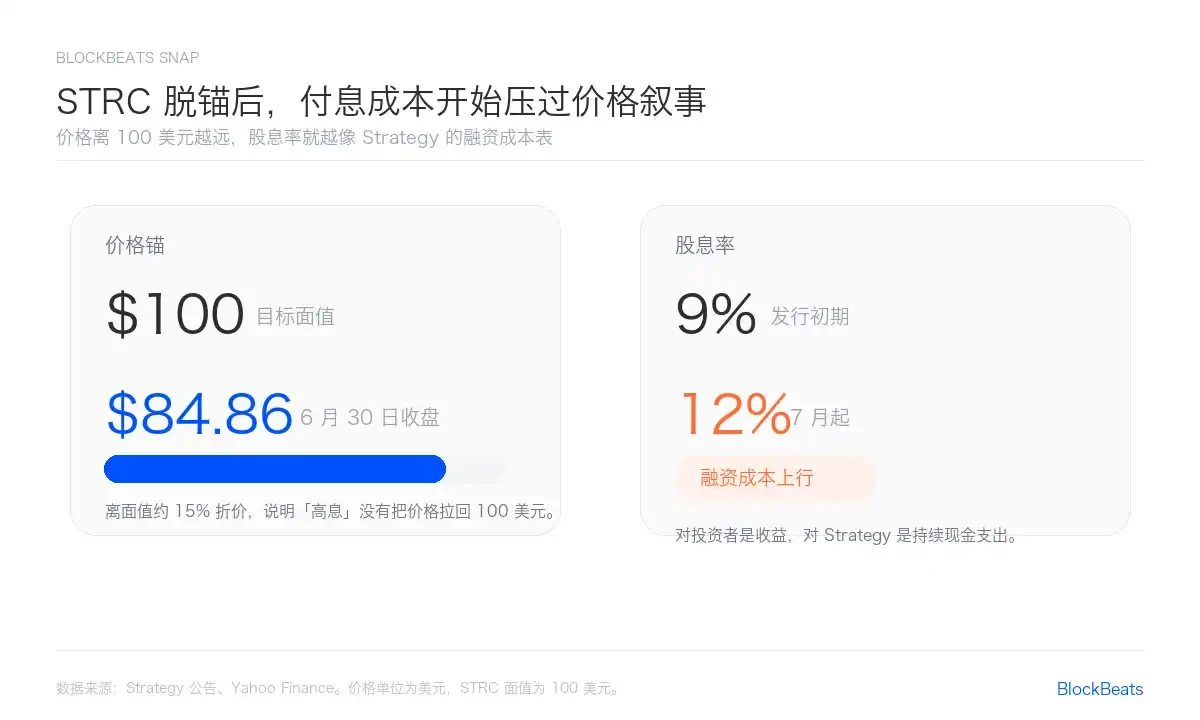
This 12% is not just investor yield; it's also Strategy's cost.
According to Strategy's announcement on June 29, the company's annualized preferred stock dividend and debt interest payments total approximately $1.76 billion. In simpler terms, it needs to set aside about $4.8 million daily just to maintain this capital structure.
This doesn't mean Strategy can't afford it. The company disclosed dollar reserves of about $2.55 billion, which alone could cover expenses for 17.4 months. However, this explains why the sales framework appeared. Selling BTC isn't about dumping coins on the market; it's about injecting cash into the entire structure of stocks and preferred shares.
Is Selling 491 BTC Bullish or Bearish for MSTR?
This needs to be viewed on two levels.
In the short term, the market might treat it as a positive. After the June 29 framework announcement, MSTR rose nearly 7% in pre-market trading. This reaction isn't contradictory. The market dislikes disorderly sell-offs but appreciates companies clearly articulating their liquidity plans in advance.
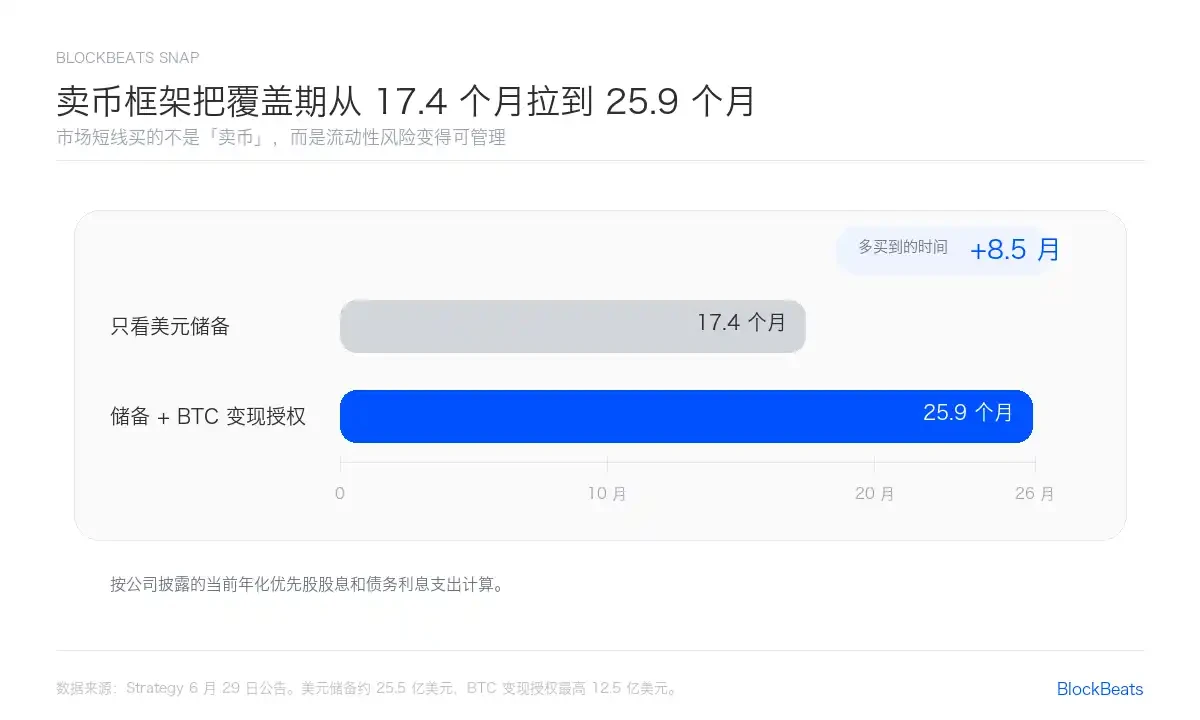
This chart explains why MSTR rose at that time. Relying solely on dollar reserves, Strategy's coverage period was about 17.4 months. Adding the authorized $1.25 billion BTC liquidation extends the coverage period to approximately 25.9 months.
The market isn't buying "selling coins."
The market is buying "at least we won't see a crisis tomorrow."
But in the medium term, this represents a downgrade for MSTR's valuation narrative. MSTR's strongest story was always one-way accumulation: raise funds, buy BTC, increase BTC per share. Now, there's a reverse action: sell BTC, replenish reserves, pay interest, and repurchase discounted securities.
This isn't necessarily wrong, and may even be the prudent thing for a mature listed company. However, it shifts MSTR from being the "perpetual marginal buyer" to "someone who sometimes has to manage liabilities."
The key stock mechanic is mNAV, the multiple of MSTR's market cap relative to its net Bitcoin holdings. When mNAV is above 1, Strategy issuing shares to buy BTC is interpreted by the market as accretive to BTC per share. But once mNAV falls below 1, further issuance becomes like selling its Bitcoin at a discount.
At that point, selling BTC might actually become a cleaner financing method.
This isn't necessarily bad for common stock immediately. If the company uses sales proceeds to repurchase discounted STRC, it can reduce future dividend pressure, benefiting common stock holders. However, the market will also start asking a new question: if even the biggest buyer is selling coins, how much of a Bitcoin premium should MSTR enjoy?
What Does This Mean for the BTC Market?
491 BTC won't change spot supply and demand.
But it will alter traders' psychological charts. In the past, when the market dipped, Strategy was often imagined as the buyer of last resort. ETF outflows, miners selling, retail not buying... and then there was Saylor.
If the 491 sale is real, a crack appears in this imagination. Strategy might remain a long-term holder and might continue buying. But it is no longer an account with only a buy button.
More troubling is the link between the sales framework and STRC. As long as STRC trades below par value for an extended period, Strategy must choose among several options: raise dividends, repurchase discounted preferred shares, replenish dollar reserves, or tap into its BTC. None of these choices are catastrophic, but each one pulls "Bitcoin faith" back towards cash flow realities.
If the 491 sale is confirmed, it's just the first receipt.
What truly matters is whether the market will continue treating every subsequent small sale as a one-off exception in the future.


