






Predicting World Cup Knockout Matches: How Big Are the Differences Between AI Models?


- Core Insight: By comparing the predictions of six AI models—ChatGPT, Grok, and DeepSeek, among others—for the 2023 World Cup knockout stage, this article finds significant divergence in their performance. DeepSeek and Gemini accurately predicted upsets (e.g., Morocco eliminating the Netherlands on penalties), Grok and Qwen correctly forecasted scores in high-profile matchups, while analytical models like ChatGPT leaned towards favorites and struggled to capture surprises.
- Key Findings:
- DeepSeek and Gemini successfully predicted the Netherlands vs. Morocco match: Gemini directly provided a 'script' of a 1:1 draw in regular time and a Morocco win on penalties, aligning with the actual result of 1:1 and a 3:2 penalty shootout victory; DeepSeek leaned towards Morocco advancing as an underdog through defensive counters.
- Grok and Qwen accurately predicted specific scores in three hot-favorite scenarios (Canada 1:0 South Africa, Brazil 2:1 Japan, Norway 2:1 Ivory Coast), demonstrating a more nuanced judgment of 'narrow wins' or 'dominant performances' by favorites.
- ChatGPT, in matches such as Brazil vs. Japan and England vs. DR Congo, predicted the correct outcome direction but emphasized opponent resistance (e.g., Japan's pressing, DR Congo's low block). Its process analysis was accurate, but score predictions lacked decisive precision. Like Claude, it also favored the favorite in the upset match of Netherlands vs. Morocco.
- All AI models collectively failed in the Germany vs. Paraguay match: Pre-match consensus favored Germany (predicting scores like 2:0, 3:0, etc.), but they underestimated Paraguay's defensive resilience, and Germany was ultimately eliminated on penalties.
- Summary of each model's applicable scenarios: DeepSeek and Gemini excel at identifying upsets and storylines; Grok and Qwen are suitable for predicting scores in favored matchups; ChatGPT and Claude are valuable for understanding game resistance but tend to favor favorites and lack decisiveness on upsets.
Original: Odaily Planet Daily (@OdailyChina)
Author: Asher (@Asher_0210)
Before every World Cup match, I ask AI to make a prediction. Almost every model provides a detailed, seemingly well-reasoned analysis.
Some talk about team valuations, some break down group stage data, others analyze injuries and tactics, and a few even provide exact scores, extra time, and penalty shootout scenarios. At first glance, ChatGPT, Grok, Qwen, DeepSeek, Gemini, and Claude all seem to know their football.
But as a prediction market user, what I really care about isn't which model gives the most comprehensive explanation, but which one is more worth referencing.
As the World Cup enters the knockout stage, Odaily Planet Daily started from the first match, asking different AI models similar questions before each game, and then comparing their predictions against the actual results afterward—to see which models just sound analytical and which ones truly captured the match's direction in advance.
So far in the concluded knockout matches, Canada narrowly defeated South Africa 1-0, Brazil beat Japan 2-1, Germany was eliminated after being dragged into a penalty shootout by Paraguay, and the Netherlands also fell to Morocco on penalties. The Belgium vs. Senegal match then turned into a 2-2 draw followed by an extra-time comeback, fully highlighting the uncertainty of the knockout stage.
DeepSeek and Gemini: Winning Big with Their Morocco Predictions
The most memorable predictions so far are definitely DeepSeek and Gemini's forecasts for the Netherlands vs. Morocco match. Before this game, it was easy to pick the wrong side—the Netherlands had a stronger squad on paper and better overall depth. Many models knew Morocco would be tough, but ultimately leaned towards the Netherlands advancing.
What made DeepSeek and Gemini stand out is that they didn't stop at saying "this will be a tight match"; they went ahead and wrote the entire script. Gemini directly predicted a 1-1 draw in regular time, with Morocco winning on penalties. The match indeed ended 1-1, and Morocco won the penalty shootout 3-2 to eliminate the Netherlands. They didn't just get the general outcome right; they accurately predicted how the game would be dragged to penalties and who would prevail.
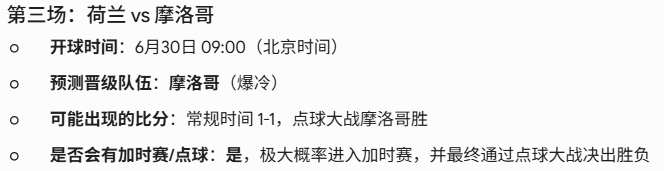
Gemini's prediction for the Netherlands vs. Morocco match
DeepSeek was very close too. It judged that regular time would likely end 1-1 or 0-0, the match could drag into extra time or even penalties, and leaned towards Morocco pulling off an upset through defense and counter-attacks.
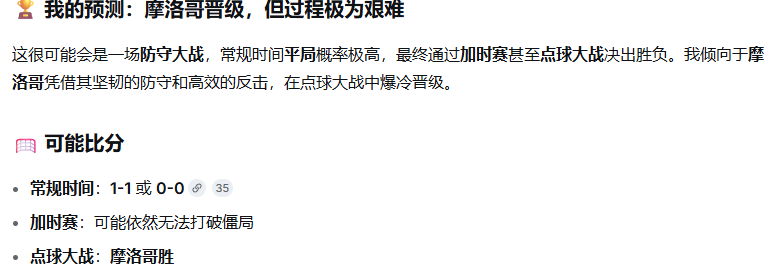
DeepSeek's prediction for the Netherlands vs. Morocco match
After this match, DeepSeek and Gemini's presence was fully established. Gemini, in particular, felt less like a pre-match predictor and more like someone who had seen the game script in advance.
Grok and Qwen Consistently Hit Exact Scores, Showing Stronger Stability Than Expected
Besides DeepSeek and Gemini's standout performance with Morocco, Grok and Qwen also made their presence felt. Their most impressive feat was in matches where the outcome was relatively clear-cut—they not only correctly predicted the advancing team but also gave specific scores that closely matched the final result.
The South Africa vs. Canada match is a prime example. Most AI models favored Canada before the game, but the question was whether Canada would win comfortably. Grok predicted a 1-0 win for Canada, and Qwen also suggested a one-goal margin. Canada ultimately won by exactly one goal, without the blowout many expected.

Qwen's prediction for the South Africa vs. Canada match
The Brazil vs. Japan match was similar. Most AI models agreed Brazil was stronger, but the key was whether Japan could keep the game tight. Grok and Qwen both predicted a 2-1 scoreline, and the match ended exactly as Brazil won 2-1. Their correct assessment wasn't simply "Brazil will win," but that Japan would cause enough trouble for Brazil.
In the Ivory Coast vs. Norway match, both models were accurate again. Norway had Haaland, so their advancement wasn't hard to foresee, but Ivory Coast's physicality and wing attacks wouldn't make it a one-sided affair. Grok and Qwen both predicted a 2-1 win for Norway, and the final score matched this script perfectly.
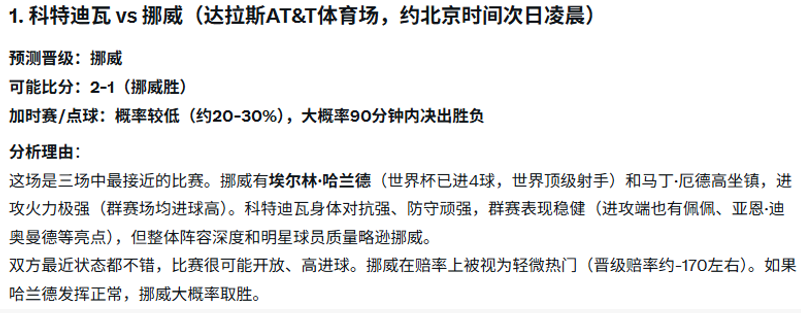
Grok's prediction for the Ivory Coast vs. Norway match
Grok and Qwen's strength lies in their detailed analysis of favored teams. They didn't predict a major upset like Morocco eliminating the Netherlands, but in matches involving Canada, Brazil, Norway, and France, they closely estimated both the winner and the final score. In other words, they might not be the best at spotting upsets, but they excel at determining whether a favorite will dominate or scrape through a tough win.
ChatGPT Didn't Produce Many Stunning Scores, but Its Match Process Analysis Was Accurate
ChatGPT didn't predict Morocco's penalty shootout win over the Netherlands like Gemini did, nor did it consistently nail specific scores like Grok and Qwen. However, its strength is that for many matches that appeared to be straightforward wins for strong teams, ChatGPT would more explicitly warn that the game might not be so easy.
Take Brazil vs. Japan. ChatGPT predicted Brazil would advance, but instead of describing a comfortable victory, it noted that Japan's pressing, running, and discipline would make Brazil uncomfortable, and Japan might even score first or equalize. Similarly for Ivory Coast vs. Norway, ChatGPT predicted a Norwegian win but warned it wouldn't be easy, as Ivory Coast's physicality, wing attacks, and transition play would create problems.
In the England vs. DR Congo knockout match, ChatGPT didn't simply predict a big win for England. Instead, it suggested the game might be quite tight, with DR Congo using a low block to slow the pace. England advanced, but they didn't win comfortably.
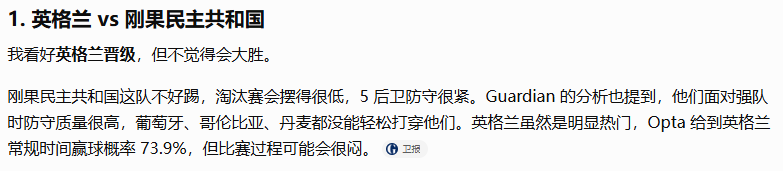
ChatGPT's prediction for the England vs. DR Congo match
ChatGPT's strength isn't in consistently nailing the exact score, but in often identifying the key challenges in a match beforehand. It's well-suited for understanding the game's dynamics, but less so for providing a definitive final score. It can describe the process accurately, but when it comes to predicting a major upset, it lacks a bit of conviction.
Germany's Elimination: A Collective Failure for AI Models
If the previous matches showcased different models' strengths, Germany vs. Paraguay was a collective failure.
Before the game, every single AI model sided with Germany. ChatGPT, Grok, Qwen, Gemini, Claude—all predicted Germany to win, with score predictions mostly ranging from 2-0, 3-0, or 3-1. The reasoning was unanimous: Germany had stronger players on paper, better squad depth, and more attacking firepower.
But this is where things went wrong. The AI models underestimated Paraguay's ability to drag the game into a grind. Germany failed to resolve the match in regular time, couldn't break the deadlock in extra time, and were ultimately eliminated after losing to Paraguay in a penalty shootout.
Who's the Most Accurate So Far?
Based on the knockout matches concluded so far, the different characteristics of each model are becoming clear.
DeepSeek and Gemini delivered the most standout moments. They didn't just predict favorites like Brazil and France to advance; in more difficult upset matches, they also provided highly insightful answers. Their key advantage in the Netherlands vs. Morocco match was daring to write the script for a Morocco upset and a penalty shootout. Gemini, in particular, directly predicting Morocco's penalty victory was a truly impressive call.
Grok and Qwen are more like "score-focused players." They accurately predicted several specific scores, performing well in matches involving Canada, Brazil, Norway, and France. However, when faced with traditional powerhouses like Germany and the Netherlands, they ultimately leaned towards the favorites.
ChatGPT and Claude are more like "analytical players." Their reasoning is comprehensive, their general direction is mostly correct, and they can alert users to the risk of extra time. However, their problem is that while they can often identify a tough match, they are hesitant to commit to the upset outcome. The Netherlands vs. Morocco match is a perfect example: they clearly saw the risk of extra time and penalties, but ultimately chose to trust the Dutch.
Therefore, instead of rushing to ask which model knows football best, it's better to consider which scenario each model is best suited for.


