From SpaceX and Micron to Galaxy Digital: A Clear Look at the 37 New AI Companies and 7 Crypto Dark Horses Added to the Russell Index


- Core Insight: The Russell U.S. indexes completed their annual reconstitution, adding 224 new companies to the Russell 3000 Index. Among them are approximately 37 AI/semiconductor-related companies and about 7 crypto-related companies. These new constituents are expected to gain market liquidity support due to passive fund allocation.
- Key Elements:
- On June 26, 2026, the day of the Russell 3000 reconstitution, the Nasdaq closing cross auction system processed a trading volume of $334.027 billion, setting a new single-day record in history.
- In this reconstitution, the market capitalization thresholds for the Russell 1000 and Russell 2000 increased by 24% to $5.7 billion, while the minimum market cap for a Russell 2000 constituent rose to $146.4 million.
- A total of 224 companies were newly added to the Russell 3000 Index: 19 entered the Russell 1000, and 205 entered the Russell 2000; concurrently, 118 companies were removed.
- Among the new additions, approximately 37 companies operate in the upstream or downstream AI industry, accounting for 17%. Notably, SpaceX, with an IPO valuation exceeding $2 trillion, was directly placed into the Russell 1000 Index through a fast-track inclusion mechanism.
- Among the new additions, about 7 companies are related to the crypto industry, accounting for 3%. These include Galaxy Digital, Hyperliquid Strategies, and Tron, with 5 of them engaged in DAT (Digital Asset Technology) business.
- Nvidia has replaced Apple as the largest weight component in the Russell 1000 Index. Semiconductor stocks recorded the largest increase in weight within the Russell 1000 Growth Index.
- After entering the Russell 3000 Index, small and mid-cap AI and crypto companies are expected to gain Wall Street institutional coverage and passive fund allocation, thereby enhancing secondary market liquidity.
Original by Odaily Planet Daily (@OdailyChina)
Author: Golem (@web3_golem)
After the US stock market closed on June 26, the Russell US Index completed its latest annual reconstitution, with all index constituents and their weights locked in. The market will officially begin trading based on the new index when US markets open on June 29 (today).
The Russell US Index is one of the most important benchmark indices for the US stock market, tracking the performance of the top 3,000 publicly listed companies in the US by market cap. (Odaily note: The actual number can fluctuate slightly due to listings and delistings; for example, the 2025-2026 data settled around 2,900+). It represents approximately 98% of the total investable US equity market, making it the broadest composite index covering both US large-cap and small-cap stocks.
If we compare the Russell US Index to a pyramid, the Russell 1000 sits at the top, comprising the 1,000 largest US companies by market cap. The Russell 2000 forms the middle-to-bottom section, including stocks ranked 1,001 through 3,000 by market cap—representing smaller companies. Together, these two indices constitute the complete Russell US Index, also known as the Russell 3000 Index.
According to official data, over $12 trillion in assets globally is benchmarked to the Russell US Index (including passive ETFs, mutual funds, pension funds, etc.). Therefore, during the annual reconstitution, a massive wave of ETFs, index funds, and institutional accounts must simultaneously adjust their holdings. Data released by Nasdaq shows that on reconstitution day, June 26, its Closing Cross system processed a staggering $334.027 billion in trading volume. This set a single-day record for Nasdaq's Closing Cross during a Russell 3000 reconstitution, far surpassing the 2025 figure.
The total number of stocks listed on Nasdaq and the NYSE is approximately 5,650. While the Russell 3000 covers 97% of the US investable market by float-adjusted market cap, it represents only about 53% of the total number of listed companies. Consequently, the final list of companies included in the Russell 3000 after the reconstitution is closely watched by the market, particularly those newly added. For these new entrants, it means they will, for the first time, attract inflows from trillions of dollars in passive funds, potentially boosting future stock performance and making them worth watching or positioning in.
224 Companies Added to the Russell 3000 Index
According to official disclosures, after this reconstitution, the market cap threshold dividing the Russell 1000 and Russell 2000 surged by 24% to $5.7 billion. This means that many companies with market caps around $5 billion were moved down from the Russell 1000 to the Russell 2000. Meanwhile, the minimum market cap threshold for the smallest constituent in the Russell 2000 rose to $146.4 million (an increase of nearly 23% compared to 2025).
A total of 61 companies were newly added to the Russell 1000 Index, with 42 of them being promoted from the Russell 2000. These new entrants are concentrated in the Technology (18 companies) and Industrials (17 companies) sectors. Truly, only 19 entirely new companies joined the Russell 1000.
A total of 244 companies were newly added to the Russell 2000 Index, of which 39 were demoted from the Russell 1000, 83 came from the Russell Microcap Index, and 17 joined the Russell 2000 via IPOs. The remaining additions came from companies previously outside the Russell US Index's constituent universe. Among these 244 new additions, 88 belong to the Healthcare sector, 36 to Technology, 31 to Consumer Discretionary, and 28 to Industrials.
Therefore, in this reconstitution, a total of 224 new companies were added to the Russell 3000 Index: 19 entered the Russell 1000, and 205 entered the Russell 2000. Simultaneously, 118 companies were completely removed from the Russell 3000 Index.
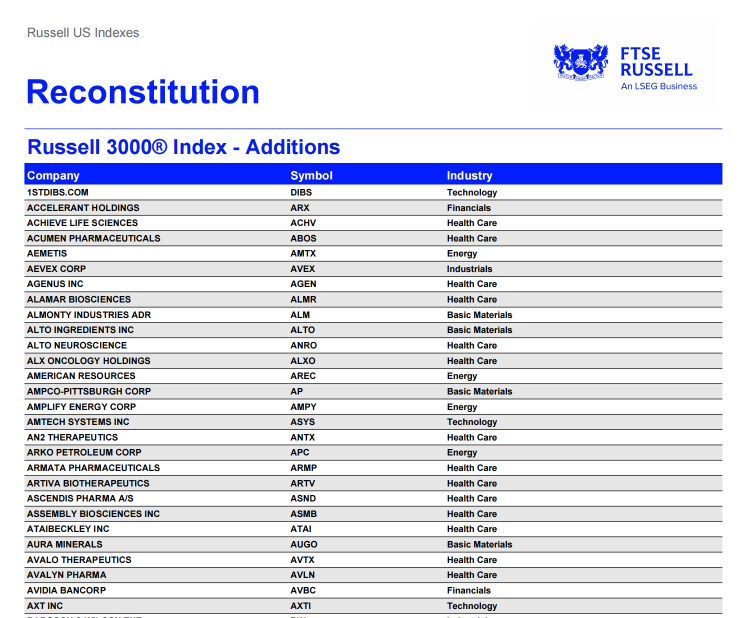
List of companies added to the Russell 3000 Index (click here for the full list)
Approximately 37 AI and Semiconductor Companies Added to the Russell 3000
Compared to the Russell 2000, technology companies constitute a significantly larger share of the Russell 1000. Driven by its rapid market cap expansion, NVIDIA has officially replaced Apple as the largest weighted stock in the Russell 1000. With the explosion of the AI and semiconductor sectors this year, semiconductor stocks have seen the largest weight increase within the Russell 1000 Growth Index (Odaily note: The Russell 1000 Index can be further broken down into Growth, Value, Top 200, and Mega Cap indices).
In terms of weight, the companies adding the most weight to the Russell 1000 Growth Index are Micron Technology and SanDisk, both of which transitioned from 100% Value stock classification to 100% Growth stock classification.
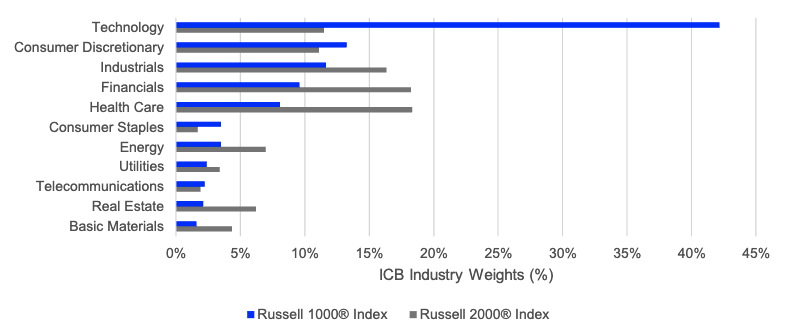
Industry weight distribution of companies in the Russell 1000 vs. Russell 2000
Meanwhile, according to Odaily's analysis, among the 224 newly added companies in the Russell 3000 Index, approximately 37 are involved in the upstream or downstream AI industry, accounting for about 17% of the new additions.
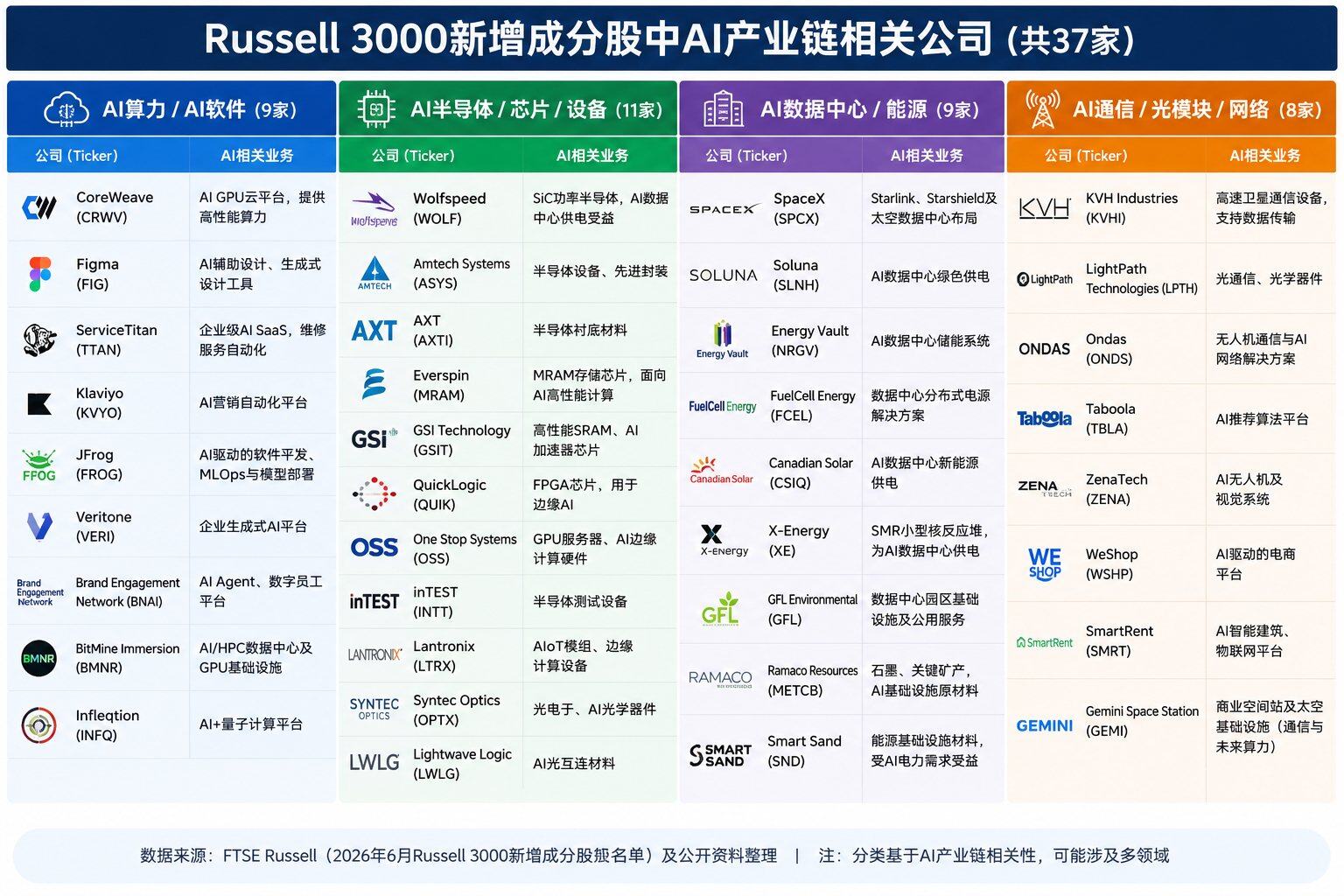
AI-related companies among the new additions to the Russell 3000 Index (AI-generated image)
Among these 37 companies, the most notable is SpaceX. After its IPO on June 12, 2026, SpaceX's market capitalization soared above $2 trillion, triggering Russell's "Fast-track" inclusion mechanism. Consequently, it directly entered the Russell 1000 Index and also immediately joined the Russell Top 200 Index. SpaceX's stock will be classified as approximately 90.4% Growth and 9.6% Value, meaning it will become a significant component of growth-oriented investments linked to the Russell 1000.
Besides the Russell indices, SpaceX is also scheduled to be added to the Nasdaq-100 Index and begin trading accordingly on July 6.
For other newly added AI concept stocks in the Russell 3000, this represents more than just an honorary title. It is a tangible catalyst that can directly translate into secondary market liquidity and stock price support.
Previously, many of these small-to-mid-cap AI and semiconductor companies (especially those with market caps below $5.7 billion in the Russell 2000) were excluded from the stock universes of large Wall Street mutual funds or hedge funds due to size constraints. However, once included in the index, Wall Street analysts may be compelled to start covering these companies. This increased visibility, combined with being in the red-hot AI track, could attract inflows from active funds or investor cohorts, potentially driving up their stock prices.
Approximately 7 Crypto-Related Companies Added to the Russell 3000
Following this Russell 3000 reconstitution, several crypto-related enterprises have been included for the first time. According to Odaily's analysis, among the 224 newly added companies, approximately 7 are related to the crypto industry, accounting for about 3% of the new additions. They are: Galaxy Digital, SharpLink, Bitmine, Forward Industries, Hyperliquid Strategies, Tron, and IREN.
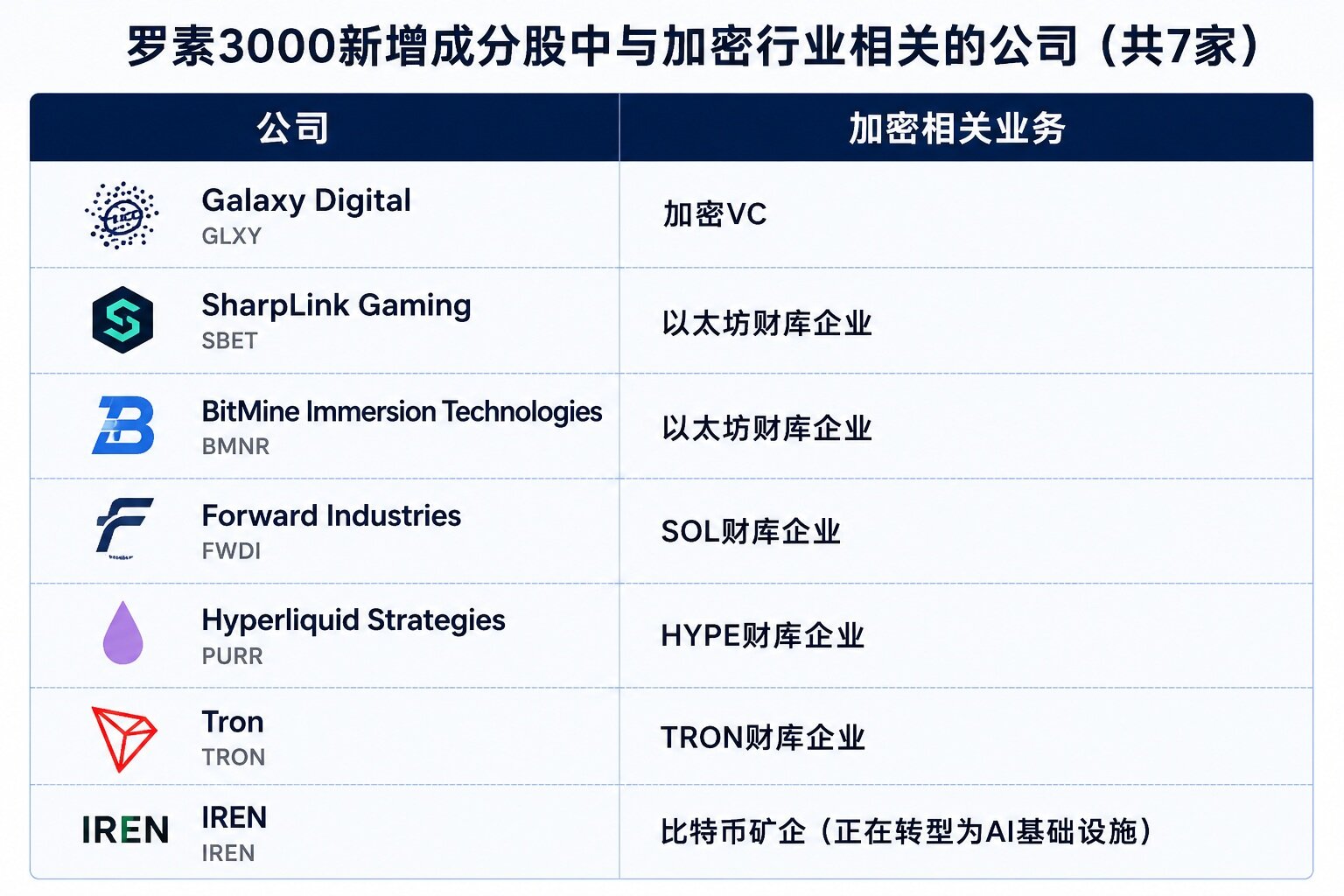
Crypto-related companies among the new additions to the Russell 3000 Index (AI-generated image)
The successful inclusion of these 7 companies in the Russell 3000 Index means their stocks will also become part of the passive allocation for numerous funds, presenting certain upside potential. Notably, 5 out of these 7 companies engage in DAT (Digital Asset Trading) businesses, corresponding to different ecosystems like ETH, SOL, HYPE, and TRON. Considering that the Russell 3000 Index is essentially a dispassionate machine that selects purely based on market cap, ignoring subjective preferences, the inclusion of these 5 companies proves that while the DAT hype may have subsided, the business model has withstood the test of both the market and time.