






Making a feint to the east while attacking in the west, is Waller paving the way for a September "rate cut"?


- Core Thesis: Analyst Peter Tchir believes Fed Chair Waller's hawkish stance is a strategic performance, aimed at suppressing long-term yields. By then adjusting the inflation narrative—using alternative indicators and blurring inflation targets—he can pave the way for rate cuts in September and October, thereby delivering on political goals before the midterm elections.
- Key Elements:
- Driven by Political Goals: The Trump administration is well aware of the importance of low interest rates for real estate. Waller's hawkish rhetoric may be a coordinated strategy with the President to manufacture room for rate cuts while maintaining the appearance of Fed independence.
- Restructuring Inflation Metrics: PCE is not Waller's preferred measure. By adopting the Cleveland Fed's New Tenant Rent Index (NTRR) or Truflation's real-time data (core inflation around 1.45%), he could argue that inflation is under control, providing a data-based rationale for cutting rates.
- Blurring the Inflation Target: Waller hints that an inflation rate "in the low 2% range," i.e., a whole number, could be considered close to the 2% target. The market may gradually accept this cognitive framework, lowering both the technical and psychological barriers to rate cuts.
- The Neutral Rate Debate: The future may involve a reassessment of the neutral rate (e.g., proving previous estimates were too high) to provide theoretical support for a 50-100 basis point cut, with the blame pinned on previous Fed errors.
- The AI Inflation Narrative Reversal: Apple's price increase leading to a stock price drop indicates weakening consumer price tolerance. The restraining effect of rate hikes on high-valuation tech companies like AI/data centers is minimal, mainly hurting ordinary borrowers.
- Market Opportunities and Asset Allocation: The most certain opportunity lies at the short end of the yield curve, betting on a decline in front-end rates. Recommendations include overweighting Energy and Biotech, underweighting Semiconductors, and being wary of share dilution pressure from large-cap tech companies.
Original Author: Zhao Ying
Original Source: Wall Street CN
Federal Reserve Chairman Kevin Warsh's hawkish stance might just be a carefully orchestrated smokescreen.
Academy Securities analyst Peter Tchir argues in a recent report that while the market currently prices in a 75% probability of a rate hike in September and expects a cumulative 1.25 rate increases by year-end, he believes the market is missing a genuine path towards a rate cut in September – a path that Warsh himself may be quietly paving.
Tchir points out that Warsh's signals have been clear enough: using hawkish rhetoric to suppress tail risks in long-end yields (the 10-year Treasury yield has already fallen from 4.46% to 4.37% this week), while leaving room for a shift in the data-driven narrative later on. In his view, the ultimate destination of this sequence of moves could be a rate cut in September, followed by another in October, conveniently timed just before the midterm elections.
This judgment remains a personal opinion, and Tchir himself acknowledges the uncertainties involved. However, his reasoning is logically coherent, encompassing a redefinition of inflation data, the battle over the narrative for the neutral interest rate, and the core premise that the White House's policy objectives have never changed.
Hawkishness Just an Act? Political Logic Points to Rate Cuts
Tchir's starting point is a political economy interpretation of Warsh's motivations.
He argues that the policy goals of the Trump administration have never fundamentally shifted. The President has repeatedly shown an understanding of real estate, aware of the importance of low interest rates for the property market. Against this backdrop, it's hard to imagine Trump being satisfied with the persistent hawkishness of the Fed chair he himself nominated – unless it's a deliberate, coordinated strategy.
Tchir paints a hypothetical scenario: Warsh convinces Trump that releasing dovish signals now would be disastrous. Instead, appearing hawkish allows him to suppress long-end yields, maintain the facade of Fed independence, and let Wall Street analysts and media fully pivot towards expecting rate hikes. Then, as data gradually "cooperates," he can pivot to rate cuts under the guise of being "data-driven," while also blaming the previous Fed for "using wrong data and acting too late" on inflation.
He adds that the fact Warsh's father-in-law is a major donor to Trump might not be entirely irrelevant.
"Taking a Scalpel" to Inflation Data: PCE Isn't This Fed's Yardstick
The most substantive part of Tchir's argument is a systematic challenge to the current system of measuring inflation.
He states explicitly that PCE is not the preferred inflation indicator for Warsh's Fed. He believes PCE was more a preference of the Bernanke era, and Warsh isn't likely to be kept up at night worrying about PCE data.
His criticism is particularly sharp regarding the measurement of housing inflation. The CPI's "Owners' Equivalent Rent" (OER) only peaked in mid-2023, around 8%. In contrast, Zillow's rent data had already hit a high of nearly 16% in early 2022. He notes that the Cleveland Fed has developed the "New Tenant Repeat Rent" (NTRR) index, which closely mirrors Zillow's trend, yet this more realistic indicator has received almost no attention.
His conclusion is that the Fed, without needing to introduce external data, could simply switch to using the Cleveland Fed's own internal index, thereby providing a data-driven justification for rate cuts.
Truflation and "Low Two Percent is Good Enough"
Beyond PCE, Tchir also cites real-time inflation data from Truflation. According to him, Truflation constructs a daily inflation index based on vast sets of real-time data, with its core inflation rate currently around 1.45%, consistently below 1.8% since February this year.
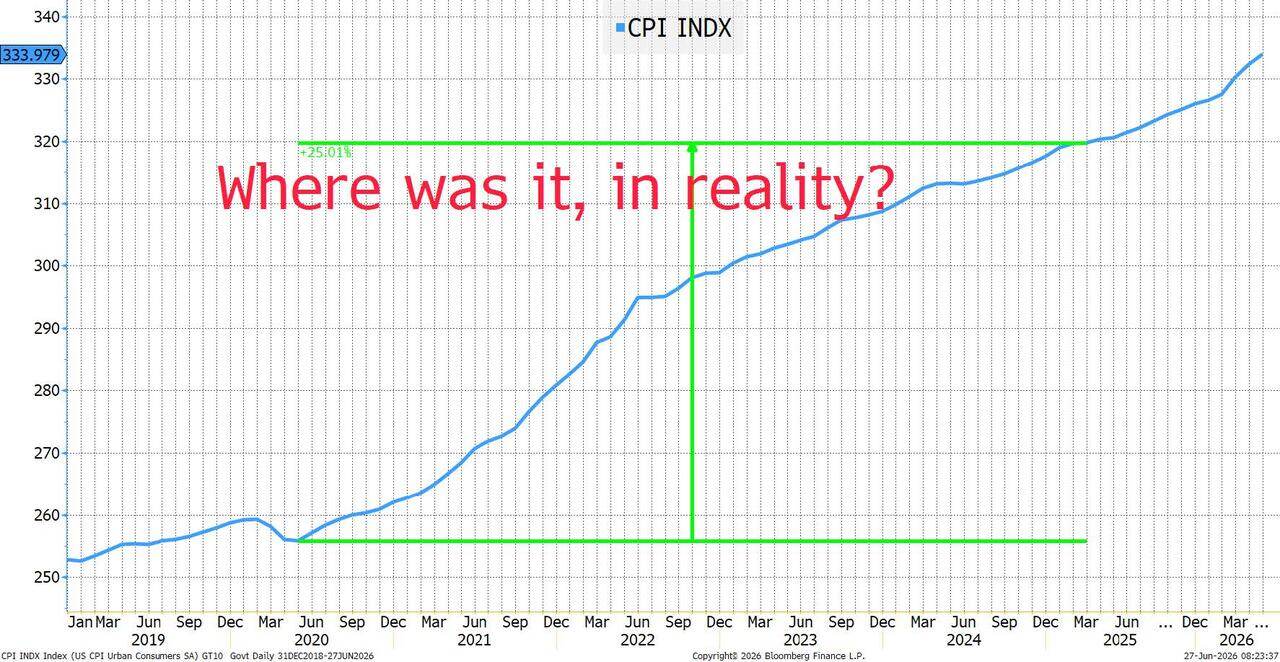
He also observes that in recent remarks, Warsh has hinted that the "big number" (i.e., the integer part) of the inflation figure is more important than the precise decimal. Tchir infers from this that the market might be gradually being "conditioned" to accept a cognitive framework where "low two percent" is considered equivalent to being near the 2% target. In his chart, Tchir itself marks the inflation target line at 2.9%, rather than the traditional 2%.
He believes that once the data narrative is fully shifted, the technical barriers to rate cuts will be significantly lowered.
Tchir also references the work of former Fed insider Miran on the issue of the neutral interest rate. He argues that although no one in the market is currently discussing the neutral rate, this topic will resurface at the appropriate time.
His logic is that the neutral rate itself is difficult to measure precisely, with a considerable estimation range. If the new Fed leadership can argue that the previous assessment of the neutral rate was too high, this alone could provide a theoretical basis for a 50 to 100 basis point rate cut, while shifting the blame to the "old Fed's mistakes."
Apple's Price Hike and AI Inflation: Rate Hikes Target the Wrong Enemy
Addressing market fears of AI-driven inflation, Tchir offers an opposing interpretation.
He points out that Apple (AAPL) recently announced a price hike but saw its stock price fall. This market reaction suggests that consumers' ability to absorb price increases is being questioned. If even a top-tier consumer goods company like Apple struggles to have its price hikes digested by the market, the pricing power of ordinary consumer goods companies is likely even weaker – a narrative contrary to persistently rising inflation.
He also cites feedback from a chip company: memory prices haven't surged due to AI demand; some products are even cheaper than they were five years ago. He argues that while AI and data center construction spending is indeed inflationary, this is a completely different dimension from the affordability issues facing ordinary consumers.
More critically, he believes that rate hikes have almost no dampening effect on AI/data center spending – tech companies trading at 100x earnings are hardly sensitive to a 50bp move in interest rates. The ones truly hurt by rate hikes are ordinary borrowers who have nothing to do with AI-driven inflation.
Based on the above analysis, he expects the market to begin re-pricing expectations for rate cuts, with the most certain opportunity lying in the short end of the yield curve – going long on short-term treasuries, betting on a decline in front-end yields. For the long end, he maintains a neutral to slightly bullish stance, believing Treasury Secretary Bessent wants to see the 10-year yield return to the "3% handle," and that Warsh has already eliminated tail risks on the long end through his hawkish rhetoric.
On the equity front, he recommends a significant overweight in the energy sector, particularly global nuclear power assets. Within the ProSec theme, he suggests overweighting biotech/pharma and underweighting chips. He maintains a cautious view on AI and data center valuations, warning that potential secondary offerings from large tech companies could weigh on their stock prices.


