






EF Epic Restructuring: 20% Layoffs, Budget Halved – Is Ethereum Streamlining for a Lightweight Future?


- Core Thesis: The Ethereum Foundation (EF) has initiated its largest restructuring in nearly a decade, cutting 20% of staff and reducing its budget by 40%. The goal is to clarify its role, transitioning from a comprehensive ecosystem hub back to focusing on core protocol research and public goods funding, while shifting certain functions to independent external ecosystem forces.
- Key Elements:
- The EF restructuring creates five functional clusters: Protocol Layer, Access Layer, User Layer, Community Layer, and Institutional Layer. It involves laying off approximately 54 people (20%) and plans to gradually reduce its annual budget expenditure rate from ~15% to 5% by 2030.
- This reform is a systematic response to the past year's challenges: low ETH prices, scalability route disputes, community doubts about the EF's execution, and key member departures. It is seen as a "belated course correction."
- Vitalik acknowledges the restructuring will cause "real losses." For example, the frontier research team PSE will gradually be dissolved, Devcon will transition to a smaller, lower-cost model, and institutional collaboration efforts will also be scaled back.
- The EF's retreat is being filled by ecosystem forces. A notable example is Ethlabs, founded by former EF core researchers, which has received support from BitMine, SharpLink, and other ecosystem players.
- Solana co-founder toly publicly endorsed the reform, stating that budget constraints will make the EF more decisive and faster, emphasizing that "Ethereum is not going anywhere."
Original by Odaily (@OdailyChina)
Author: Azuma (@azuma_eth)

The Ethereum Foundation (EF) has undergone its most significant organizational restructuring in recent years.
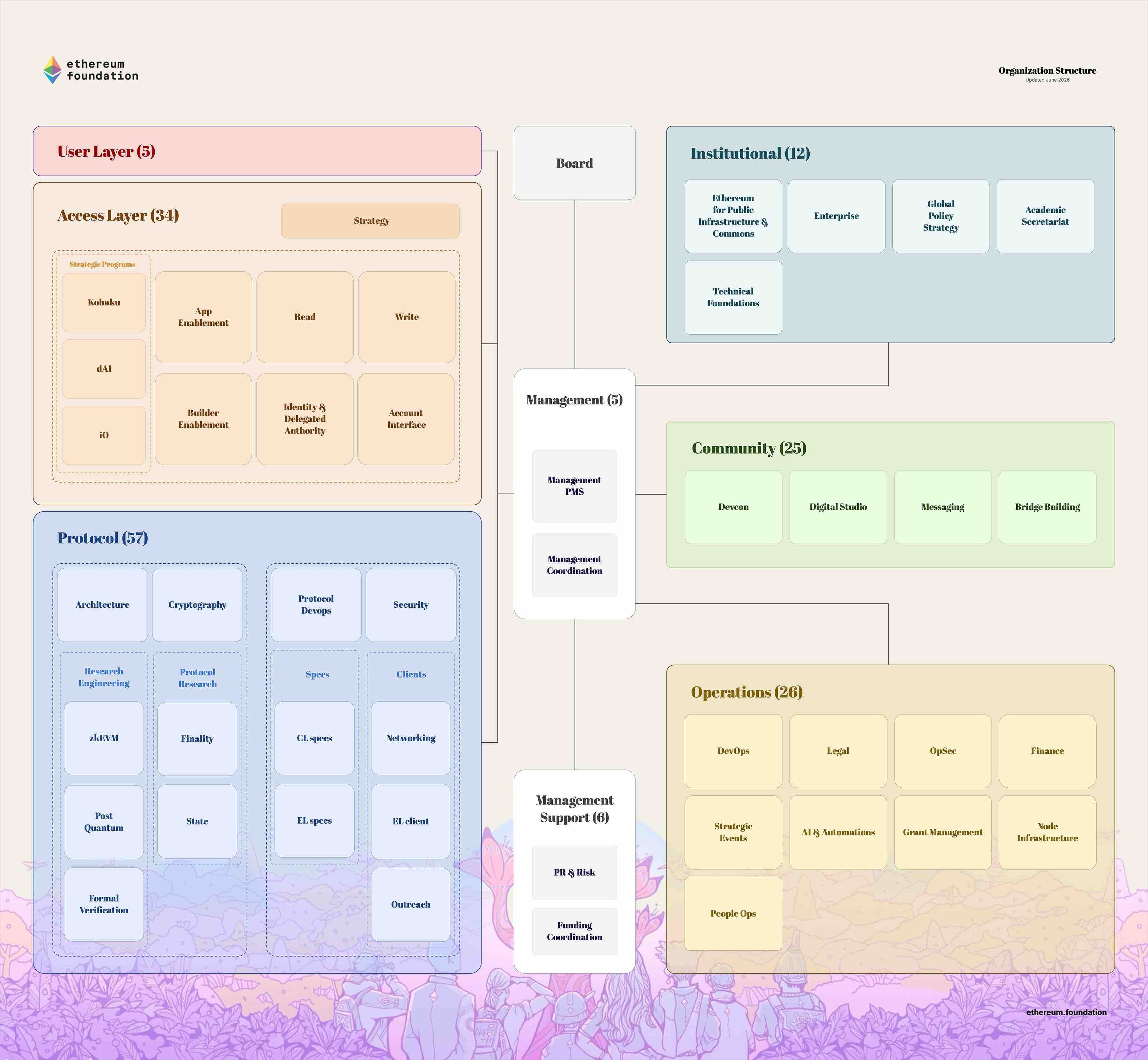
On the evening of June 23, the EF officially announced a comprehensive internal restructuring, dividing itself into several functional clusters, including Protocol Layer, Access Layer, User Layer, Community Layer, and Institutional Layer. Concurrently, the foundation has laid off approximately 20% of its staff, resulting in about 54 employees leaving.
Around the same time, Ethereum co-founder Vitalik Buterin also disclosed more detailed reform ideas on X: The EF will gradually reduce its expenditure scale over the coming years, cutting the budget by approximately 40%. It plans to lower the annual spending rate from the historical ~15% down to about 5% after 2030, transitioning towards an endowment-driven operational model.
Clearly, this is an unconventional, major structural overhaul. Viewed against the controversies and challenges Ethereum has faced over the past year, this reform seems more like a long-overdue course correction.
From the prolonged poor price performance of ETH to the heated debate over the success or failure of its scaling roadmap; from the community's persistent doubts about the foundation's execution capabilities to the successive departures of core members... Over the past year, the wave of criticism directed at the EF has hardly ceased. This round of layoffs, restructuring, and budget adjustments is widely seen as the EF's first systematic response to these issues.
Why is the EF Always Mired in Controversy?
Over the past few years, as the most influential overarching entity within the entire Ethereum ecosystem, every move by the EF has been accompanied by controversy.
Some criticize the foundation for its long-term selling of ETH, dampening community confidence. Others question the EF for overemphasizing public goods and long-term research, neglecting market competition and ecosystem growth. Still, others believe that, facing increasingly fierce industry competition, the EF has consistently lacked sufficiently clear strategic expression and execution capabilities... Whenever the market develops dissatisfaction with Ethereum, the EF often becomes the most direct target of criticism.
While these controversies seem diverse, they all point to the same underlying reality — over the past decade-plus, the EF has played an extremely unique role. It has been both a key driver of protocol research and a funder of ecosystem development; it bears the responsibility of coordinating the interests of various parties, while also largely representing the outside world's perception of Ethereum.
In Ethereum's early development days, this role definition was crucial. However, as Ethereum has grown into a global network with a massive developer community, assets worth hundreds of billions of dollars, and numerous institutional participants, market expectations for the EF have quietly shifted.
What role should the EF truly play? Is it merely a non-profit organization dedicated to research, or should it be the de facto coordination center for the entire ecosystem? Does it have a responsibility to ETH holders? Should it respond to market expectations for growth, adoption, and value accrual?
The EF has long failed to give clear answers to these questions. Consequently, controversies over ETH sales, execution capability, governance, and even personnel attrition have continuously piled up, inevitably devolving into debates about the foundation itself. Combined with the sustained poor performance of the ETH price, the community needed an outlet for its frustration, and the EF turned out to be the perfect target.
The EF's Answer: Redrawing Boundaries
If the community's doubts over the past few years have all essentially pointed to the ambiguity of the EF's role, then the core of this reform is that the EF has finally begun to redefine itself, clarifying what it should and should not do.
According to the newly announced organizational structure, the EF explicitly defines the focus of its future work in the following five directions:
- Protocol Layer: Responsible for advancing core protocol R&D and network security;
- Access Layer: Focuses on wallets, developer tools, and infrastructure experience;
- User Layer: Concentrates on applications and user experience;
- Community Layer: Takes on developer and ecosystem coordination work;
- Institutional Layer: Responsible for promoting the adoption of Ethereum by governments, enterprises, and traditional institutions.
Alongside defining these functional clusters, the EF is also proactively contracting by laying off 20% of its workforce and cutting the budget by 40%. Notably, Vitalik did not frame this reform as a simple "efficiency improvement," but rather acknowledged it as a genuine loss – some projects will cease, certain capabilities will disappear, and long-time contributors will leave.
Vitalik provided examples, stating that the PSE (Privacy and Scaling Explorations) team, long focused on cutting-edge privacy and scaling research, will be phased out. Devcon will also transition towards a smaller-scale, lower-cost model. The foundation's investment in large projects outside of core Ethereum will decrease. Work related to institutional partnerships will also be further focused and streamlined.
However, Vitalik also emphasized that this does not mean investment in these areas across the entire Ethereum ecosystem will decrease simultaneously. On the contrary, much of the work is simply moving from the "exploration" phase to the "implementation" phase, shifting from within the EF to the broader ecosystem.
For an organization that has long simultaneously shouldered research, funding, coordination, and even partial ecosystem promotion responsibilities, this marks a significant step back. The EF is no longer trying to be an all-encompassing ecosystem center but hopes to return to its core functions: protocol research, public goods support, and ecosystem coordination. More specific development work will be progressively delegated to independent teams and market forces within the ecosystem.
Ecosystem Forces Are Filling the Gap
If the EF's reform signifies a proactive retreat, the next crucial question is: who will fill the void it leaves? The answer is already emerging — the ecosystem itself.
Just before the foundation announced its restructuring, Ethlabs, founded by several former core EF researchers, was officially established and quickly garnered support from ecosystem players like BitMine, SharpLink, and Joseph Lubin. (Recommended reading: Is the Ethereum Foundation Splitting?! Understanding Ethlabs' "Bright Future")
In the past, such an outflow of talent might have been interpreted as a sign of the EF's declining influence. However, the market's reaction this time was quite the opposite. Many people now see the emergence of Ethlabs as bullish for Ethereum, as it indicates that talent, resources, and research capabilities once highly concentrated within the foundation are spreading to more independent organizations.
Beyond Ethlabs, the Ethereum ecosystem has also seen the emergence of other independent organizations like Argot Collective and Ethereum Applications Guild over the past year. Simultaneously, public treasury companies like BitMine and SharpLink have begun participating in ecosystem development through funding and research grants.
Compared to a decade ago, Ethereum's power structure has fundamentally changed. Ethereum was once almost synonymous with the EF, but today, Ethereum's development can no longer rely on a single institution. Increasingly, it requires collaboration and division of labor among different organizations within the ecosystem.
Acknowledgment from a Competitor
Of course, the EF's reform does not mean Ethereum's problems are solved.
Issues like ETH's value capture debate, institutional adoption pace, and ecosystem competitiveness and execution efficiency will not automatically disappear because of an organizational restructuring. But at least the EF has begun to acknowledge one thing — as Ethereum has grown, the foundation's influence has become increasingly limited; it can no longer pretend to be the entity that "solves all problems."
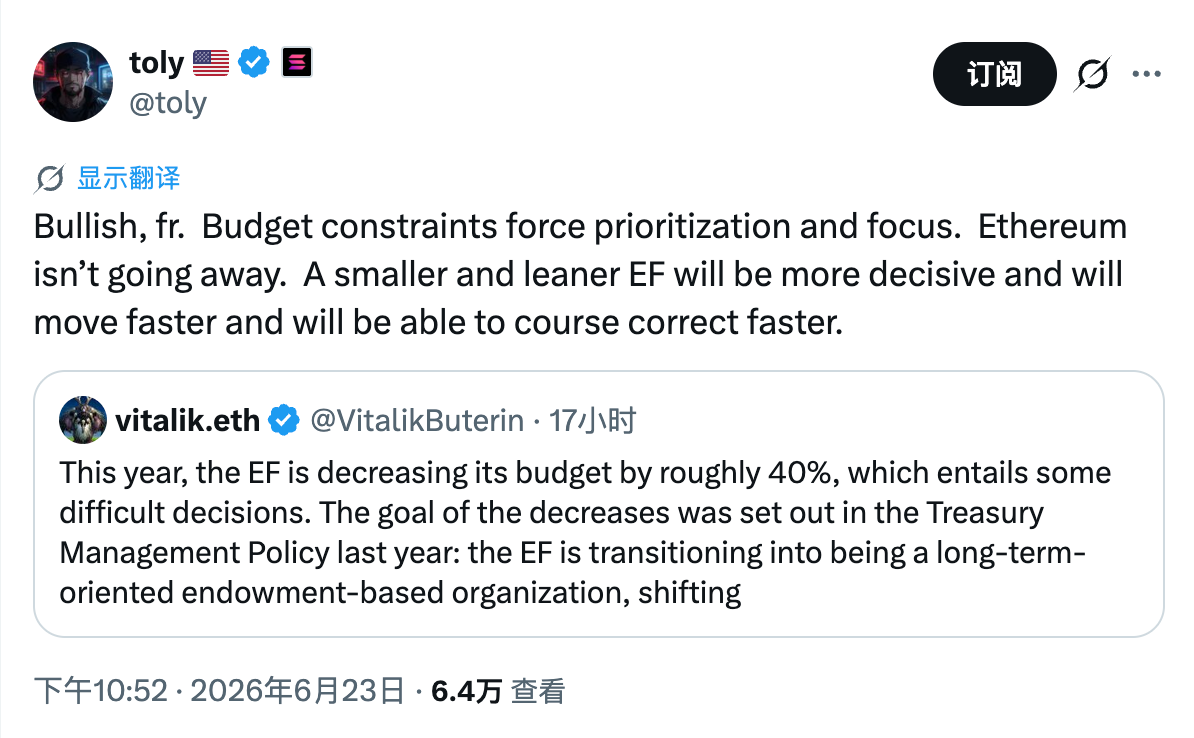
Shortly after the EF announced its reform, Solana co-founder toly posted on X: "Bullish. Budget constraints force prioritization and focus. Ethereum isn't going anywhere. A smaller, leaner Ethereum Foundation will be more decisive, move faster, and be able to pivot more quickly."
This recognition from a long-time competitor might be the highest praise for the EF's current reform.


