SK Hynix triggered a circuit breaker the day after reaching the top. Where does the storage super cycle stand now?


- Core View: The global memory chip market (DRAM/NAND) is experiencing a severe supply-demand imbalance driven by AI demand, with profit margins reaching new highs. However, a concentrated release of new capacity is not expected until after the second half of 2027, when the risk of a sharp price decline will significantly increase.
- Key Elements:
- SK Hynix's operating profit margin in Q1 2026 reached 72%, surpassing NVIDIA, and the global DRAM supply-demand gap hit 4.9%, the most severe in 15 years.
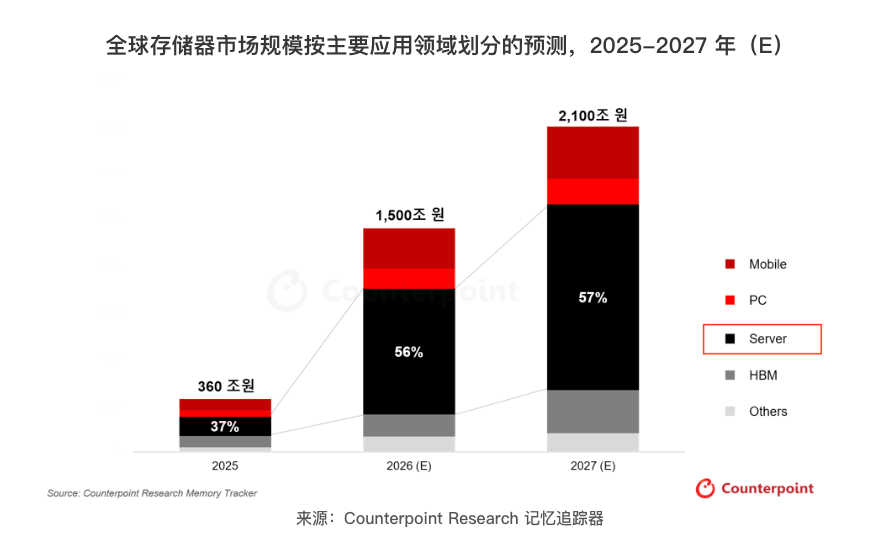
- The global memory market is projected to exceed $1.5 trillion in the first half of 2027, with server memory's share rising to 57%.
- The DRAM consumption per single AI accelerator for HBM4 has increased by 33%. New capacity from Micron, Samsung, and SK Hynix is concentrated in the period from mid-2027 to 2028.
- Micron's 2026 capital expenditure has been raised to $20 billion. Samsung's Pyeongtaek P5 plant will be operational in 2028, and SK Hynix's M15X facility will come online in mid-2027.
- The South Korean stock market triggered a circuit breaker due to excessive concentration in leveraged products, creating a contradiction between short-term volatility and fundamentals (with the shortage lasting until 2027).
Original author: Curry
Guide: On June 22, SK hynix's market cap surpassed Samsung for the first time in 26 years. The very next day, the South Korean stock market triggered a circuit breaker, with the semiconductor sector experiencing panic selling.
Yet on the same day, a research agency released a forecast predicting the global memory market size will exceed $1.5 trillion by 2027, with server memory share expanding to 57%, and the shortage expected to persist at least until the second half of next year.
Where exactly is the super cycle? When will the price inflection point arrive? The capacity expansion plans of Samsung, SK hynix, and Micron provide timeline clues, pointing towards after the second half of 2027.
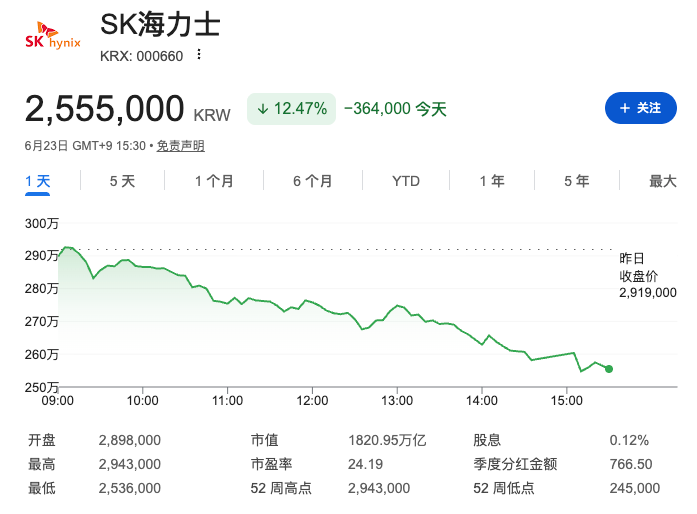
On June 23, the South Korean stock market experienced a textbook "shift from euphoria to panic."
Just a day earlier, SK hynix's intraday market cap touched approximately $1.35 trillion, surpassing Samsung Electronics for the first time in 26 years to become the highest-valued company in South Korea, closing up 5.6%. However, only one trading day later, the KOSPI 200 futures plunged 5%, triggering a circuit breaker, and both Samsung and SK hynix faced panic selling. According to TradingKey, direct triggers included concerns over AI competitiveness due to a Google executive change, as well as forced liquidations stemming from South Korean regulators' scrutiny of excessive concentration in semiconductor leveraged financial products.
This sharp volatility coincided with an optimistic industry forecast.
Memory Tracker data released by Counterpoint Research on June 23 shows that the global memory market (DRAM + NAND) will continue to expand until the first half of 2027, surpassing 2,100 trillion Korean won (approximately $1.5 trillion). Server memory share will increase from less than 50% in 2025 to 57%.
On one hand, the market is experiencing violent fluctuations at high levels; on the other, industry data points to a persistent shortage. For investors focused on the memory sector, this represents a moment of divergence.
Memory Chip Profit Margins Crush Nvidia, But the Supply-Demand Gap is the Real Anchor for Pricing
To understand current memory stock valuations, one must first look at how strong the fundamentals are.
SK hynix's Q1 2026 revenue reached $52.58 billion (converted at the current exchange rate), up 198% year-over-year. Operating profit was $37.61 billion, up 405% year-over-year, with an operating margin of 72%, surpassing Nvidia's 65% over the same period, setting a historical record for semiconductor manufacturing.
According to CNBC, Counterpoint Research analyst MS Hwang commented on this, stating that the Q1 earnings show AI inference demand for memory far exceeded expectations, and companies are scrambling for supply.
The root of this extraordinary profitability is a structural supply-demand imbalance.
A Goldman Sachs report from April estimates that the global DRAM supply-demand gap is expected to widen from 3.3% to 4.9%, the most severe in 15 years. Samsung, SK hynix, and Micron control over 95% of global DRAM capacity, but almost all incremental output is being consumed by AI.
According to TrendForce data, DRAM contract prices surged 90% to 95% quarter-over-quarter in Q1 2026. Although the increase narrowed to 58% to 63% in Q2, NAND flash contract prices accelerated to a 70% to 75% sequential increase.
HBM (High Bandwidth Memory) is at the core of this price surge. This technology, which stacks multiple DRAM chips vertically, is specifically designed for AI accelerators. Producing 1GB of HBM consumes approximately three times the wafer area of standard DDR5, but a single stacked unit sells for between $300 and $500, yielding profit margins three to five times that of regular DRAM. SK hynix currently holds approximately 57% to 62% of the global HBM market share and is Nvidia's primary supplier for AI accelerators.
Goldman Sachs estimates SK hynix has secured roughly two-thirds of the HBM4 orders for Nvidia's next-generation Rubin platform. SK Group Chairman Chey Tae-won publicly stated in March that the global semiconductor wafer shortage could last until 2030, and expanding capacity takes at least four to five years, estimating a gap of over 20%.
Therefore, from a fundamental perspective, the shortage is expected to continue for one to two more years. With the two companies controlling approximately 70% of global DRAM capacity, the supply-demand gap is unlikely to change in the short term.
Inflection Point Timeline: New Capacity Concentrated After H2 2027
In its report, Counterpoint explicitly warns: once new capacity coming online becomes visible, the risk of a sharp price decline cannot be ruled out. The specific timeline is as follows:
Micron has raised its FY 2026 capital expenditure to $20 billion. Its new fab in Idaho will start production by mid-2027, and its Singapore HBM packaging facility will contribute capacity in the same year. Samsung's Pyeongtaek P5 plant is expected to be operational by 2028. SK hynix's M15X facility will come online in mid-2027, and it has also announced an investment of 19 trillion Korean won for a new plant.
However, the pace of expansion still lags far behind demand growth.
Goldman Sachs calculates that the incremental memory demand from US data centers between 2027 and 2028 will be approximately 9% to 12%, while the capacity expansion in the region is only about 2% to 4%. Concurrently, the arrival of HBM4 will further intensify the supply-demand imbalance – HBM4 requires 16 DRAM dies per stack, up from 12, increasing DRAM consumption per AI accelerator chip by 33%.
TrendForce's assessment aligns: HBM3E remains the primary shipment driver, HBM4 is beginning to contribute revenue, but delays in AI chip upgrades and inventory accumulation are slowing growth momentum. The actual window for a price correction may appear between the second half of 2027 and 2028.
Until then, the absolute level of the supply-demand gap will continue to support high prices and high profit margins. After that, the concentrated release of new capacity, combined with a potential slowdown in AI investment pace, will start to accumulate risks of a sharp price decline.
Counterpoint emphasizes that the volume locked in LTAs (Long-Term Supply Agreements), customized HBM strategies, and the speed of next-generation process node conversion will determine market share battles among suppliers. In other words, even if overall growth slows down, the competitive landscape among the Big Three is undergoing significant restructuring.
What Does This Mean for Holders and Wait-and-See Investors, Respectively?
The peak on June 22 and the circuit breaker on June 23 encapsulate the core contradiction of the current memory sector:
The fundamentals of the memory sector are still accelerating – for example, SK hynix's Q1 margin of 72% and the largest supply-demand gap in 15 years. However, valuations have already priced in extremely optimistic expectations (SK hynix's stock is up over 340% year-to-date), while the excessive concentration of leveraged products has amplified volatility in either direction.
Both Samsung and SK hynix have warned in their earnings reports that the memory shortage is expected to last at least until 2027.
Samsung's memory head Kim Jaejune stated that the demand fulfillment rate has fallen to historical lows, and customers are scrambling to secure future supply. However, the market has already begun trading risks on the other side: the Bank of Korea is leaning towards raising interest rates due to the semiconductor supercycle, causing South Korean government bonds to underperform globally.
According to available public data, the consensus rating for SK hynix among 38 analysts is "Strong Buy," with an average 12-month price target of approximately 2,710,000 Korean won. South Korean brokerage Hanwha Investment & Securities has also just raised its target price from 1,630,000 to 4,300,000 Korean won.
Therefore, synthesizing public analysis opinions, the general assessment is:
- For holders: Both Counterpoint and TrendForce point to the second half of 2027 as the earliest potential turning point in supply-demand dynamics. Until then, fundamental support remains. However, the risk of forced liquidations triggered by leveraged ETFs is an exogenous shock unrelated to fundamentals, making position management more important than directional judgment.
- For wait-and-see investors: The transmission of the memory shortage to consumer electronics has just begun. The compression of margins for smartphone and PC brands, along with the contraction of low-end product lines, is a certainty for the next two to three quarters. The short-selling logic along this transmission chain might be safer than chasing memory stocks.