Polymarket Six-Year Anniversary: Bathrooms, Exile, and Homecoming


- Core Insights: On its sixth anniversary, Polymarket evolved from a fringe experiment born in a New York City bathroom during the pandemic lockdown into the world's most-watched prediction market, attracting ICE investment, CFTC approval, and coverage in the Wall Street Journal, mainstream sports leagues, and live television. Yet, its path to success has been fraught with regulatory conflicts and a winding journey "home."
- Key Elements:
- Technical Foundation and Early Validation: Launched in June 2020, it leveraged Polygon and USDC to reduce transaction friction. The 2020 U.S. Presidential Election market (with $8 million in trading volume) first proved its potential as a signal for public events.
- Regulatory Blow and Exile: In January 2022, the CFTC charged it with operating an unregistered binary options market, resulting in a $1.4 million fine and forcing it to block U.S. users, leading to nearly three years of low-activity overseas operations.
- Public Event-Driven Explosion: The 2023 Titan submersible incident and the 2024 U.S. Presidential Election cycle brought the platform mainstream attention, with cumulative trading volume reaching tens of billions of dollars. It successfully predicted major political events like Biden's withdrawal from the race well in advance.
- Regulatory Settlement and Return Path: In 2025, the U.S. DOJ and CFTC brought no charges. Polymarket gained entry into the U.S. regulatory framework by acquiring CFTC-registered exchange QCX and subsequently received a no-action letter from the CFTC.
- Institutional Adoption and Commercialization: ICE (the parent company of the NYSE) made a strategic investment valuing the platform at up to $2 billion, pushing its valuation to $15 billion. The platform signed exclusive partnerships with sports leagues including the NHL, UFC, and MLB, began piloting transaction fees, and estimates annualized revenue exceeding $200 million.
- Controversies and Future Challenges: The platform still faces regulatory gray areas and ethical controversies (e.g., monetizing disaster events). It is expected to issue a token and conduct an airdrop, while U.S. users may still access it via overseas sites.
On June 17, Polymarket celebrated its sixth anniversary.
In the crypto world, six years is a very long time. Long enough for a narrative to go from bubble to rubble, and long enough for a product to evolve from a fringe experiment to mainstream infrastructure. Six years ago, Polymarket was just a prediction market cobbled together by a young founder in his bathroom during the New York pandemic lockdown. Six years later, it has entered the balance sheets of Google, the WSJ, sports leagues, the CFTC's regulatory framework, and ICE, the parent company of the New York Stock Exchange, becoming the world's most-watched "information market."
If you only look at today, Polymarket seems like a classic success story: trading volume exploded, valuation skyrocketed, the founder joined the ranks of the youngest self-made billionaires, and prediction markets moved from the crypto niche into mainstream media and live sports broadcasts. But if you pull back the timeline, the story is not so smooth. It's not a history of uninterrupted product growth, but an adventure of constantly being shown the door and repeatedly trying to come back through the front entrance.
Polymarket's earliest proposition was simple: When the world is full of uncertainty, can prices get closer to the truth faster than media, experts, and polls? COVID, the US election, the Titan submersible, Biden's withdrawal, the Trump Whale, the FBI raid, CFTC approval, ICE investment – over these six years, it has repeatedly turned real-world events into markets, and just as repeatedly been hit back by the rules of the real world.
So, the significance of Polymarket's sixth anniversary lies in the fact that it's time to witness how a crypto product born in a bathroom has positioned itself at the intersection of finance, media, sports, and regulation. This article from BlockBeats aims to tell the story of these six years of Polymarket: how it survived, how it was forced out of the US, and how it bought its ticket home.
The Gambler in the Bathroom
In October 2013, an email landed in the inbox of the U.S. Securities and Exchange Commission.
The sender was Shayne Coplan, 14 years old, still in high school in Manhattan. According to the version he later shared, the email came from a teenager who had read "Flash Boys" and was captivated by electronic trading networks. The body of the email was very short, but the tone had a distinctive teenage mixture: half naivety, half confidence.
He introduced himself first, saying he was a sophomore in high school in Manhattan working on an ECN-based stock exchange. His first order of business was to confirm that the idea was "completely legal" and could comply with SEC regulations.

Shayne Coplan
On December 2, 2024, Coplan posted this old email on X with the caption: "What people call an 'overnight success' takes a decade." Looking back over a decade later, the email seems like an overly perfect foreshadowing. Of course, Coplan didn't know then that what he would eventually build wasn't a traditional stock exchange, but a prediction market where the world could bet on the future using prices. Nor did he know that this market would later be kicked out of the US due to regulatory issues, only to try and walk back in through the front door a few years later.
Polymarket's Prehistory
Coplan grew up in Manhattan, raised by his mother, while his father was a film professor at NYU. He attended a public school in Hell's Kitchen, not an elite preparatory school for Wall Street scions. The impression he later gave wasn't that of someone trained in the traditional financial system. He seemed more like a kid raised on internet culture, cryptocurrency, startup biographies, and the streets of New York.

Coplan credits his high school graduation to "spark notes, caffeine, and Wikipedia." Photo: Shayne Coplan/Facebook
During those years, he started getting into cryptocurrency. According to media reports, the entry point even had a touch of early internet serendipity: while downloading pirated music, he stumbled upon crypto, then started researching it, even trying to build his own mining rigs. For many his age, the internet was for games, music, and social media; for Coplan, it was more like a staircase leading directly to a basement. Following this staircase, he saw a new financial world with no teachers, no entry tickets, and no age requirements.
In 2014, the Ethereum presale began. Coplan bought ETH at around $0.30 per coin. This early investment later became the seed funding for his entrepreneurial venture.
Around the same time, he applied for a job at the lyrics website Genius. After sending many emails with no response, he simply showed up at their office door. NYMag later described Coplan at the time as having a mop of curly hair and an almost encyclopedic knowledge of billionaire tech entrepreneurs. Genius eventually gave him an internship.
This experience is important for the Polymarket story because it shows that Coplan's early study wasn't about finance, but about "how people turn an internet idea into reality." He annotated pages on Genius for the likes of Zuckerberg and Travis Kalanick, as if sketching a blueprint for his own future. A teenager reading these people's stories repeatedly, parsing them over and over, was essentially learning a path: how a fringe idea enters the mainstream.
He later enrolled at NYU to study computer science but dropped out after just one semester to focus full-time on crypto startups. From 2018 to 2019, he bought the domain union.market and built a product called Union Market, focused on yield-generating digital assets. This project didn't really take off.
But failure didn't steer him away from the "market" problem. During that time, he read economist Robin Hanson's papers on futarchy. The core idea of futarchy is radical: If markets can aggregate information, could prediction markets help society make decisions? In other words, can prices reflect not just asset values, but also the probability of future events?
Coplan wrote to Hanson, saying he wanted to build the prediction market. Hanson didn't take it too seriously. The reason wasn't complicated: prediction markets weren't a new concept. There had been countless attempts over the decades, with far more failures than successes. The field always sounded correct in theory, but it was always difficult to truly enter the public's daily life.
By the end of 2019, Coplan was completely disillusioned with crypto. He was 21, had been a dropout for two and a half years, hadn't achieved enough, and was running out of money. Looking back at the birth of Polymarket, it's easy to frame it as a "genius founder seizes an opportunity" story. But on the real timeline, it's more like someone who hit rock bottom, still looking for a way out within an old idea.
What truly changed everything was 2020.
COVID Breaks the Mold
In March 2020, New York became the epicenter of the COVID-19 pandemic in the United States.
Times Square was empty, Broadway was closed, restaurants had their chairs stacked upside down on tables, and subway cars had only a few masked passengers. The sound of ambulances became the city's background noise. Every morning, people woke up not to check the weather, but for new case numbers, hospitalizations, death tolls, press conferences from the governor, and new lockdown rules.
For the vast majority of New Yorkers, the lockdown meant fear, stagnation, and endless waiting. Some lost jobs, others left the city, and many were trapped in small apartments, endlessly refreshing the news.
Everyone was asking the same kinds of questions: When will the lockdown end? Will cases keep rising? When will a vaccine come? Will the presidential election be rewritten by the pandemic? But traditional information channels offered unstable answers. Every voice – experts, media, government, social platforms – sounded certain, but every certainty was quickly overturned by new realities.
This is precisely the environment most fertile for prediction markets. Not because people suddenly loved to gamble, but because life was full of unavoidable and unpredictable real-world problems. The pandemic turned the "future" from an abstract concept into something everyone had to confront daily. Everyone was predicting, but most predictions didn't have a price.
Coplan saw the opportunity.
He developed the product in the bathroom of his apartment on the Lower East Side of Manhattan. He would later repeatedly refer to it as his "makeshift bathroom office."
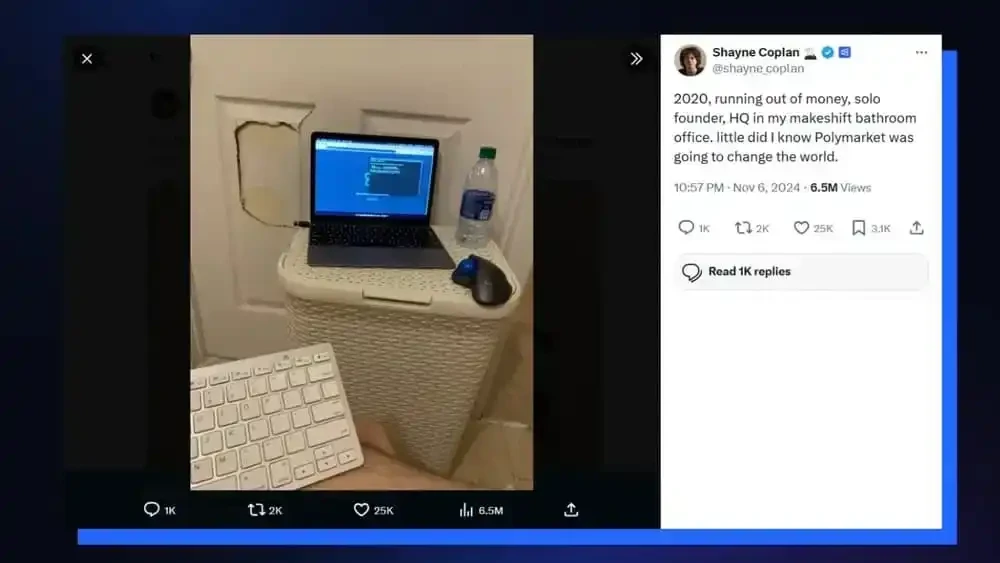
A young man with almost no resources, in the most chaotic time in the world, trying to build a market to price that chaos. The pandemic made everyone a predictor, and what Coplan wanted to do was compress the judgments scattered across chat groups, news comment sections, expert interviews, and trader desktops into a single tradable price.
He had no co-founder, was running out of money, and had to inventory the items in his apartment to see what he could sell to pay rent. The product's name was still in flux: Union.market, Union Marketplace, finally becoming Polymarket. The name sounds obvious in retrospect, but in the beginning, it was just a new entrance growing out of the wreckage of an old project.

Polymarket founder Shayne Coplan, Source: CBS "60 Minutes"
In June 2020, Polymarket officially launched. Technically, it used Polygon and USDC for settlement, offering lower fees, faster speeds, and a user experience closer to a normal internet product compared to early Ethereum mainnet prediction markets like Augur.
The early markets were direct: ETH price, US COVID-19 case trends, the 2020 election. These markets seemed disparate, but they all pointed to the same question: When the world is surrounded by uncertainty, are people willing to use real money to express their judgment about the future?
Four months later, the answer started to surface.
In October 2020, the US presidential election entered its final stretch. The pandemic wasn't over, mail-in ballots became a new battleground, the aftermath of racial justice protests still echoed in the streets and TV debates, and the shadow of economic recession weighed on household bills and market expectations. Trump tried to prove he could lead the country out of crisis, while Biden framed the election as a chance to "return to normal."
That fall, every part of American society was being pulled by politics. TV stations ran polls on a loop, with hosts repeatedly analyzing red and blue maps; social media was filled with conspiracy theories, partisan mobilization, and arguments over mail-in ballots; Wall Street tried to gauge the direction of taxes, regulation, and fiscal policy; ordinary people searched for some certainty amidst the pandemic and the election. Everyone was asking: Does Trump still have a chance? Is Biden's lead really solid? If vote counting is delayed, will the market crash first?
Polymarket was still a niche crypto tool at launch, but the election gave it its first real public test. In October, Polymarket completed a $4 million seed funding round, led by Polychain Capital, with participation from Naval Ravikant, 1confirmation's Nick Tomaino, and others.
For a product that came straight out of a bathroom, this funding wasn't just capital; it was a signal. At least a group of crypto investors believed that prediction markets could become useful again.
In November, the showdown between Biden and Trump reached its climax. Polymarket's market price consistently pointed to a Biden victory for weeks before the election. The "Will Trump win?" market saw over $8 million in trading volume. Looking back today, $8 million is small, nowhere near the tens of billions of 2024 election cycle. But at the time, it was enough to prove one thing: some people were willing to put their political judgments on-chain for trading.
This $8 million wasn't the end point of a commercial success, but the beginning of a product proposition. It proved Polymarket was more than just a temporary pandemic toy or a self-indulgent experiment within the crypto circle. It gave the first visible sample of the question: "Can market prices become real-time signals for public events?"
Of course, Polymarket in 2020 was still small. It was more like a niche crypto tool than a reference source for mainstream political media. Coplan was still managing social accounts himself, sending private messages to investors one by one, hoping they would retweet or like his posts. Vitalik Buterin tried Polymarket around the same time and praised its UX as being friendly for non-crypto users. This endorsement was important because one of the biggest failures of prediction markets in the past was that the ideas were brilliant, but the products were too difficult to use.
Slapped by Regulators
In 2021, Polymarket grew from a personal project into a company of over a dozen people. Monthly active users grew from thousands to tens of thousands. A more complete team began operating around it: people watching the product, people watching the market, people managing the community, people handling the constant stream of settlement disputes. It was no longer just a page built by Coplan alone in his bathroom; it was a real trading venue producing prices, disputes, and news material.
The internal team culture was very "rebel/maverick," carrying the typical vibe of a crypto startup: build it first, get the market running, and deal with the rules and boundaries later.
It was the 2021 crypto bull market, and almost everyone believed speed was more important than order. DeFi, NFTs, DAOs, GameFi – every day brought a new narrative, and every new narrative challenged old rules. Polymarket was part of this atmosphere.
Meanwhile, Coplan continued to accumulate social capital within crypto culture. Under the pseudonym ethsquiat, he amassed a large collection of NFTs, early supporting crypto artists like FEWOCiOUS. This wasn't part of Polymarket's product roadmap, but it's useful for understanding Coplan. For this generation of founders, identity, capital, taste, and product are often intertwined; a wallet address can sometimes say more about who you are than a business card.
But Polymarket was different from most crypto products. NFTs could be called art, DeFi could be called a financial experiment, DAOs could be called organizational innovation. Prediction markets, once they started dealing with real-world events, directly bumped into the boundaries of financial regulation and oversight. Polymarket could call itself an information market, but regulators saw something else: users were using money to bet on event outcomes, which looked like unregistered event contract trading.
So the CFTC's questions became specific. The issue was no longer "Is your product interesting?" but "Are you qualified to offer these contracts?" The more markets Polymarket listed, the sharper the questions became. ETH price, COVID cases, presidential elections, policy events – users saw these markets as information, but in regulatory filings, they looked like binary options.
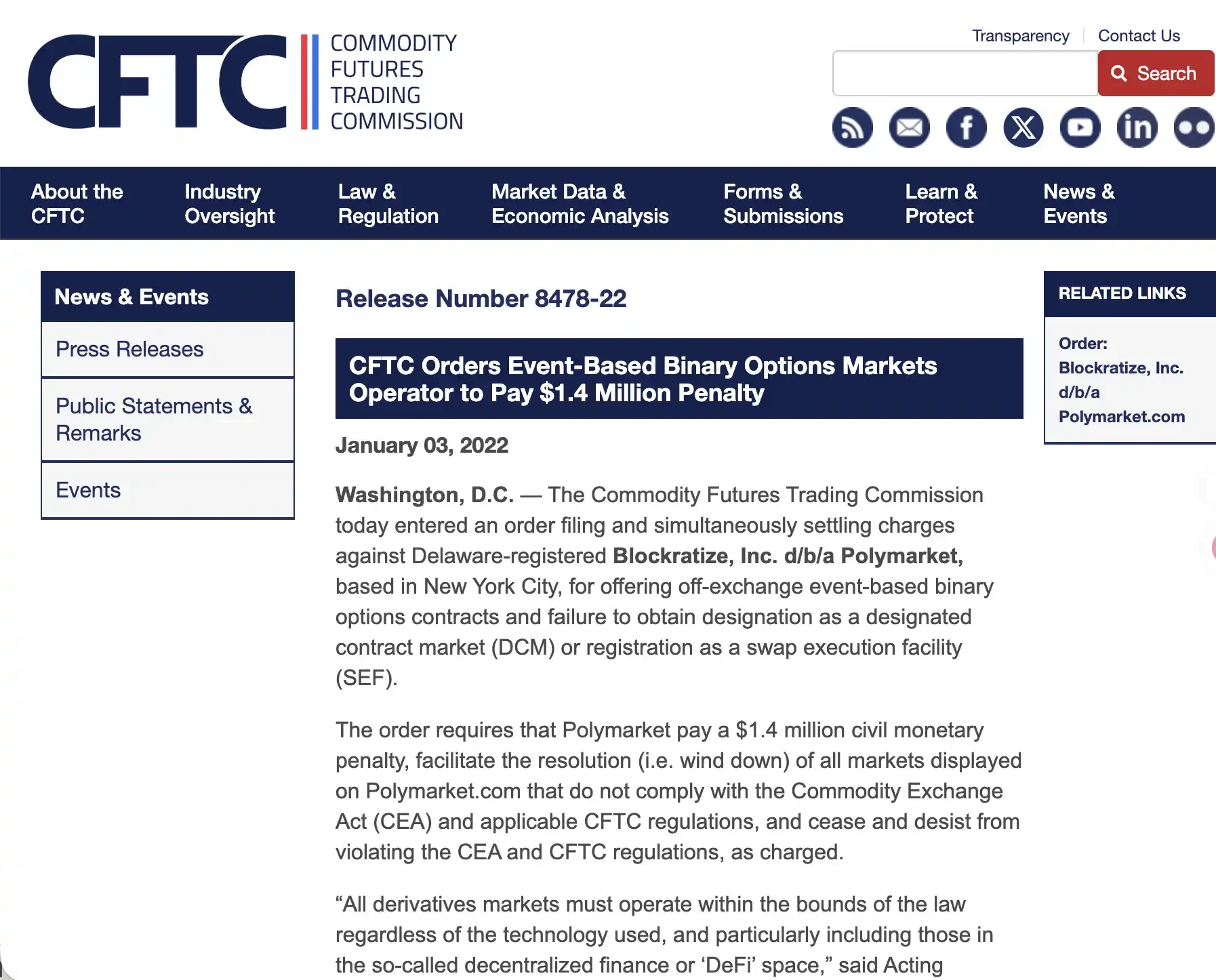
On January 3, 2022, the CFTC issued a cease and desist order against Polymarket. The charge was that Polymarket operated unregistered event-based binary options markets, i.e., off-exchange binary options contracts not offered on a designated contract market. The penalty included a $1.4 million civil fine, requiring it to wind down non-compliant markets and cease the violations. The CFTC also noted that Polymarket received a penalty reduction for "substantial cooperation." By that time, Polymarket had offered over 900 event markets.
Following the penalty, Polymarket began geoblocking US users.
A platform still operating out of New York, still run by an American founder, and still serving global political and financial events, was forced to shift its core trading outside the US, even though many of the events it discussed still occurred in America.
Exile and Explosion
After the CFTC penalty, Polymarket entered a very strange state. It wasn't dead, but it was no longer whole. It was still running, still serving international users, still able to list various markets, but it had lost its most crucial and symbolically important domestic market.
For a New York company, this situation was awkward. It didn't feel like complete failure, because the product was still alive; nor did it feel like true success, because US users were locked out. It felt more like an exile: the company's people were in the US, but the product had to pretend the US didn't exist.
In May 2022, former CFTC Chairman J. Christopher Giancarlo joined Polymarket's advisory board as its chair. Giancarlo is known in crypto circles as "CryptoDad." The signal of this appointment was clear: after being hit by regulators, Polymarket was starting to build its compliance narrative.
But a compliance narrative couldn't immediately change the situation. An advisory board wasn't a license, and a former regulator's name couldn't automatically open the US market. From 2022 to 2023, Polymarket entered a low ebb. Operating purely overseas, its scale shrank. By the end of 2023, its cumulative total trading volume was about $73 million. This number could be presented at the time, but compared to the explosion of the 2024 election cycle, it felt like a different era.
Low ebbs are the hardest to write about and are easily overlooked because