When 24/7 Is No Longer Scarce: CME Crude Oil and Binance US Stocks Encroach, Hyperliquid's Valuation Anchor Is Loosening


- Core Thesis: CME, Binance, and NYSE/ICE are respectively launching tokenized or 24/7 trading products, replicating Hyperliquid’s previously unique round-the-clock trading capability for traditional assets. This has triggered a market reassessment of HYPE’s valuation anchor, shifting from performance validation to competitive expectations.
- Key Elements:
- CME plans to launch 24/7 trading for 10-barrel mini WTI crude oil futures and 1-ounce gold futures by 2026, emphasizing regulatory oversight and low barriers to entry, aiming to fill the risk management gap during traditional market closures.
- Binance has launched bStocks, offering 24/7 trading of tokenized US stocks like NVDA and TSLA, moving beyond synthetic perpetuals toward a tokenized stock gateway.
- While these products differ in form (futures, tokenized stocks, on-chain perpetuals), they collectively replicate Hyperliquid’s core narrative: the ability to trade traditional assets during market holidays.
- For Hyperliquid, while liquidity inertia, high leverage, and on-chain experience can retain some users, the “uniqueness” of its traditional asset exposure is diminishing. The market is beginning to question future growth in trading volume and fee revenue.
- CME’s gold and crude oil new products are scheduled to launch in July and August 2026 respectively. Actual trading volumes and depth data during nighttime and weekends will then become a key observation window to verify whether competitive diversion is real.
TL;DR
- CME plans to launch 24/7 trading for mini-sized crude oil and 1-ounce gold, as traditional markets fill the risk management gap during off-hours.
- Binance, NYSE/ICE are also advancing 24/7 tokenized assets, and Hyperliquid 's advantage of "trading traditional assets anytime" is being repriced.
- Related assets: HYPE, CME, ICE, BNB, and products related to tokenized crude oil, gold, and US stocks.
HYPE's recent pullback can easily be attributed to unlocks, large holders selling, or issues with TradeXYZ's SpaceX pre-IPO. But looking at a longer timeline, another issue is becoming more important: Hyperliquid's ability to "trade traditional assets anytime," which was previously rewarded by the market, is now being replicated by traditional finance and centralized trading platforms.
On June 11, CME announced plans to launch 24/7 mini-sized WTI crude oil futures, pending regulatory approval, and to extend 24/7 trading to its existing 1-ounce gold futures. Around the same time, according to public reports, Binance launched bStocks, allowing users to trade tokenized US stocks like NVDA and TSLA using liquidity from Binance's main exchange. NYSE/ICE is also developing its own 24/7 tokenized securities and on-chain settlement platform.
These products are not identical. CME offers regulated futures, Binance bStocks is more of a tokenized stock gateway, and Hyperliquid provides on-chain perpetual contracts. But they compete for the same demand: when crude oil, gold, and US stocks are off-hours in traditional markets, traders still want immediate exposure or the ability to hedge risks instantly.
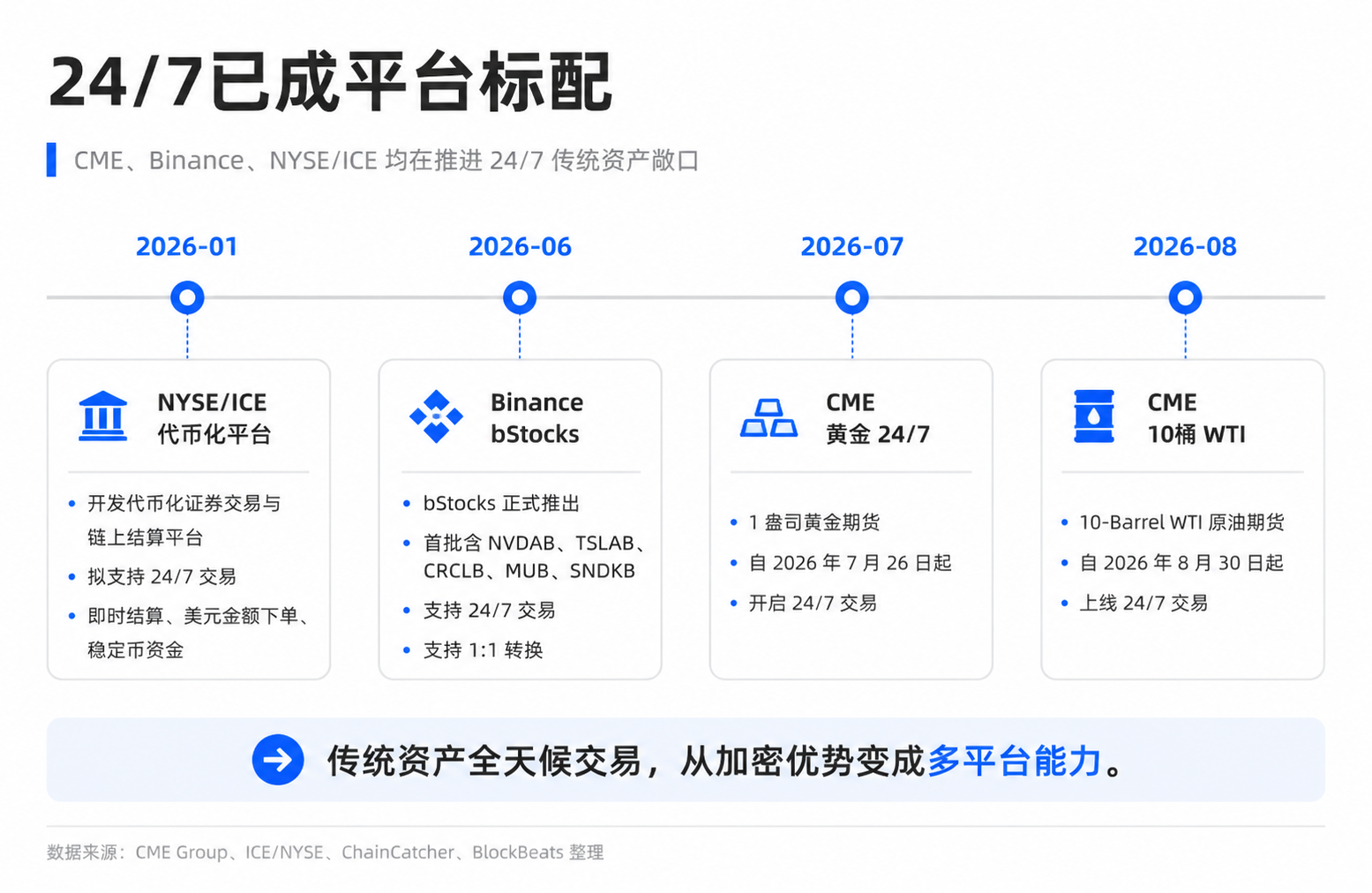
So this isn't a story of "CME taking Hyperliquid's volume." CME's new crude oil products haven't launched yet, and 24/7 gold trading won't start until July, so actual diversion needs to be verified by trading data. It's more like a revaluation of expectations: if 24/7 is no longer a unique advantage exclusive to Hyperliquid, how should the market understand HYPE's valuation anchor?
24/7 Trading is Evolving from a Crypto Advantage to an Industry Standard
For average investors, the issue can be simplified: news doesn't wait for market open.
Geopolitical conflicts can happen over the weekend, immediately changing expectations for oil and gold prices. Earnings reports, regulatory investigations, or unexpected events for a US-listed company can also occur outside traditional trading hours. In the past, traders either waited for the open, accepting gap risk, or sought alternative tools to hedge in advance. The crypto market, with its inherent 24/7 trading, has long benefited from this.
Hyperliquid seized this gap. It's not just a crypto perpetual trading platform; it brings exposure to traditional assets like stocks, crude oil, and gold on-chain. Some third-party HIP-3 markets and ecosystem products extend to even earlier-stage assets. For some traders, Hyperliquid acts like a "risk convenience store that never closes": when US markets are closed or commodity futures are illiquid, on-chain contracts still allow them to express a directional view, hedge, or even trade with leverage.
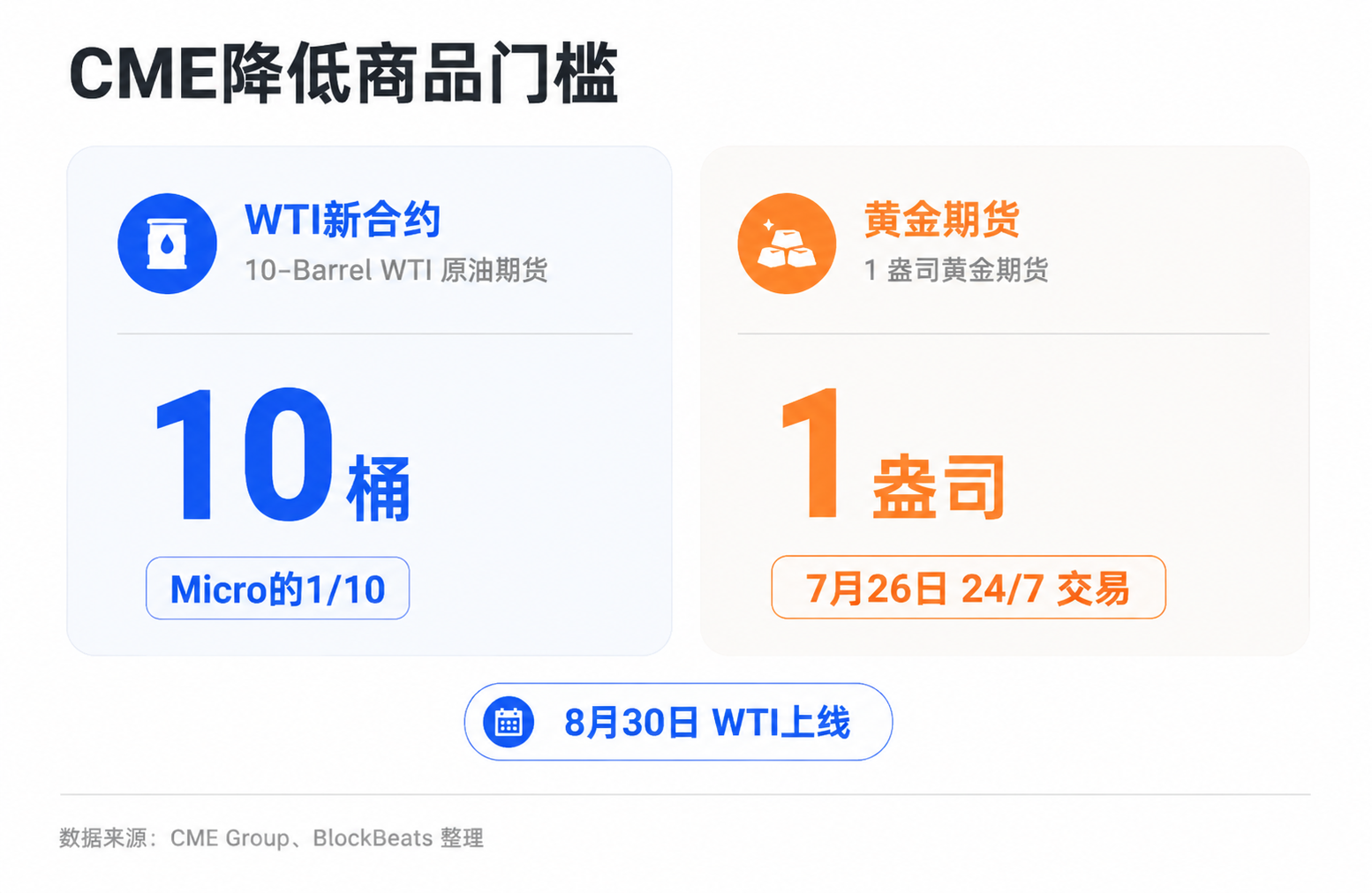
This is precisely the pain point CME is targeting. According to CME's June 11 announcement, the new 10-Barrel WTI Crude Oil futures contract will represent about 10 barrels, one-tenth the size of the existing Micro WTI, scheduled for launch on August 30, 2026, and will be cash-settled. The existing 1-ounce gold futures are planned to begin 24/7 trading starting July 26, 2026, also cash-settled.
In simple terms, these mini-sized futures break down large commodity contracts into smaller pieces, allowing traders to manage risk more precisely without committing large amounts of capital. Derek Sammann, CME's Global Head of Commodities, stated in the announcement that amid geopolitical uncertainty, traders need regulated products with appropriate contract sizes available 24/7 to manage risk exposure when news breaks.
The key points in this statement are not just "24/7" but also "regulated" and "appropriate size." The former targets institutional and compliant funds, while the latter lowers the entry barrier. CME doesn't necessarily need to replicate Hyperliquid's high leverage and on-chain experience; it aims to provide an alternative form of 24/7 access: more traditional, more compliant, and more easily accepted by the existing financial system.
CME, Binance, and NYSE Target the Same Underlying Demand
While the product forms offered by CME, Binance, and NYSE/ICE differ, they collectively replicate a key advantage Hyperliquid was once clearly known for: the ability to trade traditional assets during market off-hours.
CME's entry point is commodities. Crude oil and gold are core assets in global macro trading; the greater the geopolitical tension, the stronger the demand for risk management outside regular trading hours. For traditional institutions, if CME can provide sufficient liquidity during nights and weekends, they may not need to bear the additional compliance, custody, and operational risks associated with on-chain perpetual platforms.
Binance's entry point is tokenized US stocks. According to public reports, bStocks' initial offerings include NVDAB, TSLAB, CRCLB, MUB, SNDKB, emphasizing 24/7 trading, 1:1 conversion, and self-custody support. It's important to distinguish bStocks from Binance's other stock-related products; bStocks is more of a tokenized stock gateway and should not be confused with stock perpetual contracts.
Tokenized stocks can be understood as "stock certificates on the blockchain," differing from Hyperliquid's synthetic perpetuals. Synthetic perpetuals are more like contracts betting on price movements, where the trader doesn't hold the actual stock. Tokenized stocks aim to have their price anchored more closely to the real asset and enhance trust through conversion mechanisms.
NYSE/ICE's direction seems more like foundational infrastructure. In January of this year, ICE/NYSE announced plans to develop a platform for tokenized securities trading and on-chain settlement, intending to support 24/7 trading, instant settlement, orders denominated in US dollars, and stablecoin fund transfers, subject to regulatory approval. If this materializes, traditional exchanges would not just be extending trading hours but shifting part of the securities market's settlement and trading logic towards an experience closer to on-chain.
These three cannot be directly equated. CME futures have margin, delivery, and regulatory frameworks; Binance bStocks is more like a tokenized stock gateway within a centralized exchange; Hyperliquid perpetuals lean towards high leverage, on-chain margin, and rapid speculation or hedging. Their users, risk controls, leverage, and KYC requirements differ.
But the market revaluation doesn't require them to be identical. As long as they cover some of the same demand, Hyperliquid's narrative changes. The old narrative was: if you want to trade exposure to crude oil, gold, or US stocks at any time, on-chain perpetuals are one of the most direct entry points. The current narrative is becoming: you can still go to Hyperliquid, but you can also choose CME, Binance, and perhaps even NYSE's tokenized platform in the future.
Hyperliquid Needs to Prove Traders Will Stay
For Hyperliquid supporters, the actions of CME and Binance certainly don't mean complete substitution. The appeal of on-chain perpetuals has never solely been about 24/7 trading.
Hyperliquid's advantages include high leverage, self-custody, on-chain speed, trading culture, and a well-established liquidity network. For crypto-native traders and some high-frequency speculative funds, features like less KYC, faster listings, and more flexible margin usage provide experiences that traditional platforms find hard to replicate. Even if CME offers 24/7 crude oil and gold, it won't immediately cause all traders willing to bear on-chain risk and seek higher leverage to migrate.
Liquidity itself creates inertia. Where traders go depends not only on product specifications but also on depth, slippage, fees, available leverage, and counterparties. If Hyperliquid already has sufficiently deep order books for certain contracts, new compliant products may not immediately capture its volume. Especially in the early stages, whether CME's night and weekend trading is genuinely active remains to be seen based on actual trading data, not just product announcements.
The pressure is coming from this: Hyperliquid can no longer rely solely on "we are 24/7" to prove the scarcity of its traditional asset exposure. It needs to prove that even when other platforms offer 24/7 trading, traders will still prefer to keep their positions, margin, and volume here.
This will transmit to HYPE's pricing logic. Some investors typically view HYPE as a platform asset linked to trading volume and fees: more trading leads to more fees, stronger protocol buyback capacity for HYPE, and a stronger cash flow narrative for the token. This fee and buyback cycle was a key reason HYPE previously stood out from many purely narrative tokens.
The actions of CME, Binance, and NYSE/ICE may not immediately change Hyperliquid's current revenue, but they will alter the market's expectation for future revenue growth. HYPE's pullback can be explained by multiple factors, including unlocks, large holder behavior, overall risk appetite, and competitive expectations, and cannot be simply attributed to CME's new products. However, when competitors start to fill the 24/7 capability gap, the market will naturally question: can the future volume growth for traditional asset perpetuals be as smoothly converted into fees and buybacks as in the past?
This is why this discussion feels more like a revaluation of expectations rather than a verification of performance. CME's new crude oil contracts haven't launched yet, and there is no clear data on user migration between Binance bStocks and Hyperliquid's stock perpetuals. What can be confirmed now is that Hyperliquid's "uniqueness" in traditional asset exposure is declining; what cannot be confirmed is to what extent this will translate into real volume loss.
July and August Will Provide the First Verification
What's truly worth watching next isn't which platform wrote "24/7" in its announcement, but whether there is real trading volume and depth during off-hours.
CME's 1-ounce gold futures are scheduled to start 24/7 trading on July 26, 2026, and the new 10-barrel WTI crude oil futures are scheduled for launch on August 30, 2026. These two milestones will provide the market with initial data points: whether night and weekend trading activity is sufficient, whether spreads are narrow enough, and whether institutions and professional traders are indeed moving their risk management back into the regulated futures system.
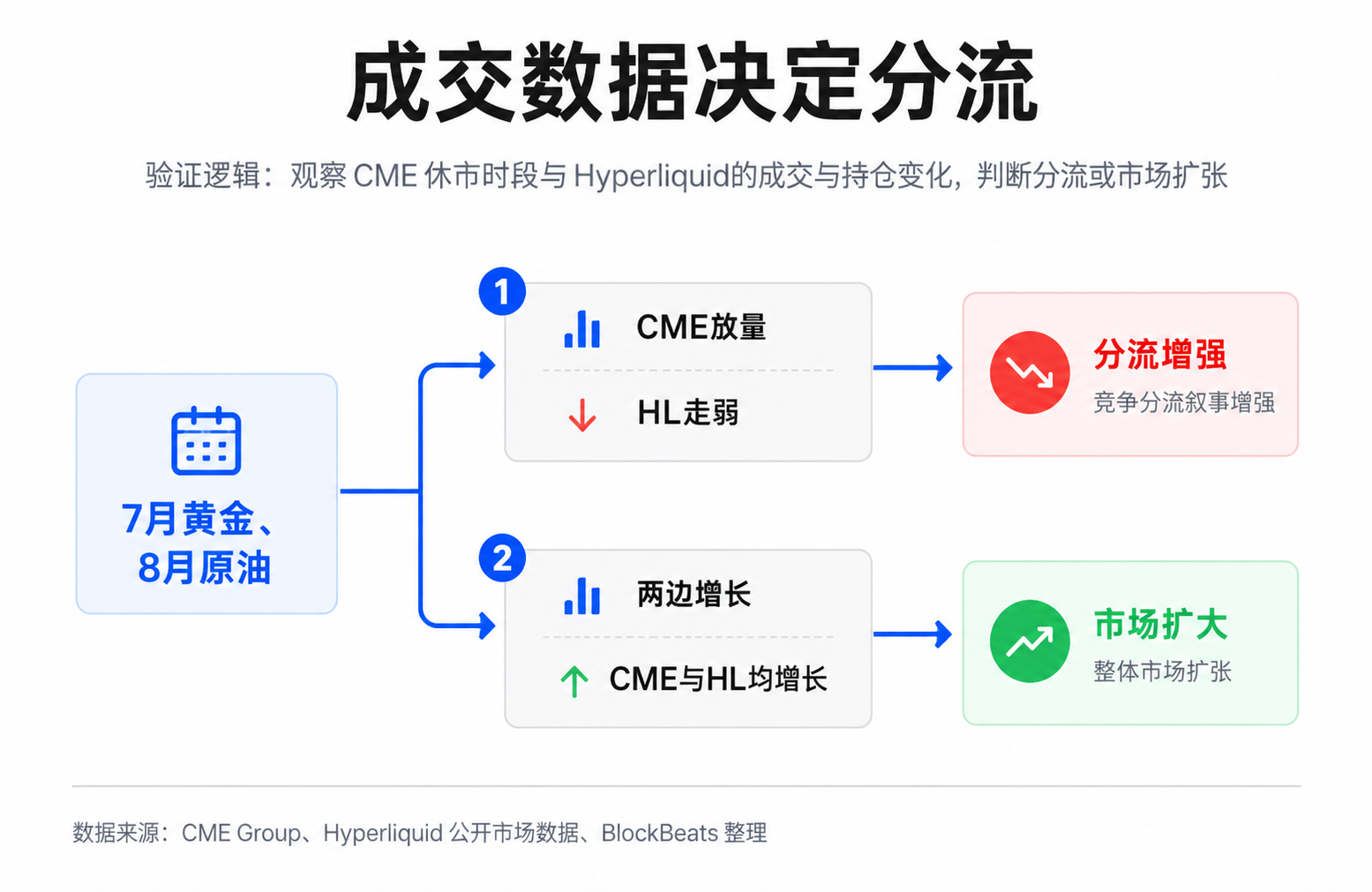
For Hyperliquid, the more direct indicators to watch are the volume, open interest, and fee contribution of its corresponding commodity and stock perpetuals. If CME's gold and crude oil new products start gaining volume while Hyperliquid's corresponding market volume and open interest weaken, the narrative of competitive diversion will strengthen. If both sides grow, it suggests 24/7 trading might be expanding the overall market rather than simply shifting volume from on-chain to off-chain.
This is where HYPE's situation is critical. Unlocks and large holder trading affect short-term prices, but the longer-term valuation anchor still relies on whether the platform can consistently generate fees and convert those fees into buybacks. As long as trading volume and buyback intensity can cover new supply and emotional pressure, competitive expectations may not necessarily turn into a trend-driven decline. Conversely, if traditional asset perpetual growth slows down while external platforms' 24/7 liquidity begins to form, the market's pricing of HYPE will shift from "high-growth platform token" to a more cautious cash flow expectation.
It's not time to draw a final conclusion on Hyperliquid. A more accurate statement is that the demand it pioneered and validated is being acknowledged and replicated by larger financial platforms. The next round of data will determine whether this revaluation remains at the narrative level or continues to transmit to revenue and token price.