






“Unlimited Money Printing” Vulnerability Lurks for Four Years, Privacy Coin ZEC Crashes by Half in a Day


- Key Takeaway: Zcash’s founder disclosed that its privacy pool Orchard had a severe forgery vulnerability. Although it has been fixed, the market panicked and sold off due to fears of historically “unlimited, undetectable” counterfeit coins. The ZEC token dropped over 50% intraday, triggering a full-blown crisis of trust in the project’s security.
- Key Components:
- A security researcher discovered an incomplete constraint vulnerability in the Orchard circuit on May 29 and successfully generated a test version of forged ZEC locally, confirming the attack vector.
- The vulnerability was described as allowing “unlimited, undetectable forged ZEC,” which could be used to create assets out of thin air without violating normal transaction logic.
- Due to Orchard’s privacy features, it is impossible to quantify or trace whether forged ZEC has historically entered circulation. It is also extremely difficult to cryptographically prove that it never happened, leading to a collapse in market confidence.
- BitMEX co-founder Arthur Hayes liquidated all his ZEC holdings after the vulnerability was exposed. His exit, as a key narrative driver, exacerbated market panic and narrative degradation.
- The community believes that the vulnerability, lying dormant for nearly four years after being enabled in 2022 before being discovered with AI assistance, has shaken Zcash’s core assumptions about supply and privacy security. This crisis of trust far surpasses the price correction itself.
Original: Odaily (@OdailyChina)
Author: Asher (@Asher_0210)

On the early morning of June 5, Zcash founder Zooko Wilcox posted that a critical counterfeiting vulnerability had been confirmed to have existed in Orchard, the next-generation privacy pool launched by Zcash in 2022. Although the Zcash team emphasized that the vulnerability has been fixed and considered the probability of exploitation low, it still failed to stem the spread of market panic.
After the news broke, Zcash's token ZEC quickly plummeted, with short-term losses exceeding 30%; by the afternoon, the sell-off had not stopped, with panic continuing to spread and the price falling to around $250 at one point, extending the intraday decline to over 50%. 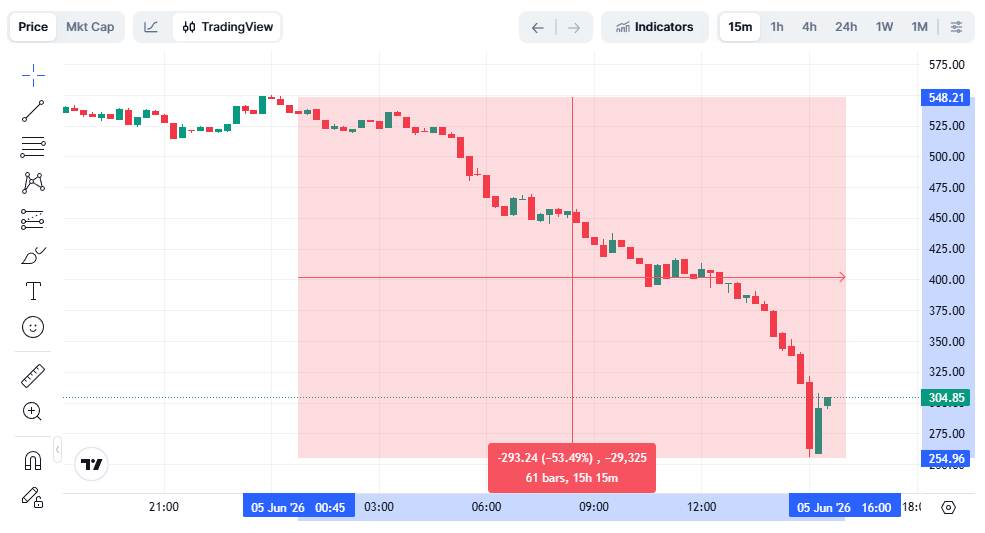
Security researcher Taylor Hornby discovered the issue on May 29 and subsequently verified the vulnerability in a local environment, generating a test version of counterfeit ZEC, further confirming that the vulnerability is an exploitable attack path. Currently, two major controversies surround Zcash: first, whether counterfeit ZEC has ever appeared in the privacy pool over the past four years; second, how can the team officially prove that no counterfeit ZEC has flowed into the privacy pool – a task that is extremely difficult to verify.
Where Does the "Unlimited Minting" of ZEC Come From?
Orchard (Zcash's privacy-protecting "shielded pool") relies on zero-knowledge proof circuits for security, with the core rule being asset conservation: every transaction's output must come from legitimate inputs, and ZEC cannot be created out of thin air. Users can hide balances and transaction amounts, but the system must verify the legitimacy of the transaction.
Security researcher Taylor Hornby discovered an under-constrained constraint in the Orchard circuit. An attacker could input data that should not pass verification, yet the verification might still return a success. In other words, without needing administrator privileges or control over nodes, and without relying on a backdoor vulnerability, as long as the system mistakenly considers the transaction legitimate, non-existent ZEC could be recorded as a legitimate asset within Orchard.
Shielded Labs described this as an "unlimited, undetectable counterfeit ZEC" vulnerability.
The Bug Is Fixed, But Historical Issues Linger
For common security incidents, the biggest fear is the scale of loss, but the most troublesome aspect of this Zcash crisis is that the loss cannot be directly quantified.
If an attack occurred on the transparent chain, the market could at least see the attacker's address, fund flows, and affected assets. However, the transaction amounts, balances, and fund paths within Orchard are inherently hidden. Once counterfeit ZEC has appeared in the pool, it is extremely difficult for outsiders to determine whether it remains within Orchard or has gradually leaked out through normal transactions.
More critically, Orchard is not a completely isolated black box. Users can migrate assets between different pools, meaning both legitimate ZEC and potential counterfeit ZEC could be mixed together within the pool.
The Zcash ecosystem can emphasize that no evidence of the vulnerability being exploited has been found, and can also claim that the probability of malicious exploitation is low. But for traders, "no anomaly detected" and "proven to be safe" are not the same thing.
This is the core reason behind ZEC's expanding decline. Until the question of whether fake ZEC has ever existed in Orchard is proven, the credibility of ZEC's supply will remain under a shadow.
Arthur Hayes Liquidation Triggers Market Confidence Crisis
After the ZEC vulnerability was exposed, BitMEX co-founder Arthur Hayes publicly liquidated his holdings, further amplifying market panic.
Arthur Hayes stated on the X platform that he had sold all his ZEC holdings. Hayes said he learned about the attack yesterday but did not realize its conflict with his narrative framework. The 30% drop in ZEC prompted him to reconsider and decide to take profits on the entire position. He added that while he believes the possibility of additional minting is extremely low, it cannot be formally proven impossible at the cryptographic level; he will continue to reassess the situation and will repurchase if his assumptions are proven wrong, hoping to build a position at a lower price. He noted that privacy is priceless and he would not mind repurchasing at a higher price.
This move dealt a heavy blow to ZEC. Over the past period, Arthur Hayes had been one of the key narrative drivers for ZEC. His bullish view was based on the long-term logic of privacy assets regaining pricing power amidst the expansion of AI, government surveillance, and big tech companies. Therefore, his liquidation was not just a profit-taking move by a major holder, but more like a public downgrade of ZEC's current narrative.
When a leading narrative supporter chooses to exit first, long positions supported by conviction and expectations become more prone to collective profit-taking and risk aversion.
Community Sentiment Spirals, ZEC Turns from Price Correction to Trust Crisis
Possibly influenced by Arthur Hayes' liquidation, community discussions about ZEC quickly shifted from "should I buy the dip?" to "can I still trust this?"
On one hand, the community repeatedly emphasized the severity of the vulnerability itself. Compared to short-term price declines, many users were more concerned that a vulnerability theoretically capable of creating unlimited counterfeit coins had lurked within Orchard for nearly four years. For them, the price drop was just a surface phenomenon; what truly shook confidence was that the core security assumptions of Zcash had been called into question.
On the other hand, the role of AI in discovering the vulnerability further exacerbated distrust. Taylor Hornby, assisted by an AI tool, conducted a targeted review of the Orchard circuit, eventually finding the vulnerability, writing an exploit program, and generating counterfeit ZEC in a local environment. Although AI did not independently complete the audit, the community quickly latched onto the narrative that "a critical vulnerability that had existed for years was uncovered with AI assistance in a short time," which spread rapidly.
This directed public criticism at Zcash's development and auditing system. The community questioned why a vulnerability existing since 2022 could go undetected for years on the mainnet. If a core privacy pool could have constraint omissions, how can users trust Zcash's promises regarding supply and privacy security?
Therefore, this decline is not merely profit-taking. Until Zcash provides more convincing proof, no one is truly willing to hold ZEC long-term.





