8-Day Deity Creation, 1-Night Reckoning: The Emotional Manipulation Playbook of the "Monster Coin" RAVE


- Core Viewpoint: After experiencing a surge of over 100x within a week, the RAVE token plummeted nearly 95% in less than 24 hours following accusations of market manipulation by on-chain detectives and subsequent investigations by multiple exchanges. This extreme volatility highlights the potential manipulation risks and regulatory gaps in the crypto market.
- Key Elements:
- The price of the RAVE token soared from around $0.22 to $28 in approximately one week, a gain exceeding 100x, before crashing to around $1 within 24 hours, a drop of 95%.
- On-chain detective ZachXBT publicly accused RAVE of market manipulation and offered a bounty for leads, directly triggering the price reversal and investigations by exchanges (Bitget, Binance, Gate).
- During the crash, approximately $6 billion in market capitalization evaporated, yet the 24-hour liquidation volume was only about $52 million, highlighting a severe asymmetry between price action and actual market leverage.
- The project team, RaveDAO, denied involvement in price manipulation, emphasizing its long-term development vision. It hosted an offline event in Hong Kong on the night of the crash, creating a stark contrast between market frenzy and project activity.
- The incident sparked widespread market discussion about "pump-and-dump schemes," exposing the structural risks where liquidity, attention, and price manipulation could dominate the market in a regulatory vacuum.
Original | Odaily (@OdailyChina)
Author | Asher (@Asher_ 0210)

Over the past week, the crypto market has been dominated by one name—RAVE.
Whether on social media, in trading groups, or in various market recaps, the focus, the complaints, and even the outlet for emotional venting have almost all revolved around it. The reason is simple: the price action of this token has been incredibly bizarre. It surged from $0.22 to $28, achieving a gain of over 100x in just over a week; then, last weekend, the trend suddenly reversed, plummeting from its highs to around $1 in less than 24 hours, a drop of nearly 95%, and it continues to fall.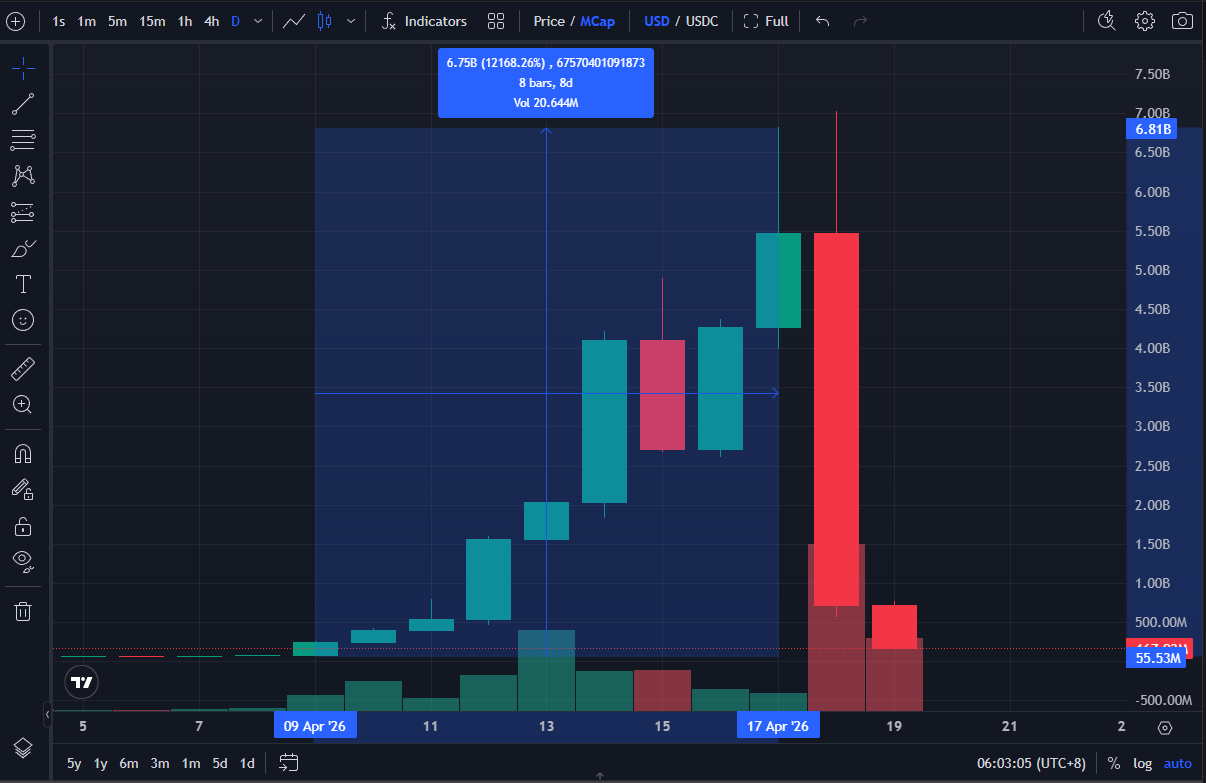
RAVE token surged over 100x in a week
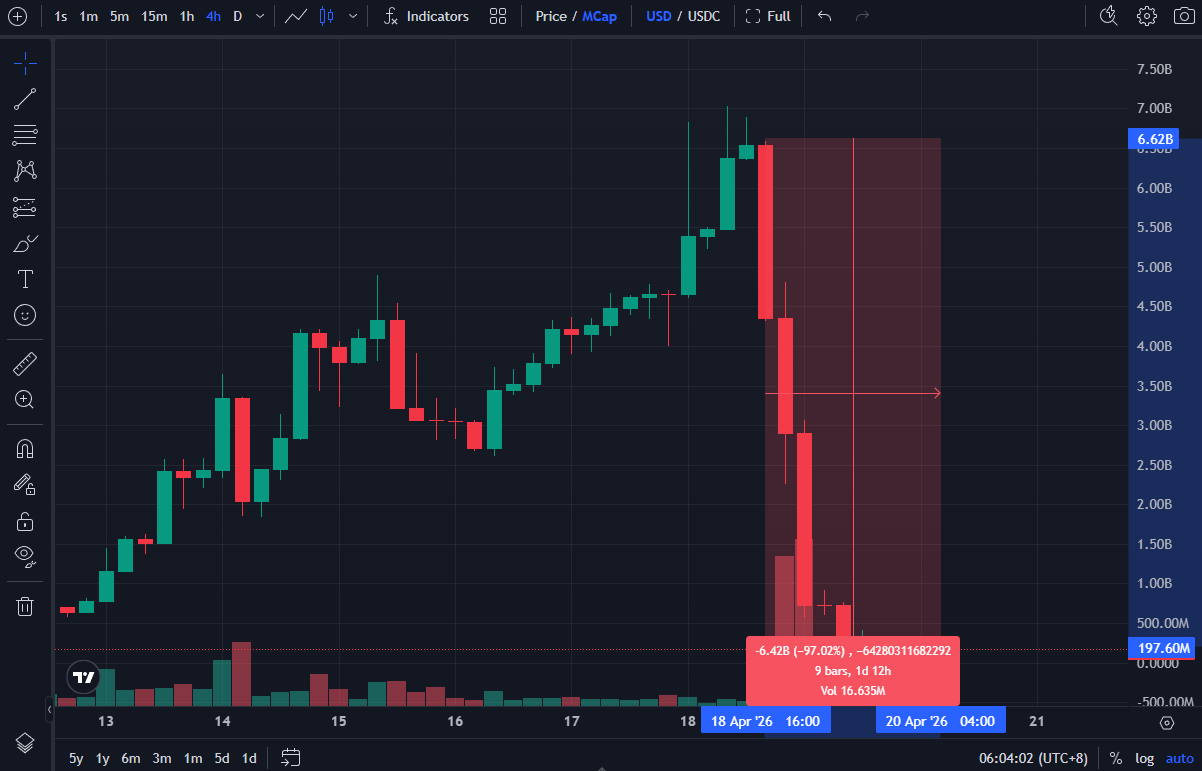
RAVE token plunged nearly 95% in a day
The switch from a continuous parabolic rise to an instant collapse is not only exaggerated but also difficult to explain as "normal market behavior." Precisely because of this, RAVE quickly evolved from a "case study of a bizarre token" into a focal event repeatedly discussed across the entire market. Odaily will now provide a complete recap of RAVE's journey from its explosive rise to its dramatic fall.
A Week-Long "Short Squeeze" Rally
Over the course of a week, RAVE's price climbed almost in a straight line, completing its 100x gain. This ascent was not a steady progression but unfolded in a constantly accelerating manner, repeatedly breaking expectations and leaving almost no "reasonable" point to short. Thus, a familiar script began to play out—the higher it went, the more people wanted to short it.
Looking back at community and media commentary during that week of gains, the vast majority of traders were waiting for the moment "when it should crash." The more outrageous the price became, the stronger the confidence of the bears grew. Many, while cursing it as "ridiculous," continuously added to their short positions, trying to catch the inevitable turning point. However, the reality was that RAVE offered almost no meaningful pullback space. Every oscillation that seemed like a potential top eventually turned into another leg higher. At one point on April 18th, RAVE's liquidation volume within an hour even surpassed that of BTC.
Screenshots of "got liquidated again" began to appear frequently in group chats. Some chose to double down and hold on, some cut their losses and exited, and others saw their losses snowball as they kept adding to losing positions. Market sentiment gradually shifted from the initial "How can this even go up?" to "When will it finally stop?"
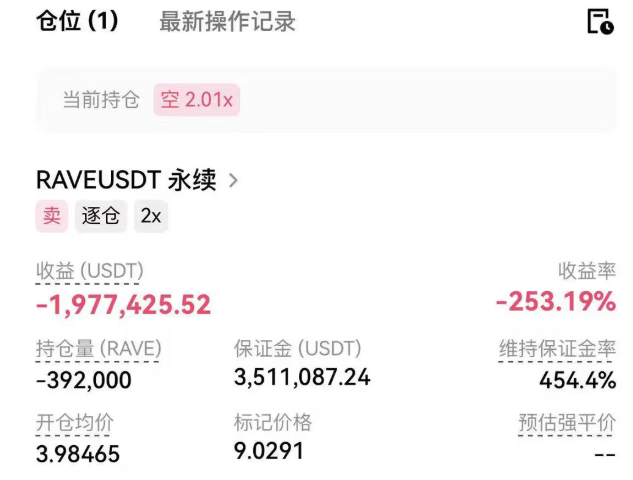
During RAVE's rise, users continuously shorted, leading to significant losses
Meanwhile, more subtle changes were occurring. As prices kept hitting new highs, the focus of market discussion began to shift from "where to short" to "how to catch the next RAVE." Some analyzed the rhythm of each pump, some scrutinized data trying to find patterns, and others, knowing something was off, still couldn't resist participating. The entire market, caught between disbelief and fear of missing out, was drawn deeper into this rally.
Just as the market was still immersed in this week-long frenzy of squeezing shorts, RAVE's market cap once approached $7 billion. Almost everyone knew that such a price action would eventually lead to a crash; the only uncertainty was when and how it would happen.
Ultimately, this turning point did not come from the market itself but from a public call-out by on-chain detective ZachXBT.
After ZachXBT's Call-Out: Investigation, Responses, and the Crash Happen Simultaneously
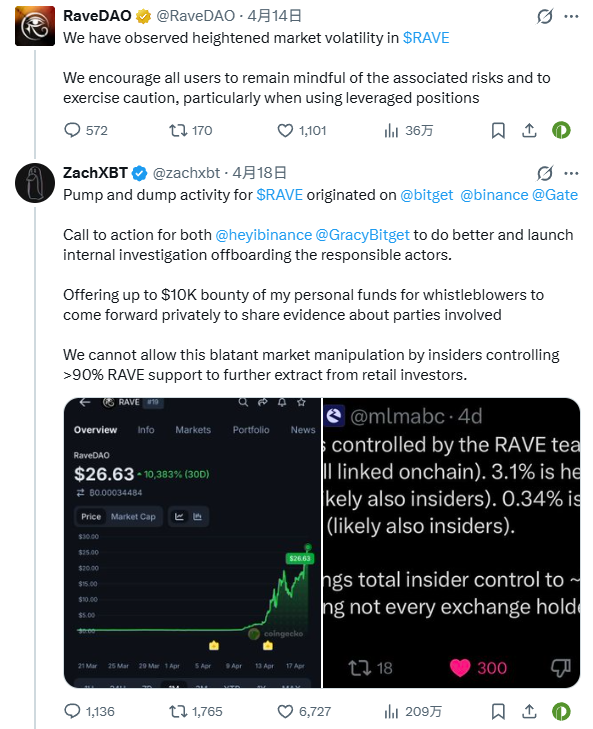
On April 18th, a public comment by on-chain detective ZachXBT under a post related to the RaveDAO team became the turning point of the entire event. At 15:26 (Beijing Time), he directly accused RAVE of obvious market manipulation and called on Binance, Bitget, and Gate to investigate, while also offering a $10,000 bounty for insider information. Hours later, as community participation grew, the bounty was quickly raised to $25,000.
The incident quickly escalated. The first to respond was Bitget. At 19:18 (Beijing Time), Bitget CEO Gracy Chen stated: "Thanks for highlighting! We've started investigating into $RAVE", confirming the platform had initiated an investigation.
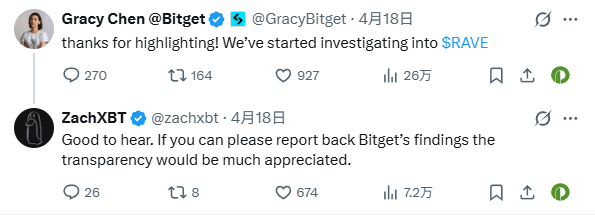
Bitget's Response to ZachXBT's Accusations Against RAVE Token
Subsequently, Binance also gave its stance. At 22:08 (Beijing Time), Binance Co-CEO Richard Teng responded: "Thanks for flagging this with us, we’re looking into it. We will always do our part to investigate all market misconduct."
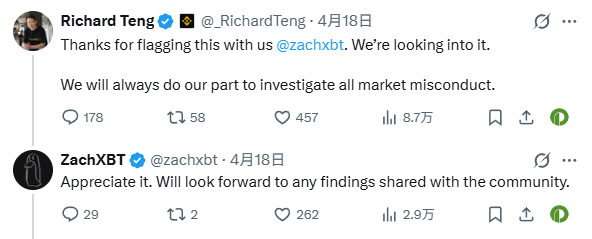
Binance's Response to ZachXBT's Accusations Against RAVE Token
Then, at 00:19 (Beijing Time) the next day, Gate also responded. Gate Chief Business Officer Kevin Lee stated: "Already on it. User protection comes first at Gate. We're reviewing $RAVE activity and will act accordingly."
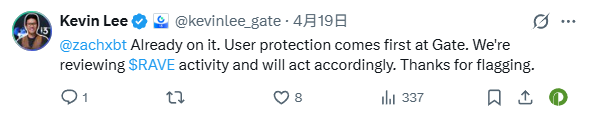
Gate's Response to ZachXBT's Accusations Against RAVE Token
And as this series of responses unfolded, RAVE's price also began to lose momentum and fall. From initial high-volatility oscillations to a continuous price plunge, it gave the market almost no time to react—a trust collapse triggered by a public call-out was playing out simultaneously on the price charts.
From around $26 down to $1, in less than 24 hours, RAVE fell by nearly 95%. This "bizarre token," which once neared a $7 billion market cap, was completely deflated in a single night. Even more impactful was the comparative data ZachXBT later provided: approximately $6 billion in market cap was wiped out, but the 24-hour liquidation volume was only about $52 million. This extremely asymmetric collapse further amplified the suspicion of "inflated valuation and distorted price."
"Who Actually Made Money?": Divided Market Sentiment
As RAVE rapidly collapsed amid the investigation calls, the market did not reach a consensus but instead showed clear division. Some viewed it as a classic case of "market manipulation and harvesting," while others believed it was simply part of market dynamics, albeit in an extremely dramatic form this time.
To some traders, RAVE's essence was never a "normal market." "A token with 99% controlled supply—you're not trading, you're participating in a script. The price isn't discovered; it's designed based on the order of liquidations." Under this narrative, concepts like trends, technical analysis, and even trading logic lose meaning—you see a candlestick chart, while the manipulator sees who should be liquidated next. "In this kind of setup, you have no say. You think you're betting against the market, but you're actually providing liquidity for the whale."
But another voice was equally strong. Some saw this as the crypto space's quintessential dark humor: "They start investigating after a 100x pump, but no one asks questions when it goes to zero." "You have to prove your innocence when it goes up, but no one is held responsible when it crashes." In their view, RAVE is not an exception but merely amplifies long-standing market issues to the extreme—projects that bleed slowly to zero also cause massive losses for retail but are rarely scrutinized this way.
Others pointed fingers at more macro structural problems. "Isn't the crypto space already an unregulated casino?" From market makers dominating liquidity to the closed loop of pumping, liquidating, and dumping, so-called "value" has long been marginalized. Attention and capital are the only pricing logic. In such an environment, RAVE is neither the first nor likely the last; it just used a more exaggerated way to make everyone see the rules clearly again.
Official Response: Denies Manipulation, Emphasizes "Long-Term Narrative"
Amidst the intense volatility from exchanges and market sentiment, RaveDAO also provided an official response promptly. Its core stance was very clear: deny involvement in price manipulation and distance the team from the recent extreme price volatility.
RaveDAO stated that the team did not participate in and is not responsible for the recent token price performance, emphasizing its long-term goal of "bringing Web3 to the real world" and attempting to build culture and user gateways through offline events. In this framing, price volatility is downplayed as external market behavior, while the team positions itself more as "builders."
Simultaneously, the project also addressed token-related questions to some extent. It stated that it would indeed sell some unlocked tokens at an appropriate time in the future for operations, hiring, market expansion, and other development expenses. However, it would explore mechanisms, including price or performance-triggered lock-ups, to align long-term interests with the community.
In tone, this statement deliberately avoided short-term price action, pulling the narrative back to "long-term building" and "real-world adoption." From "driving mass adoption of Web3" to "connecting the world through music and events," and promising to donate part of the profits to charity, RaveDAO attempted to paint a project vision that transcends price volatility.
At the same time this statement emphasizing "long-term building" and "real-world adoption" was released, RaveDAO held an offline event in Hong Kong's Central district on the evening of April 18th—"Dim Sum Rave."
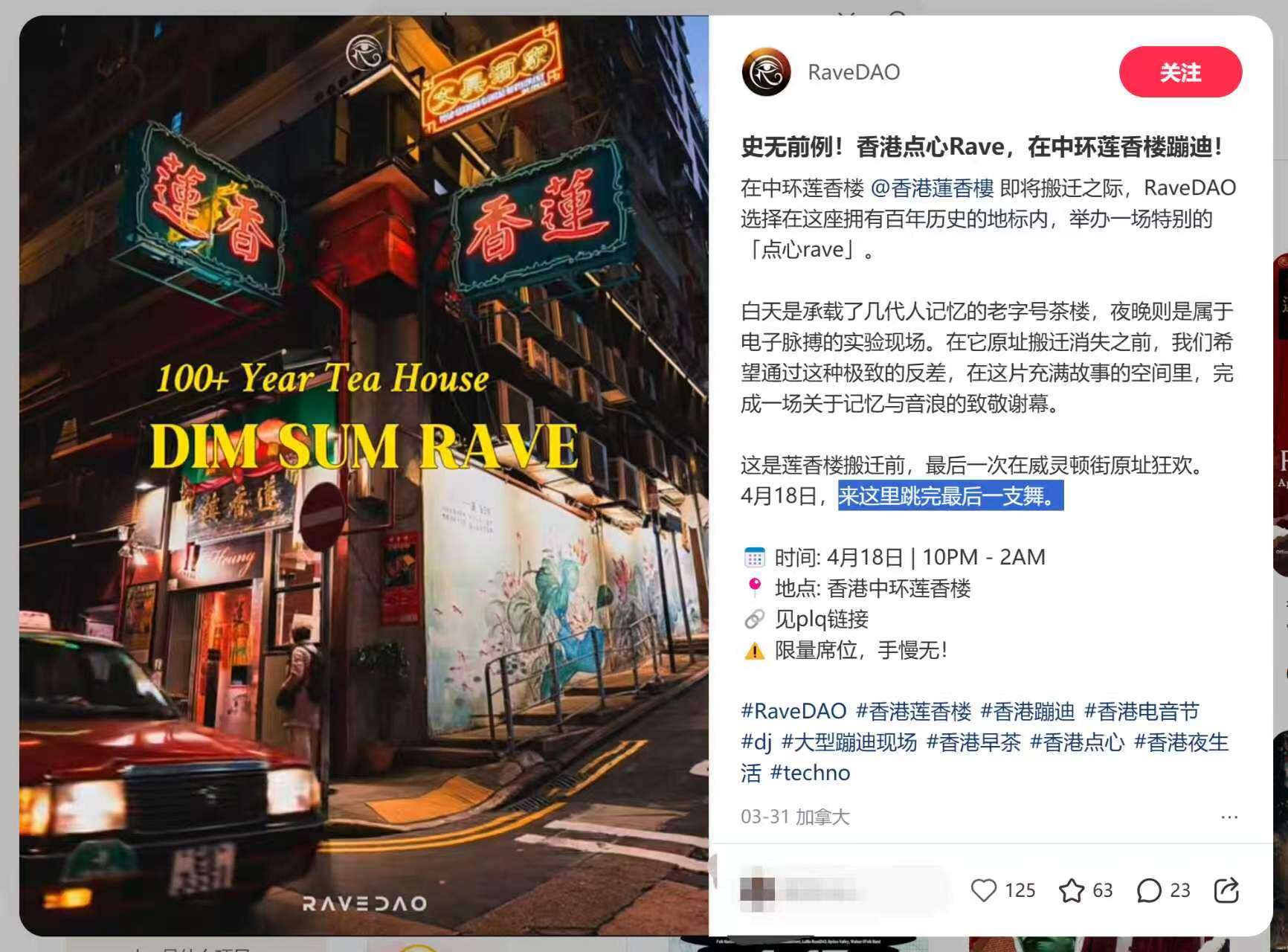
Announcement for RaveDAO's Offline Event in Hong Kong
But in the crypto world, RAVE's price was simultaneously plummeting, sliding from its highs almost without pause. On one hand, the offline event proceeded as scheduled, with crowds continuing to revel in the music; on the other, the price completed a near-zero crash in a short time, rapidly cooling market sentiment. These two timelines intersected on the same night, creating a stark contrast that was hard to ignore.
Because of this, the event description stating "April 18th, come here to dance the last dance" took on an additional layer of meaning in the eyes of many market participants. As for who truly danced the "last dance" that night, perhaps only the K-line left on the chart keeps giving different answers.