Bernstein Analysis: 50GW Computing Power Revaluation of Equipment Stocks, Is the AI Equipment Super Cycle Here?


- Core Thesis: A Bernstein report links AI data center expansion to semiconductor equipment spending (WFE). Under a scenario of 50GW of new computing power by 2030, it estimates cumulative related WFE will reach approximately $736 billion from 2027 to 2029, with memory equipment suppliers like Applied Materials showing the greatest earnings elasticity.
- Key Elements:
- Bernstein estimates that each additional 1GW/year of AI computing power requires approximately 46K-50K WSPM (Wafer Starts Per Month) of fab capacity, with DRAM accounting for the highest share (53%), followed by NAND (20%) and HBM (16%).
- Under the baseline 50GW scenario, AI-driven WFE could reach $291 billion in a single year by 2029; under an optimistic 100GW scenario, 2029 WFE could rise to $542 billion.
- Under the 50GW scenario, Applied Materials' 2029 EPS is estimated to be approximately 59.5% above consensus, with its forward P/E ratio falling to 14.9x, showing the greatest elasticity; Lam Research and KLA Corporation see EPS upside of approximately 54.4% and 37.1%, respectively.
- The pipeline capacity of U.S. data center projects has surged to 338GW as of June 2026, an increase of 217GW over the past 12 months. This figure far exceeds current operational capacity, indicating strong investment intent.
- The estimation model carries multiple risks: the pipeline capacity must clear thresholds related to power supply, financing, and delivery before converting into firm orders. Additionally, limited capacity in the equipment supply chain could extend lead times.
TL;DR
- Bernstein estimates that in a 50GW scenario, cumulative related WFE from 2027-2029 will be approximately $736 billion.
- Each additional 1GW/year of AI computing power requires approximately 46K-50K WSPM of wafer capacity, with DRAM and HBM accounting for the majority.
- Applied Materials, Lam Research, and KLA have higher earnings elasticity, but pipeline capacity does not equal actual orders.
A new report from Bernstein translates AI data center expansion into semiconductor manufacturing equipment orders: if AI data centers add 50GW of computing power annually by 2030, cumulative related global WFE spending from 2027-2029 could reach approximately $736 billion, with $291 billion in 2029 alone.
WFE refers to wafer fab equipment spending and is a key demand driver for equipment companies such as Applied Materials (AMAT), Lam Research (LRCX), KLA (KLAC), ASML, and Tokyo Electron. For investors, the most direct question from this calculation is: As AI computing power continues to expand, how much additional order volume and earnings elasticity can equipment manufacturers expect?
When the report was published, semiconductor equipment stocks had already experienced a significant rally, followed by a notable pullback from recent highs. Meanwhile, the pipeline for US data center construction continues to expand. Public excerpts show that as of June 2026, the project pipeline capacity has risen to 338GW, an increase of 217GW over the past 12 months, far exceeding the currently operational scale.
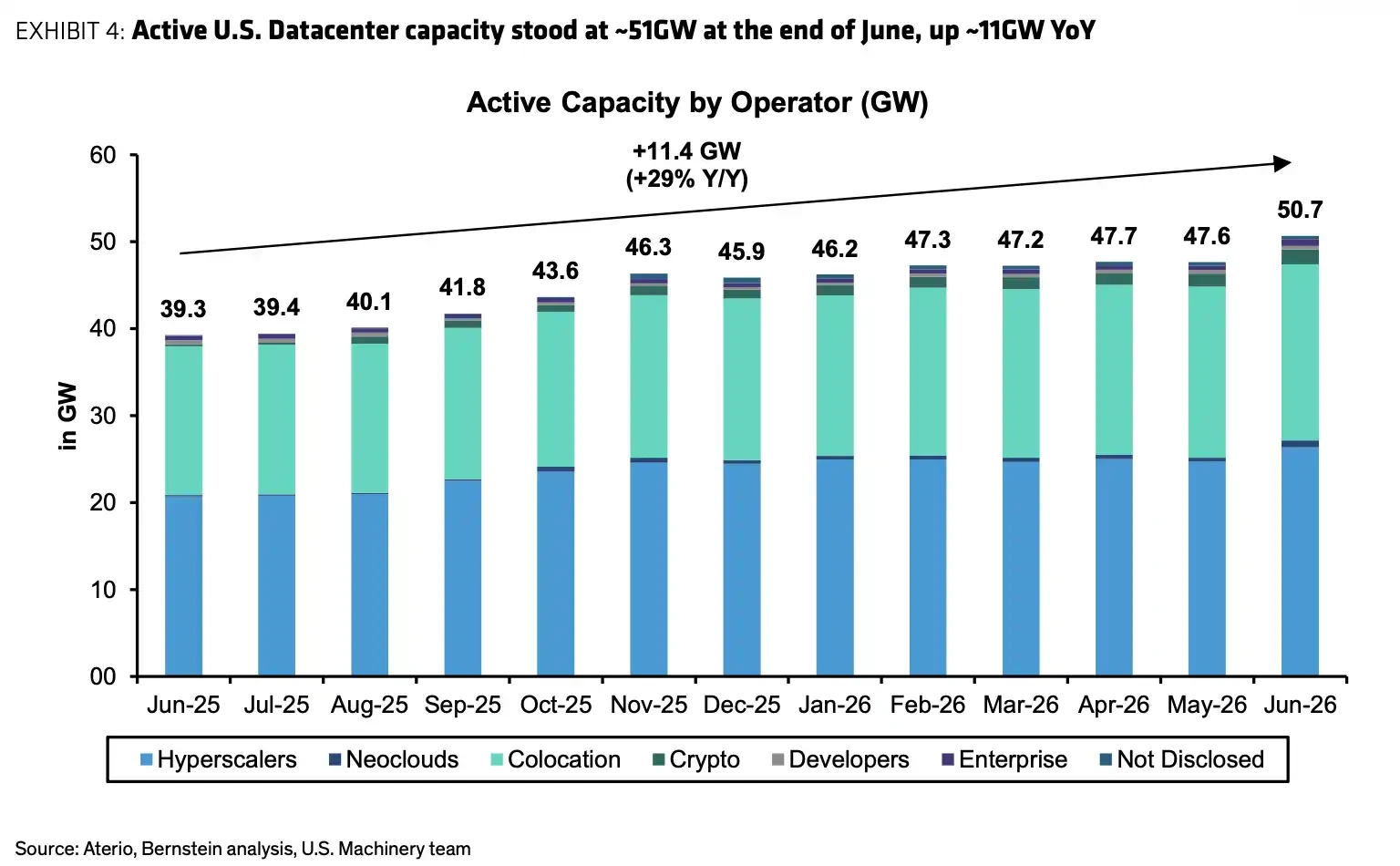
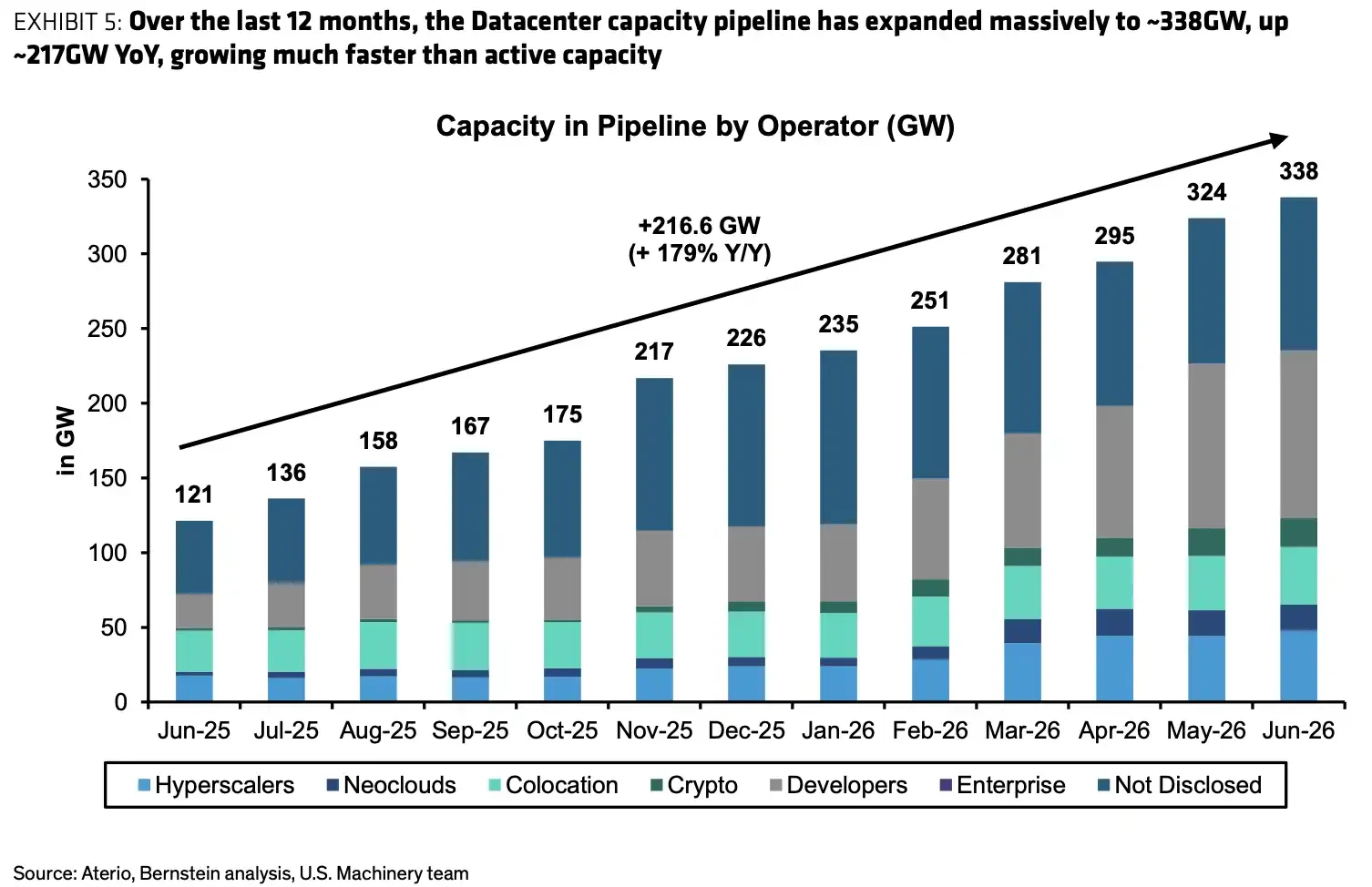
Changes in US data center active capacity and project pipeline; pipeline capacity increased from 121GW to 338GW.
Each Additional 1GW of Computing Power Requires Approximately 50K Wafer Starts Per Month
The core conversion in this report is that each additional 1GW/year of AI computing power requires approximately 46K-50K WSPM of new wafer capacity. WSPM stands for wafer starts per month, a common metric for measuring fab capacity.
Data center capacity itself does not directly translate into equipment orders. Only when AI servers require more GPUs, HBM, DRAM, NAND, and advanced logic chips do fabs need to expand, and equipment companies see new WFE spending.
Within the approximately 46K WSPM/GW of new demand, DRAM accounts for the largest share at about 53%; NAND about 20%; HBM about 16%; and advanced logic about 11%. This means that AI data center expansion does not solely drive demand for advanced GPU processes but also boosts memory capacity requirements, especially for DRAM and HBM.
This is also why Applied Materials is the most watched in this calculation. The incremental wafer demand comes primarily from DRAM, HBM, and NAND. Applied Materials has higher exposure in memory equipment, deposition, and etching, making its earnings elasticity more direct.
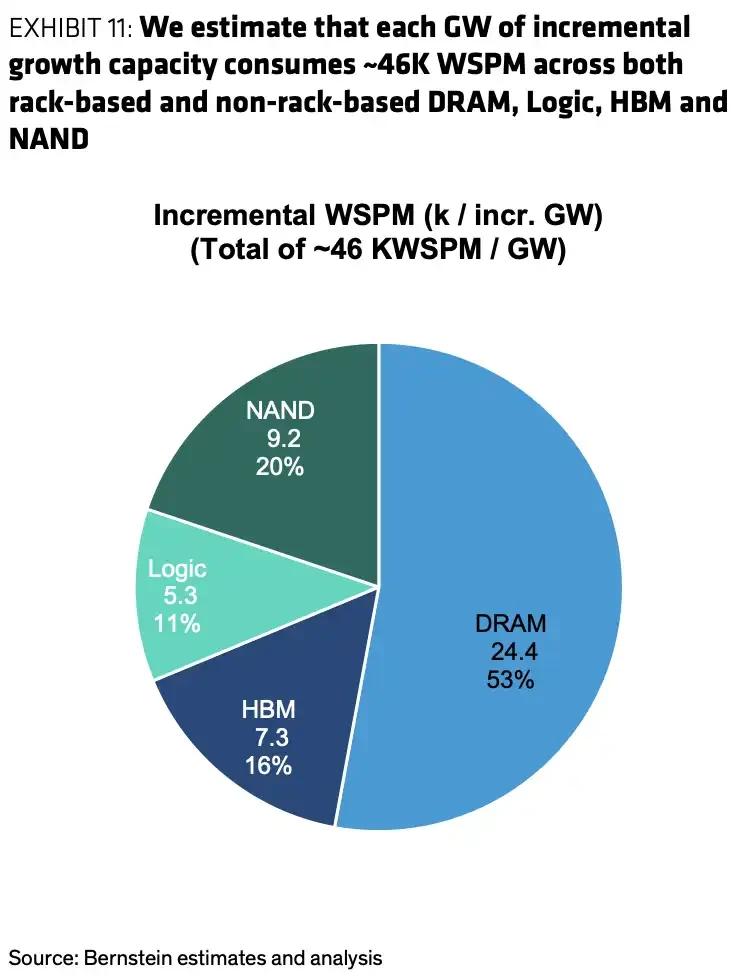
Each additional 1GW of computing power requires approximately 46K WSPM: DRAM 53%, NAND 20%, HBM 16%, Logic 11%.
Annual WFE in 2029 Could Approach $291 Billion
In the base scenario, AI data centers add 50GW of computing power annually by 2030 compared to the 2026 baseline. To support this goal, related WFE needs to be deployed gradually from 2027-2029.
Scenario calculations show that AI-driven WFE spending alone would total approximately $376 billion cumulatively from 2027-2029; adding roughly $120 billion per year in non-AI baseline spending brings the three-year total WFE to about $736 billion. The annual trajectory is approximately $200 billion in 2027, $245 billion in 2028, and $291 billion in 2029.
These figures are higher than equipment spending assumptions in current more conservative models. If the 50GW scenario materializes, WFE in 2029 would approach $300 billion; under higher GW scenarios, equipment spending has further upside.
The report also presents a more aggressive scenario. In the 75GW scenario, upside revisions to equipment company earnings could exceed 100%; in the 100GW scenario, the potential for WFE spending in 2029 expands further, potentially compressing valuation multiples for some companies to below 10 times.
However, these remain model projections, not finalized orders. Their realization depends on whether the data center construction pipeline converts to actual operation, whether AI server shipments can keep pace, whether fabs are willing to expand capacity in advance, and whether the equipment supply chain has sufficient delivery capability.
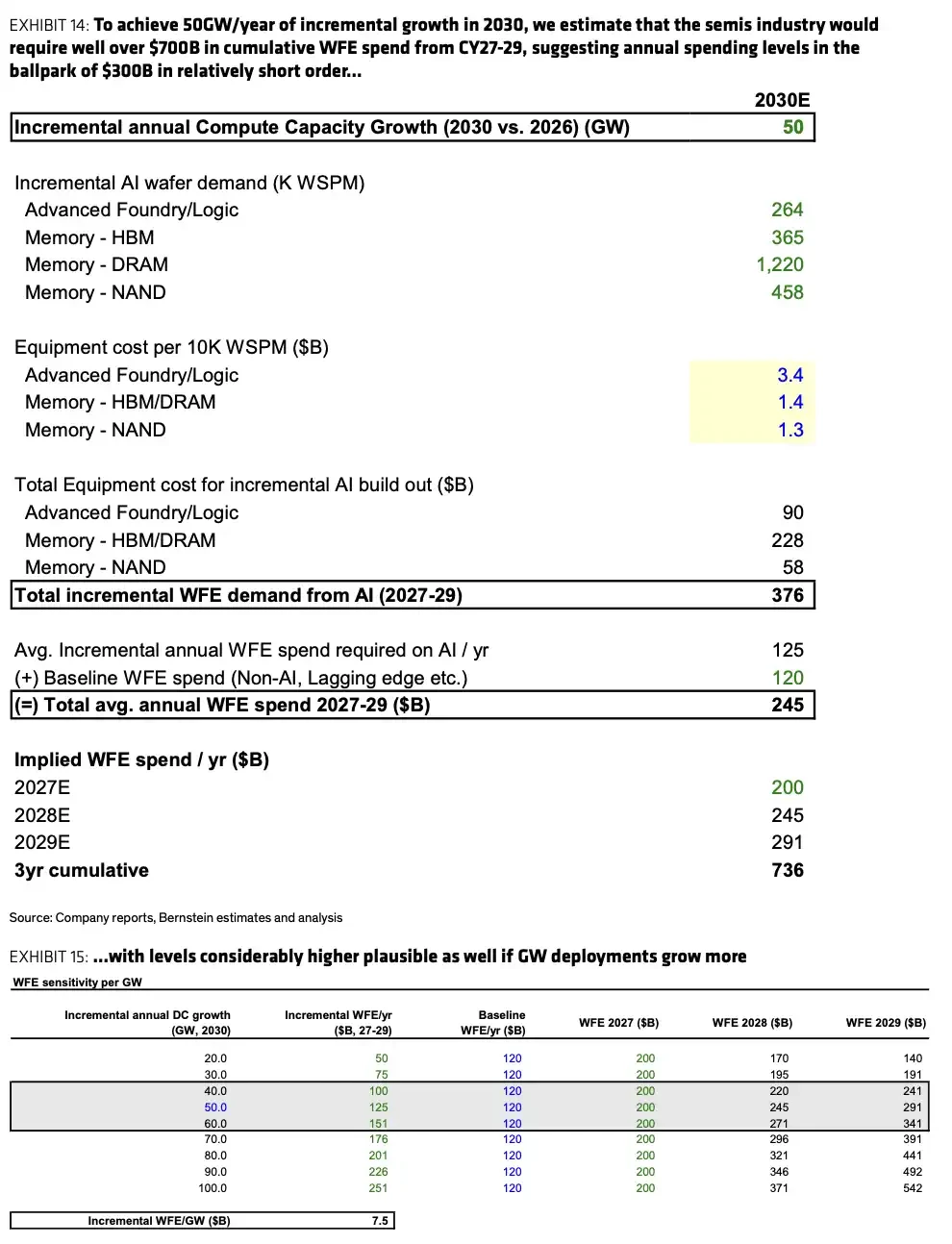
In the 50GW scenario, cumulative WFE from 2027-2029 is approximately $736 billion, with $291 billion in 2029; in the 100GW scenario, 2029 WFE is approximately $542 billion.
Applied Materials Has the Highest Elasticity, Lam Research and KLA Also Benefit
The stock impact is mainly concentrated on Applied Materials, Lam Research, and KLA.
In the 50GW scenario, the EPS of these three companies by 2029 could see upside of approximately 37%-60% compared to current Wall Street consensus. Corresponding forward P/E ratios could fall to the 15-20 times range, while equipment stocks are currently still trading in a higher range.
Among them, Applied Materials has the highest elasticity. In the 50GW scenario, its 2029 EPS shows an upside of nearly 60% versus consensus, corresponding to a forward P/E of about 14.9 times; Lam Research's EPS upside is about 54%, corresponding to about 18.4 times; KLA's EPS upside is about 37%, corresponding to about 21.2 times.
The reason lies in the composition of wafer demand. New capacity driven by AI expansion is mainly concentrated in DRAM, HBM, and NAND, rather than a single advanced logic process. Applied Materials has broader coverage in memory-related equipment, making it easier to capture incremental demand compared to companies that only benefit from specific segments.
According to the report, Bernstein maintains Outperform ratings for multiple equipment stocks including Applied Materials, Lam Research, KLA, ASML, and Tokyo Electron, with Applied Materials remaining the top pick. Screen receives a Neutral rating.
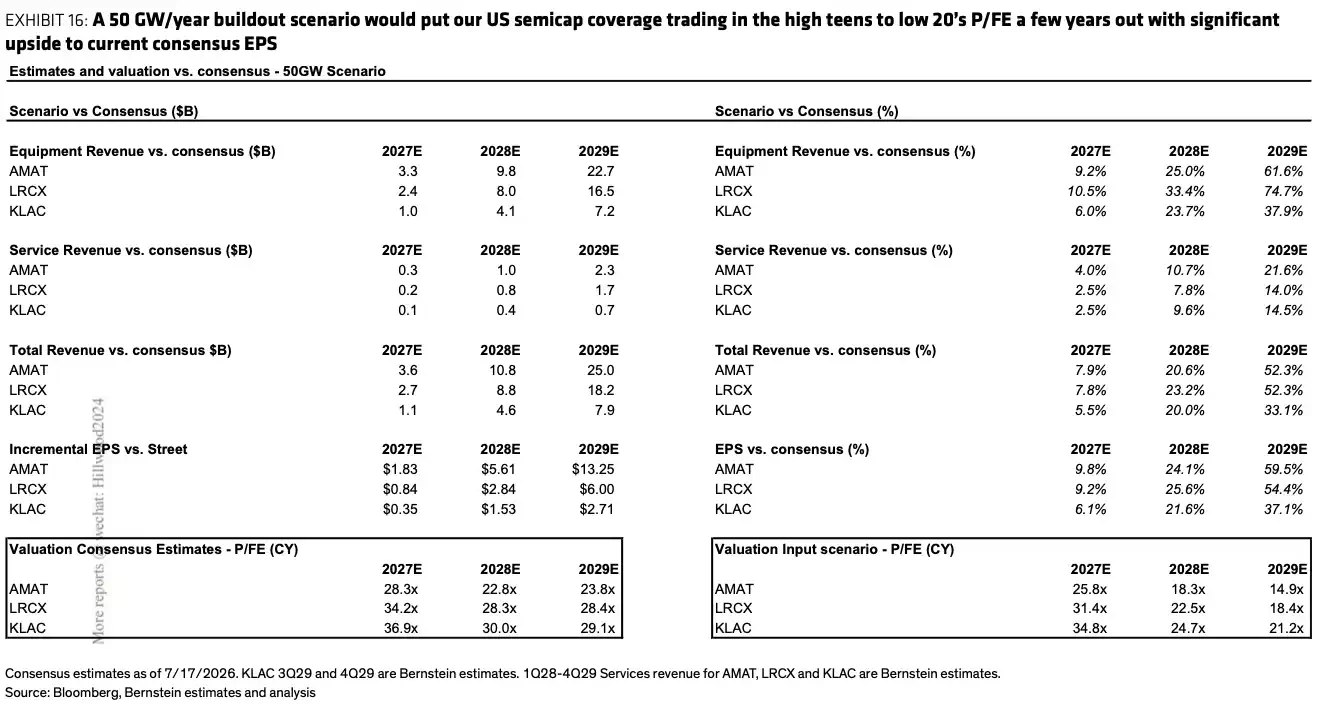
In the 50GW scenario, AMAT/LRCX/KLAC 2029 EPS upside versus consensus is 59.5%/54.4%/37.1%, with P/FE declining to 14.9x/18.4x/21.2x.
Pipeline Capacity Must Overcome Hurdles of Power, Financing, and Delivery
The most easily misinterpreted aspect of this calculation is treating data center pipeline capacity directly as future equipment orders.
The significant expansion of the US data center pipeline over the past year indicates strong investment intent in AI infrastructure. However, multiple hurdles exist between the pipeline and actual operation: power availability, land permits, financing costs, GPU supply, customer demand, and network and cooling infrastructure all impact the final deployment pace.
Constraints also exist on the equipment side. If WFE scale is to surge toward the $300 billion level within a few years, equipment companies, component suppliers, and fabs all need to expand capacity simultaneously. The semiconductor equipment industry is not one that can ramp up output infinitely and rapidly; advanced equipment, key components, installation and commissioning, and customer qualification all extend delivery cycles.
The model assumptions themselves have boundaries. The calculations are based on specific GPU architectures, power consumption, chip area, and capital intensity assumptions, assuming WFE must be in place by the end of 2029 to support the incremental computing power in 2030. Architectural changes, reductions in energy consumption per unit of computing power, improvements in chip yield, and adjustments in capital intensity could all alter the final equipment demand.
Bias in the other direction also exists. If the replacement demand for older computing power before 2030 is not fully accounted for, equipment demand may have further upside; however, if the monetization pace of AI applications falls short of expectations, or if major cloud providers slow capital expenditure, the 50GW, 75GW, or even 100GW scenarios could also prove too optimistic.
This report does not provide a definitive order book; rather, it offers a clearer conversion: Every additional 1GW of AI data center capacity may correspond to approximately 50K wafer starts per month and roughly $80 billion in incremental WFE demand. Equipment stocks have already priced in some AI expectations; the point of contention is whether data center construction can materialize to a degree sufficient to support annual WFE on the order of $300 billion.